


Description
A micropython library to control the DFPlayer mini mp3 player module.
This library focuses on the most essential functions. Some advanced functions of the DFPlayer, like the equalizer modes are not implemented yet.
Further this library is made to use the folders function of the dfmini. You can use up to 99 folders and 255 files per folder. The files on your micro sd card need to be structured like this:
.
├── 01
│   ├── 001.mp3
│   ├── 002.mp3
│   └── ...
├── 02
│   ├── 001.mp3
│   ├── 002.mp3
│   └── ...
├── 03
│   ├── 001.mp3
│   ├── 002.mp3
│   └── ...
└── ...
There should be no gaps in the numbering scheme. It might be best to prepare the whole file structure on your harddrive first and then copy them in one go on a freshly formated micro sd card, as the DFPlayer might get confused from artifacts left on the sd cards filesystem. You can use the files in /sample_files to test your module.
Sometimes the module isn't able to keep up if you try to send commands to fast, so some delay between the commands is needed.
Connection
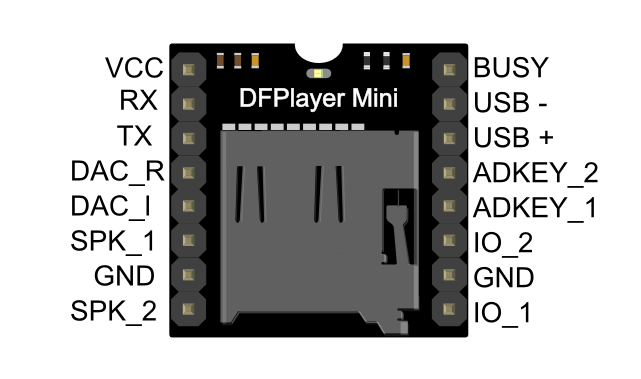
- Connect GND of the DFPlayer to the GND of your microcontroller (and your power source)
- Connect VCC of the DFPlayer to 3.3V / 5V
- Connect the RX pin of the DFPlayer to the TX pin of your microcontroller. This is used to send data to the DFPlayer mini.
- Connect the TX pin of the DFPlayer to the RX pin of your microcontroller. This is optional and only needed if you want to return data from the DFPlayer (as in
get_files_in_folder(),get_volume()orìs_playing())
Examples
Play a file from a folder
import time
from dfplayer import DFPlayer
df=DFPlayer(uart_id=1,tx_pin_id=4,rx_pin_id=5)
#wait some time till the DFPlayer is ready
time.sleep(0.2)
#change the volume (0-30). The DFPlayer doesn't remember these settings
df.volume(25)
time.sleep(0.2)
#play file ./01/001.mp3
df.play(1,1)
Find the number of files in a folder
If a folder doesn't exist, get_files_in_folder will return 0
import time
from dfplayer import DFPlayer
df=DFPlayer(uart_id=1,tx_pin_id=4,rx_pin_id=5)
#wait some time till the DFPlayer is ready
time.sleep(0.2)
print(df.get_files_in_folder(1))
time.sleep(0.2)
print(df.get_files_in_folder(4))
API
class DFPlayer(uart_id,tx_pin_id=None,rx_pin_id=None)
- uart_id: Uart channel you want to use (0 or 1 for pi pico)
- tx_pin_id: Pin id for uart tx if your board supports changing the pins of the uart channel.
- tx_pin_id: Pin id for uart rx if your board supports changing the pins of the uart channel.
play(folder,file)
- play a file from a folder (stops all previous playback)
- folder: Folder number of the file you want to play
- file: File number of the file you want to play
stop()
- stop all playback
volume(vol)
- set the volume of the module.
- vol: Volume of the module. The range is 0 to 30. The DFPlayer doesn't remember these settings
volume_up()
- increase the volume by 1 up to the maximum of 30.
volume_down()
- decrease the volume by 1 down to the minimum of 1.
get_volume()
- returns the current volume setting of the module or -1 on communication error
ìs_playing()
- returns if currently some playback is running or -1 on communication error
get_files_in_folder(folder)
- returns the number of files in a folder or 0 if the folder doesn't exist or -1 on communication error
- folder: folder to get the number of files in
reset()
- reset the module
send_cmd(cmd,param1=0,param2=0)
- sends a command byte with 2 bytes for parameters to the module. This can be used to send commands not yet implemented in this library. Use the modules documentation as reference.
- cmd: cammand byte (0-255)
- param1: parameter 1 or MSB of a 2 byte parameter
- param2: parameter 2 or LSB of a 2 byte parameter
send_query(cmd,param1=0,param2=0)
- like send_cmd, but returns the bytes the module sends as answer to the query
- cmd: cammand byte (0-255)
- param1: parameter 1 or MSB of a 2 byte parameter
- param2: parameter 2 or LSB of a 2 byte parameter
1 maintainer

Metadata
1 maintainer
Release files for micropython-dfplayer 1.0.5
For a detailed explanation of source distributions (sdists) and built distributions (wheels), please see the package formats documentation.
Source distribution (sdist)
| File | Size | Uploaded | Provenance | |
|---|---|---|---|---|
| micropython_dfplayer-1.0.5.tar.gz | 4.7 kB | Without provenance | Details |
Built distribution (wheel)
| File | Interpreter | ABI | Platform | Reset |
|---|---|---|---|---|
| micropython_dfplayer-1.0.5-py3-none-any.whl | Python 3 | none | any | Details |
Total release size: 10.2 kB
Release files / micropython_dfplayer-1.0.5.tar.gz
| Download URL | micropython_dfplayer-1.0.5.tar.gz |
|---|---|
| Size | 4.7 kB |
| Tags | Source |
|
SHA-256 checksum How to use checksums |
eafaaf5834014ad405b6bba9e65b8e5f90bcb7d7e27e54544d1a18173b39229c
|
|
BLAKE2b-256 checksum How to use checksums |
c352f89c0bb6fa44e52cba9f44d76845f72f0b762905f0c431bbc03b4ab0132e
|
| Upload date | |
|
Uploaded using Trusted Publishing? What is trusted publishing? |
No |
| Uploaded via |
twine/5.0.1.dev0+g94f810c.d20240510 CPython/3.12.6
|
Release files / micropython_dfplayer-1.0.5-py3-none-any.whl
| Download URL | micropython_dfplayer-1.0.5-py3-none-any.whl |
|---|---|
| Size | 5.5 kB |
| Tags | Python 3 |
|
SHA-256 checksum How to use checksums |
d1dab45b20f1011ab71f1ffe954832ec8ce94d27d51c4976311d03505cbf7ab3
|
|
BLAKE2b-256 checksum How to use checksums |
58920043b55036802ac60a77249191450009192fd9bb7d315858454a809b87b6
|
| Upload date | |
|
Uploaded using Trusted Publishing? What is trusted publishing? |
No |
| Uploaded via |
twine/5.0.1.dev0+g94f810c.d20240510 CPython/3.12.6
|
Security for micropython-dfplayer 1.0.5
Provenance
Provenance describes where a file came from. On PyPI, provenance is shared via attestations, which provide a verifiable record of the build or publishing details. View details, limitations and caveats.
No provenance found
None of the files in this release were uploaded with provenance metadata.
A note on package security
PyPI is a repository for distributing packages, not a service for auditing them. While third-party security researchers and our staff do their best to detect and remove malicious packages, PyPI cannot guarantee the quality, security or suitability of any given package.














