
mikrotik-doh-failover
Read this in: English · Deutsch · 中文 · हिन्दी · Español · Русский
Failover DNS-over-HTTPS (DoH) configuration for MikroTik RouterOS, as diffable .rsc scripts.
Docs · Releases · Changelog · Issues · Security · For agents



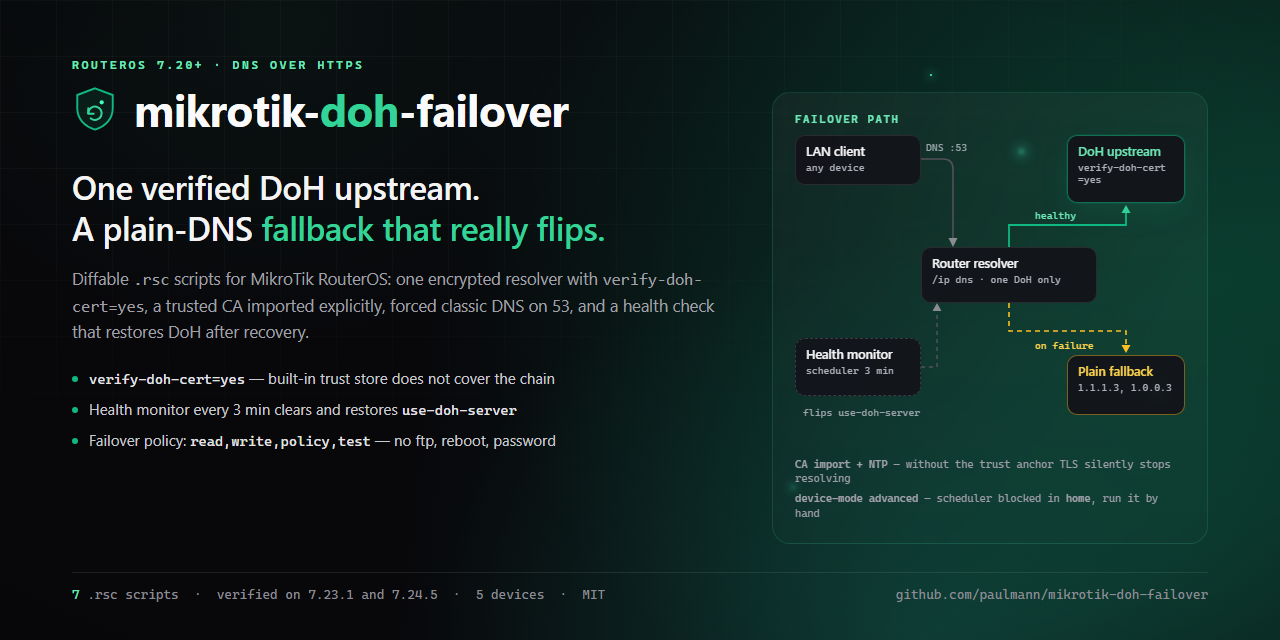
RouterOS routes a LAN's DNS through the router, but by default that upstream leg
is plaintext. This project configures one verified DoH upstream with a
second verified DoH endpoint as failover, forces classic LAN DNS to the router,
and adds a scheduled health-check that switches endpoints on failure. It is the
"how to reproduce and maintain" companion to the article
«Архитектура отказоустойчивого DNS-over-HTTPS в RouterOS»
on sysadministrator.ru.
Documentation status. Version v0.4.2 (2026-11-02). Counts in "By the numbers" were re-measured on 2026-10-28. Behaviour was verified on RouterOS 7.23.1 and 7.24.5; anything not verified on a device is marked as such in the text, and
device-modeis named wherever it changes the outcome.
Contents
- What this is and why
- What changed
- What changed in 0.4.0
- What changed in 0.2.0
- Capabilities
- By the numbers
- How it works
- Installation
- First steps
- Reliability and limits
- Security
- Requirements and compatibility
- Documentation
- Contributing
- License
What this is and why
A common broken approach to "DoH on MikroTik" is to add several DoH servers via
/ip dns static-server type=doh and expect failover. That syntax does not exist
and does not produce redundancy; RouterOS supports exactly one use-doh-server.
Another common failure is verify-doh-cert=yes without a trusted CA, which
silently stops all resolution.
This project avoids both:
- one active DoH upstream — standard Cloudflare by default, no filtering;
plain
serversare bootstrap only and are never used as a working fallback; - a managed failover script that switches to a second DoH endpoint on failure, verifies the switch and returns to the primary after recovery;
- an explicit CA import — verified that the built-in trust store does not cover the Cloudflare chain on 7.23/7.24;
- bootstrap static A records for both endpoint hosts, so the health probe can reach them even when the resolver itself is dead.
What changed in 0.4.2
- The probe checks the payload, not only
"Status":0: a substituted answer is reported assubstituted. probeMode "resolve"— liveness of a self-hosted endpoint judged by answer quality, because such an endpoint serves wire format and has no DNS-JSON API.STUBis declared only after one cache flush and a re-check (STUB_CLEAREDwhen the stub was a cache leftover).- zabbix part: neutral example addresses instead of the maintainer's own.
What changed in 0.4.1
- Every
/tool fetchnow carriesduration=5s, so a hung endpoint cannot block the run past the scheduler interval. - The tertiary switch is verified after the switch with rollback (like the secondary), and every switch increments
DNSFailoverAttempts. - Recovery from plain DNS climbs to any working DoH endpoint, not only the primary.
What changed in 0.2.0
Version 0.1.0 was wrong in a way that mattered in the field: it called the
resolver healthy when the answer was the pair 8.6.112.0 / 8.47.69.0, which
several networks cannot reach — pages stopped opening while the monitor reported
"fine". 0.2.0 changes five things (full text:
docs/release-notes-v0.2.0.md):
| Change | Before (0.1.0) | Now (0.2.0) |
|---|---|---|
| Default upstream | Cloudflare Family (family.cloudflare-dns.com, filtering) |
Cloudflare standard (cloudflare-dns.com, 1.1.1.1/1.0.0.1); filtering is an opt-in |
| Failover target | plain DNS fallback | a second DoH endpoint (dns.google) |
| Health check | any valid IP counted as healthy | answer content judged via three canaries |
| Endpoint probe | flipped use-doh-server (LAN lost DoH on every check) |
/tool fetch against the DNS-JSON API, /ip dns untouched |
| Failed failover | router left on a dead endpoint | probed before, verified after, rolled back on failure |
Upgrading from 0.1.0 needs two steps beyond copying the scripts: clear the old
state globals (DNSMonitorState, DNSFailoverAttempts), and decide explicitly
whether you want filtering back — that means the Family URL, the matching
servers and the CA from examples/cloudflare-family.rsc. The filtering flag
in 05-dns-health-monitor.rsc is a marker for the reader only: the script
declares it and never reads it, so nothing in the log depends on it (measured
2026-10-26). The 0.1.0 global DNSCurrentMode no longer exists.
Capabilities
| Capability | Detail |
|---|---|
| Encrypted upstream | one DoH upstream with verify-doh-cert=yes |
| Fallback | a second DoH endpoint (Google) when the primary is unreachable — managed, not transparent: the operator changes |
| Recovery | automatic return to the primary after the health check passes |
| Health check | judges the ANSWER (content), not the type; probes endpoints with /tool fetch |
| Bootstrap | static A records for both endpoint hostnames |
| Force classic DNS | dstnat redirect of UDP/TCP 53 from the LAN bridge |
| Resolver protection | drop DNS from WAN, accept from LAN (UDP and TCP) |
| Failover policy | read,write,policy,test only (no ftp/reboot/password) |
| Fleet monitoring | Zabbix 8 collector for DoH and VPN state over SSH — zabbix/, on main after the v0.2.0 tag |
By the numbers
Measured on main, 2026-10-26:
| Surface | Count | Measured from |
|---|---|---|
| RouterOS scripts | 7 (360 lines) | routeros/*.rsc |
| Example configs | 2 | examples/*.rsc |
| Docs | 5 | docs/*.md |
| Diagrams | 3 | diagrams/*.mmd |
| README languages | 6 | README*.md |
| Files tracked by git | 38 | git ls-files |
| Devices tested | 6 | docs/verification.md, table below |
| RouterOS versions tested | 2 (7.23.1, 7.24.5) | docs/verification.md |
| Zabbix objects | 8 items, 5 triggers, 2 service trees | zabbix/doh-zabbix-setup.py |
The v0.2.0 tag itself contains 32 files; everything under zabbix/ was
committed after the tag and is therefore unreleased on main until the next
version.
How it works
flowchart LR
    Client["LAN client"] -->|"DNS 53"| ForceDNS["force-DNS redirect"]
    ForceDNS --> Resolver["Router resolver"]
    Resolver --> Mode{"DoH healthy?"}
    Mode -->|"yes"| DoH["DoH A<br/>verify-doh-cert=yes"]
    Mode -->|"no"| DoHB["DoH B (dns.google)<br/>switched by the monitor"]
    Monitor["health monitor every interval (60s default)"] -->|"3 canaries, content judged"| Resolver
    Monitor -->|"/tool fetch probe"| DoH
    Monitor -->|"probe before switch<br/>rollback on failure"| DoHB
    CA["Trusted CA"] -->|"TLS validation"| DoH
    CA -->|"TLS validation"| DoHB
    NTP["NTP"] -->|"clock"| CA
The monitor never toggles use-doh-server to test an endpoint: the probe is an
HTTPS request from /tool fetch, so a routine check leaves /ip dns alone. The
state machine (diagram: diagrams/dns-failover.mmd,
full definition in docs/architecture.md) is
healthy → suspect → fallback → recovering → healthy, with stub,
plain, degraded, clock-invalid and manual-only as terminal/edge states.
Failover is managed, not transparent: the upstream operator changes, so
answers, filtering and geo behaviour may change too.
What changed in 0.4.0. The endpoint probe now returns the JSON body in memory
(/tool fetch ... as-value output=user), so it creates no temporary files in
/file and cannot leave stale ones behind; the JSON check accepts both
"Status":0 and "Status": 0. Failover is an ordered chain: primary → secondary →
tertiary (dohUrlC, optional, empty disables it) → plain DNS (plainFallback,
optional, off by default and logged PRIVACY DEGRADED).
Since 0.4.2 the probe also asks a second question: is the answer honest? A network that
substitutes DNS returns a perfect-looking reply {"Status":0,…, "data":"<stub>"}, so the
payload is checked against the configured stub prefixes and reported as substituted.
Use probeMode "resolve" when the primary is your own endpoint: it serves wire format,
has no DNS-JSON API, and judging it by the JSON probe sends the router onto a public
fallback — the very path where answers are substituted (docs/troubleshooting.md §6.13).
| Component | Responsibility |
|---|---|
00-install-ca.rsc |
trust anchor for verify-doh-cert=yes |
01-configure-doh.rsc |
one DoH upstream + bootstrap for both endpoint hosts |
02-security-policies.rsc |
force classic DNS + resolver protection |
03-capsman.rsc |
targeted CAPsMAN/DHCP integration |
04-cert-update.rsc |
optional CA refresh |
05-dns-health-monitor.rsc |
content check + DoH-to-DoH failover (maxAttempts=3) |
Installation
Requirements:
- RouterOS 7.20+ as declared; behaviour verified only on 7.23.1 and 7.24.5;
- NTP synchronized;
device-modeadvancedfor the automatic failover scheduler.
device-mode=home. Onhomedevices the failover scheduler and/tool fetchare rejected (not allowed by device-mode): DoH and force-DNS still work, but the monitor runs manually and cannot fail over — it logsMONITOR_DISABLED_BY_DEVICE_MODEand entersmanual-only. Switch toadvanced(/system/device-mode/update device-mode=advanced, then confirm and reboot) for automatic failover.
Quick start (standard Cloudflare, no filtering — the default since 0.2.0):
# 1. Upload certs/cloudflare-doh-ca.crt to the router, then:
/import file-name=00-install-ca.rsc
/import file-name=01-configure-doh.rsc
/import file-name=02-security-policies.rsc
/import file-name=05-dns-health-monitor.rsc
For other providers (Quad9, Google, Cloudflare standard/security) edit the
values in routeros/config.example.rsc. Pinning
raw URLs to v0.2.0 (or a commit) is safer than main; main is ahead of the tag.
First steps
/ip dns cache flush
:put [:resolve example.com]     # expect 104.20.x / 172.66.x
                                # 8.6.112.0 / 8.47.69.0 is the "stub pair", not an outage:
                                # see docs/troubleshooting.md §6.10
:put [:resolve pornhub.com]     # a real IP with the standard resolver;
                                # 0.0.0.0 only with Family/Security
/log print where message~"connection error"
Reliability and limits
| Situation | Behaviour |
|---|---|
| Primary DoH unreachable | after failureThreshold bad runs the monitor switches to the fallback, verifies it, rolls back if it fails |
| Primary DoH recovers | after recoveryThreshold good runs the monitor returns to the primary |
| Both endpoints down | state degraded: keeps the current configuration, logs once |
| Answers are the stub pair | state stub: logs once, does not fail over (§6.10) |
| Clock is wrong | state clock-invalid: logs CLOCK_INVALID and stops — verify-doh-cert cannot succeed on a wrong date |
| Failover keeps failing | at most maxAttempts (3) per outage, then the monitor waits for the primary |
device-mode=home |
state manual-only: logs MONITOR_DISABLED_BY_DEVICE_MODE; run by hand, no failover |
| Client uses its own DoH/DoT | not blocked in standard; strict blocks DoT 853 and known public DoH endpoints (residual risk documented) |
Scheduler rejected: not allowed by device-mode
On devices with device-mode=home (for example the RB4011iGS+ tested here),
RouterOS rejects /system scheduler add and /tool fetch with
not allowed by device-mode. This is an expected RouterOS limit, not a script
defect: the DoH config and force-DNS still work, but the failover monitor can
only be run manually, and without fetch it cannot probe endpoints at all — it
then keeps the current configuration.
- leave
homeand run/system script run DNS_HealthMonitor_Failoverby hand; - switch to
advancedto enable the scheduler:/system/device-mode/update device-mode=advanced
then confirm the change and reboot.
Security
- The resolver drops DNS from WAN and only redirects classic DNS (53); client DoH (443) and DoT (853) bypass is documented, not hidden.
- Choosing Cloudflare/Quad9/Google means trusting that third party with your queries; DoH hides them from the local link only.
- CA bootstrap must use a trusted source;
check-certificate=nois bootstrap-only. - The failover target must be a DoH endpoint that answers the DNS-JSON API — a
Quad9 fallback would always look unreachable (
docs/troubleshooting.md§6.12). - See SECURITY.md for reporting and the security model.
Requirements and compatibility
| Device | RouterOS | device-mode | Wireless stack | Result |
|---|---|---|---|---|
| Chateau PRO ax | 7.24.5 | advanced | legacy /caps-man (controller) |
verified (hub) |
| cAP ax | 7.24.5 | advanced | legacy /caps-man (client) |
verified |
| RB4011iGS+ | 7.24.5 | home | — | verified; scheduler blocked |
| hAP ax² | 7.24.5 | advanced | — | verified |
| RB951Ui-2HnD | 7.24.5 | advanced | — | verified |
| RB2011UiAS | 7.23.1 | advanced | — | verified |
Documentation
| Document | Contents |
|---|---|
docs/architecture.md |
design rationale, state table, threat model |
docs/verification.md |
per-subsystem checks + eight failover scenarios |
docs/troubleshooting.md |
known failures and workarounds, including §6.10 (stub pair) |
docs/release-notes-v0.2.0.md |
what 0.2.0 changed and the measurements behind it |
zabbix/README.md |
fleet monitoring in Zabbix: DoH and VPN state, triggers, service tree |
routeros/config.example.rsc |
all tunable values |
AGENTS.md |
the same contract written for a machine caller |
Contributing
Read CONTRIBUTING.md. Security issues: SECURITY.md, never a public issue.
License
MIT © 2026 Mikhail Deynekin.
1 maintainer

Metadata
1 maintainer
Release files for mikrotik-doh-failover 0.4.2
For a detailed explanation of source distributions (sdists) and built distributions (wheels), please see the package formats documentation.
Source distribution (sdist)
| File | Size | Uploaded | Provenance | Actions |
|---|---|---|---|---|
| mikrotik_doh_failover-0.4.2.tar.gz | 24.5 kB | Without provenance | Details for mikrotik_doh_failover-0.4.2.tar.gz |
Built distribution (wheel)
| File | Interpreter | ABI | Platform | Actions Reset |
|---|---|---|---|---|
| mikrotik_doh_failover-0.4.2-py3-none-any.whl | Python 3 | none | any | Details for mikrotik_doh_failover-0.4.2-py3-none-any.whl |
Total release size: 42.8 kB
Release files / mikrotik_doh_failover-0.4.2.tar.gz
| Download URL | mikrotik_doh_failover-0.4.2.tar.gz |
|---|---|
| Size | 24.5 kB |
| Tags | Source |
|
SHA-256 checksum How to use checksums |
9653564f7dd42af15f0ef0e898c84830baadb6e7d14bd1ac65720ea21ffaa3a5
|
|
BLAKE2b-256 checksum How to use checksums |
8f9019c444509d6d36aeb9d92bd1a309859b674d24c547095b6cfa01ec2b3238
|
| Upload date | |
|
Uploaded using Trusted Publishing? What is trusted publishing? |
No |
| Uploaded via |
twine/7.0.0 CPython/3.13.15
|
Release files / mikrotik_doh_failover-0.4.2-py3-none-any.whl
| Download URL | mikrotik_doh_failover-0.4.2-py3-none-any.whl |
|---|---|
| Size | 18.2 kB |
| Tags | Python 3 |
|
SHA-256 checksum How to use checksums |
e6bfbf148e77857f0e8d6b88ea3fd82d12efc15e8e638d9fe0a987ed2b169279
|
|
BLAKE2b-256 checksum How to use checksums |
ef456a6e58cae7fca49e55796e3ba987b08e5a6585654574e11659e292eec20e
|
| Upload date | |
|
Uploaded using Trusted Publishing? What is trusted publishing? |
No |
| Uploaded via |
twine/7.0.0 CPython/3.13.15
|
Security for mikrotik-doh-failover 0.4.2
Provenance
Provenance describes where a file came from. On PyPI, provenance is shared via attestations, which provide a verifiable record of the build or publishing details. View details, limitations and caveats.
No provenance found
None of the files in this release were uploaded with provenance metadata.
A note on package security
PyPI is a repository for distributing packages, not a service for auditing them. While third-party security researchers and our staff do their best to detect and remove malicious packages, PyPI cannot guarantee the quality, security or suitability of any given package.
To learn more about protecting yourself from malicious actors, visit our package security documentation.














