
🧠 MindCache
An open-source long-term memory engine for LLM agents.







Agents forget.
More history doesn't mean better memory.
As conversations grow, important information gets buried. An AI needs to know what to remember, what has changed, which decisions still matter, and what is relevant now.
Most systems treat this as a search problem.
MindCache treats it as a memory problem.
It turns conversations into organized, persistent memory and continuously updates that memory as the conversation evolves.
👉 Read the 4-Minute Blog | 🎥 Watch Demo Video | ⚡ Quick Start | 📖 Read the Engineering Journal
📖 Want the technical deep dive?
The short article explains the problem, architecture, and lessons behind MindCache in about four minutes.
For the full engineering story — including implementation details, architectural decisions, experiments, failures, retrieval design, and evaluation — see the MindCache Engineering Journal.
🧠 How MindCache Builds Memory
MindCache doesn't treat every message as equally important, and it doesn't leave memories as a flat collection.
It turns conversations into four kinds of memory:
- User — preferences, constraints, and habits.
- Decision — choices and their current state over time.
- Episodic — things that happened in previous conversations.
- Knowledge — useful facts and information learned along the way.
These memories are then placed into a living topic tree that organizes related information together. As new conversations arrive, MindCache can reorganize that structure, split growing topics, merge related ones, and build summaries of broader areas.
The result is not just a collection of stored memories. It is an evolving map of what the agent has learned over time.
Conversations
     │
     ▼
┌───────────────────────────┐
│        MindCache          │
│                           │
│  User                     │
│  Decision                 │
│  Episodic                 │
│  Knowledge                │
│                           │
│       ┌─ Work             │
│       ├─ Projects         │
│       │   ├─ MindCache    │
│       │   └─ ML Project   │
│       ├─ Preferences      │
│       └─ Personal         │
└───────────────────────────┘
🎯 Memory changes. MindCache keeps up
People change their minds. Projects change direction. Old decisions become irrelevant.
For example:
“We use TensorFlow for model training.”
Later:
“We switched to PyTorch.”
A simple store can keep both statements without explicitly representing which decision replaced the other.
MindCache tracks the state of decisions over time:
Old decision
TensorFlow
    ↓
SUPERSEDED

New decision
PyTorch
    ↓
ACTIVE
MindCache keeps the old decision in the history, but knows that it is no longer the current choice. This lets MindCache distinguish what used to be true from what is true now, instead of treating every past statement as equally relevant.
📚 Memory needs context, not just facts
Remembering individual things is useful. But over time, an agent also needs to understand how those things fit together.
For example:
Machine Learning
├── PyTorch
├── NLP
├── Computer Vision
└── Handwriting Project
MindCache builds summaries at different levels of this topic structure.
So instead of storing only:
“Built a handwriting model.”
it can maintain a broader understanding of:
“The user has been working on machine learning, with a focus on PyTorch, NLP, and handwriting synthesis.”
As new memories arrive, these summaries are updated with the new information instead of rebuilding everything from scratch.
This gives the agent both the details and the bigger picture.
💡 How It Works Together: An End-to-End Example
Consider how an agent's memory evolves across weeks of interaction:
User conversations over time

  Week 1: "I'm starting a new project and using TensorFlow for model training."
    │
  Week 4: "I'm running a few experiments with PyTorch."
    │
  Week 8: "I've switched completely to PyTorch for all model training."

                     │
                     ▼
                 MindCache
                     │
    ┌────────────────┴────────────────┐
    │                                 │
    ▼                                 ▼
Decision Lifecycle              Living Topic Tree & Summary
TensorFlow → SUPERSEDED         Machine Learning
PyTorch    → ACTIVE             └── Frameworks
                                    └── PyTorch

                                Summary: "User's ML stack has transitioned
                                from TensorFlow to PyTorch."
                     │
                     ▼
User query (Week 10): "What ML framework am I using?"
                     │
                     ▼
Retrieved Context: PyTorch (ACTIVE)
By maintaining decision states, topic hierarchy, and incremental summaries, MindCache supplies the LLM with the current decision (PyTorch) while keeping the superseded choice (TensorFlow) in history.
📹 Demo
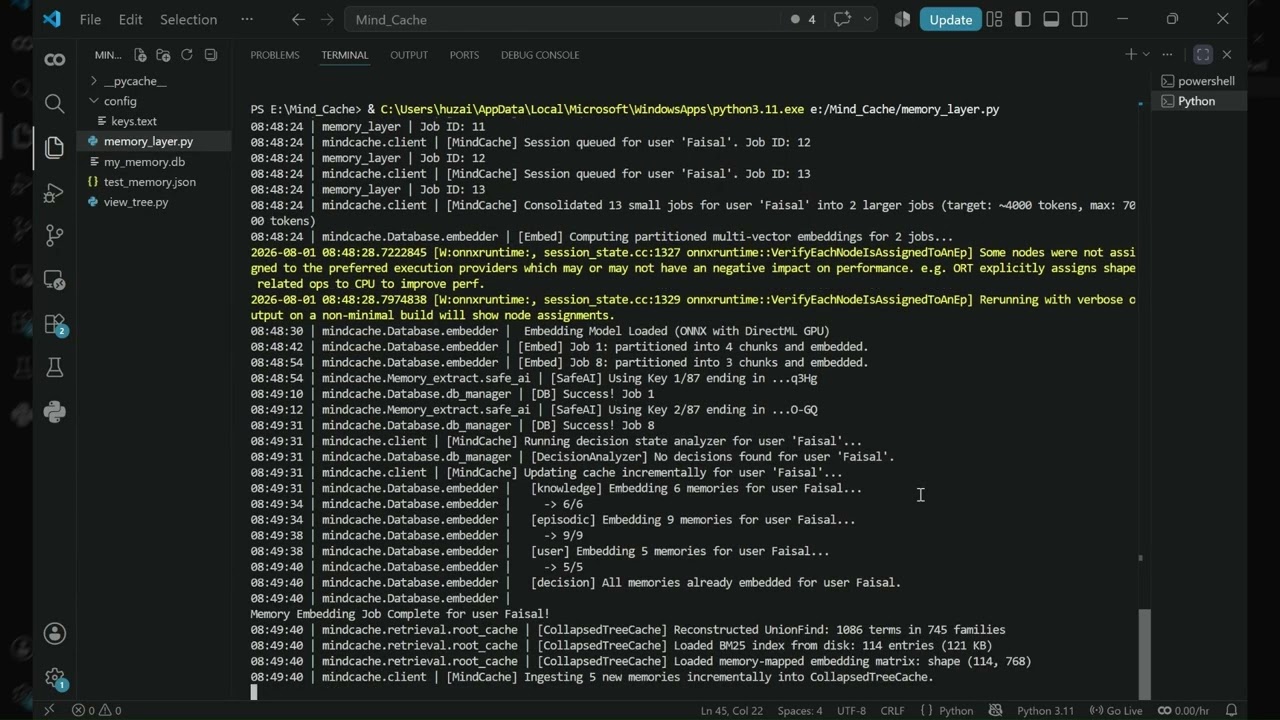
A 2-minute walkthrough covering installation, ingestion, automatic hierarchy generation, and hybrid retrieval.
🚀 Quick Start (30 Seconds)
1. Install
export GEMINI_API_KEY="your-gemini-api-key"
pip install mindcache
2. Usage
from mindcache import MindCache

# Initialize client (SQLite-backed by default)
mc = MindCache(
    db_path="my_memory.db",
    provider="gemini",
    model_name="gemini-2.5-flash"
)

# 1. Ingest conversation turns (buffered into processing queue)
job_id = mc.add([
    {"role": "user", "content": "I prefer Python and FastAPI for backend development, and Postgres for DB."},
    {"role": "assistant", "content": "Got it! I will remember your preference for Python, FastAPI, and Postgres."}
], user_id="alice")

# 2. Process pending queue (extracts memories, updates tree and indices)
mc.process(user_id="alice")

# 3. Retrieve structured context for future prompts
context = mc.search("What is Alice's preferred database?", user_id="alice")
print(context)
⚡ What Makes MindCache Different?
| Problem | Simple Memory Approach | MindCache |
|---|---|---|
| Different kinds of information | Treats memories similarly | Separates User, Decision, Episodic, and Knowledge memory |
| Changing decisions | Keeps old and new information together | Tracks which decision replaced another |
| Growing information | Leaves memories in a flat collection | Builds a living topic structure |
| Big-picture questions | Relies on individual memories | Maintains incremental summaries across the topic hierarchy |
Under the hood, MindCache combines this memory structure with hybrid search, decision-guided retrieval, and controlled context allocation.
Memory Pipeline
Conversations
      │
      ▼
Important Information Extracted
      │
      ▼
Four Kinds of Memory (User / Decision / Episodic / Knowledge)
      │
      ▼
Living Topic Structure
      │
      ▼
Changing Decisions Tracked
      │
      ▼
Broader Summaries
      │
      ▼
Relevant Context Assembled
      │
      ▼
LLM Prompt
⚙️ Architecture & Technical Retrieval
The MindCache pipeline operates in three distinct phases:
- Phase 1 — Ingestion Pipeline: Filters noise, maps memories to existing topic paths, and extracts structured facts.
- Phase 2 — Tree Lifecycle & Maintenance: Handles leaf node splitting, sibling merging, Leiden graph partitioning, and incremental summaries.
- Phase 3 — Online Multi-Stage Hybrid Retrieval Engine: Executes vector + BM25 hybrid search, RRF rank fusion, query classification, decision-anchor expansion, and memory-type budgeting in 1.08s average retrieval latency in our evaluation setup (reranking disabled).
👉 View Complete Architecture Specification | 🔄 Trace End-to-End Retrieval Flow | 🧠 Core Architectural Ideas
📊 Where MindCache Works Best
MindCache is not designed to outperform every memory system on every workload. Its architecture is particularly focused on long-running conversations where useful information is spread across sessions, decisions evolve over time, and answering a question requires understanding the bigger picture.
In our evaluation on the BEAM QA benchmark (300 questions across 15 multi-session conversations), MindCache showed its strongest relative performance in summarization, contradiction resolution, and multi-session reasoning, while Mem0 performed better on preference following and information extraction. Some categories, including temporal reasoning and knowledge update, were closely matched.
| Workload Category | MindCache | Mem0 |
|---|---|---|
| Summarization | 0.75 | 0.46 |
| Contradiction resolution | 0.56 | 0.38 |
| Multi-session reasoning | 0.92 | 0.83 |
| Preference following | 0.79 | 0.84 |
| Information extraction | 0.40 | 0.45 |
| Knowledge update | 0.50 | 0.50 |
| Temporal reasoning | 0.875 | 0.875 |
👉 View Full Benchmark & Evaluation Details | 🔬 View Deep Competitive Analysis Matrix | 🏗️ View Architecture & Evidence Matrix
📁 Project Structure
The project is organized into independent ingestion, storage, and retrieval modules.
mindcache/
├── client.py                # Main SDK interface & MindCache client
├── Database/                # Storage, tree reorg, embeddings & summaries
│   ├── db_manager.py        # Database operations (SQLite & pgvector)
│   ├── db_setup.py          # Table schema initialization
│   ├── decision_analyzer.py # Decision state tracking logic
│   ├── embedder.py          # Embedding generation & vector indexing
│   ├── nodes_summary.py     # Bottom-up delta summarization
│   └── reorganize_tree.py   # Tree splitting, merging & Leiden partitioning
├── Memory_extract/          # Ingestion & extraction pipeline
│   ├── input_denoiser.py    # Conversation noise filtering
│   ├── memory_extractor.py  # Structured fact & memory extraction
│   ├── safe_ai.py           # Provider LLM client wrapper (Gemini/OpenAI/Anthropic)
│   └── schema.py            # Pydantic schemas for memory types
└── retrieval/               # Online hybrid retrieval engine
    ├── active_path.py       # Does retrieval & Query classification & context assembly
    ├── hybrid_search.py     # Hybrid vector + BM25 + RRF ranking
    └── root_cache.py        # Caches the nodes, memories and bm25 indexing
⚙️ Configuration & Database Setup
MindCache supports SQLite out-of-the-box and PostgreSQL (pgvector) for production workloads.
- ⚙️ SQLite: Default local setup (
mindcache.db). - 🐘 PostgreSQL: Set
MINDCACHE_DB_URL="postgresql://..."or pass toMindCache(db_path=...).
👉 View Full Configuration & Setup Guide
📡 API Reference
add(messages, user_id): Buffer conversation turns into the ingestion queue in milliseconds.process(user_id): Extract memories, update decision state, and refresh dynamic topic summaries.search(query, user_id): Retrieve structured memory context and retrieval metadata for LLM prompt construction.inspect(user_id, view): Inspect stored memory state (memories,tree,all).forget(memory_id, user_id): Remove a specific memory entry by ID.reset(user_id): Clear all stored memory data for a user.
🔌 MCP Server — Connect MindCache to AI Clients
MindCache includes a built-in MCP server (mindcache-mcp) that exposes long-term memory tools to MCP-compatible AI clients such as Claude Desktop, Cursor, and Codex over stdio.
1. Install MCP Extension
pip install "mindcache[mcp]"
2. Launch CLI Server
mindcache-mcp --db-path my_memory.db --provider gemini --model-name gemini-2.5-flash
3. Exposed MCP Tools
| MCP Tool | Description |
|---|---|
add_memory |
Buffer conversation turns into the ingestion queue. |
process_memory |
Extract structured memories & update topic tree summaries. |
search_memory |
Search and retrieve structured memory context, query classification, and retrieval metadata. |
inspect_memories |
Inspect stored memory records (user, knowledge, episodic, decision). |
inspect_tree |
View the live dynamic topic hierarchy tree. |
forget_memory |
Remove a specific memory entry by ID. |
4. Claude Desktop Setup
Add to your claude_desktop_config.json:
{
  "mcpServers": {
    "mindcache": {
      "command": "mindcache-mcp",
      "args": ["--db-path", "my_memory.db"],
      "env": {
        "GEMINI_API_KEY": "your-gemini-api-key"
      }
    }
  }
}
🗺️ Roadmap
- Hierarchical Topic Tree: Dynamic graph organization.
- Decision Lifecycle: Evolving choice tracking (
ACTIVE,SUPERSEDED,CONDITIONAL,REJECTED). - Incremental Delta Summaries: Bottom-up rollup summaries across the topic tree.
- Hybrid Retrieval & Budgeting: Vector + BM25 RRF ranking with memory-type quotas.
- BEAM QA Evaluation: Evaluated across 300 questions on 1M and 10M token context windows.
- Model Context Protocol (MCP) Server: Native stdio MCP server (
mindcache-mcp) with 6 core tools. - Developer Tooling & Integrations: Expanded agent framework adapters (LangChain / LlamaIndex / AutoGen).
Future Work
- 3-way RRF ranking — Evaluate 3-way RRF (Semantic + Lexical + Temporal ranking) for recency-sensitive queries and evolving state retrieval.
- Selective stateful memories — Explore state tracking for User and Knowledge memories that represent evolving information, while keeping ingestion cost bounded.
- Utility-based retrieval — Explore retrieval strategies that optimize for the expected utility of a memory for a query rather than semantic similarity alone.
🤝 Contributing
We welcome contributions! Please open an issue or submit a pull request on GitHub to help advance structured long-term memory for AI agents.
📄 License
MindCache is open-source software licensed under the MIT License.
1 maintainer

Download files
Download the file for your platform. If you're not sure which to choose, learn more about installing packages.
Source Distribution
Built Distribution
Filter files by name, interpreter, ABI, and platform.
If you're not sure about the file name format, learn more about wheel file names.
Copy a direct link to the current filters
File details
Details for the file mindcache-1.0.0.tar.gz.
File metadata
- Download URL: mindcache-1.0.0.tar.gz
- Upload date:
- Size: 120.9 kB
- Tags: Source
- Uploaded using Trusted Publishing? No
- Uploaded via: twine/7.0.0 CPython/3.11.9
File hashes
| Algorithm | Hash digest | |
|---|---|---|
| SHA256 |
e58f2485131e4b18a95d82f8a6210f3067c97c736cbd13b37f61b35bda21bded
|
|
| MD5 |
179282a01c9458472358e4d215184abc
|
|
| BLAKE2b-256 |
315c6d14bad4ee01f2bcde7bf21306493db909e6e5f59da48ff6fc432624e480
|
File details
Details for the file mindcache-1.0.0-py3-none-any.whl.
File metadata
- Download URL: mindcache-1.0.0-py3-none-any.whl
- Upload date:
- Size: 108.9 kB
- Tags: Python 3
- Uploaded using Trusted Publishing? No
- Uploaded via: twine/7.0.0 CPython/3.11.9
File hashes
| Algorithm | Hash digest | |
|---|---|---|
| SHA256 |
6a752f1f7c4e2d9130ceedf0857595e21284cdfee59b69613ca8d7cf8f4b4483
|
|
| MD5 |
b8f3c048ff8f2018e0a961dde04e1f3a
|
|
| BLAKE2b-256 |
77759c603f37dab16a16f1876fa48c42b5ee68fd120862c085cee5d1bb9d59bd
|







