
MiniEval - the trust layer for AI memory
Everyone is racing to make AI remember more. Nobody is asking whether what it remembers is true.


Verify every fact before it enters your AI's memory. Adjudicate conflicts by evidence rather than recency. Keep a record you can hand to an auditor.
Runs fully local. No API keys, no data leaving your machine.
The one-sentence pitch
Memory systems optimise for recall - how reliably a stored fact comes back. MiniEval optimises for correctness - whether the fact should have been stored at all. A perfect memory of a false fact is worse than no memory.
The problem
AI memory systems extract facts from conversations and store them permanently. Nobody checks whether those facts are true.
A conversation about a neighbour's cat becomes "the user has a cat." A misheard sentence becomes a permanent fact, recalled with total confidence, quietly poisoning every downstream response.
The second-order problem is worse. When a new fact conflicts with a stored one, memory systems generally let the newer fact win. Recency is a reasonable default until the newest fact is a hallucination — at which point the system silently overwrites something that was true.
Stored (true):    "The user is allergic to peanuts."
Incoming (false): "The user loves eating peanuts."
Recency wins:     the true memory is gone.
Why the audit trail is the actual product
The gate : checking a fact against its source before storing it is a thin wrapper over an off-the-shelf NLI model. Any competent engineer can build one in a few weeks. It is not the defensible part of this project, and this README doesn't pretend otherwise.
What's harder to bolt on afterwards is a record that survives scrutiny months later: hash-chained so tampering is detectable, versioned by the exact policy in force when each decision was made, with the specific span of source text each verdict is based on, so a regulator or a security lead can ask "what was decided about this fact, under which rules, why, and has this record been touched since?" and get a real, provable answer.
That's the part a memory engine focused on recall and latency has no reason to build.
Why this is differentiated
The pieces exist. This combination does not.
| Category | Examples | What's missing |
|---|---|---|
| Output validation | Guardrails AI, TruLens | Validates at query-time, not at the point a fact is written to memory |
| LLM observability | Arize Phoenix | Observes after the fact, doesn't block a hallucination before it's stored |
| Memory engines | Supermemory, Mem0, Zep | Conflict resolution tuned for recall quality; no faithfulness check before an overwrite |
| Memory benchmarks | MemoryBench | Measures whether memory recalls correctly, not whether the fact was ever true |
Nobody combines gate-before-write with evidence-based conflict resolution backed by a tamper-evident record.
Install
pip install minieval-pro
Python 3.10+. Roughly 700 MB of models download once, then run offline. No GPU required.
Quickstart
from minieval_pro.gate import MemoryGate

gate = MemoryGate()

decision = gate.check(
    source="I am allergic to peanuts.",
    fact="The user loves eating peanuts.",
)

print(decision.verdict)        # REJECT
print(decision.reason)         # Fact contradicts its source.
print(decision.evidence_span)  # The exact sentence the verdict is based on
Three outcomes, not two:
| Verdict | Meaning |
|---|---|
| STORE | Supported by the source : safe to remember |
| REJECT | Contradicts the source : a hallucination |
| REVIEW | Neither clearly supported nor contradicted : flagged for a human |
REVIEW is deliberate. A gate that forces every uncertain fact into yes/no will either discard true information or admit false information. Flagging is the honest third option.
Guarding overwrites
The part nobody else does. A new memory earns the right to replace an old one only if it is itself faithful to its own source.
result = gate.adjudicate(
    existing_fact="The user is allergic to peanuts.",
    existing_source="I am allergic to peanuts.",
    incoming_fact="The user loves eating peanuts.",
    incoming_source="I had a great salad for lunch.",
)

print(result.verdict)   # BLOCK
print(result.reason)    # Incoming memory contradicts its own source.
                        # Existing memory protected.
A genuine update passes:
gate.adjudicate(
    existing_fact="The user lives in Bangalore.",
    existing_source="I live in Bangalore.",
    incoming_fact="The user lives in Chennai.",
    incoming_source="I moved to Chennai last week.",
)
# ACCEPT — the new memory is faithful to its own source.
Each memory is scored against its own source, not against the other. Two facts can both have been true at different moments; what matters is whether each was justified when it was made.
Optionally, pass existing_timestamp, existing_source, and incoming_source through to the returned AdjudicationDecision & this lets an audit record show both when an overwrite happened and what each side was originally checked against, without cross-referencing the log by fact text.
The audit trail
The durable part. Anyone can add a faithfulness check; what is hard to bolt on later is a record that survives scrutiny months afterwards and that can prove, not just claim, it hasn't been altered.
from minieval_pro.persistence import AuditLog, generate_report

log = AuditLog("memory_audit.jsonl")

decision = gate.check(source, fact)
log.record(decision)

print(generate_report(log))
log.to_csv("audit.csv")
Every entry records the fact, its source, the verdict, the reason, the exact source sentence the verdict is based on, the model's raw probabilities, and the policy fingerprint that produced it:
{"verdict": "REJECT", "fact": "The user loves eating peanuts.",
 "source": "I am allergic to peanuts.", "faithfulness": 0.0,
 "reason": "Fact contradicts its source.",
 "evidence_span": "I am allergic to peanuts.",
 "policy_fingerprint": "e7403d698e00", "policy_version": "1.0",
 "entailment": 0.0001, "contradiction": 0.999, "neutral": 0.001,
 "relatedness": 0.7865, "timestamp": "2026-07-19T14:31:17+00:00",
 "prev_hash": "a3f8...", "entry_hash": "c710..."}
Change a threshold next month and old entries still say what was in force when they were written. That is what makes a decision reproducible rather than merely recorded.
Hash-chained, not just append-only by convention. Every entry carries a hash of its own content plus the previous entry's hash, the log forms a chain. Edit any entry and every hash after it breaks.
ok, report = log.verify_chain()

print(ok)       # False if anything was altered
print(report)   # {'verified': N, 'broken_at': [...], 'compromised': [...], ...}
verify_chain() distinguishes a directly-edited entry (broken_at) from an untouched entry that's merely downstream of one (compromised), the second case still matters: its own math checks out, but it's anchored to a chain link now known to be bad, so it can't be trusted either. Legacy entries written before hashing existed are reported as unhashed, not falsely flagged as tampered.
Readable without this library. If MiniEval disappears, the log is still a text file anyone can grep and the hash chain can still be independently verified with nothing but hashlib.
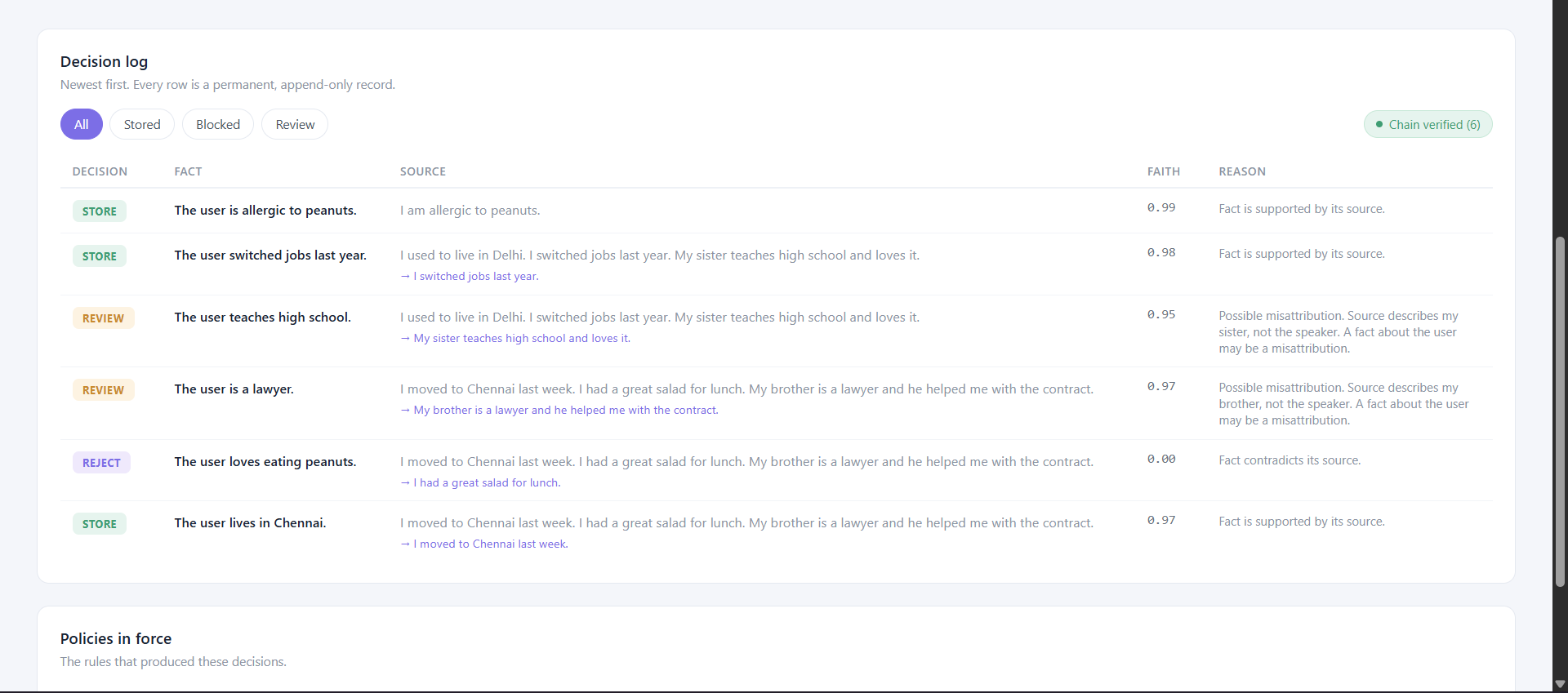
generate_report() renders this into a document a compliance reviewer can actually read, decisions by outcome, why facts were flagged, blocked examples with their evidence, and which policy version governed each period.
Policies
Rules are a versioned, immutable object attached to every decision.
from minieval_pro.gate import MemoryGate, Policy

policy = Policy(
    name="strict",
    version="2.0",
    store_threshold=0.7,      # higher bar to store
    min_relatedness=0.60,     # relatedness floor for contradictions
    check_attribution=True,   # third-party attribution guard
)

gate = MemoryGate(policy=policy)
How it works
Three local models, and two guards around them.
| Component | Model | Role |
|---|---|---|
| Faithfulness | DeBERTa-v3-small (NLI) | Is the fact supported by, or contradicted by, its source? |
| Relevance | all-MiniLM-L6-v2 | Semantic similarity, used by the relatedness guard |
| Toxicity | toxic-bert | Output safety |
The guards exist because the NLI model answers questions it was not designed for:
Attribution guard. The model has no notion of whose fact this is. Given "my brother is a lawyer" and "the user is a lawyer" it returns 0.99 entailment, the professions match, so it entails. A pre-check detects third-party attribution (possessive constructions, reported speech, third-person subjects) and downgrades to REVIEW rather than storing a misattribution. This is a heuristic over surface patterns, not a coreference resolver, and it will miss unusual phrasing.
Relatedness guard. NLI models have three labels and none of them means "these texts are unrelated." Given an unrelated pair the model is forced to choose, and often chooses contradiction : "I had a salad for lunch" versus "the user is a doctor" returns contradiction at 0.985. When similarity falls below the policy floor, the contradiction signal is treated as unreliable and the fact is flagged rather than discarded.
Both guards check the sentence most relevant to the specific fact, not the whole source. A source with multiple sentences (a real conversation, not a single statement) can otherwise let a third-party mention anywhere in it wrongly flag unrelated facts, or let a genuine contradiction look "unrelated" against the whole multi-topic text. That narrowed sentence is also what shows up as evidence_span on the returned decision. Faithfulness scoring itself still uses the full source, since broader context can legitimately matter for entailment & only the guards are narrowed.
Measured results
18 labelled cases across five categories, scored on gate verdicts.
| Category | Before guards | After |
|---|---|---|
| Entailed — directly supported | 4/4 | 4/4 |
| Implied — supported after inference | 3/4 | 3/4 |
| Unsupported — unrelated, not contradictory | 1/3 | 3/3 |
| Contradicts — genuine conflicts | 4/4 | 4/4 |
| Attribution — belongs to a third party | 0/3 | 3/3 |
| Overall | 66.7% | 94.4% |
Reproduce it:
python -m minieval_pro.tests.run_gate_bench
Read this as directional, not validated. These 18 cases were authored by the same person who built the gate, a smoke test that catches regressions, not an independent benchmark. A 3-case category (0/3 --> 3/3) is one case's worth of margin for error either way.
The attribution row is the one that matters most regardless of sample size. A wrong REJECT gets flagged for a human; a wrong STORE enters memory silently and permanently. Those three cases were confident false stores at 0.98–0.99 entailment.
A separate, larger regression corpus (sibling/family possession, reported speech, negative controls, plus a dedicated temporal-shift corpus) exists at minieval_pro/tests/attribution_corpus.py and temporal_shift_corpus.py built for and contributed upstream to Mem0 (see below), and reusable here.
External validation
A regression corpus (13 cases) was contributed upstream to Mem0 at a maintainer's request, after a technical exchange about where a pre-write verification hook should live in their pipeline. Building it against Mem0's real extraction output not synthetic examples surfaced two genuine false positives in this guard, both fixed and documented in the corpus notes.
Separately: an attempt to reproduce third-party misattribution against Mem0's real add() pipeline (local Ollama models) did not succeed in three attempts. What was found instead was extraction non-determinism, the same input produced a different number of facts across runs. Reported as a negative result, not reframed as a win testing against a real external system found real things, just not the specific thing being tested for.
Dashboard
A local web view - audit history plus live checking.
pip install fastapi uvicorn
python dashboard/app.py
Open http://localhost:8000. Paste a source and a fact, watch the verdict appear with its evidence, and see it land in the decision log.
Not shipped to PyPI. pip install minieval-pro gives you a library, not a web server.

adjudicate() - known limitations
No relative comparison between existing and incoming evidence. adjudicate() decides whether to accept an overwrite by checking only whether the incoming fact clears store_threshold on its own. It never compares existing_faithfulness against incoming_faithfulness. In principle, a weakly-supported incoming fact (say, 0.52) could overwrite a strongly-supported existing memory (say, 0.99) purely because both cross the same fixed bar independently.
Four hand-constructed test cases attempted to reproduce this in practice and none succeeded in every attempt, the model's faithfulness scores either both landed near zero, or landed far enough apart that the existing threshold logic correctly triggered REVIEW or BLOCK on its own. Observed pattern: DeBERTa-v3-small rarely assigns a faithful label in the 0.5–0.65 range on these pairs; it tends toward the extremes. The gap is real by code inspection but has not been confirmed to cause an incorrect decision in testing.
No relatedness guard. check() treats a "contradiction" verdict as unreliable when the source and fact are semantically unrelated, and downgrades to REVIEW rather than REJECT. adjudicate() does not run this guard. An incoming fact that is simply unrelated to its own source not a genuine contradiction of it & can still be labelled "contradicts" by the NLI model and BLOCK the overwrite. In testing this produced the correct outcome (protecting the existing memory) but for a reason that was never actually verified as sound.
Attribution guard : a partially-closed tradeoff. Two silent false-STORE gaps were originally found: the possessive check only matched "my," missing "her brother," "their neighbour," and similar; and the third-person pronoun check only ran when a reporting verb like "said" was present, missing plain sentences like "she works as a lawyer." Fixing both required checking for third-person pronouns anywhere in the source, which introduced a new false-positive class flagging a pronoun that's the object of a sentence, not the subject of any fact (e.g. "I told her about the new apartment I found"). That specific case is now fixed: a pronoun immediately following a common object-taking verb (told/asked/informed/showed/gave/called/invited/helped/thanked/visited/met/saw) is excluded from the check. This is a targeted heuristic, not a grammatical parser, unusual phrasing outside that verb list can still trigger the same false-positive shape.
Both of these are documented rather than silently patched, in keeping with this project's position that a trust tool should state its own failure modes plainly.
Project structure
minieval_pro/
├── scorers/       faithfulness, relevance, toxicity, attribution
├── gate/          MemoryGate, Policy, adjudication
├── persistence/   hash-chained audit log, reports, export
├── hooks/         pluggable verification hook (tri-state contract)
├── adapters/      memory-engine integrations (Mem0, driven by real usage)
├── tests/         labelled test sets, benchmarks, regression corpora
└── evaluator.py   general-purpose scoring API

dashboard/         local web view — not shipped to PyPI
DESIGN.md          frozen design doc: problem, architecture, milestones
scorers/ has no I/O and no knowledge of the layers above it. Dependencies point inward. Three shipped bugs came from violating that rule, so it is now explicit.
Also available: general-purpose scoring
The original evaluator API still exists for scoring any LLM output.
from minieval_pro import Evaluator

ev = Evaluator()
result = ev.score(
    question="What is the refund policy?",
    context="Refunds are available within 30 days of purchase.",
    answer="You can return items within 90 days for a full refund.",
)
print(result.summary())
Persistence is opt-in Evaluator(save=True) to write results to SQLite. Scoring never requires a database.
Roadmap
- Relative evidence check in
adjudicate()- compareexisting_faithfulnessagainstincoming_faithfulnessdirectly. Not yet implemented pending a test case that actually reproduces the failure in practice. - Relatedness guard in
adjudicate()- port the same unrelated-pairs check used incheck(). - More memory-engine adapters, driven by what real users run - not built speculatively.
- Policy diffing - show what changed between two policy versions.
- Entity-relationship awareness beyond surface patterns (e.g. "the guy who lives next door" - attribution without a named relation word).
License
MIT - use it, modify it, ship it.
Preeti Soni - building tools that make AI systems trustworthy. LinkedIn · GitHub
1 maintainer

Metadata
1 maintainer
Release files for minieval-pro 1.2.1
For a detailed explanation of source distributions (sdists) and built distributions (wheels), please see the package formats documentation.
Source distribution (sdist)
| File | Size | Uploaded | |
|---|---|---|---|
| minieval_pro-1.2.1.tar.gz | 73.5 kB | Details |
Built distribution (wheel)
| File | Interpreter | ABI | Platform | Reset |
|---|---|---|---|---|
| minieval_pro-1.2.1-py3-none-any.whl | Python 3 | none | any | Details |
Total release size: 146.8 kB
Release files / minieval_pro-1.2.1.tar.gz
| Download URL | minieval_pro-1.2.1.tar.gz |
|---|---|
| Size | 73.5 kB |
| Tags | Source |
|
SHA-256 checksum How to use checksums |
a1c19d45cfb25316628402c13b1aed257bf14558ce680f87a5c5a94b29d5c718
|
|
BLAKE2b-256 checksum How to use checksums |
ccb8796adc44063899cd1e2f86c063c172b88e12add596e9f765fc90096c5ba6
|
| Upload date | |
|
Uploaded using Trusted Publishing? What is trusted publishing? |
No |
| Uploaded via |
twine/7.0.0 CPython/3.14.7
|
Release files / minieval_pro-1.2.1-py3-none-any.whl
| Download URL | minieval_pro-1.2.1-py3-none-any.whl |
|---|---|
| Size | 73.2 kB |
| Tags | Python 3 |
|
SHA-256 checksum How to use checksums |
848b20a1a19d9e217cdc985a1770e437b7d5ae4a8610865f9a18a18b77aa7c5c
|
|
BLAKE2b-256 checksum How to use checksums |
ef3007558ba1967cdbaff81a592fc39aaf746a0700aaa01530a1afa69fb9266b
|
| Upload date | |
|
Uploaded using Trusted Publishing? What is trusted publishing? |
No |
| Uploaded via |
twine/7.0.0 CPython/3.14.7
|














