
MiniTorch
A compact NumPy neural-network framework with fast reverse-mode autograd, a compiled dense-training loop, and an interactive scientific model explorer. MiniTorch keeps the implementation small enough to study while providing a practical API for experiments.




Highlights
- Linear-time reverse execution tape for first-order backpropagation.
- Raw NumPy gradient kernels avoid constructing temporary autograd graphs.
- Familiar
Variable,Module,Sequential,Linear, activation, and optimizer APIs. - Optional Cython-generated C loop for dense classifier training; NumPy still provides optimized matrix multiplication.
- Self-contained React full-neuron model explorer.
- Higher-order differentiation remains available with
backward(create_graph=True).
Install
Python 3.10 or newer is required. Release wheels target Linux x86-64, Windows x64, and 64-bit Intel/Apple silicon macOS.
pip install minitorchbr
For development or to compile the native trainer from source:
git clone https://github.com/BriceLucifer/MiniTorch.git
cd MiniTorch
uv venv
uv sync
Source installation requires a C/C++ build toolchain because the native trainer is compiled during installation.
Autograd
import numpy as np
from MiniTorch import Variable

x = Variable(np.array([[2.0]], dtype=np.float32), name="x")
w = Variable(np.array([[3.0]], dtype=np.float32), name="w")
b = Variable(np.array([[1.0]], dtype=np.float32), name="b")

loss = (x * w + b - 10.0) ** 2
loss.backward()

print(loss.data)    # [[9.]]
print(x.grad.data)  # [[-18.]]
print(w.grad.data)  # [[-12.]]
print(b.grad.data)  # [[-6.]]
The normal backward path traverses each graph node and edge once. Pass
create_graph=True when the backward computation itself must remain
differentiable.
Build a model
from MiniTorch.nn import Linear, ReLU, Sequential

model = Sequential(
    Linear(64, 128),
    ReLU(),
    Linear(128, 64),
    ReLU(),
    Linear(64, 10),
)

print(model)
print(model.summary())
Eager training
Use eager mode for arbitrary modules, custom operations, dynamic model code, or higher-order gradients:
from MiniTorch import Variable
from MiniTorch.ops import softmax_cross_entropy
from MiniTorch.optim import Adam

optimizer = Adam(model.parameters(), lr=1e-3)

for features, labels in loader:
    logits = model(Variable(features))
    loss = softmax_cross_entropy(logits, Variable(labels))

    optimizer.zero_grad()
    loss.backward()
    optimizer.step()
Compiled training loop
For a static Sequential(Linear, ReLU, ..., Linear) classifier, train moves
the epoch, mini-batch, forward, backward, softmax cross-entropy, and Adam loops
out of Python:
from MiniTorch.native import train

history = train(
    model,
    x_train,
    y_train,
    epochs=15,
    batch_size=128,
    lr=1e-3,
)

print(history.losses[-1])
Inputs and parameters use contiguous float32; labels use integer class
indices. Parameters are updated in place, and gradients from the final batch
remain attached for inspection. Unsupported model structures should use eager
training.
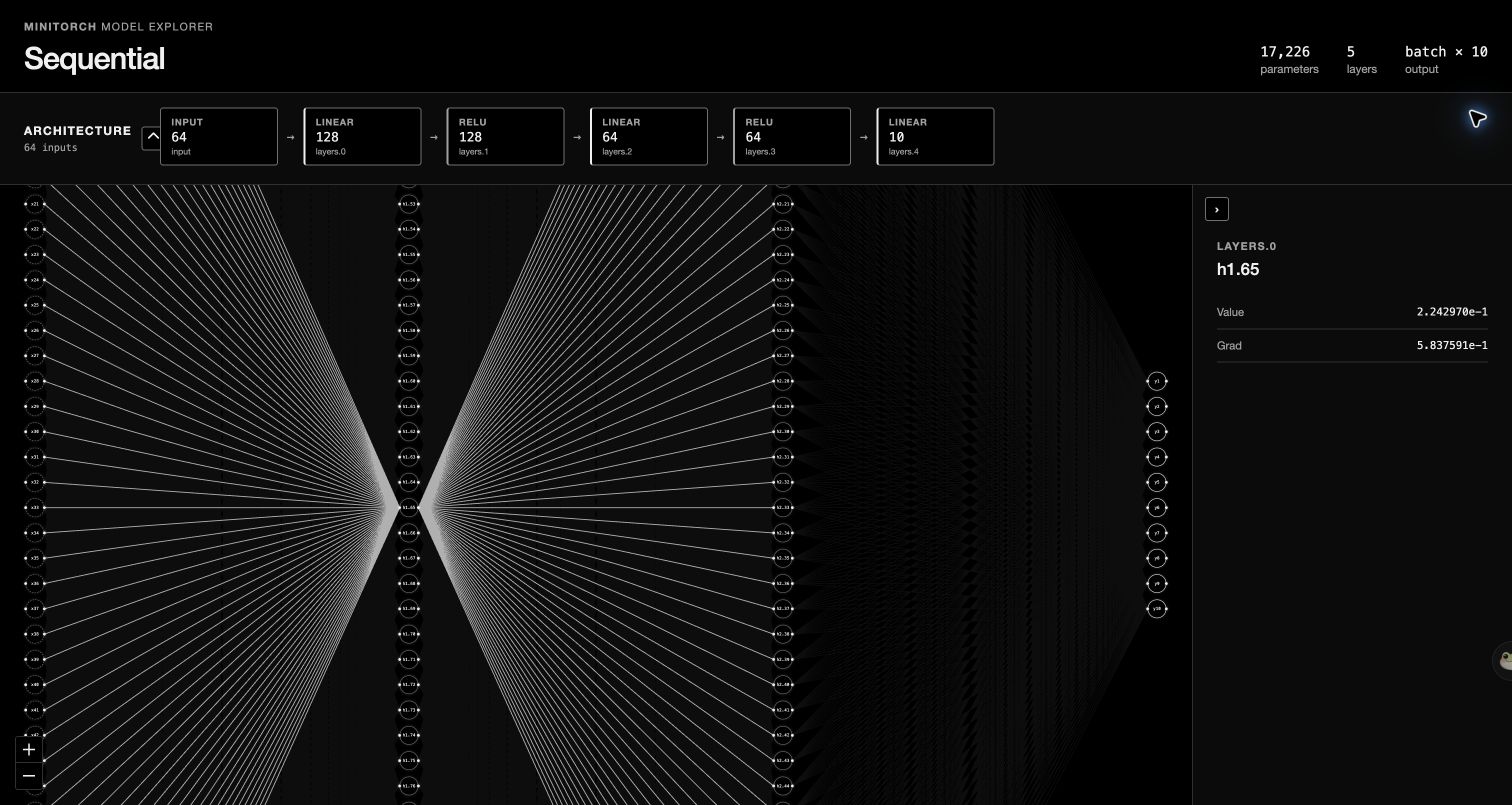
Interactive model visualization
The public API is intentionally small:
from MiniTorch import visualize

visualize(model)
This writes model_architecture.html and opens a self-contained interactive
viewer. No server is required.
result = visualize(
    model,
    filename="artifacts/model.html",
    input_shape=(None, 64),
    open_browser=False,
)
print(result.path)
The viewer provides:
- every neuron in every dense layer—no representative sampling;
- a canvas-rendered full connection mesh that remains responsive at high edge counts;
- a separate compact architecture overview above the neuron map;
- map-style zoom and pan plus slim horizontal and vertical scrollbars;
- a fixed, distraction-free black scientific theme;
- independent collapse controls for the architecture and inspector;
- a deliberately small neuron inspector containing only
ValueandGrad.
Value is captured by the latest eager forward pass. Use
loss.backward(retain_grad=True) before visualize(model) to retain hidden
activation gradients for Grad.
import numpy as np

from MiniTorch import Variable, sum as tensor_sum, visualize

probe = Variable(np.random.default_rng(7).normal(size=(1, 64)).astype(np.float32))
probe_output = model(probe)
probe_loss = tensor_sum(probe_output)
probe_loss.backward(retain_grad=True)
visualize(model)
The exporter is shape-driven rather than tied to the example above. A
single-layer 10 → 1 network produces exactly 10 input neurons, one output
neuron, and 10 connections:
from MiniTorch import visualize
from MiniTorch.nn import Linear, Sequential

small_model = Sequential(Linear(10, 1))
visualize(small_model, filename="small-model.html")
To rebuild the bundled frontend after editing it:
cd lib/graph-viewer
npm ci
npm run typecheck
npm run build
The generated JavaScript and CSS are packaged under
MiniTorch/visualization/static/.
Autograd graph debugging
Use the separate computation-graph viewer to inspect one expression:
from MiniTorch import visualize_graph

loss.backward(retain_grad=True)
visualize_graph(loss, filename="autograd_graph.html")
Examples
All examples run from the repository root:
uv run python examples/basic_autograd.py
uv run python examples/native_training.py
uv run python examples/model_visualization.py
uv run python examples/autograd_graph.py
uv run python examples/mnist.py
examples/mnist.py downloads MNIST on first use, trains it through the compiled
loop, evaluates the result, and opens the trained network in the model explorer.
Performance
The benchmark scripts compare graph traversal and complete training paths:
uv run python benchmarks/benchmark_autograd.py
uv run python benchmarks/benchmark_native_training.py
uv run python benchmarks/benchmark_autograd.py --quick --json
Latest local smoke results (Python 3.14.3, NumPy 2.4.3, Apple silicon):
| Benchmark | Median |
|---|---|
| Backward through a 2,000-node chain | 5.20 ms |
| Backward through 1,000 fan-out branches | 5.54 ms |
| Dense MLP training, batch 256 | 1.28 ms / 199,740 samples/s |
| Compiled loop versus eager training | 1.74× faster |
Results depend on CPU, NumPy build, BLAS library, and workload. Run the included benchmarks on the target machine; quick-mode samples are smoke measurements, not fixed performance guarantees.
Repository layout
MiniTorch/
├── core/              Variable, Function, and gradient configuration
├── ops/               differentiable NumPy operations
├── nn/                modules, dense layers, activations, containers
├── optim/             SGD and Adam
├── native/            compiled dense-classifier training loop
├── visualization/     model exporter and packaged web viewer
├── data/              MNIST loader and mini-batch DataLoader
└── utils/             graph tools, plots, and numerical checks
benchmarks/             reproducible performance measurements
docs/                   MkDocs Material documentation
examples/               runnable focused examples
lib/graph-viewer/       React and TypeScript viewer source
tests/                  correctness and integration tests
Generated plots and demo outputs are deliberately not committed. Examples write their artifacts into the current working directory.
Development
uv sync
uv run pytest tests/ -q
uv run mypy MiniTorch

cd lib/graph-viewer && npm ci && npm run typecheck && npm run build
cd ../..
uv run --group docs mkdocs build --strict
uv build
Documentation
The full guide covers installation, training, and model visualization.
License
MiniTorch is released under the MIT License.
1 maintainer

Download files
Download the file for your platform. If you're not sure which to choose, learn more about installing packages.
Source Distribution
Built Distributions
Filter files by name, interpreter, ABI, and platform.
If you're not sure about the file name format, learn more about wheel file names.
Copy a direct link to the current filters
File details
Details for the file minitorchbr-0.4.2.tar.gz.
File metadata
- Download URL: minitorchbr-0.4.2.tar.gz
- Upload date:
- Size: 373.9 kB
- Tags: Source
- Uploaded using Trusted Publishing? Yes
- Uploaded via:
twine/6.1.0 CPython/3.13.14
File hashes
| Algorithm | Hash digest | |
|---|---|---|
| SHA256 |
a00d3f955514a71b515e7ade4d27c4ef06e1e2651cc1b6315d4c97e02651b714
|
|
| MD5 |
2c3666f44cf3890fea2e1e36ed7aec7f
|
|
| BLAKE2b-256 |
1d5a406f8d252de0ceb7d9c0b83d1f9438891b80e87f25000e2ab1d2b0d8d3f0
|
Provenance
The following attestation bundles were made for minitorchbr-0.4.2.tar.gz:
Publisher:
release.yml on BriceLucifer/MiniTorch
-
Statement:
-
Statement type:
https://in-toto.io/Statement/v1 -
Predicate type:
https://docs.pypi.org/attestations/publish/v1 -
Subject name:
minitorchbr-0.4.2.tar.gz -
Subject digest:
a00d3f955514a71b515e7ade4d27c4ef06e1e2651cc1b6315d4c97e02651b714 - Sigstore transparency entry: 2225410525
- Sigstore integration time:
-
Permalink:
BriceLucifer/MiniTorch@5afdefc92c2cc274bf7f29fa28625279f5f1d89e -
Branch / Tag:
refs/tags/v0.4.2 - Owner: https://github.com/BriceLucifer
-
Access:
public
-
Token Issuer:
https://token.actions.githubusercontent.com -
Runner Environment:
github-hosted -
Publication workflow:
release.yml@5afdefc92c2cc274bf7f29fa28625279f5f1d89e -
Trigger Event:
release
-
Statement type:
File details
Details for the file minitorchbr-0.4.2-cp314-cp314-win_amd64.whl.
File metadata
- Download URL: minitorchbr-0.4.2-cp314-cp314-win_amd64.whl
- Upload date:
- Size: 429.4 kB
- Tags: CPython 3.14, Windows x86-64
- Uploaded using Trusted Publishing? Yes
- Uploaded via:
twine/6.1.0 CPython/3.13.14
File hashes
| Algorithm | Hash digest | |
|---|---|---|
| SHA256 |
f9f7284bf414f42ca23c9fe89c090c31eebcdfe3fef08a1c688f29161171cc41
|
|
| MD5 |
12ca235d40cb72c38d7310e6109bea42
|
|
| BLAKE2b-256 |
00d728d492702a4c619defebee617b68425e7e7d2621c5111fe7e420cd5c8725
|
Provenance
The following attestation bundles were made for minitorchbr-0.4.2-cp314-cp314-win_amd64.whl:
Publisher:
release.yml on BriceLucifer/MiniTorch
-
Statement:
-
Statement type:
https://in-toto.io/Statement/v1 -
Predicate type:
https://docs.pypi.org/attestations/publish/v1 -
Subject name:
minitorchbr-0.4.2-cp314-cp314-win_amd64.whl -
Subject digest:
f9f7284bf414f42ca23c9fe89c090c31eebcdfe3fef08a1c688f29161171cc41 - Sigstore transparency entry: 2225412685
- Sigstore integration time:
-
Permalink:
BriceLucifer/MiniTorch@5afdefc92c2cc274bf7f29fa28625279f5f1d89e -
Branch / Tag:
refs/tags/v0.4.2 - Owner: https://github.com/BriceLucifer
-
Access:
public
-
Token Issuer:
https://token.actions.githubusercontent.com -
Runner Environment:
github-hosted -
Publication workflow:
release.yml@5afdefc92c2cc274bf7f29fa28625279f5f1d89e -
Trigger Event:
release
-
Statement type:
File details
Details for the file minitorchbr-0.4.2-cp314-cp314-manylinux1_x86_64.manylinux_2_28_x86_64.manylinux_2_5_x86_64.whl.
File metadata
- Download URL: minitorchbr-0.4.2-cp314-cp314-manylinux1_x86_64.manylinux_2_28_x86_64.manylinux_2_5_x86_64.whl
- Upload date:
- Size: 617.6 kB
- Tags: CPython 3.14, manylinux: glibc 2.28+ x86-64, manylinux: glibc 2.5+ x86-64
- Uploaded using Trusted Publishing? Yes
- Uploaded via:
twine/6.1.0 CPython/3.13.14
File hashes
| Algorithm | Hash digest | |
|---|---|---|
| SHA256 |
8924bae3490cde96e69e9fdd65cf6258075c7f92f680182ee8e7507ffdb7d636
|
|
| MD5 |
3c42cff2c1cf62e6958c0f3b3c2e716f
|
|
| BLAKE2b-256 |
d7bdcf463439b1f082990b1e9412c322ac3ee46cfbdd83e04257a47a070609d1
|
Provenance
The following attestation bundles were made for minitorchbr-0.4.2-cp314-cp314-manylinux1_x86_64.manylinux_2_28_x86_64.manylinux_2_5_x86_64.whl:
Publisher:
release.yml on BriceLucifer/MiniTorch
-
Statement:
-
Statement type:
https://in-toto.io/Statement/v1 -
Predicate type:
https://docs.pypi.org/attestations/publish/v1 -
Subject name:
minitorchbr-0.4.2-cp314-cp314-manylinux1_x86_64.manylinux_2_28_x86_64.manylinux_2_5_x86_64.whl -
Subject digest:
8924bae3490cde96e69e9fdd65cf6258075c7f92f680182ee8e7507ffdb7d636 - Sigstore transparency entry: 2225414037
- Sigstore integration time:
-
Permalink:
BriceLucifer/MiniTorch@5afdefc92c2cc274bf7f29fa28625279f5f1d89e -
Branch / Tag:
refs/tags/v0.4.2 - Owner: https://github.com/BriceLucifer
-
Access:
public
-
Token Issuer:
https://token.actions.githubusercontent.com -
Runner Environment:
github-hosted -
Publication workflow:
release.yml@5afdefc92c2cc274bf7f29fa28625279f5f1d89e -
Trigger Event:
release
-
Statement type:
File details
Details for the file minitorchbr-0.4.2-cp314-cp314-macosx_11_0_arm64.whl.
File metadata
- Download URL: minitorchbr-0.4.2-cp314-cp314-macosx_11_0_arm64.whl
- Upload date:
- Size: 428.1 kB
- Tags: CPython 3.14, macOS 11.0+ ARM64
- Uploaded using Trusted Publishing? Yes
- Uploaded via:
twine/6.1.0 CPython/3.13.14
File hashes
| Algorithm | Hash digest | |
|---|---|---|
| SHA256 |
e24ef9990701cc7587082b1d740f27a95c3aef7ea87e5a0d89184f271e3ff6f1
|
|
| MD5 |
f18b40b5666fb7a4c6e93a8236220822
|
|
| BLAKE2b-256 |
9fab5721f10c1ba2f109fda4eb5e801759dc7352f70f063340aa779c555cf039
|
Provenance
The following attestation bundles were made for minitorchbr-0.4.2-cp314-cp314-macosx_11_0_arm64.whl:
Publisher:
release.yml on BriceLucifer/MiniTorch
-
Statement:
-
Statement type:
https://in-toto.io/Statement/v1 -
Predicate type:
https://docs.pypi.org/attestations/publish/v1 -
Subject name:
minitorchbr-0.4.2-cp314-cp314-macosx_11_0_arm64.whl -
Subject digest:
e24ef9990701cc7587082b1d740f27a95c3aef7ea87e5a0d89184f271e3ff6f1 - Sigstore transparency entry: 2225419056
- Sigstore integration time:
-
Permalink:
BriceLucifer/MiniTorch@5afdefc92c2cc274bf7f29fa28625279f5f1d89e -
Branch / Tag:
refs/tags/v0.4.2 - Owner: https://github.com/BriceLucifer
-
Access:
public
-
Token Issuer:
https://token.actions.githubusercontent.com -
Runner Environment:
github-hosted -
Publication workflow:
release.yml@5afdefc92c2cc274bf7f29fa28625279f5f1d89e -
Trigger Event:
release
-
Statement type:
File details
Details for the file minitorchbr-0.4.2-cp314-cp314-macosx_10_15_x86_64.whl.
File metadata
- Download URL: minitorchbr-0.4.2-cp314-cp314-macosx_10_15_x86_64.whl
- Upload date:
- Size: 429.0 kB
- Tags: CPython 3.14, macOS 10.15+ x86-64
- Uploaded using Trusted Publishing? Yes
- Uploaded via:
twine/6.1.0 CPython/3.13.14
File hashes
| Algorithm | Hash digest | |
|---|---|---|
| SHA256 |
bfe810ea76fdedaf7b243fca4fe915042938ce61c817b801cac596826a99ea9f
|
|
| MD5 |
d971c0761f6a5915e81527646be909f0
|
|
| BLAKE2b-256 |
5c5624528dca379891a73568131c027dce6ba4adcac3e08b4e10f550bd683953
|
Provenance
The following attestation bundles were made for minitorchbr-0.4.2-cp314-cp314-macosx_10_15_x86_64.whl:
Publisher:
release.yml on BriceLucifer/MiniTorch
-
Statement:
-
Statement type:
https://in-toto.io/Statement/v1 -
Predicate type:
https://docs.pypi.org/attestations/publish/v1 -
Subject name:
minitorchbr-0.4.2-cp314-cp314-macosx_10_15_x86_64.whl -
Subject digest:
bfe810ea76fdedaf7b243fca4fe915042938ce61c817b801cac596826a99ea9f - Sigstore transparency entry: 2225412077
- Sigstore integration time:
-
Permalink:
BriceLucifer/MiniTorch@5afdefc92c2cc274bf7f29fa28625279f5f1d89e -
Branch / Tag:
refs/tags/v0.4.2 - Owner: https://github.com/BriceLucifer
-
Access:
public
-
Token Issuer:
https://token.actions.githubusercontent.com -
Runner Environment:
github-hosted -
Publication workflow:
release.yml@5afdefc92c2cc274bf7f29fa28625279f5f1d89e -
Trigger Event:
release
-
Statement type:
File details
Details for the file minitorchbr-0.4.2-cp313-cp313-win_amd64.whl.
File metadata
- Download URL: minitorchbr-0.4.2-cp313-cp313-win_amd64.whl
- Upload date:
- Size: 423.4 kB
- Tags: CPython 3.13, Windows x86-64
- Uploaded using Trusted Publishing? Yes
- Uploaded via:
twine/6.1.0 CPython/3.13.14
File hashes
| Algorithm | Hash digest | |
|---|---|---|
| SHA256 |
1e45f9188a7b3e17f1de7994180e1b467afc6c0c4fbe5a8530a7d0d388096ee3
|
|
| MD5 |
456338ff5b6af6b11d1e314968fa8bdd
|
|
| BLAKE2b-256 |
aefae4e4f69201a1270c83c00388e303aa66217e6cccb8f3e37cec568a0264bb
|
Provenance
The following attestation bundles were made for minitorchbr-0.4.2-cp313-cp313-win_amd64.whl:
Publisher:
release.yml on BriceLucifer/MiniTorch
-
Statement:
-
Statement type:
https://in-toto.io/Statement/v1 -
Predicate type:
https://docs.pypi.org/attestations/publish/v1 -
Subject name:
minitorchbr-0.4.2-cp313-cp313-win_amd64.whl -
Subject digest:
1e45f9188a7b3e17f1de7994180e1b467afc6c0c4fbe5a8530a7d0d388096ee3 - Sigstore transparency entry: 2225422115
- Sigstore integration time:
-
Permalink:
BriceLucifer/MiniTorch@5afdefc92c2cc274bf7f29fa28625279f5f1d89e -
Branch / Tag:
refs/tags/v0.4.2 - Owner: https://github.com/BriceLucifer
-
Access:
public
-
Token Issuer:
https://token.actions.githubusercontent.com -
Runner Environment:
github-hosted -
Publication workflow:
release.yml@5afdefc92c2cc274bf7f29fa28625279f5f1d89e -
Trigger Event:
release
-
Statement type:
File details
Details for the file minitorchbr-0.4.2-cp313-cp313-manylinux1_x86_64.manylinux_2_28_x86_64.manylinux_2_5_x86_64.whl.
File metadata
- Download URL: minitorchbr-0.4.2-cp313-cp313-manylinux1_x86_64.manylinux_2_28_x86_64.manylinux_2_5_x86_64.whl
- Upload date:
- Size: 617.8 kB
- Tags: CPython 3.13, manylinux: glibc 2.28+ x86-64, manylinux: glibc 2.5+ x86-64
- Uploaded using Trusted Publishing? Yes
- Uploaded via:
twine/6.1.0 CPython/3.13.14
File hashes
| Algorithm | Hash digest | |
|---|---|---|
| SHA256 |
94c55edced0a9c84998896be33b1d84b873abc801375983ccbe9df66f1c1be88
|
|
| MD5 |
600916d5690a5020b518b9a3eb7699ae
|
|
| BLAKE2b-256 |
c1ce6e6804024dc15bf48d8606b5a625c092e56ec2e63e2a52e10df8076f70be
|
Provenance
The following attestation bundles were made for minitorchbr-0.4.2-cp313-cp313-manylinux1_x86_64.manylinux_2_28_x86_64.manylinux_2_5_x86_64.whl:
Publisher:
release.yml on BriceLucifer/MiniTorch
-
Statement:
-
Statement type:
https://in-toto.io/Statement/v1 -
Predicate type:
https://docs.pypi.org/attestations/publish/v1 -
Subject name:
minitorchbr-0.4.2-cp313-cp313-manylinux1_x86_64.manylinux_2_28_x86_64.manylinux_2_5_x86_64.whl -
Subject digest:
94c55edced0a9c84998896be33b1d84b873abc801375983ccbe9df66f1c1be88 - Sigstore transparency entry: 2225420796
- Sigstore integration time:
-
Permalink:
BriceLucifer/MiniTorch@5afdefc92c2cc274bf7f29fa28625279f5f1d89e -
Branch / Tag:
refs/tags/v0.4.2 - Owner: https://github.com/BriceLucifer
-
Access:
public
-
Token Issuer:
https://token.actions.githubusercontent.com -
Runner Environment:
github-hosted -
Publication workflow:
release.yml@5afdefc92c2cc274bf7f29fa28625279f5f1d89e -
Trigger Event:
release
-
Statement type:
File details
Details for the file minitorchbr-0.4.2-cp313-cp313-macosx_11_0_arm64.whl.
File metadata
- Download URL: minitorchbr-0.4.2-cp313-cp313-macosx_11_0_arm64.whl
- Upload date:
- Size: 425.6 kB
- Tags: CPython 3.13, macOS 11.0+ ARM64
- Uploaded using Trusted Publishing? Yes
- Uploaded via:
twine/6.1.0 CPython/3.13.14
File hashes
| Algorithm | Hash digest | |
|---|---|---|
| SHA256 |
8db788938660390597a5c1f7c2ed52ef7ed6afb5740ee8744eecdb7aa3641cb8
|
|
| MD5 |
2f6fb489086bd434b28fc80b5d425c69
|
|
| BLAKE2b-256 |
9ce5b813df6ec7e6d4dad215cc870766cfbb11ba5a173f919f6e3b521f939fb0
|
Provenance
The following attestation bundles were made for minitorchbr-0.4.2-cp313-cp313-macosx_11_0_arm64.whl:
Publisher:
release.yml on BriceLucifer/MiniTorch
-
Statement:
-
Statement type:
https://in-toto.io/Statement/v1 -
Predicate type:
https://docs.pypi.org/attestations/publish/v1 -
Subject name:
minitorchbr-0.4.2-cp313-cp313-macosx_11_0_arm64.whl -
Subject digest:
8db788938660390597a5c1f7c2ed52ef7ed6afb5740ee8744eecdb7aa3641cb8 - Sigstore transparency entry: 2225414869
- Sigstore integration time:
-
Permalink:
BriceLucifer/MiniTorch@5afdefc92c2cc274bf7f29fa28625279f5f1d89e -
Branch / Tag:
refs/tags/v0.4.2 - Owner: https://github.com/BriceLucifer
-
Access:
public
-
Token Issuer:
https://token.actions.githubusercontent.com -
Runner Environment:
github-hosted -
Publication workflow:
release.yml@5afdefc92c2cc274bf7f29fa28625279f5f1d89e -
Trigger Event:
release
-
Statement type:
File details
Details for the file minitorchbr-0.4.2-cp313-cp313-macosx_10_13_x86_64.whl.
File metadata
- Download URL: minitorchbr-0.4.2-cp313-cp313-macosx_10_13_x86_64.whl
- Upload date:
- Size: 426.5 kB
- Tags: CPython 3.13, macOS 10.13+ x86-64
- Uploaded using Trusted Publishing? Yes
- Uploaded via:
twine/6.1.0 CPython/3.13.14
File hashes
| Algorithm | Hash digest | |
|---|---|---|
| SHA256 |
e975abe9e7557bbfb87241c7d118bccbb0f38524bd7698a7ba633ec19ccd5fa2
|
|
| MD5 |
5621c2fc2bfe7ebac50c9c6c4f35db03
|
|
| BLAKE2b-256 |
4c1c16ac3e28b511d8f324f1afeeebcc1c6851536a573a723c2832a5532f8742
|
Provenance
The following attestation bundles were made for minitorchbr-0.4.2-cp313-cp313-macosx_10_13_x86_64.whl:
Publisher:
release.yml on BriceLucifer/MiniTorch
-
Statement:
-
Statement type:
https://in-toto.io/Statement/v1 -
Predicate type:
https://docs.pypi.org/attestations/publish/v1 -
Subject name:
minitorchbr-0.4.2-cp313-cp313-macosx_10_13_x86_64.whl -
Subject digest:
e975abe9e7557bbfb87241c7d118bccbb0f38524bd7698a7ba633ec19ccd5fa2 - Sigstore transparency entry: 2225417287
- Sigstore integration time:
-
Permalink:
BriceLucifer/MiniTorch@5afdefc92c2cc274bf7f29fa28625279f5f1d89e -
Branch / Tag:
refs/tags/v0.4.2 - Owner: https://github.com/BriceLucifer
-
Access:
public
-
Token Issuer:
https://token.actions.githubusercontent.com -
Runner Environment:
github-hosted -
Publication workflow:
release.yml@5afdefc92c2cc274bf7f29fa28625279f5f1d89e -
Trigger Event:
release
-
Statement type:
File details
Details for the file minitorchbr-0.4.2-cp312-cp312-win_amd64.whl.
File metadata
- Download URL: minitorchbr-0.4.2-cp312-cp312-win_amd64.whl
- Upload date:
- Size: 423.8 kB
- Tags: CPython 3.12, Windows x86-64
- Uploaded using Trusted Publishing? Yes
- Uploaded via:
twine/6.1.0 CPython/3.13.14
File hashes
| Algorithm | Hash digest | |
|---|---|---|
| SHA256 |
347f8f30363372a9a701d77b366daf8bee43961e12cb0a0c0341fc5e2005b3bc
|
|
| MD5 |
492da0a98ce0b7c4fcefd4b92a1d537d
|
|
| BLAKE2b-256 |
9e5ed82005d4cfb7947858b4df3a2bf2a7e9c75c998315fab7267d8f7ca5179b
|
Provenance
The following attestation bundles were made for minitorchbr-0.4.2-cp312-cp312-win_amd64.whl:
Publisher:
release.yml on BriceLucifer/MiniTorch
-
Statement:
-
Statement type:
https://in-toto.io/Statement/v1 -
Predicate type:
https://docs.pypi.org/attestations/publish/v1 -
Subject name:
minitorchbr-0.4.2-cp312-cp312-win_amd64.whl -
Subject digest:
347f8f30363372a9a701d77b366daf8bee43961e12cb0a0c0341fc5e2005b3bc - Sigstore transparency entry: 2225411159
- Sigstore integration time:
-
Permalink:
BriceLucifer/MiniTorch@5afdefc92c2cc274bf7f29fa28625279f5f1d89e -
Branch / Tag:
refs/tags/v0.4.2 - Owner: https://github.com/BriceLucifer
-
Access:
public
-
Token Issuer:
https://token.actions.githubusercontent.com -
Runner Environment:
github-hosted -
Publication workflow:
release.yml@5afdefc92c2cc274bf7f29fa28625279f5f1d89e -
Trigger Event:
release
-
Statement type:
File details
Details for the file minitorchbr-0.4.2-cp312-cp312-manylinux1_x86_64.manylinux_2_28_x86_64.manylinux_2_5_x86_64.whl.
File metadata
- Download URL: minitorchbr-0.4.2-cp312-cp312-manylinux1_x86_64.manylinux_2_28_x86_64.manylinux_2_5_x86_64.whl
- Upload date:
- Size: 625.5 kB
- Tags: CPython 3.12, manylinux: glibc 2.28+ x86-64, manylinux: glibc 2.5+ x86-64
- Uploaded using Trusted Publishing? Yes
- Uploaded via:
twine/6.1.0 CPython/3.13.14
File hashes
| Algorithm | Hash digest | |
|---|---|---|
| SHA256 |
907dfda9cd66e20edf50701d59342ef02d4a9e525e35bb4dab14c04888fd4f18
|
|
| MD5 |
124a6022f269385f02605517ce233788
|
|
| BLAKE2b-256 |
af6b8f7511694a96b83354ebf51c3d61a2172876e9d4c283796eab244ac2b19e
|
Provenance
The following attestation bundles were made for minitorchbr-0.4.2-cp312-cp312-manylinux1_x86_64.manylinux_2_28_x86_64.manylinux_2_5_x86_64.whl:
Publisher:
release.yml on BriceLucifer/MiniTorch
-
Statement:
-
Statement type:
https://in-toto.io/Statement/v1 -
Predicate type:
https://docs.pypi.org/attestations/publish/v1 -
Subject name:
minitorchbr-0.4.2-cp312-cp312-manylinux1_x86_64.manylinux_2_28_x86_64.manylinux_2_5_x86_64.whl -
Subject digest:
907dfda9cd66e20edf50701d59342ef02d4a9e525e35bb4dab14c04888fd4f18 - Sigstore transparency entry: 2225419968
- Sigstore integration time:
-
Permalink:
BriceLucifer/MiniTorch@5afdefc92c2cc274bf7f29fa28625279f5f1d89e -
Branch / Tag:
refs/tags/v0.4.2 - Owner: https://github.com/BriceLucifer
-
Access:
public
-
Token Issuer:
https://token.actions.githubusercontent.com -
Runner Environment:
github-hosted -
Publication workflow:
release.yml@5afdefc92c2cc274bf7f29fa28625279f5f1d89e -
Trigger Event:
release
-
Statement type:
File details
Details for the file minitorchbr-0.4.2-cp312-cp312-macosx_11_0_arm64.whl.
File metadata
- Download URL: minitorchbr-0.4.2-cp312-cp312-macosx_11_0_arm64.whl
- Upload date:
- Size: 425.9 kB
- Tags: CPython 3.12, macOS 11.0+ ARM64
- Uploaded using Trusted Publishing? Yes
- Uploaded via:
twine/6.1.0 CPython/3.13.14
File hashes
| Algorithm | Hash digest | |
|---|---|---|
| SHA256 |
4f10610507b32c9a831fc56282feaf6bf12505e5b1d80e0c8b75fee90c52991c
|
|
| MD5 |
1d95d80a07d983bd1f8ca336e5d38624
|
|
| BLAKE2b-256 |
993c5983e7e4c8f66d86dd9d6782b020e4775c7aceb36d89c7d76deb9f11baf5
|
Provenance
The following attestation bundles were made for minitorchbr-0.4.2-cp312-cp312-macosx_11_0_arm64.whl:
Publisher:
release.yml on BriceLucifer/MiniTorch
-
Statement:
-
Statement type:
https://in-toto.io/Statement/v1 -
Predicate type:
https://docs.pypi.org/attestations/publish/v1 -
Subject name:
minitorchbr-0.4.2-cp312-cp312-macosx_11_0_arm64.whl -
Subject digest:
4f10610507b32c9a831fc56282feaf6bf12505e5b1d80e0c8b75fee90c52991c - Sigstore transparency entry: 2225416208
- Sigstore integration time:
-
Permalink:
BriceLucifer/MiniTorch@5afdefc92c2cc274bf7f29fa28625279f5f1d89e -
Branch / Tag:
refs/tags/v0.4.2 - Owner: https://github.com/BriceLucifer
-
Access:
public
-
Token Issuer:
https://token.actions.githubusercontent.com -
Runner Environment:
github-hosted -
Publication workflow:
release.yml@5afdefc92c2cc274bf7f29fa28625279f5f1d89e -
Trigger Event:
release
-
Statement type:
File details
Details for the file minitorchbr-0.4.2-cp312-cp312-macosx_10_13_x86_64.whl.
File metadata
- Download URL: minitorchbr-0.4.2-cp312-cp312-macosx_10_13_x86_64.whl
- Upload date:
- Size: 426.8 kB
- Tags: CPython 3.12, macOS 10.13+ x86-64
- Uploaded using Trusted Publishing? Yes
- Uploaded via:
twine/6.1.0 CPython/3.13.14
File hashes
| Algorithm | Hash digest | |
|---|---|---|
| SHA256 |
91589a7788ee26f7218d4f5f8036641765a47840b040eb2d910a893d4c561cb1
|
|
| MD5 |
0d13e9d8bca8373db8f8b145000c13fb
|
|
| BLAKE2b-256 |
585e0ee0c05d687f6aab0c154d64617317ae2e7be8bbe3435fda2014bcd8962e
|
Provenance
The following attestation bundles were made for minitorchbr-0.4.2-cp312-cp312-macosx_10_13_x86_64.whl:
Publisher:
release.yml on BriceLucifer/MiniTorch
-
Statement:
-
Statement type:
https://in-toto.io/Statement/v1 -
Predicate type:
https://docs.pypi.org/attestations/publish/v1 -
Subject name:
minitorchbr-0.4.2-cp312-cp312-macosx_10_13_x86_64.whl -
Subject digest:
91589a7788ee26f7218d4f5f8036641765a47840b040eb2d910a893d4c561cb1 - Sigstore transparency entry: 2225415754
- Sigstore integration time:
-
Permalink:
BriceLucifer/MiniTorch@5afdefc92c2cc274bf7f29fa28625279f5f1d89e -
Branch / Tag:
refs/tags/v0.4.2 - Owner: https://github.com/BriceLucifer
-
Access:
public
-
Token Issuer:
https://token.actions.githubusercontent.com -
Runner Environment:
github-hosted -
Publication workflow:
release.yml@5afdefc92c2cc274bf7f29fa28625279f5f1d89e -
Trigger Event:
release
-
Statement type:
File details
Details for the file minitorchbr-0.4.2-cp311-cp311-win_amd64.whl.
File metadata
- Download URL: minitorchbr-0.4.2-cp311-cp311-win_amd64.whl
- Upload date:
- Size: 423.5 kB
- Tags: CPython 3.11, Windows x86-64
- Uploaded using Trusted Publishing? Yes
- Uploaded via:
twine/6.1.0 CPython/3.13.14
File hashes
| Algorithm | Hash digest | |
|---|---|---|
| SHA256 |
b6b6ef283a872bd0b1fa28e946224b6370f7814095188c6bea949fc792ebe01f
|
|
| MD5 |
a387741e5eac5fc2b94cf62f65d83c86
|
|
| BLAKE2b-256 |
f2068ab332dc77dfa8c081ea4efe38157e7d08e59c4af688cf7643e0ba851087
|
Provenance
The following attestation bundles were made for minitorchbr-0.4.2-cp311-cp311-win_amd64.whl:
Publisher:
release.yml on BriceLucifer/MiniTorch
-
Statement:
-
Statement type:
https://in-toto.io/Statement/v1 -
Predicate type:
https://docs.pypi.org/attestations/publish/v1 -
Subject name:
minitorchbr-0.4.2-cp311-cp311-win_amd64.whl -
Subject digest:
b6b6ef283a872bd0b1fa28e946224b6370f7814095188c6bea949fc792ebe01f - Sigstore transparency entry: 2225420432
- Sigstore integration time:
-
Permalink:
BriceLucifer/MiniTorch@5afdefc92c2cc274bf7f29fa28625279f5f1d89e -
Branch / Tag:
refs/tags/v0.4.2 - Owner: https://github.com/BriceLucifer
-
Access:
public
-
Token Issuer:
https://token.actions.githubusercontent.com -
Runner Environment:
github-hosted -
Publication workflow:
release.yml@5afdefc92c2cc274bf7f29fa28625279f5f1d89e -
Trigger Event:
release
-
Statement type:
File details
Details for the file minitorchbr-0.4.2-cp311-cp311-manylinux1_x86_64.manylinux_2_28_x86_64.manylinux_2_5_x86_64.whl.
File metadata
- Download URL: minitorchbr-0.4.2-cp311-cp311-manylinux1_x86_64.manylinux_2_28_x86_64.manylinux_2_5_x86_64.whl
- Upload date:
- Size: 615.0 kB
- Tags: CPython 3.11, manylinux: glibc 2.28+ x86-64, manylinux: glibc 2.5+ x86-64
- Uploaded using Trusted Publishing? Yes
- Uploaded via:
twine/6.1.0 CPython/3.13.14
File hashes
| Algorithm | Hash digest | |
|---|---|---|
| SHA256 |
156bb6e5f8a1d538ac37bec771b5a9d1217eb8ed6f7f4db5d549b2ebe20e6bff
|
|
| MD5 |
1a31bbd19c5dadbdff2eb7cb831374d8
|
|
| BLAKE2b-256 |
77818b367483d6d630fd44864dda3038bbdece2b0cce13c46134137b5bfbf81f
|
Provenance
The following attestation bundles were made for minitorchbr-0.4.2-cp311-cp311-manylinux1_x86_64.manylinux_2_28_x86_64.manylinux_2_5_x86_64.whl:
Publisher:
release.yml on BriceLucifer/MiniTorch
-
Statement:
-
Statement type:
https://in-toto.io/Statement/v1 -
Predicate type:
https://docs.pypi.org/attestations/publish/v1 -
Subject name:
minitorchbr-0.4.2-cp311-cp311-manylinux1_x86_64.manylinux_2_28_x86_64.manylinux_2_5_x86_64.whl -
Subject digest:
156bb6e5f8a1d538ac37bec771b5a9d1217eb8ed6f7f4db5d549b2ebe20e6bff - Sigstore transparency entry: 2225418233
- Sigstore integration time:
-
Permalink:
BriceLucifer/MiniTorch@5afdefc92c2cc274bf7f29fa28625279f5f1d89e -
Branch / Tag:
refs/tags/v0.4.2 - Owner: https://github.com/BriceLucifer
-
Access:
public
-
Token Issuer:
https://token.actions.githubusercontent.com -
Runner Environment:
github-hosted -
Publication workflow:
release.yml@5afdefc92c2cc274bf7f29fa28625279f5f1d89e -
Trigger Event:
release
-
Statement type:
File details
Details for the file minitorchbr-0.4.2-cp311-cp311-macosx_11_0_arm64.whl.
File metadata
- Download URL: minitorchbr-0.4.2-cp311-cp311-macosx_11_0_arm64.whl
- Upload date:
- Size: 425.1 kB
- Tags: CPython 3.11, macOS 11.0+ ARM64
- Uploaded using Trusted Publishing? Yes
- Uploaded via:
twine/6.1.0 CPython/3.13.14
File hashes
| Algorithm | Hash digest | |
|---|---|---|
| SHA256 |
84c7928179d2c719246102b08979954185e5a1ac12240c13f63b6360b1c37cee
|
|
| MD5 |
8965e6d7af175d341a4ba11e2382b361
|
|
| BLAKE2b-256 |
95e2b351f132c5cd4f28bf781b41d9e572396d64202806c1ce59573d99af928f
|
Provenance
The following attestation bundles were made for minitorchbr-0.4.2-cp311-cp311-macosx_11_0_arm64.whl:
Publisher:
release.yml on BriceLucifer/MiniTorch
-
Statement:
-
Statement type:
https://in-toto.io/Statement/v1 -
Predicate type:
https://docs.pypi.org/attestations/publish/v1 -
Subject name:
minitorchbr-0.4.2-cp311-cp311-macosx_11_0_arm64.whl -
Subject digest:
84c7928179d2c719246102b08979954185e5a1ac12240c13f63b6360b1c37cee - Sigstore transparency entry: 2225413591
- Sigstore integration time:
-
Permalink:
BriceLucifer/MiniTorch@5afdefc92c2cc274bf7f29fa28625279f5f1d89e -
Branch / Tag:
refs/tags/v0.4.2 - Owner: https://github.com/BriceLucifer
-
Access:
public
-
Token Issuer:
https://token.actions.githubusercontent.com -
Runner Environment:
github-hosted -
Publication workflow:
release.yml@5afdefc92c2cc274bf7f29fa28625279f5f1d89e -
Trigger Event:
release
-
Statement type:
File details
Details for the file minitorchbr-0.4.2-cp311-cp311-macosx_10_9_x86_64.whl.
File metadata
- Download URL: minitorchbr-0.4.2-cp311-cp311-macosx_10_9_x86_64.whl
- Upload date:
- Size: 426.5 kB
- Tags: CPython 3.11, macOS 10.9+ x86-64
- Uploaded using Trusted Publishing? Yes
- Uploaded via:
twine/6.1.0 CPython/3.13.14
File hashes
| Algorithm | Hash digest | |
|---|---|---|
| SHA256 |
c14f6cb07a46b219fe541d77cc8cea000cb0660c0c1fc2380db06fd88be31ca1
|
|
| MD5 |
8c6e5df8a583993a8e32645a5d82ff3d
|
|
| BLAKE2b-256 |
8d01eb8a08c0e24b3c66244bd436d0422f4aba1bfcd44133efbf3e23a2e6e203
|
Provenance
The following attestation bundles were made for minitorchbr-0.4.2-cp311-cp311-macosx_10_9_x86_64.whl:
Publisher:
release.yml on BriceLucifer/MiniTorch
-
Statement:
-
Statement type:
https://in-toto.io/Statement/v1 -
Predicate type:
https://docs.pypi.org/attestations/publish/v1 -
Subject name:
minitorchbr-0.4.2-cp311-cp311-macosx_10_9_x86_64.whl -
Subject digest:
c14f6cb07a46b219fe541d77cc8cea000cb0660c0c1fc2380db06fd88be31ca1 - Sigstore transparency entry: 2225419608
- Sigstore integration time:
-
Permalink:
BriceLucifer/MiniTorch@5afdefc92c2cc274bf7f29fa28625279f5f1d89e -
Branch / Tag:
refs/tags/v0.4.2 - Owner: https://github.com/BriceLucifer
-
Access:
public
-
Token Issuer:
https://token.actions.githubusercontent.com -
Runner Environment:
github-hosted -
Publication workflow:
release.yml@5afdefc92c2cc274bf7f29fa28625279f5f1d89e -
Trigger Event:
release
-
Statement type:
File details
Details for the file minitorchbr-0.4.2-cp310-cp310-win_amd64.whl.
File metadata
- Download URL: minitorchbr-0.4.2-cp310-cp310-win_amd64.whl
- Upload date:
- Size: 423.8 kB
- Tags: CPython 3.10, Windows x86-64
- Uploaded using Trusted Publishing? Yes
- Uploaded via:
twine/6.1.0 CPython/3.13.14
File hashes
| Algorithm | Hash digest | |
|---|---|---|
| SHA256 |
af9221fcc6292d91963701f5c73d32da7d03c73f26ee63e06e4e0582add6e4d1
|
|
| MD5 |
ff62e19b03d4be64022ae7d026121fb4
|
|
| BLAKE2b-256 |
7dedfba6e4c658bcc84d4978223f9558e6df56315960fb30eb7589e3e8bb4230
|
Provenance
The following attestation bundles were made for minitorchbr-0.4.2-cp310-cp310-win_amd64.whl:
Publisher:
release.yml on BriceLucifer/MiniTorch
-
Statement:
-
Statement type:
https://in-toto.io/Statement/v1 -
Predicate type:
https://docs.pypi.org/attestations/publish/v1 -
Subject name:
minitorchbr-0.4.2-cp310-cp310-win_amd64.whl -
Subject digest:
af9221fcc6292d91963701f5c73d32da7d03c73f26ee63e06e4e0582add6e4d1 - Sigstore transparency entry: 2225413110
- Sigstore integration time:
-
Permalink:
BriceLucifer/MiniTorch@5afdefc92c2cc274bf7f29fa28625279f5f1d89e -
Branch / Tag:
refs/tags/v0.4.2 - Owner: https://github.com/BriceLucifer
-
Access:
public
-
Token Issuer:
https://token.actions.githubusercontent.com -
Runner Environment:
github-hosted -
Publication workflow:
release.yml@5afdefc92c2cc274bf7f29fa28625279f5f1d89e -
Trigger Event:
release
-
Statement type:
File details
Details for the file minitorchbr-0.4.2-cp310-cp310-manylinux1_x86_64.manylinux_2_28_x86_64.manylinux_2_5_x86_64.whl.
File metadata
- Download URL: minitorchbr-0.4.2-cp310-cp310-manylinux1_x86_64.manylinux_2_28_x86_64.manylinux_2_5_x86_64.whl
- Upload date:
- Size: 600.0 kB
- Tags: CPython 3.10, manylinux: glibc 2.28+ x86-64, manylinux: glibc 2.5+ x86-64
- Uploaded using Trusted Publishing? Yes
- Uploaded via:
twine/6.1.0 CPython/3.13.14
File hashes
| Algorithm | Hash digest | |
|---|---|---|
| SHA256 |
7ae948ffb03959377fefe31c48df257f480d4b517af5210121e83d772d7494e3
|
|
| MD5 |
0e2d6e679e69bc5be68b9e92db437dce
|
|
| BLAKE2b-256 |
a8b8ce986b916d893d1a17ce66ffabbc462a803d76520caf66b7626649eb13af
|
Provenance
The following attestation bundles were made for minitorchbr-0.4.2-cp310-cp310-manylinux1_x86_64.manylinux_2_28_x86_64.manylinux_2_5_x86_64.whl:
Publisher:
release.yml on BriceLucifer/MiniTorch
-
Statement:
-
Statement type:
https://in-toto.io/Statement/v1 -
Predicate type:
https://docs.pypi.org/attestations/publish/v1 -
Subject name:
minitorchbr-0.4.2-cp310-cp310-manylinux1_x86_64.manylinux_2_28_x86_64.manylinux_2_5_x86_64.whl -
Subject digest:
7ae948ffb03959377fefe31c48df257f480d4b517af5210121e83d772d7494e3 - Sigstore transparency entry: 2225421676
- Sigstore integration time:
-
Permalink:
BriceLucifer/MiniTorch@5afdefc92c2cc274bf7f29fa28625279f5f1d89e -
Branch / Tag:
refs/tags/v0.4.2 - Owner: https://github.com/BriceLucifer
-
Access:
public
-
Token Issuer:
https://token.actions.githubusercontent.com -
Runner Environment:
github-hosted -
Publication workflow:
release.yml@5afdefc92c2cc274bf7f29fa28625279f5f1d89e -
Trigger Event:
release
-
Statement type:
File details
Details for the file minitorchbr-0.4.2-cp310-cp310-macosx_11_0_arm64.whl.
File metadata
- Download URL: minitorchbr-0.4.2-cp310-cp310-macosx_11_0_arm64.whl
- Upload date:
- Size: 425.4 kB
- Tags: CPython 3.10, macOS 11.0+ ARM64
- Uploaded using Trusted Publishing? Yes
- Uploaded via:
twine/6.1.0 CPython/3.13.14
File hashes
| Algorithm | Hash digest | |
|---|---|---|
| SHA256 |
3b4ff13b6805aa8430036ab58db02af0562f2ba168b3844b3bf282f30c775b99
|
|
| MD5 |
973ab014a6147e4269d82b479fd52ccd
|
|
| BLAKE2b-256 |
0aba4cfb2722803060cebb311e28863085676aa42c1b2e63578d7298c7e0e34a
|
Provenance
The following attestation bundles were made for minitorchbr-0.4.2-cp310-cp310-macosx_11_0_arm64.whl:
Publisher:
release.yml on BriceLucifer/MiniTorch
-
Statement:
-
Statement type:
https://in-toto.io/Statement/v1 -
Predicate type:
https://docs.pypi.org/attestations/publish/v1 -
Subject name:
minitorchbr-0.4.2-cp310-cp310-macosx_11_0_arm64.whl -
Subject digest:
3b4ff13b6805aa8430036ab58db02af0562f2ba168b3844b3bf282f30c775b99 - Sigstore transparency entry: 2225417908
- Sigstore integration time:
-
Permalink:
BriceLucifer/MiniTorch@5afdefc92c2cc274bf7f29fa28625279f5f1d89e -
Branch / Tag:
refs/tags/v0.4.2 - Owner: https://github.com/BriceLucifer
-
Access:
public
-
Token Issuer:
https://token.actions.githubusercontent.com -
Runner Environment:
github-hosted -
Publication workflow:
release.yml@5afdefc92c2cc274bf7f29fa28625279f5f1d89e -
Trigger Event:
release
-
Statement type:
File details
Details for the file minitorchbr-0.4.2-cp310-cp310-macosx_10_9_x86_64.whl.
File metadata
- Download URL: minitorchbr-0.4.2-cp310-cp310-macosx_10_9_x86_64.whl
- Upload date:
- Size: 426.6 kB
- Tags: CPython 3.10, macOS 10.9+ x86-64
- Uploaded using Trusted Publishing? Yes
- Uploaded via:
twine/6.1.0 CPython/3.13.14
File hashes
| Algorithm | Hash digest | |
|---|---|---|
| SHA256 |
5b2c6460d1928f2b2558a7707ab51ce786242b27bc896201461d8b06a7e4782b
|
|
| MD5 |
601c889f3a5c79a6f7a9b99811754358
|
|
| BLAKE2b-256 |
bf46bb63480d15bb3e0765795c1af183319ea30d8800dec9b7d8f6d9fbc83e94
|
Provenance
The following attestation bundles were made for minitorchbr-0.4.2-cp310-cp310-macosx_10_9_x86_64.whl:
Publisher:
release.yml on BriceLucifer/MiniTorch
-
Statement:
-
Statement type:
https://in-toto.io/Statement/v1 -
Predicate type:
https://docs.pypi.org/attestations/publish/v1 -
Subject name:
minitorchbr-0.4.2-cp310-cp310-macosx_10_9_x86_64.whl -
Subject digest:
5b2c6460d1928f2b2558a7707ab51ce786242b27bc896201461d8b06a7e4782b - Sigstore transparency entry: 2225416718
- Sigstore integration time:
-
Permalink:
BriceLucifer/MiniTorch@5afdefc92c2cc274bf7f29fa28625279f5f1d89e -
Branch / Tag:
refs/tags/v0.4.2 - Owner: https://github.com/BriceLucifer
-
Access:
public
-
Token Issuer:
https://token.actions.githubusercontent.com -
Runner Environment:
github-hosted -
Publication workflow:
release.yml@5afdefc92c2cc274bf7f29fa28625279f5f1d89e -
Trigger Event:
release
-
Statement type:














