
MissBGM
Missingness-aware data imputation with Bayesian generative modeling and uncertainty quantification.
MissBGM is a missingness-aware Bayesian generative model for imputing data with non-ignorable missingness (Missing Not At Random, MNAR). It jointly models the data-generating process and the missingness mechanism, enabling both accurate imputations and principled uncertainty quantification via posterior sampling.
Highlights
- Joint modeling data-generating process and missingness mechanisms
- MAP imputation for fast point estimates
- Posterior sampling (MCMC) for uncertainty quantification and prediction intervals
- Bridging Bayesian deep learning and missing data imputation
Model overview
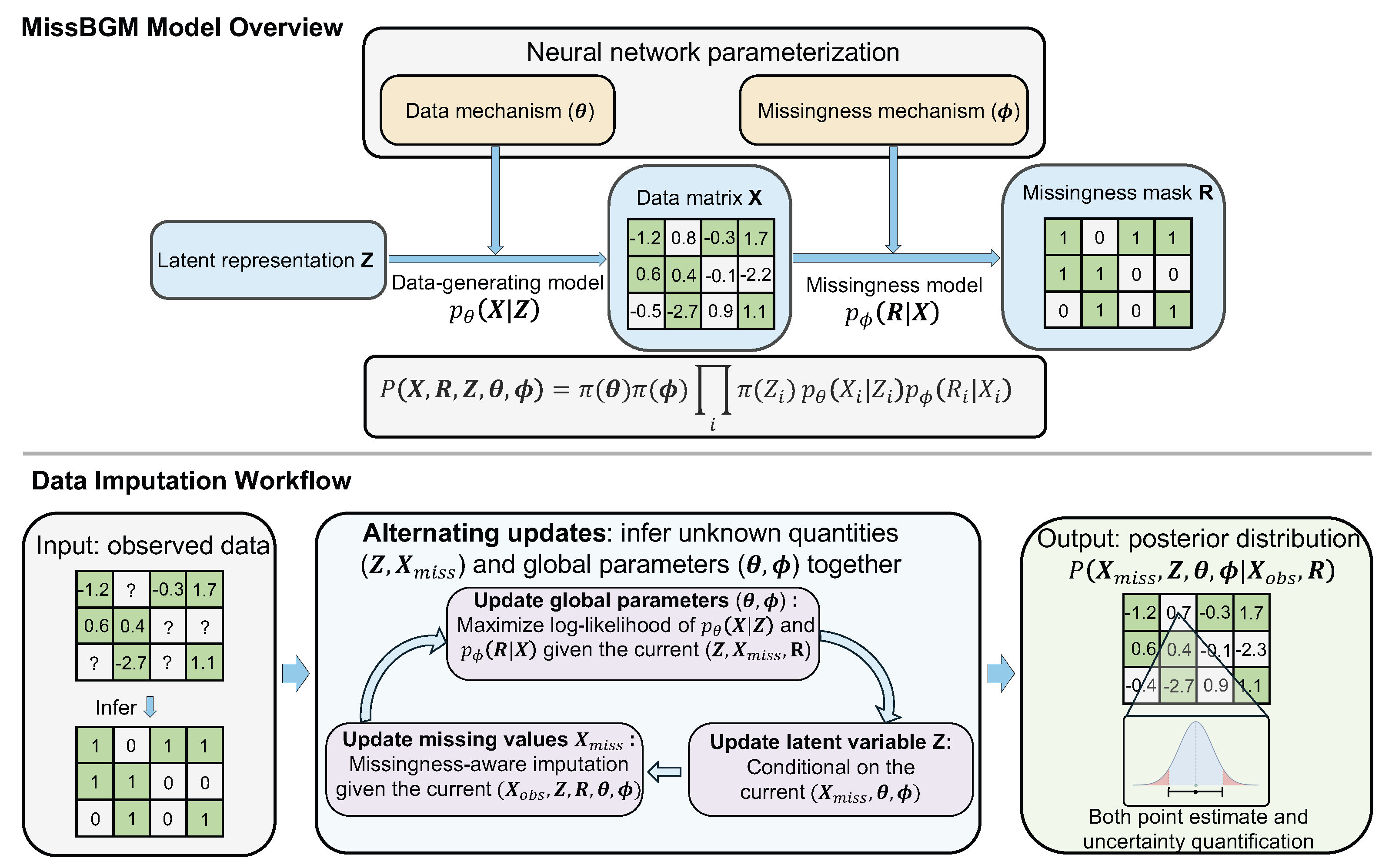
MissBGM model overview.
Installation
Create a conda environment
conda create -n missbgm python=3.12 -y
conda activate missbgm
Install from source
git clone https://github.com/liuq-lab/MissBGM.git && cd MissBGM
pip install -e .
Install from PyPI
pip install missbgm
Dependencies
This project is tested with:
- Python 3.12
- TensorFlow 2.18.0
- TensorFlow Probability 0.25.0
tf-keras==2.18.0numpy,pandas,pyyaml,scikit-learn
Quickstart (Python API)
Below is a minimal end-to-end example that mirrors the logic in main.py: simulate MNAR data, train MissBGM, read MAP imputations, and then draw posterior samples to produce uncertainty intervals.
import yaml

from missbgm.models import MissBGM
from missbgm.datasets import simulate_mnar_oracle_data

# Load experiment configuration
params = yaml.safe_load(open("configs/Sim_MNAR_oracle.yaml", "r"))

# Simulate MNAR-oracle data (synthetic benchmark)
data = simulate_mnar_oracle_data(
    n_samples=500,
    x_dim=50,
    n_anchor=5,
    missing_rate=0.5,
    alpha=0.05,
    seed=123,
)

# Instantiate the MissBGM model with the configuration
model = MissBGM(params, random_seed=42)

# Train the MissBGM model
model.fit(data=data["x_obs"], mask=data["mask"], x_true=data["x_full"], verbose=1)

# Get the MAP imputation
map_imputed = model.x_map_imputed_

# Make posterior predictions with uncertainty quantification
mcmc_imputed, intervals = model.predict(
    data=data["x_obs"],
    mask=data["mask"],
    x_true=data["x_full"],
    alpha=0.05,
    n_mcmc=1000,
    burn_in=1000,
    step_size=0.1,
    num_leapfrog_steps=5,
    seed=42,
    verbose=1,
)
Reproducing experiments with main.py
main.py is the primary experiment entrypoint. It reads a YAML config (-c) and runs:
- Synthetic simulation when
dataset: Sim_MNAR_oracle - Real-data benchmark otherwise (the code normalizes data, trains, and evaluates RMSE on missing entries)
1) Synthetic MNAR simulation
Use configs/Sim_MNAR_oracle.yaml:
python main.py -c configs/Sim_MNAR_oracle.yaml
2) Real-data benchmarks (4 datasets)
The following configs are provided:
configs/Real_Wine.yaml(UCI Wine)configs/Real_Concrete.yaml(UCI Concrete)configs/Real_Breast.yaml(UCI Breast Cancer Wisconsin Original)configs/Real_Gisette.yaml(UCI Gisette (high-dimensional))
Run each dataset:
python main.py -c configs/Real_Wine.yaml
python main.py -c configs/Real_Concrete.yaml
python main.py -c configs/Real_Breast.yaml
python main.py -c configs/Real_Gisette.yaml
If you want to re-run even when cached staged files / outputs exist, add --force:
python main.py -c configs/Real_Wine.yaml --force
What main.py does (pipeline summary)
For each run:
- Loads config from YAML (e.g.,
configs/Real_Wine.yaml) - Prepares data
- Synthetic: calls
simulate_mnar_oracle_data(...) - Real: calls
prepare_real_benchmark_data(dataset_name, missing_rate=..., seed=..., force=...)
- Synthetic: calls
- Trains
MissBGM.fit(...) - Computes MAP imputation via
model.x_map_imputed_ - Draws posterior samples via
model.predict(...)to get:mcmc_imputed: posterior mean imputation (from samples)intervals: prediction intervals (controlled byalpha)
- Reports metrics such as RMSE on missing entries
Project structure
missbgm/
  datasets/        # synthetic simulators + real dataset staging / preprocessing
  models/          # BGM base model + MissBGM
  utils/           # masking, baselines, metrics, prediction intervals
configs/           # YAML configs for experiments
main.py            # experiment entrypoint (simulation + real benchmarks)
Citation
If you use MissBGM in your research, please cite our paper (arXiv link coming soon):
@misc{missbgm2026,
  title        = {MissBGM: Missingness-Aware Bayesian Generative Modeling for MNAR Imputation},
  author       = {TBD},
  year         = {2026},
  eprint       = {TBD},
  archivePrefix= {arXiv},
  primaryClass = {stat.ML}
}
1 maintainer

Metadata
1 maintainer
Release files for missbgm 0.1.1
For a detailed explanation of source distributions (sdists) and built distributions (wheels), please see the package formats documentation.
Source distribution (sdist)
| File | Size | Uploaded | |
|---|---|---|---|
| missbgm-0.1.1.tar.gz | 24.7 kB | Details |
Release files / missbgm-0.1.1.tar.gz
| Download URL | missbgm-0.1.1.tar.gz |
|---|---|
| Size | 24.7 kB |
| Tags | Source |
|
SHA-256 checksum How to use checksums |
5157dc1224ad88b560fd34c7129d2d66b2ae158d38c446bc3668fc6cf773b857
|
|
BLAKE2b-256 checksum How to use checksums |
f9ba38c1efbd238d801c5aaad08f6999692f2048956b2cfd46aafc3fc5adb15b
|
| Upload date | |
|
Uploaded using Trusted Publishing? What is trusted publishing? |
No |
| Uploaded via |
twine/6.2.0 CPython/3.12.11
|














