
mkdocstrings-python-legacy
The legacy Python handler for mkdocstrings.


WARNING: We suggest using the new handler instead: mkdocstrings-python.
Installation
You can install this handler as a mkdocstrings extra:
# PEP 621 dependencies declaration
# adapt to your dependencies manager
[project]
dependencies = [
    "mkdocstrings[python-legacy]>=0.18",
]
You can also explicitely depend on the handler:
# PEP 621 dependencies declaration
# adapt to your dependencies manager
[project]
dependencies = [
    "mkdocstrings-python-legacy",
]
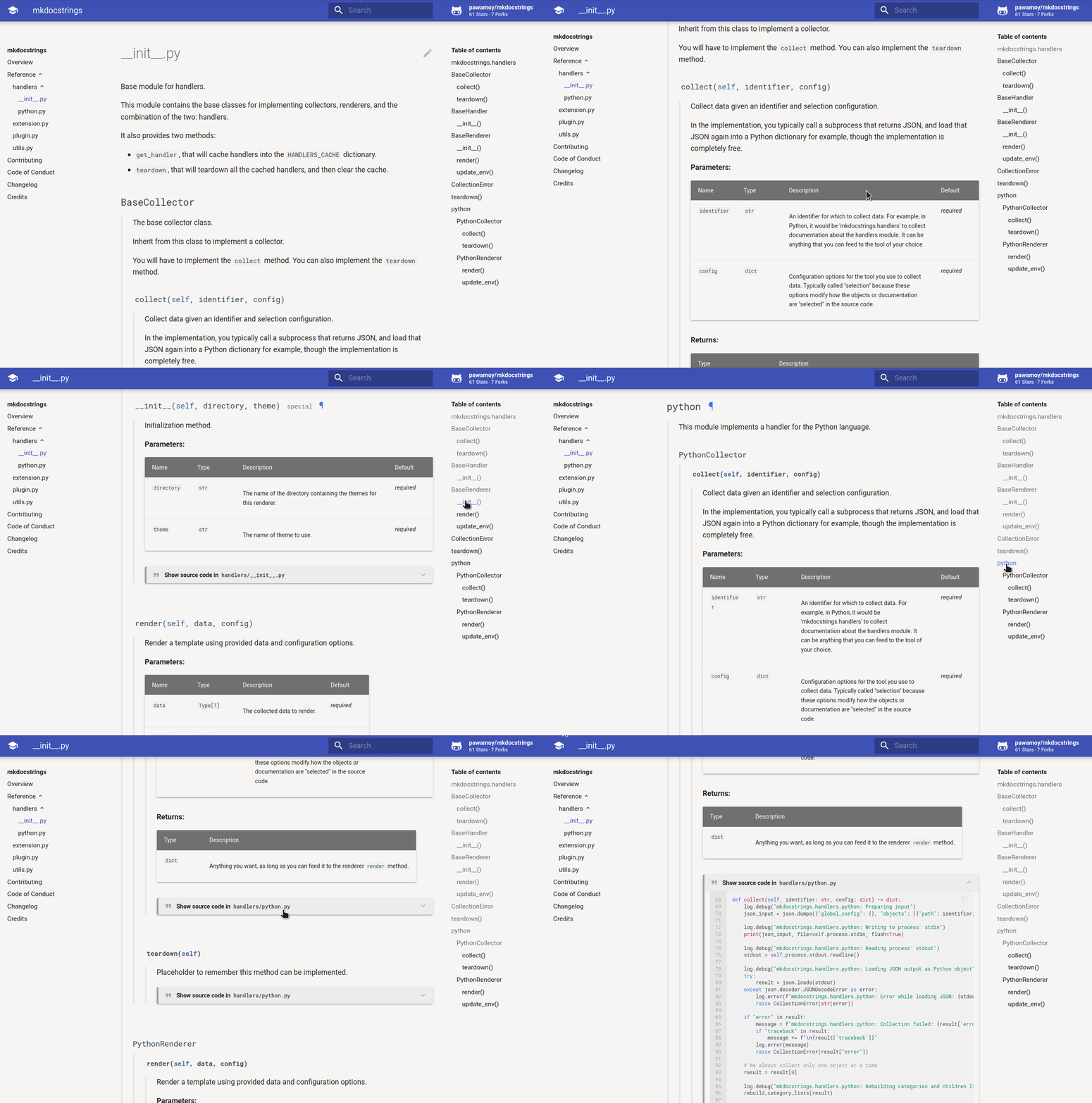
Preview
Features
-
Data collection from source code: collection of the object-tree and the docstrings is done thanks to pytkdocs.
-
Support for type annotations: pytkdocs collects your type annotations and mkdocstrings uses them to display parameters types or return types.
-
Recursive documentation of Python objects: just use the module dotted-path as identifier, and you get the full module docs. You don't need to inject documentation for each class, function, etc.
-
Support for documented attributes: attributes (variables) followed by a docstring (triple-quoted string) will be recognized by Griffe in modules, classes and even in
__init__methods. -
Multiple docstring-styles support: common support for Google-style, Numpydoc-style, and Sphinx-style docstrings.
-
Admonition support in Google docstrings: blocks like
Note:orWarning:will be transformed to their admonition equivalent. We do not support nested admonitions in docstrings! -
Every object has a TOC entry: we render a heading for each object, meaning MkDocs picks them into the Table of Contents, which is nicely display by the Material theme. Thanks to mkdocstrings cross-reference ability, you can reference other objects within your docstrings, with the classic Markdown syntax:
[this object][package.module.object]or directly with[package.module.object][] -
Source code display: mkdocstrings can add a collapsible div containing the highlighted source code of the Python object.
1 maintainer

Metadata
1 maintainer
Release files for mkdocstrings-python-legacy 0.2.7
For a detailed explanation of source distributions (sdists) and built distributions (wheels), please see the package formats documentation.
Source distribution (sdist)
| File | Size | Uploaded | Provenance | Actions |
|---|---|---|---|---|
| mkdocstrings_python_legacy-0.2.7.tar.gz | 99.6 kB | Without provenance | Details for mkdocstrings_python_legacy-0.2.7.tar.gz |
Built distribution (wheel)
| File | Interpreter | ABI | Platform | Actions Reset |
|---|---|---|---|---|
| mkdocstrings_python_legacy-0.2.7-py3-none-any.whl | Python 3 | none | any | Details for mkdocstrings_python_legacy-0.2.7-py3-none-any.whl |
Total release size: 128.9 kB
Release files / mkdocstrings_python_legacy-0.2.7.tar.gz
| Download URL | mkdocstrings_python_legacy-0.2.7.tar.gz |
|---|---|
| Size | 99.6 kB |
| Tags | Source |
|
SHA-256 checksum How to use checksums |
1aa8a277a332fb0d49be3786de3fa18af7d8792e8d611f6ba8d550dc3a1ff8a1
|
|
BLAKE2b-256 checksum How to use checksums |
394b3b1724ae9d82646c81f9dda3a7e3a0101f433e0b9e4344157b6e3a4e48b2
|
| Upload date | |
|
Uploaded using Trusted Publishing? What is trusted publishing? |
No |
| Uploaded via |
twine/6.1.0 CPython/3.13.3
|
Release files / mkdocstrings_python_legacy-0.2.7-py3-none-any.whl
| Download URL | mkdocstrings_python_legacy-0.2.7-py3-none-any.whl |
|---|---|
| Size | 29.3 kB |
| Tags | Python 3 |
|
SHA-256 checksum How to use checksums |
c24a0a5867749fd826dfa190e10afcbd4c415cbcb2f805fc4791472b4bf221e9
|
|
BLAKE2b-256 checksum How to use checksums |
e225b353bc04f24502ea0afe129b3045b73f3297e828e4baaf33c286417a9657
|
| Upload date | |
|
Uploaded using Trusted Publishing? What is trusted publishing? |
No |
| Uploaded via |
twine/6.1.0 CPython/3.13.3
|
Security for mkdocstrings-python-legacy 0.2.7
Provenance
Provenance describes where a file came from. On PyPI, provenance is shared via attestations, which provide a verifiable record of the build or publishing details. View details, limitations and caveats.
No provenance found
None of the files in this release were uploaded with provenance metadata.
A note on package security
PyPI is a repository for distributing packages, not a service for auditing them. While third-party security researchers and our staff do their best to detect and remove malicious packages, PyPI cannot guarantee the quality, security or suitability of any given package.
To learn more about protecting yourself from malicious actors, visit our package security documentation.














