
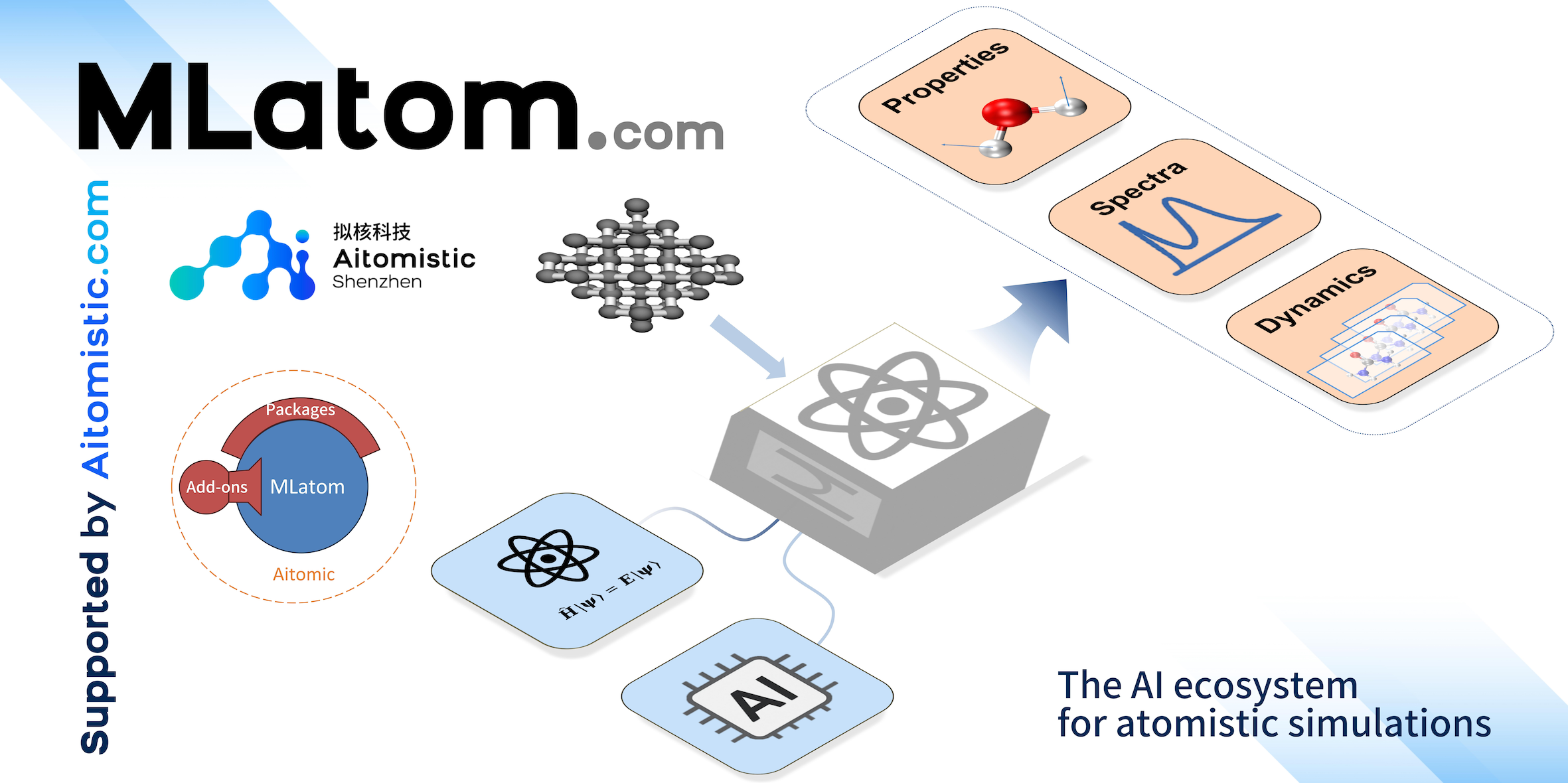





MLatom
Version 3.25.5
MLatom is an open-source package for atomistic simulations with machine learning and quantum chemical methods — DFT, wavefunction-based, and semi-empirical approximations. Use it as a Python library, through input files, or from the command line — run it locally, or online with no installation.
Website: http://mlatom.com · Documentation: http://mlatom.com/docs · GitHub: https://github.com/dralgroup/mlatom
Run online — no installation
Run MLatom in your browser on either online platform — both powered by Protomia, with an AI assistant for autonomous atomistic simulations:
- Aitomistic Hub — free registration.
- Aitomistic Lab@XMU — free for academic users (registration with an academic email).
Installation
MLatom is developed and tested on Linux — the only platform it is verified on — and requires Python 3.9 or newer. It is often usable on macOS but nothing there is tested; Windows is not supported. Install and upgrade via pip:
pip install -U mlatom
That pulls the core, including the ML backends. A few features need one extra package — install only what you use:
| for | install |
|---|---|
| PySCF methods: single point, TDDFT, frequencies and thermochemistry, densities, Raman | pip install pyscf |
| AIMNet2 models | pip install "aimnet==0.0.1" (the version MLatom's interface targets; newer aimnet releases are a rewrite that does not work with the shipped models) |
| format conversions (SMILES to xyz and back) | conda install -c conda-forge openbabel |
| the ASE interface (ASE optimizers and dynamics) and MACE | pip install ase |
KREG_API backend (ml_program='MLatomF' needs none of this) |
conda install -c conda-forge mkl mkl-service |
| MDtrajNet | pip install "e3nn==0.5.0" (with e3nn 0.5.1 or newer, the published MDtrajNet-1 model produces different trajectories) |
| MLTPA / DMC / hyperparameter search | pip install rdkit / pyvibdmc / hyperopt |
The AIQM2 quick start below additionally needs the DFT-D4 program, which is distributed via conda:
conda install -c conda-forge 'dftd4==3.6.0'   # the version MLatom is tested against
export dftd4bin=$(which dftd4)
See the installation guide for optional interfaces and other methods. Advanced Aitomistic methods such as AIQM3 are available through the Aitomic add-ons.
Quick start
Optimize the geometry of a water molecule with AIQM2 — an AI-enhanced quantum-mechanical method (native to MLatom, CHNO elements) that reaches beyond-DFT accuracy at semi-empirical cost:
import mlatom as ml

mol = ml.data.molecule.from_xyz_string('''3

O    0.00000    0.00000    0.11779
H    0.00000    0.75545   -0.47116
H    0.00000   -0.75545   -0.47116
''')
aiqm2 = ml.methods(method='AIQM2')
opt = ml.optimize_geometry(model=aiqm2, initial_molecule=mol).optimized_molecule
print(opt.energy)          # optimized energy in hartree (≈ -76.3838)
Prefer zero setup? Run it online on the Aitomistic Hub or Aitomistic Lab@XMU — no installation needed.
Features
- Methods — universal ML potentials (ANI, AIMNet2); AI-enhanced QM methods (AIQM1/AIQM2, UAIQM) approaching coupled-cluster accuracy at semi-empirical cost; and DFT, semi-empirical, and wavefunction methods via interfaces (PySCF, Gaussian, ORCA, xtb, MNDO, Turbomole, DFTB+, Sparrow, Columbus).
- Simulations — geometry optimization, transition-state search, IRC, frequencies and thermochemistry, molecular dynamics, surface-hopping nonadiabatic dynamics, IR/Raman/UV–vis spectra, and periodic boundary conditions.
- ML models — train and use KREG, GAP-SOAP, ANI, MACE, and more, with active learning, Δ-learning, transfer learning, and self-correction.
Full manuals and tutorials are at mlatom.com/docs.
Using with AI agents
MLatom can be driven by AI agents. Protomia is the main assistant and runs online with nothing to install; Aitomia is an agentic system academic users can install locally; and MLatom Skills is an open, agent-agnostic collection of skills for your own AI coding assistant (Protomia, Claude, Cursor, GitHub Copilot, ...). The MLatom repository also ships an AGENTS.md to orient your agent. See Using MLatom with AI agents for an overview.
License and citations
License
MLatom is open-source software under the Apache License 2.0.
Copyright 2013-2026 Pavlo O. Dral (http://dr-dral.com/)
Licensed under the Apache License, Version 2.0 (the "License"); you may not use this software except in compliance with the License. You may obtain a copy of the License at https://www.apache.org/licenses/LICENSE-2.0.
Unless required by applicable law or agreed to in writing, software distributed under the License is distributed on an "AS IS" BASIS, WITHOUT WARRANTIES OR CONDITIONS OF ANY KIND, either express or implied. See the License for the specific language governing permissions and limitations under the License.
Citations
If you use MLatom in scientific work, please cite it. For convenience, the citations are provided below in BibTeX format.
@article{MLatom 3,
author = {Dral, Pavlo O. and Ge, Fuchun and Hou, Yi-Fan and Zheng, Peikun and Chen, Yuxinxin and Barbatti, Mario and Isayev, Olexandr and Wang, Cheng and Xue, Bao-Xin and Pinheiro Jr, Max and Su, Yuming and Dai, Yiheng and Chen, Yangtao and Zhang, Shuang and Zhang, Lina and Ullah, Arif and Zhang, Quanhao and Ou, Yanchi},
title = {MLatom 3: A Platform for Machine Learning-Enhanced Computational Chemistry Simulations and Workflows},
journal = {J. Chem. Theory Comput.},
volume = {20},
number = {3},
pages = {1193--1213},
DOI = {10.1021/acs.jctc.3c01203},
year = {2024},
type = {Journal Article}
}

@misc{MLatomProg,
author = {Dral, Pavlo O. and Ge, Fuchun and Hou, Yi-Fan and Chen, Yuxinxin and Zheng, Peikun and Xue, Bao-Xin and Martyka, Mikolaj and Zhang, Lina and Martinka, Jakub and Zhang, Quanhao and Tong, Xin-Yu and Ullah, Arif and Pios, Sebastian V. and Kumar, Vignesh B. and Ou, Yanchi and Jr, Max Pinheiro and Su, Yuming and Dai, Yiheng and Chen, Yangtao and Zhang, Shuang and Hu, Jinming and Bispo, Matheus O.},
title = {MLatom: A Package for Atomistic Simulations with Machine Learning},
note = {version 3.25.5, Xiamen University, Xiamen, China},
year = {2013--2026},
type = {Computer Program}
}
1 maintainer

Metadata
1 maintainer
Release files for mlatom 3.25.5
For a detailed explanation of source distributions (sdists) and built distributions (wheels), please see the package formats documentation.
Source distribution (sdist)
| File | Size | Uploaded | |
|---|---|---|---|
| mlatom-3.25.5.tar.gz | 61.9 MB | Details |
Built distribution (wheel)
| File | Interpreter | ABI | Platform | Reset |
|---|---|---|---|---|
| mlatom-3.25.5-py3-none-any.whl | Python 3 | none | any | Details |
Total release size: 123.9 MB
Release files / mlatom-3.25.5.tar.gz
| Download URL | mlatom-3.25.5.tar.gz |
|---|---|
| Size | 61.9 MB |
| Tags | Source |
|
SHA-256 checksum How to use checksums |
29613b3cd458b245c3adf4ef725a132a00ce0e08f39a848321b01ec32f384152
|
|
BLAKE2b-256 checksum How to use checksums |
75045fbf10e023897828d8e915b72b01fe41ebeb67c07789e366c32b736e1846
|
| Upload date | |
|
Uploaded using Trusted Publishing? What is trusted publishing? |
No |
| Uploaded via |
twine/6.2.0 CPython/3.11.13
|
Release files / mlatom-3.25.5-py3-none-any.whl
| Download URL | mlatom-3.25.5-py3-none-any.whl |
|---|---|
| Size | 62.1 MB |
| Tags | Python 3 |
|
SHA-256 checksum How to use checksums |
5faad6801b85639ba41c6045c37454f126e6fec3907d7d8cb7932fc0bee65dbb
|
|
BLAKE2b-256 checksum How to use checksums |
139430b791f047b1b0c6cb28193404c15f1af9455000c975c61debab257d5792
|
| Upload date | |
|
Uploaded using Trusted Publishing? What is trusted publishing? |
No |
| Uploaded via |
twine/6.2.0 CPython/3.11.13
|














