Python-first Development for AI Compilers

Project description

MLC-Python
Python-first Development for AI Compilers.
MLC is a Python-first toolkit that streamlines the development of AI compilers, runtimes, and compound AI systems with its Pythonic dataclasses, structure-aware tooling, and Python-based text formats.
Beyond pure Python, MLC natively supports zero-copy interoperation with C++ plugins, and enables a smooth engineering practice transitioning from Python to hybrid or Python-free development.
:inbox_tray: Installation
pip install -U mlc-python
:key: Key Features
:building_construction: Define IRs with MLC Dataclasses
MLC provides Pythonic dataclasses:
import mlc.dataclasses as mlcd

@mlcd.py_class("demo.MyClass")
class MyClass(mlcd.PyClass):
  a: int
  b: str
  c: float | None

instance = MyClass(12, "test", c=None)
Type safety. MLC dataclass enforces strict type checking using Cython and C++.
>>> instance.c = 10; print(instance)
demo.MyClass(a=12, b='test', c=10.0)

>>> instance.c = "wrong type"
TypeError: must be real number, not str

>>> instance.non_exist = 1
AttributeError: 'MyClass' object has no attribute 'non_exist' and no __dict__ for setting new attributes
Serialization. MLC dataclasses are picklable and JSON-serializable.
>>> MyClass.from_json(instance.json())
demo.MyClass(a=12, b='test', c=None)

>>> import pickle; pickle.loads(pickle.dumps(instance))
demo.MyClass(a=12, b='test', c=None)
:snake: Design Python-based Text Formats for IRs
Printer. MLC looks up method __ir_print__ to convert IR nodes to Python AST:
[Example]. Copy the toy IR definition to REPL and then create a Func node below:
>>> a, b, c, d, e = Var("a"), Var("b"), Var("c"), Var("d"), Var("e")
>>> f = Func("f", [a, b, c],
  stmts=[
    Assign(lhs=d, rhs=Add(a, b)),  # d = a + b
    Assign(lhs=e, rhs=Add(d, c)),  # e = d + c
  ],
  ret=e)
- Method
mlc.printer.to_pythonconverts an IR node to Python-based text;
>>> print(mlcp.to_python(f))  # Stringify to Python
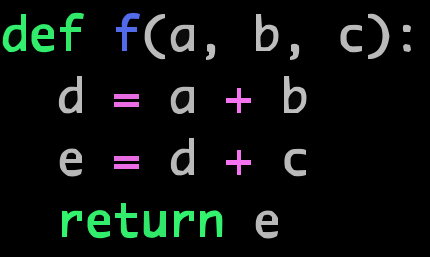
def f(a, b, c):
  d = a + b
  e = d + c
  return e
- Method
mlc.printer.print_pythonfurther renders the text with proper syntax highlighting. [Screenshot]
>>> mlcp.print_python(f) # Syntax highlighting
AST Parser. MLC has a concise set of APIs for implementing parser with Python's AST module, including:
- Inspection API that obtains source code of a Python class or function and the variables they capture;
- Variable management APIs that help with proper scoping;
- AST fragment evaluation APIs;
- Error rendering APIs.
[Example]. With MLC APIs, a parser can be implemented with 100 lines of code for the Python text format above defined by __ir_printer__.
:dart: Test IRs with MLC Structure-Aware Tooling
By annotating IR definitions with structure, MLC supports structural equality and structural hashing to detect structural equivalence between IRs:
Define a toy IR with `structure`.
import mlc.dataclasses as mlcd

@mlcd.py_class
class Expr(mlcd.PyClass):
  def __add__(self, other):
    return Add(a=self, b=other)

@mlcd.py_class(structure="nobind")
class Add(Expr):
  a: Expr
  b: Expr

@mlcd.py_class(structure="var")
class Var(Expr):
  name: str = mlcd.field(structure=None) # excludes `name` from defined structure

@mlcd.py_class(structure="bind")
class Let(Expr):
  rhs: Expr
  lhs: Var = mlcd.field(structure="bind") # `Let.lhs` is the def-site
  body: Expr
Structural equality. Member method eq_s compares the structural equality (alpha equivalence) of two IRs represented by MLC's structured dataclass.
>>> x, y, z = Var("x"), Var("y"), Var("z")
>>> L1 = Let(rhs=x + y, lhs=z, body=z)  # let z = x + y; z
>>> L2 = Let(rhs=y + z, lhs=x, body=x)  # let x = y + z; x
>>> L3 = Let(rhs=x + x, lhs=z, body=z)  # let z = x + x; z
>>> L1.eq_s(L2)
True
>>> L1.eq_s(L3, assert_mode=True)
ValueError: Structural equality check failed at {root}.rhs.b: Inconsistent binding. RHS has been bound to a different node while LHS is not bound
Structural hashing. The structure of MLC dataclasses can be hashed via hash_s, which guarantees if two dataclasses are alpha-equivalent, they will share the same structural hash:
>>> L1_hash, L2_hash, L3_hash = L1.hash_s(), L2.hash_s(), L3.hash_s()
>>> assert L1_hash == L2_hash
>>> assert L1_hash != L3_hash
:zap: Migrate Gradually to C++ with MLC Plugins
(🚧 Under construction)
MLC seamlessly supports zero-copy bidirectional interoperabilty with C++ plugins with no extra dependency. By gradually migrating classes and methods one at a time, a pure Python prototype can be transitioned to hybrid or Python-free development.
:fuelpump: Development
:gear: Editable Build
pip install --verbose --editable ".[dev]"
pre-commit install
:ferris_wheel: Create Wheels
This project uses cibuildwheel to build cross-platform wheels. See .github/workflows/wheels.ym for more details.
export CIBW_BUILD_VERBOSITY=3
export CIBW_BUILD="cp3*-manylinux_x86_64"
python -m pip install pipx
pipx run cibuildwheel==2.22.0 --output-dir wheelhouse
Release history Release notifications | RSS feed


Download files
Download the file for your platform. If you're not sure which to choose, learn more about installing packages.
Source Distributions
Built Distributions
Filter files by name, interpreter, ABI, and platform.
If you're not sure about the file name format, learn more about wheel file names.
Copy a direct link to the current filters
File details
Details for the file mlc_python-0.3.0-cp310-cp310-macosx_11_0_arm64.whl.
File metadata
- Download URL: mlc_python-0.3.0-cp310-cp310-macosx_11_0_arm64.whl
- Upload date:
- Size: 52.5 MB
- Tags: CPython 3.10, macOS 11.0+ ARM64
- Uploaded using Trusted Publishing? Yes
- Uploaded via: twine/6.1.0 CPython/3.12.9
File hashes
| Algorithm | Hash digest | |
|---|---|---|
| SHA256 |
83510cecf27ce5c1f4539614bb31a47a9d883fe3e1272d8c4d66c63047e24ca1
|
|
| MD5 |
4cbe3d9f1254a90a7ed3c2f3a9dbbb45
|
|
| BLAKE2b-256 |
1b22901ab18463c305e313dbf9f5adc86538fc508f89d28cd2378a246416353c
|
Provenance
The following attestation bundles were made for mlc_python-0.3.0-cp310-cp310-macosx_11_0_arm64.whl:
Publisher:
release.yml on mlc-ai/mlc-python
-
Statement:
-
Statement type:
https://in-toto.io/Statement/v1 -
Predicate type:
https://docs.pypi.org/attestations/publish/v1 -
Subject name:
mlc_python-0.3.0-cp310-cp310-macosx_11_0_arm64.whl -
Subject digest:
83510cecf27ce5c1f4539614bb31a47a9d883fe3e1272d8c4d66c63047e24ca1 - Sigstore transparency entry: 196317157
- Sigstore integration time:
-
Permalink:
mlc-ai/mlc-python@262f270b803c37725f12b88b28727e830500ea5c -
Branch / Tag:
refs/tags/v0.3.0 - Owner: https://github.com/mlc-ai
-
Access:
public
-
Token Issuer:
https://token.actions.githubusercontent.com -
Runner Environment:
github-hosted -
Publication workflow:
release.yml@262f270b803c37725f12b88b28727e830500ea5c -
Trigger Event:
release
-
Statement type:
File details
Details for the file mlc_python-0.3.0-cp310-cp310-macosx_10_9_x86_64.whl.
File metadata
- Download URL: mlc_python-0.3.0-cp310-cp310-macosx_10_9_x86_64.whl
- Upload date:
- Size: 49.2 MB
- Tags: CPython 3.10, macOS 10.9+ x86-64
- Uploaded using Trusted Publishing? Yes
- Uploaded via: twine/6.1.0 CPython/3.12.9
File hashes
| Algorithm | Hash digest | |
|---|---|---|
| SHA256 |
64a988a7d4ec800ed267688b4638e4bd21a017982f94dff42ec2e0f578e18609
|
|
| MD5 |
baebc0bcaf5bc6d16b7cd30dd662e473
|
|
| BLAKE2b-256 |
a8c2fe4227b98efd0c0b9dd6e3860b47bca35b30de61c66f4d632ec1f0d1d5ab
|
Provenance
The following attestation bundles were made for mlc_python-0.3.0-cp310-cp310-macosx_10_9_x86_64.whl:
Publisher:
release.yml on mlc-ai/mlc-python
-
Statement:
-
Statement type:
https://in-toto.io/Statement/v1 -
Predicate type:
https://docs.pypi.org/attestations/publish/v1 -
Subject name:
mlc_python-0.3.0-cp310-cp310-macosx_10_9_x86_64.whl -
Subject digest:
64a988a7d4ec800ed267688b4638e4bd21a017982f94dff42ec2e0f578e18609 - Sigstore transparency entry: 196317168
- Sigstore integration time:
-
Permalink:
mlc-ai/mlc-python@262f270b803c37725f12b88b28727e830500ea5c -
Branch / Tag:
refs/tags/v0.3.0 - Owner: https://github.com/mlc-ai
-
Access:
public
-
Token Issuer:
https://token.actions.githubusercontent.com -
Runner Environment:
github-hosted -
Publication workflow:
release.yml@262f270b803c37725f12b88b28727e830500ea5c -
Trigger Event:
release
-
Statement type: