
A Lightweight Logger for ML Experiments 📖






Simple logging of statistics, model checkpoints, plots and other objects for your Machine Learning Experiments (MLE). Furthermore, the MLELogger comes with smooth multi-seed result aggregation and combination of multi-configuration runs. For a quickstart check out the notebook blog 🚀
The API 🎮
from mle_logging import MLELogger

# Instantiate logging to experiment_dir
log = MLELogger(time_to_track=['num_updates', 'num_epochs'],
                what_to_track=['train_loss', 'test_loss'],
                experiment_dir="experiment_dir/",
                model_type='torch')

time_tic = {'num_updates': 10, 'num_epochs': 1}
stats_tic = {'train_loss': 0.1234, 'test_loss': 0.1235}

# Update the log with collected data & save it to .hdf5
log.update(time_tic, stats_tic)
log.save()
You can also log model checkpoints, matplotlib figures and other .pkl compatible objects.
# Save a model (torch, tensorflow, sklearn, jax, numpy)
import torchvision.models as models
model = models.resnet18()
log.save_model(model)

# Save a matplotlib figure as .png
fig, ax = plt.subplots()
log.save_plot(fig)

# You can also save (somewhat) arbitrary objects .pkl
some_dict = {"hi" : "there"}
log.save_extra(some_dict)
Or do everything in a single line...
log.update(time_tic, stats_tic, model, fig, extra, save=True)
File Structure & Re-Loading 📚
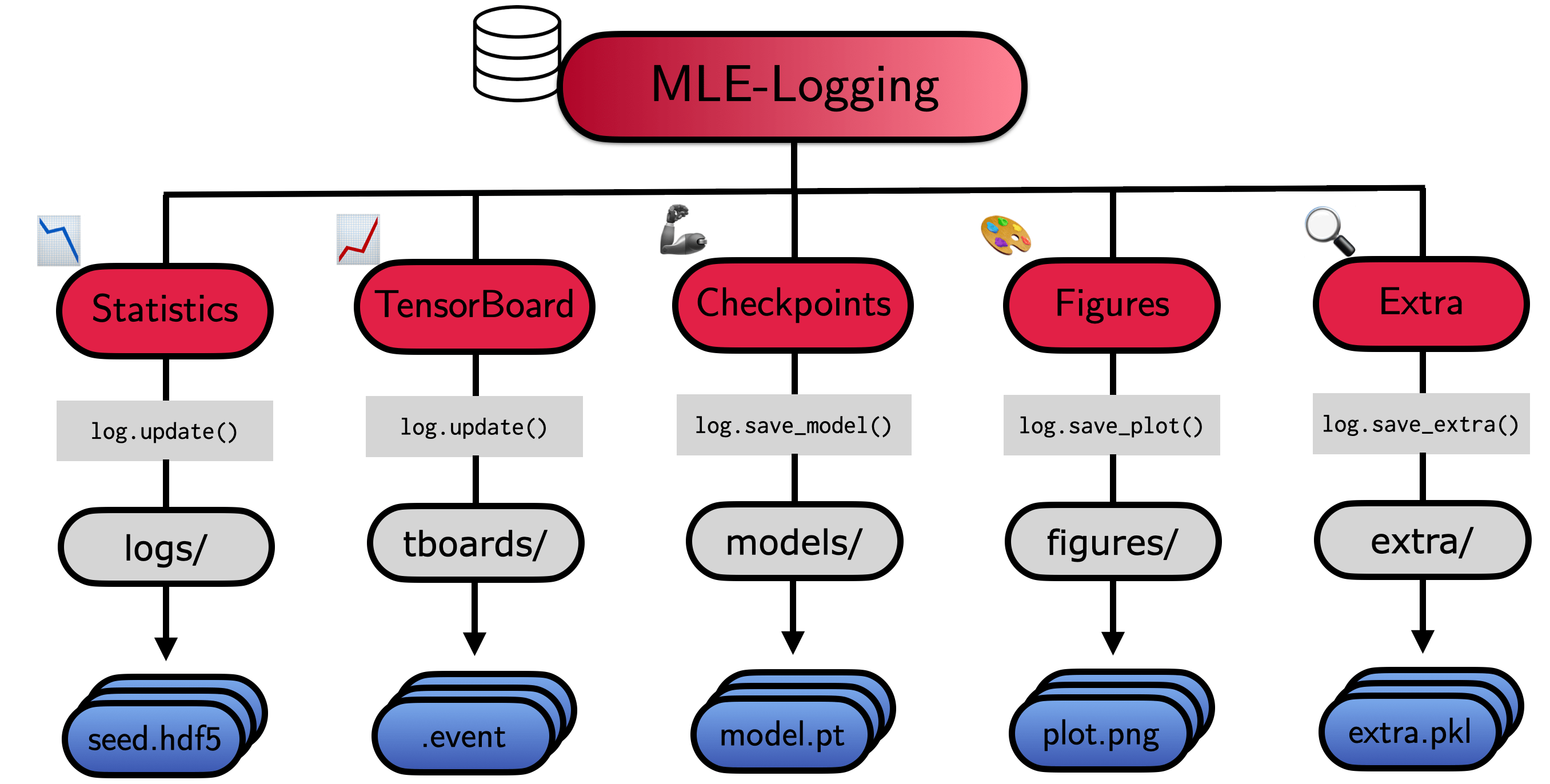
The MLELogger will create a nested directory, which looks as follows:
experiment_dir
├── extra: Stores saved .pkl object files
├── figures: Stores saved .png figures
├── logs: Stores .hdf5 log files (meta, stats, time)
├── models: Stores different model checkpoints
    ├── init: Stores initial checkpoint
    ├── final: Stores most recent checkpoint
    ├── every_k: Stores every k-th checkpoint provided in update
    ├── top_k: Stores portfolio of top-k checkpoints based on performance
├── tboards: Stores tensorboards for model checkpointing
├── <config_name>.json: Copy of configuration file (if provided)
For visualization and post-processing load the results via
from mle_logging import load_log
log_out = load_log("experiment_dir/")

# The results can be accessed via meta, stats and time keys
# >>> log_out.meta.keys()
# odict_keys(['experiment_dir', 'extra_storage_paths', 'fig_storage_paths', 'log_paths', 'model_ckpt', 'model_type'])
# >>> log_out.stats.keys()
# odict_keys(['test_loss', 'train_loss'])
# >>> log_out.time.keys()
# odict_keys(['time', 'num_epochs', 'num_updates', 'time_elapsed'])
If an experiment was aborted, you can reload and continue the previous run via the reload=True option:
log = MLELogger(time_to_track=['num_updates', 'num_epochs'],
                what_to_track=['train_loss', 'test_loss'],
                experiment_dir="experiment_dir/",
                model_type='torch',
                reload=True)
Installation ⏳
A PyPI installation is available via:
pip install mle-logging
If you want to get the most recent commit, please install directly from the repository:
pip install git+https://github.com/mle-infrastructure/mle-logging.git@main
Advanced Options 🚴
Merging Multiple Logs 👫
Merging Multiple Random Seeds 🌱 + 🌱
from mle_logging import merge_seed_logs
merge_seed_logs("multi_seed.hdf", "experiment_dir/")
log_out = load_log("experiment_dir/")
# >>> log.eval_ids
# ['seed_1', 'seed_2']
Merging Multiple Configurations 🔖 + 🔖
from mle_logging import merge_config_logs, load_meta_log
merge_config_logs(experiment_dir="experiment_dir/",
                  all_run_ids=["config_1", "config_2"])
meta_log = load_meta_log("multi_config_dir/meta_log.hdf5")
# >>> log.eval_ids
# ['config_2', 'config_1']
# >>> meta_log.config_1.stats.test_loss.keys()
# odict_keys(['mean', 'std', 'p50', 'p10', 'p25', 'p75', 'p90']))
Plotting of Logs 🧑🎨
meta_log = load_meta_log("multi_config_dir/meta_log.hdf5")
meta_log.plot("train_loss", "num_updates")
Storing Checkpoint Portfolios 📂
Logging every k-th checkpoint update ❗ ⏩ ... ⏩ ❗
# Save every second checkpoint provided in log.update (stored in models/every_k)
log = MLELogger(time_to_track=['num_updates', 'num_epochs'],
                what_to_track=['train_loss', 'test_loss'],
                experiment_dir='every_k_dir/',
                model_type='torch',
                ckpt_time_to_track='num_updates',
                save_every_k_ckpt=2)
Logging top-k checkpoints based on metric 🔱
# Save top-3 checkpoints provided in log.update (stored in models/top_k)
# Based on minimizing the test_loss metric
log = MLELogger(time_to_track=['num_updates', 'num_epochs'],
                what_to_track=['train_loss', 'test_loss'],
                experiment_dir="top_k_dir/",
                model_type='torch',
                ckpt_time_to_track='num_updates',
                save_top_k_ckpt=3,
                top_k_metric_name="test_loss",
                top_k_minimize_metric=True)
Weights&Biases Backend Integration 🧑🎨
You can also use W&B as a backend for logging. All results are stored as before but additionally we report to the W&B server:
# Provide all configuration details as option
log = MLELogger(time_to_track=['num_updates', 'num_epochs'],
                what_to_track=['train_loss', 'test_loss'],
                use_wandb=True,
                wandb_config={
                  "key": "sadfasd",  # Only needed if not logged in
                  "entity": "roberttlange",  # Only needed if not logged in
                  "project": "some-project-name",
                  "group": "some-group-name"
                })
Citing the MLE-Infrastructure ✏️
If you use mle-logging in your research, please cite it as follows:
@software{mle_infrastructure2021github,
  author = {Robert Tjarko Lange},
  title = {{MLE-Infrastructure}: A Set of Lightweight Tools for Distributed Machine Learning Experimentation},
  url = {http://github.com/mle-infrastructure},
  year = {2021},
}
Development 👷
You can run the test suite via python -m pytest -vv tests/. If you find a bug or are missing your favourite feature, feel free to create an issue and/or start contributing 🤗.
1 maintainer

Release files for mle-logging 0.0.6
For a detailed explanation of source distributions (sdists) and built distributions (wheels), please see the package formats documentation.
Source distribution (sdist)
| File | Size | Uploaded | |
|---|---|---|---|
| mle_logging-0.0.6.tar.gz | 34.6 kB | Details |
Built distribution (wheel)
| File | Interpreter | ABI | Platform | Reset |
|---|---|---|---|---|
| mle_logging-0.0.6-py3-none-any.whl | Python 3 | none | any | Details |
Total release size: 69.6 kB
Release files / mle_logging-0.0.6.tar.gz
| Download URL | mle_logging-0.0.6.tar.gz |
|---|---|
| Size | 34.6 kB |
| Tags | Source |
|
SHA-256 checksum How to use checksums |
a1d0803841c6f278e9d1b7499ddc69f8598258ab73128a06ec493de6c3683b83
|
|
BLAKE2b-256 checksum How to use checksums |
fc81dad2b934a91c01d63f8898283bc0faf0100e3241fcc66f4ae57042bcd5d3
|
| Upload date | |
|
Uploaded using Trusted Publishing? What is trusted publishing? |
No |
| Uploaded via |
twine/5.1.1 CPython/3.12.5
|
Release files / mle_logging-0.0.6-py3-none-any.whl
| Download URL | mle_logging-0.0.6-py3-none-any.whl |
|---|---|
| Size | 35.0 kB |
| Tags | Python 3 |
|
SHA-256 checksum How to use checksums |
ddbab1e93e4982c9aa10d09fce80db3d627866eb5a170ddeb4f9960187eed9f4
|
|
BLAKE2b-256 checksum How to use checksums |
daa0f7cd5184f6471ac9aaf3b59c7ef0ee60dd3540f60dd15cfc31ed7fdff773
|
| Upload date | |
|
Uploaded using Trusted Publishing? What is trusted publishing? |
No |
| Uploaded via |
twine/5.1.1 CPython/3.12.5
|














