

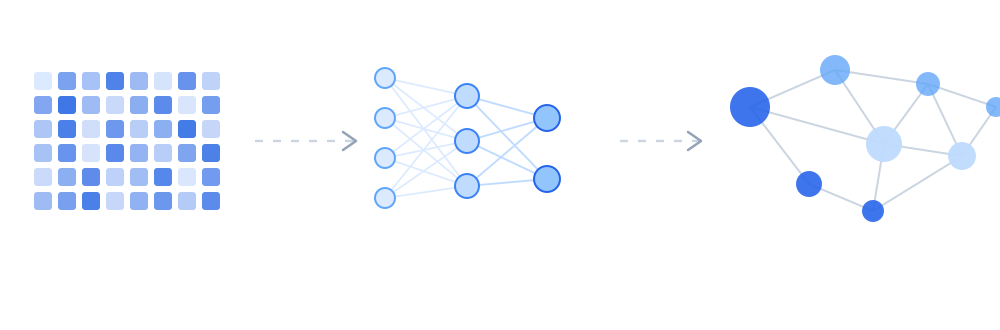
Evaluate, ensemble, explain machine learning for microbiota data analysis in single-modality and multimodality scenarios.
An integrated leakage-controlled framework for microbiome machine learning that jointly handles compositional preprocessing and taxonomic representation selection, subject/cohort-aware nested evaluation, inner-OOF ensemble and multimodal model construction, cross-fitted explanation, and uncertainty/robustness analysis.
mllabiome addresses a methodological gap between general-purpose machine-learning libraries and microbiome-specific analytical workflows. Its distinguishing feature is an evaluation architecture in which microbiome representation, preprocessing, model optimization, ensemble construction, and multimodal integration can be evaluated within the same nested, group-aware resampling hierarchy. This design allows analytical choices that are commonly fixed before cross-validation to be treated as model-selection decisions while maintaining an untouched outer evaluation set. The framework additionally propagates this separation to model interpretation and robustness analyses, providing a common provenance structure from preprocessing through prediction and explanation.
mllabiome is a Python library for microbiome machine learning, designed for rigorous phenotype prediction, model benchmarking, ensemble learning, multimodal integration, explainable AI, and cross-cohort validation.
It provides an end-to-end workflow for evaluating combinations of microbiome representations, abundance transformations, taxonomic resolutions, machine-learning models, and ensembles using nested validation procedures that keep preprocessing and model selection inside the training data.
Use mllabiome when you need to build or benchmark predictive models from microbiome abundance data without leaking information from held-out samples.
What it does
- Nested cross-validation and repeated nested cross-validation
- Subject-aware grouped splitting for repeated or longitudinal samples
- Leave-one-dataset-out (LODO) and cross-cohort evaluation
- Leakage-controlled preprocessing fitted within training partitions
- Microbiome transformations including relative abundance, presence/absence, Hellinger, arcsine-square-root, CLR, ALR, ILR, and prevalence filtering
- Evaluation across taxonomic resolutions
- Classification and regression
- scikit-learn-compatible models plus XGBoost, LightGBM, CatBoost, AutoML, and SIAMCAT integration
- Ensemble learning using inner out-of-fold predictions
- Multimodal learning with early, intermediate, and late integration
- Explainable AI using permutation importance, SHAP, ALE, LIME, and ALE interactions
- Cross-fitted explanations based on held-out predictions
- Robustness and feature-stability analyses
- Exploratory microbiome analysis, including community-level statistics and differential abundance
- Publication-oriented tables, figures, prediction files, and HTML reports
Why mllabiome?
Microbiome machine-learning workflows are unusually vulnerable to optimistic performance estimates when feature filtering, transformations, model selection, repeated samples, or dataset structure are handled outside the validation procedure.
mllabiome is designed around a simple rule:
Information from a held-out sample must not influence the pipeline used to predict that sample.
Accordingly, preprocessing and candidate selection are performed within the appropriate training partitions, repeated samples can be kept at the subject level, and ensemble members are selected from inner out-of-fold predictions before evaluation on the outer test data.
This makes mllabiome particularly suited to microbiome phenotype prediction, microbiome ML benchmarking, cross-study validation, and reproducible evaluation of predictive microbiome signatures.
Install
Python 3.10 or newer is required.
uv pip install mllabiome
or:
pip install mllabiome
To use benchmark datasets:
pip install -e ".[benchmark]"
For development from a checked-out repository:
uv venv
source .venv/bin/activate
uv pip install -e ".[dev]"
uv run pytest -q
Quick start
Analyses are defined in Python configuration files and can be run end-to-end:
mllabiome examples/ncv__ptsd_configs_sweep.py
or stage by stage:
mllabiome examples/ncv__ptsd_configs_sweep.py --stage explore
mllabiome examples/ncv__ptsd_configs_sweep.py --stage evaluate
mllabiome examples/ncv__ptsd_configs_sweep.py --stage ensemble
mllabiome examples/ncv__ptsd_configs_sweep.py --stage explain
mllabiome examples/ncv__ptsd_configs_sweep.py --stage robustness
mllabiome examples/ncv__ptsd_configs_sweep.py --stage report
For cross-study validation:
mllabiome examples/ibs_lodo_configs_sweep.py --stage evaluate
The main workflow is:
explore → evaluate → ensemble → inference → explain → robustness → report
Typical use cases
mllabiome is intended for questions such as:
- Which preprocessing and machine-learning pipeline generalizes best for a microbiome phenotype?
- How should microbiome models be compared using nested cross-validation?
- How well does a microbiome classifier generalize to unseen cohorts?
- Which taxonomic resolution or abundance transformation is most useful for prediction?
- Can multiple omics or clinical modalities improve prediction?
- Does an ensemble improve over individual microbiome models?
- Which microbial features consistently influence held-out predictions?
- How stable are model explanations across folds, cohorts, and analysis choices?
Data
mllabiome operates on already quantified feature or abundance tables together with sample metadata.
Supported workflows include wide tabular data and feature-by-sample microbiome profiles such as MetaPhlAn-style taxonomic abundance tables.
mllabiome is not a raw sequencing pipeline: read QC, assembly, taxonomic profiling, and generation of abundance tables should be performed upstream.
Models and representations
Any compatible scikit-learn estimator can be included in a model sweep. Common workflows can combine models such as logistic regression, random forests, ExtraTrees, XGBoost, LightGBM, CatBoost, neural networks, SIAMCAT, and AutoML methods.
Microbiome representations can be evaluated across taxonomic levels and abundance transformations within the same validation framework.
Multimodal analysis
mllabiome supports unimodal and multimodal prediction, including:
- early feature concatenation
- modality-specific intermediate representations
- joint intermediate representations
- late prediction integration
- weighted prediction integration
- stacked / Super Learner-style integration
Integration choices are evaluated within the same held-out evaluation framework.
Explainability
Model interpretation is available for selected individual models and ensembles using:
- permutation importance
- SHAP
- accumulated local effects (ALE)
- ALE interactions
- LIME
Where applicable, explanations are generated from models for which the explained observations were held out during model fitting.
Feature attribution should be interpreted as model-based evidence and hypothesis generation, not as proof of causal biological effects.
Outputs
A run can produce:
- out-of-fold predictions
- classification or regression metrics
- candidate rankings
- selected model and ensemble specifications
- statistical comparisons
- explainability results
- robustness analyses
- publication-ready figures
- machine-readable result tables
- an integrated HTML report
Tabular results can also be exported as TSV and figures as PNG or PDF.
Reproducibility
mllabiome records analysis configurations and separates model selection from held-out performance estimation.
For reproducible research, analyses should be run from a fixed mllabiome release together with the exact configuration, dataset version, software environment, and random seed used for the study.
Optional R-backed functionality uses version-controlled integrations for SIAMCAT and ANCOM-BC2.
Examples
Runnable configurations are available in examples/, including:
- grouped repeated nested cross-validation
- leave-one-dataset-out evaluation
- microbiome transformation and taxonomic-resolution sweeps
- ensemble selection
- explainability and robustness analysis
Scope
mllabiome focuses on rigorous evaluation of predictive microbiome models.
It complements upstream microbiome-processing tools and general-purpose machine-learning frameworks by providing microbiome-aware evaluation, representation search, cohort-aware validation, ensemble construction, explainability, and reporting in one workflow.
Citation
If you use mllabiome in published research, please cite the software release and the accompanying methods paper.
Citation information will be provided in CITATION.cff.
License
mllabiome is released under the Apache License 2.0.
Keywords
Microbiome machine learning · microbiota machine learning · metagenomics · phenotype prediction · nested cross-validation · grouped cross-validation · leave-one-dataset-out · cross-cohort validation · compositional data · ensemble learning · multimodal learning · explainable AI · SHAP · ALE · LIME · microbiome biomarker discovery · bioinformatics · classifying gut microbiome profiles to predict a health condition · taxonomic profiling data · comparing model performance across validation approaches
1 maintainer

Metadata
1 maintainer
Release files for mllabiome 0.1.0
For a detailed explanation of source distributions (sdists) and built distributions (wheels), please see the package formats documentation.
Source distribution (sdist)
| File | Size | Uploaded | |
|---|---|---|---|
| mllabiome-0.1.0.tar.gz | 466.7 kB | Details |
Built distribution (wheel)
| File | Interpreter | ABI | Platform | Reset |
|---|---|---|---|---|
| mllabiome-0.1.0-py3-none-any.whl | Python 3 | none | any | Details |
Total release size: 940.1 kB
Release files / mllabiome-0.1.0.tar.gz
| Download URL | mllabiome-0.1.0.tar.gz |
|---|---|
| Size | 466.7 kB |
| Tags | Source |
|
SHA-256 checksum How to use checksums |
41d7c0dcaaad0c2b486c4f96dce4dd90c2f681634802c3aa5dd3d4ded5cd02e1
|
|
BLAKE2b-256 checksum How to use checksums |
07720d71070c63166efa9d8af3693c748db9aec6cbcb0b8114d39273a0df1bc6
|
| Upload date | |
|
Uploaded using Trusted Publishing? What is trusted publishing? |
Yes |
| Uploaded via |
uv/0.12.21 {"installer":{"name":"uv","version":"0.12.21","subcommand":["publish"]},"python":null,"implementation":{"name":null,"version":null},"distro":{"name":"Ubuntu","version":"24.04","id":"noble","libc":null},"system":{"name":null,"release":null},"cpu":null,"openssl_version":null,"setuptools_version":null,"rustc_version":null,"ci":true}
|
Provenance
Provenance describes where a file came from. On PyPI, provenance is shared via attestations, which provide a verifiable record of the build or publishing details. View details, limitations and caveats.


PyPI Publish Attestation
PyPI verified that this artifact, at this checksum, originated from the publisher listed below.
Signed by GitHub Actions, verified by PyPI on Oct 5, 2026.
Transparency logRelease files / mllabiome-0.1.0-py3-none-any.whl
| Download URL | mllabiome-0.1.0-py3-none-any.whl |
|---|---|
| Size | 473.5 kB |
| Tags | Python 3 |
|
SHA-256 checksum How to use checksums |
2d8f29c4841dadbe90ce634b91f1f105711e45f6f12345f07583542c0e987a2a
|
|
BLAKE2b-256 checksum How to use checksums |
74eb5f3ee9dfb11eb952da4f8e4bdad1f7421fbb0a9f7f2799e663b6a5cd5ab2
|
| Upload date | |
|
Uploaded using Trusted Publishing? What is trusted publishing? |
Yes |
| Uploaded via |
uv/0.12.21 {"installer":{"name":"uv","version":"0.12.21","subcommand":["publish"]},"python":null,"implementation":{"name":null,"version":null},"distro":{"name":"Ubuntu","version":"24.04","id":"noble","libc":null},"system":{"name":null,"release":null},"cpu":null,"openssl_version":null,"setuptools_version":null,"rustc_version":null,"ci":true}
|
Provenance
Provenance describes where a file came from. On PyPI, provenance is shared via attestations, which provide a verifiable record of the build or publishing details. View details, limitations and caveats.
PyPI Publish Attestation
PyPI verified that this artifact, at this checksum, originated from the publisher listed below.
Signed by GitHub Actions, verified by PyPI on Oct 5, 2026.
Transparency log













