
mlx-quant-fidelity




You install a 4-bit model. It loads, it answers, the prose reads fine. Nothing in the logs suggests otherwise.
On Qwen2.5-7B with a 4-bit KV cache active from the first token, 99% of next-token choices come out different from the same model running a full-precision cache. Quantizing from token zero is the harshest way to measure, and it is not what you get by default: mlx-lm's own generate command leaves the cache unquantized until token 5000. Nothing about installing that model, or setting that flag, surfaces a number like 99%. A quantization failure does not announce itself, and file size tells you nothing about it.
mlx-quant-fidelity runs the same text through your model twice, once quantized and once not, and reports how far apart the two ended up: KL divergence, top-token flip rate, perplexity delta. It covers both KV-cache quantization and weight quantization.
The CUDA and GGUF world has had this for years — llama.cpp's --kl-divergence-base, EleutherAI's lm-evaluation-harness. MLX had nothing, and neither of those covers the KV-cache and attention angle.
Try it in one command
pip install mlx-quant-fidelity
mlx-quant-fidelity kv mlx-community/Llama-3.2-3B-Instruct-4bit --kv-bits 8 --max-chunks 100
# KV-fidelity: `mlx-community/Llama-3.2-3B-Instruct-4bit` @ 8-bit (group 64)

**Verdict:** good · **mode:** stress (quantize_start=0)

| metric | value |
|---|---|
| KL mean | 0.0002 nats |
| KL median | 0.0001 nats |
| KL p99 | 0.0015 nats |
| KL max | 0.1129 nats |
| flip rate | 0.0065 |
| perplexity Δ | +0.0054 (17.722 → 17.728) |

Measured on **wikitext-2-raw/test**, 51100 positions across 100 chunks of length 512 (tokenizer `mlx-community/Llama-3.2-3B-Instruct-4bit`).

...
That model at 8-bit KV clears the good tier on this corpus. Apple Silicon, Python 3.11+.
Common options
--kv-bits/--kv-group-size— the KV configuration to score, default4/64. The4:32,4:64shorthand incompare kv --configsisbits:group_size.--kv-method—stock(default) reads--kv-bits/--kv-group-sizedirectly.turboquant,turboquant-vonly, andaffinealso take a colon-delimited spec string in place of a bare name:turboquant:bits[:seed],turboquant-vonly:v_bits[:seed](K stays fp16; only V quantizes), andaffine:k_bits:v_bits[:group_size](an independent per-side K/V bit width no shipped cache runs — see docs/measurement-principles.md).compare kv --configsmixes any of these into one list, e.g.8:64,turboquant:4,affine:8:4.--kv-seedsets the TurboQuant rotation seed (default 42, must be ≥ 1) for the flag-based--kv-method turboquantand--kv-method turboquant-vonlyforms.--control— stock only. Runs a third, quantizer-only forward (dequantize on fetch, standard SDPA, the same bits and group size) alongside the deployed path, so a stock report carries both numbers.compare kvalways ranks every method on the quantizer-only number and runs this control lane for stock automatically — see docs/ranking-principles.md.--max-chunks N— score only the first N corpus chunks. Every number in this README uses--max-chunks 100; leave it off and the run covers the whole WikiText-2 test split.--chunk-length N— the scoring window, default 512, hard ceiling 4096.--quantize-start N—0for stress mode, the default; any N above 0 for deployment mode.--format json|md|badge—mdby default.jsonis the machine-readable form the reports under_artifacts/samples/are written in, andbadgeworks onweightsas well askv. The twocomparesubcommands takejsonandmdonly.
Both cost something to run. The quickstart pulls roughly 1.8 GB of weights plus the corpus on first use, and a wider window costs memory rather than time: the 4096-token run further down peaks at 13.53 GiB, so it will not fit a 16 GB machine. docs/measurement-principles.md lists the measured peak for every window length and explains the pre-flight that refuses one too large for your device.
Does this apply to you?
Precision gets lost in two places — on disk and in the running cache — and each needs its own command.
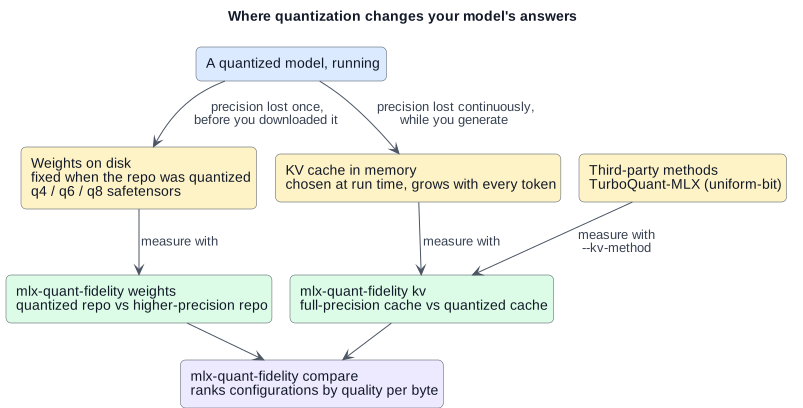
"I'm about to run a quantized model and I want to know what I gave up."
mlx-quant-fidelity kv mlx-community/Llama-3.2-3B-Instruct-4bit --kv-bits 4
mlx-quant-fidelity weights mlx-community/Llama-3.2-3B-Instruct-4bit --reference mlx-community/Llama-3.2-3B-Instruct-bf16
"I need this model to fit in my RAM and I don't know which setting to cut."
mlx-quant-fidelity compare kv <model> --sweep --max-kv-bytes-per-token 200
Builds the whole bits-by-group-size grid from the model's config.json, drops anything over your memory budget, and ranks what's left by quality per byte. Building the grid downloads that file and nothing else.
"I publish quantized models and I want to show they're good."
mlx-quant-fidelity kv <model> --kv-bits 8 --format badge
Prints one shields.io line for your model card. Green, yellow, or red, with the bit width, corpus, chunk length, and mode baked into the message, so two badges from the same model at different configurations are distinguishable at a glance.
Badge output
--format badge replaces the whole report with one line:

Green for good, yellow for marginal, red for bad. Threshold values and the color map are in docs/threshold-policy.md.
What it found
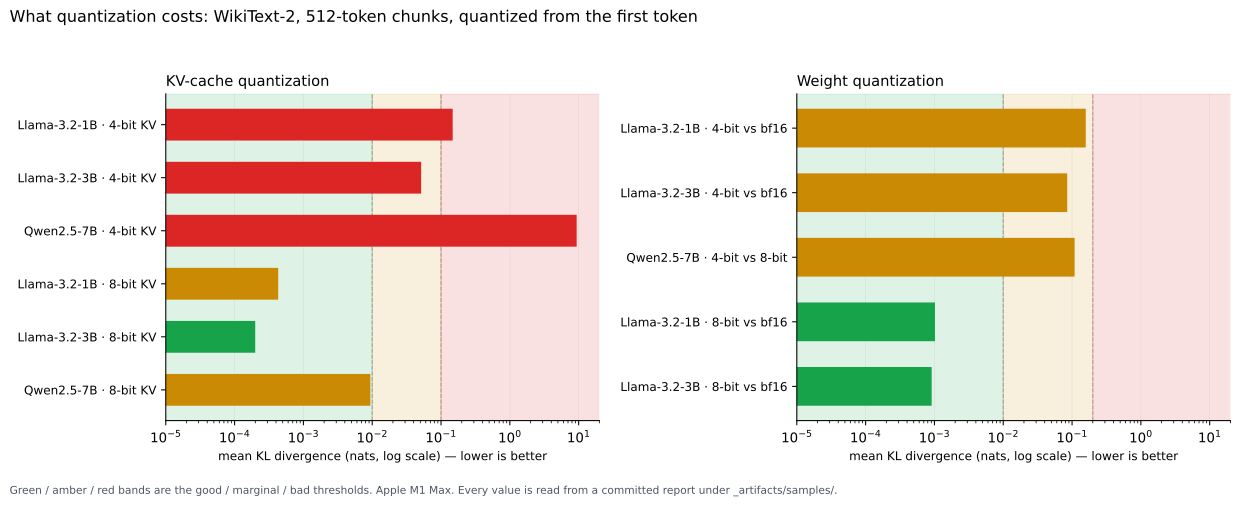
Eight-bit costs little everywhere we measured it. Four-bit is a real trade, and on one checkpoint it collapses.
Bar length is mean KL divergence and nothing else. Bar color is the overall verdict, which also weighs the p99 tail and the top-token flip rate, so two of the three 8-bit KV bars sit in the green band and are still amber, and the 4-bit Llama-3.2-3B bar is red inside the amber band. docs/threshold-policy.md lists the ceilings. The right panel gets its own section further down.
KV cache, M1 Max, WikiText-2 test (100 chunks of 512 tokens), stress mode (quantize from token 0). Reproduce any row with mlx-quant-fidelity kv <model> --kv-bits <bits> --max-chunks 100; the full committed reports are under _artifacts/samples/.
| Model | KV bits | KL mean (nats) | flip rate | verdict |
|---|---|---|---|---|
| Llama-3.2-1B | 4 | 0.148 | 0.20 | bad |
| Llama-3.2-1B | 8 | 0.0004 | 0.013 | marginal |
| Llama-3.2-3B | 4 | 0.051 | 0.11 | bad |
| Llama-3.2-3B | 8 | 0.0002 | 0.007 | good |
| Qwen2.5-7B | 4 | 9.36 | 0.99 | bad |
| Qwen2.5-7B | 8 | 0.009 | 0.032 | marginal |
8-bit KV costs little on all three models, though only Llama-3.2-3B clears the good tier outright. 4-bit is another matter, and Qwen2.5-7B at 4-bit in stress mode falls apart: nearly every token flips. This measurement establishes a checkpoint-specific failure, not its cause. mlx-lm's own generate command leaves the cache unquantized until token 5000, so those positions are computed while attention uses a full-precision cache. At the boundary, however, mlx-lm converts the entire stored prefix too. The Python API defaults differently: pass kv_bits to mlx_lm.generate and quantization starts at token 0 unless you also set quantized_kv_start. Run the tool first and you see the fidelity risk before deployment.
Does drift change with position depth?
Every stress-mode report already breaks mean and p99 KLD down by position depth within a chunk. --chunk-length 4096 widens the window so those buckets span more positions.
mlx-quant-fidelity kv mlx-community/Llama-3.2-1B-Instruct-4bit \
  --kv-bits 4 --chunk-length 4096 --max-chunks 12
Llama-3.2-1B at 4-bit KV, M1 Max, WikiText-2 test (12 chunks of 4096 tokens, the same ~50k-token corpus coverage as the 512-token samples above):
| positions | KL mean | KL p99 |
|---|---|---|
| 0-510 | 0.1485 | 0.9470 |
| 511-1022 | 0.1455 | 0.8659 |
| 1023-1534 | 0.1534 | 0.9329 |
| 1535-2046 | 0.1479 | 0.9568 |
| 2047-2558 | 0.1439 | 0.9048 |
| 2559-3070 | 0.1572 | 0.9835 |
| 3071-3582 | 0.1537 | 0.9757 |
| 3583-4094 | 0.1554 | 1.0237 |
On this model and corpus, drift at position 4000 looks about the same as drift at position 60 — quantization cost isn't building up across the window at these lengths. That's a narrower claim than it might sound: 4096 tokens is short next to the context lengths where other work has found KV-quantization drift growing with depth. docs/measurement-principles.md covers the measured memory cost of longer windows and why the comparison to longer-context findings elsewhere isn't apples to apples. The full report, including the 8-bit KV counterpart, is under _artifacts/samples/ (llama-3.2-1b-4bit-kv4-cl4096.md, llama-3.2-1b-4bit-kv8-cl4096.md).
How much does weight quantization cost?
Same corpus and recipe, but the comparison is now a quantized model repo against a higher-precision reference repo. Reproduce any row with mlx-quant-fidelity weights <quant> --reference <reference> --max-chunks 100; the committed reports are under _artifacts/samples/weights/.
| Model | quant | reference | KL mean (nats) | flip rate | perplexity Δ | verdict |
|---|---|---|---|---|---|---|
| Llama-3.2-1B | 4-bit | bf16 | 0.158 | 0.21 | +3.5 | marginal |
| Llama-3.2-1B | 8-bit | bf16 | 0.001 | 0.023 | −0.01 | good |
| Llama-3.2-3B | 4-bit | bf16 | 0.085 | 0.15 | +1.4 | marginal |
| Llama-3.2-3B | 8-bit | bf16 | 0.0009 | 0.021 | 0.00 | good |
| Qwen2.5-7B | 4-bit | 8-bit | 0.109 | 0.16 | +0.9 | marginal |
8-bit weights are near-lossless: about 2% of top tokens flip and perplexity barely moves. 4-bit is a real trade: 15 to 21% of top tokens flip and perplexity climbs by 0.9 to 3.5 points, worst on the small 1B model. The Qwen row compares 4-bit against 8-bit rather than bf16, so its drift is relative to an already-quantized reference, not full precision; the report records that the reference is 8-bit and says so in plain text. The verdict tiers are provisional, anchored to these q8 and q4 reference points on short prose rather than to downstream task accuracy.
Unlike the KV probe, both runs use standard attention, so the drift is the deployed quantized model's weight-quant cost with no quantized-attention kernel folded in. It does still include the quantized-matmul kernel's numerics, which is exactly what you run when you load the model.
Comparing quantizations
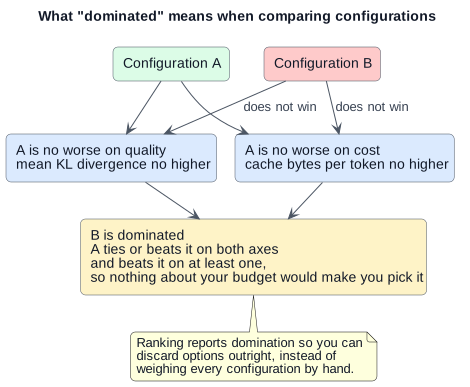
compare ranks a set of quantizations on a memory-normalized Pareto frontier: quality (mean KL divergence) on one axis, memory cost on the other. It identifies any configuration that another option on the list matches or beats on both axes and beats on at least one — those are dominated and you would never choose them.
# rank weight quantizations against a bf16 reference
mlx-quant-fidelity compare weights q4 q6 q8 --reference fp16

# rank KV configs on a single model
mlx-quant-fidelity compare kv <model> --configs 4:32,4:64,8:64

# or auto-generate the grid from the model's config.json instead of listing configs by hand
mlx-quant-fidelity compare kv <model> --sweep --max-kv-bytes-per-token 200
Add --max-kld 0.05 to get the cheapest configuration whose mean KLD stays under a threshold, or --min-tier good to get the cheapest one that passes the good-tier verdict. --sweep builds the (bits × group-size) grid from the model's config alone, no weight download needed, and drops any combination that would crash the upstream KV cache implementation; --max-kv-bytes-per-token narrows that grid to configurations under a memory budget. Either way, skipped configurations are listed in the report rather than silently dropped. docs/ranking-principles.md explains how each axis is computed, what Pareto domination means in practice, and where the ranking has limits.
Measuring a third-party cache
The KV probe is not tied to mlx-lm's cache. --kv-method turboquant measures the
TurboQuant-MLX uniform-bit cache on the same
paired, teacher-forced, full-vocabulary yardstick, and compare kv ranks it against the stock
configurations memory-normalized. Install the pinned port first — the PyPI package named
turboquant-mlx is unrelated:
pip install "turboquant-mlx @ git+https://github.com/arozanov/turboquant-mlx@6e928d715595dee9f6b6cc3968baa44e1f408d28"
mlx-quant-fidelity compare kv mlx-community/Llama-3.2-1B-Instruct-4bit --configs 8:64,4:64,turboquant:4,turboquant:3,turboquant-vonly:4,turboquant-vonly:3,affine:8:4,affine:8:2
With uv, uv sync --group turboquant installs the same pin.
# Quant comparison (kv) vs `mlx-community/Llama-3.2-1B-Instruct-4bit`

| target | cost | KL mean | KL p99 | flip | bundled KL | resident +/token | verdict | frontier |
|---|---|---|---|---|---|---|---|---|
| `turboquant:3` | 8.2 KB | 0.4229 | 2.3559 | 0.3259 | — | 65.5 KB | bad | ✓ |
| `4:64` | 9.2 KB | 0.1485 | 0.9571 | 0.2056 | 0.1477 | 0 B | bad | ✗ dominated by `turboquant:4` |
| `turboquant:4` | 9.2 KB | 0.0825 | 0.5663 | 0.1582 | — | 65.5 KB | bad | ✓ |
| `affine:8:2` | 11.3 KB | 0.2180 | 1.3105 | 0.2391 | — | 32.8 KB | bad | ✗ dominated by `turboquant:4` |
| `affine:8:4` | 13.3 KB | 0.0120 | 0.0818 | 0.0628 | — | 32.8 KB | bad | ✓ |
| `8:64` | 17.4 KB | 0.0004 | 0.0028 | 0.0121 | 0.0004 | 0 B | marginal | ✓ |
| `turboquant-vonly:3` | 36.9 KB | 0.0297 | 0.2025 | 0.0974 | — | 32.8 KB | bad | ✗ dominated by `affine:8:4` |
| `turboquant-vonly:4` | 37.4 KB | 0.0078 | 0.0520 | 0.0508 | — | 32.8 KB | bad | ✗ dominated by `8:64` |
Read this table with two things in mind. The KL mean column is quantizer-only for every row:
turboquant, turboquant-vonly, and affine dequantize on fetch and ride standard SDPA by
construction, and 4:64/8:64 ran a --control forward alongside their deployed path so stock
ranks on the same footing. Stock's own deployed-path number — mlx-lm's two-quantized-matmul
attention — is the bundled KL column instead; on this sample it barely differs from the
quantizer-only column (0.1477 vs 0.1485 for 4:64) — the two numbers land within about half a
percent of each other at this configuration and scale, not evidence that the kernel's own
contribution is small or zero in general (see
docs/measurement-principles.md).
And the cost column is stored bytes, not the memory a method's fetch path needs while it runs:
turboquant and its V-only variant keep full-precision dequantization buffers beyond what they
store, shown in resident +/token — turboquant-vonly's pinned port even stores an unused fp16
copy of V, so its stored bytes exceed a plain fp16 cache's even though V itself compresses (see
docs/ranking-principles.md). The
uniform-bit cache and its V-only variant are measured at the port's default seed; its asymmetric
and layer-adaptive configurations are not, and its make_adaptive_cache silently ignores the
documented k_bits/v_bits parameters at the pinned commit. affine:k:v measures an independent
per-side bit width that no shipped cache runs. Sample captured on Apple M1 Max, 32 GB, revision
08231374…, 100 chunks of 512 tokens, stress mode.
How it works
Teacher-forced scoring, not generation. For each fixed-length corpus chunk the model runs twice on the same tokens — once with a full-precision KV cache, once with a quantized one — and the two next-token distributions are compared position by position. Generation would let the runs diverge in their own inputs the moment quantization changed a sampled token, turning the measurement into trajectory drift instead of cache cost. Logits collapse to per-position scalars inside the chunk loop and are released before the next chunk, so a long corpus never holds full distributions in memory.
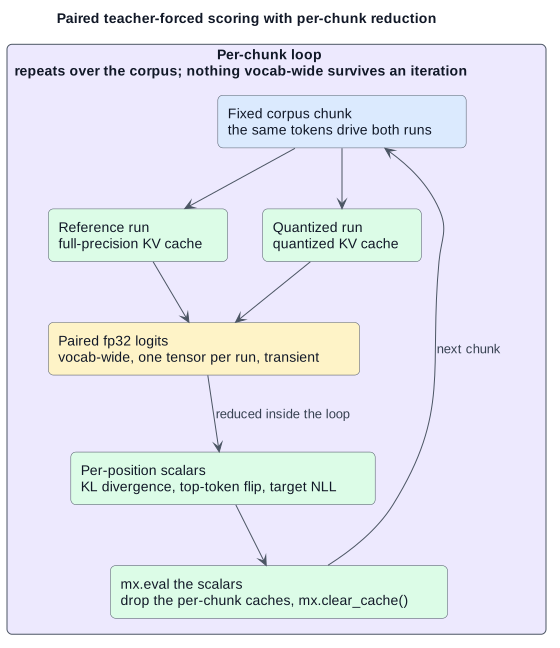
Every report records which of two modes produced it.
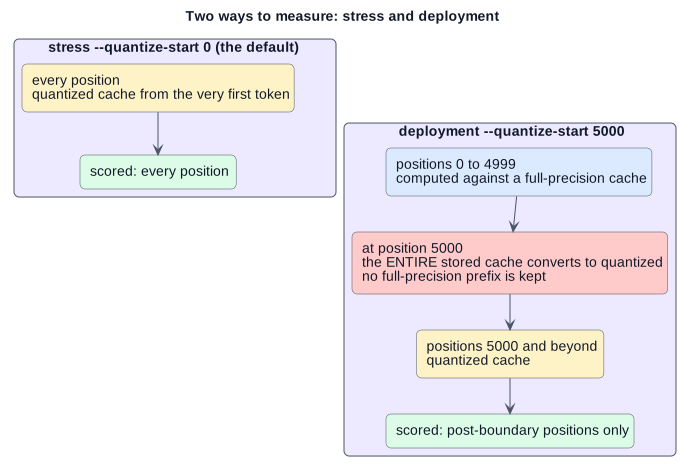
Stress mode (--quantize-start 0, the default) quantizes from token 0 — the harsh, apples-to-apples quantizer test. Deployment mode (--quantize-start N) computes the first N positions with a full-precision cache, then converts the entire stored cache and scores only the post-boundary region. That matches mlx-lm's --quantized-kv-start conversion behavior, which does not preserve a full-precision prefix in storage. docs/measurement-principles.md explains why deployment and stress drift need a matched comparison and why neither is a long-context deployment average.
A run that returns exactly zero drift raises instead of reporting a silent "perfect fidelity." That almost always means quantization never engaged, not that it was free.
The weight probe works the same way with two models instead of two caches: a quantized repo and a reference repo, scored on the same corpus tokens. A compatibility gate refuses a mismatched pair before loading, and a memory pre-flight refuses a pair too large for the device rather than risking a kernel panic.
See docs/measurement-principles.md for the zero-probability policy, the exact-zero guard, and how perplexity delta relates to mean KLD.
What a fidelity number can't tell you
- A fidelity number is corpus- and context-length-specific. WikiText-2 at temperature 0 measures short-prose distributional drift; the paper this builds on, Accuracy Is Not All You Need, shows that under-predicts task-specific and long-context degradation. Every report records the corpus and the token count so the number is never read as a bare score.
- Perplexity delta is reported for continuity with llama.cpp. It is related to but distinct from mean KLD — it scores the realized next token and can diverge from full-vocabulary drift — so it is not independent corroboration.
- The KV probe's deployed-path drift bundles the quantizer's error with the quantized-attention kernel's numerics. That is the real end-to-end cost.
kv --control(stock only) measures the quantizer alone alongside it, andcompare kvalways ranks on that quantizer-only number — see docs/measurement-principles.md.
Python API
Each command has a function behind it that returns the same report object the CLI renders.
from mlx_quant_fidelity import measure_kv_fidelity

report = measure_kv_fidelity("mlx-community/Llama-3.2-3B-Instruct-4bit", kv_bits=8)
print(report.kl.mean, report.flip_rate, report.verdict)
from mlx_quant_fidelity import measure_weight_fidelity

# measure_weight_fidelity(quantized_repo, reference_repo)
report = measure_weight_fidelity(
    "mlx-community/Llama-3.2-3B-Instruct-4bit",  # quantized
    "mlx-community/Llama-3.2-3B-Instruct-bf16",  # reference
)
print(report.kl.mean, report.flip_rate, report.verdict)
compare_kv_fidelity and compare_weight_fidelity back the two compare subcommands and return a ComparisonReport.
Further reading
- Low-bit KV caches on MLX: what exists and what is missing — surveys mlx-lm's shipped cache, the measured 8-bit and 4-bit fidelity cost, KIVI and KVQuant-style alternatives, and the remaining MLX layout and kernel gaps.
- How to measure what quantization actually costs — the methods companion: teacher-forced paired scoring, streaming full-vocabulary KL on a 32 GB machine, the guards that keep a harness from passing by doing nothing, and where the verdict thresholds honestly come from.
- More writing at ineshin.space.
Status
0.7.0, released on PyPI as mlx-quant-fidelity. compare kv now ranks every method — stock, TurboQuant-MLX, its V-only variant, and an independent-per-side-bits affine method — on the same quantizer-only footing, with stock's own deployed-path number shown alongside. Threshold validation and wider attention coverage are on the roadmap.
License
Sister projects
Other MLX libraries for Apple Silicon:
- mlx-taef — tiny autoencoders for fast diffusion-latent previews and low-memory decode (FLUX / SD).
- mlx-teacache — TeaCache residual caching to skip redundant FLUX denoising steps.
- mlx-model-doctor — validate an MLX / Hugging Face model repo before you load it (config, tokenizer, safetensors, memory).
1 maintainer

Download files
Download the file for your platform. If you're not sure which to choose, learn more about installing packages.
Source Distribution
Built Distribution
Filter files by name, interpreter, ABI, and platform.
If you're not sure about the file name format, learn more about wheel file names.
Copy a direct link to the current filters
File details
Details for the file mlx_quant_fidelity-0.7.0.tar.gz.
File metadata
- Download URL: mlx_quant_fidelity-0.7.0.tar.gz
- Upload date:
- Size: 1.1 MB
- Tags: Source
- Uploaded using Trusted Publishing? Yes
- Uploaded via:
twine/7.0.0 CPython/3.13.14
File hashes
| Algorithm | Hash digest | |
|---|---|---|
| SHA256 |
16701eca3429fd5092737974b8b234c19253d897ce303fea260caaa72dc2d074
|
|
| MD5 |
ae95977ceddf628b7569d4c102be15c2
|
|
| BLAKE2b-256 |
df90902957ffc40fd96d39b750c65e01340cf57007cd5bca85f3061f9ff100f6
|
Provenance
The following attestation bundles were made for mlx_quant_fidelity-0.7.0.tar.gz:
Publisher:
release.yml on IonDen/mlx-quant-fidelity
-
Statement:
-
Statement type:
https://in-toto.io/Statement/v1 -
Predicate type:
https://docs.pypi.org/attestations/publish/v1 -
Subject name:
mlx_quant_fidelity-0.7.0.tar.gz -
Subject digest:
16701eca3429fd5092737974b8b234c19253d897ce303fea260caaa72dc2d074 - Sigstore transparency entry: 2625000273
- Sigstore integration time:
-
Permalink:
IonDen/mlx-quant-fidelity@57b78e5846cd96980a6db86ff5f1e1d5f4ec1a84 -
Branch / Tag:
refs/tags/v0.7.0 - Owner: https://github.com/IonDen
-
Access:
public
-
Token Issuer:
https://token.actions.githubusercontent.com -
Runner Environment:
github-hosted -
Publication workflow:
release.yml@57b78e5846cd96980a6db86ff5f1e1d5f4ec1a84 -
Trigger Event:
push
-
Statement type:
File details
Details for the file mlx_quant_fidelity-0.7.0-py3-none-any.whl.
File metadata
- Download URL: mlx_quant_fidelity-0.7.0-py3-none-any.whl
- Upload date:
- Size: 80.9 kB
- Tags: Python 3
- Uploaded using Trusted Publishing? Yes
- Uploaded via:
twine/7.0.0 CPython/3.13.14
File hashes
| Algorithm | Hash digest | |
|---|---|---|
| SHA256 |
e1ec808a10379ed3653986d9089803039afc2fd5442ec4ef28087cbeed8450d8
|
|
| MD5 |
4f043d08ecf33776c88b03b5bed0322f
|
|
| BLAKE2b-256 |
51b7e33a66ecfaacccb3c0e82c92531f208e395f7dd68488f932a7f7ef7440b7
|
Provenance
The following attestation bundles were made for mlx_quant_fidelity-0.7.0-py3-none-any.whl:
Publisher:
release.yml on IonDen/mlx-quant-fidelity
-
Statement:
-
Statement type:
https://in-toto.io/Statement/v1 -
Predicate type:
https://docs.pypi.org/attestations/publish/v1 -
Subject name:
mlx_quant_fidelity-0.7.0-py3-none-any.whl -
Subject digest:
e1ec808a10379ed3653986d9089803039afc2fd5442ec4ef28087cbeed8450d8 - Sigstore transparency entry: 2625001586
- Sigstore integration time:
-
Permalink:
IonDen/mlx-quant-fidelity@57b78e5846cd96980a6db86ff5f1e1d5f4ec1a84 -
Branch / Tag:
refs/tags/v0.7.0 - Owner: https://github.com/IonDen
-
Access:
public
-
Token Issuer:
https://token.actions.githubusercontent.com -
Runner Environment:
github-hosted -
Publication workflow:
release.yml@57b78e5846cd96980a6db86ff5f1e1d5f4ec1a84 -
Trigger Event:
push
-
Statement type:














