
Fast, differentiable quantum-machine-learning in pure Apple MLX — GPU statevector simulation with native autodiff.

Project description
mlx-quantum

Fast, differentiable quantum machine learning in pure Apple MLX.
Statevector simulation runs on the Metal GPU and is differentiable end-to-end
through MLX autodiff — so a quantum layer trains like any other mlx.nn module,
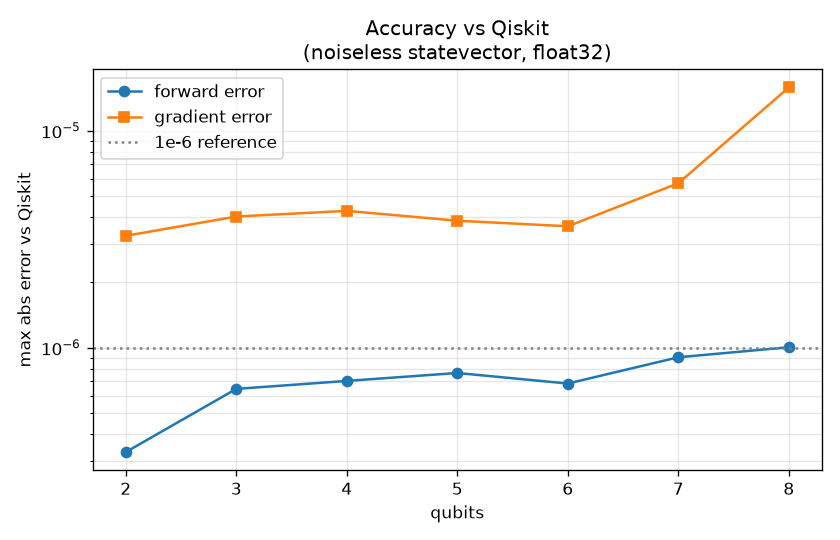
with no custom gradient code. Forward values and gradients match Qiskit to
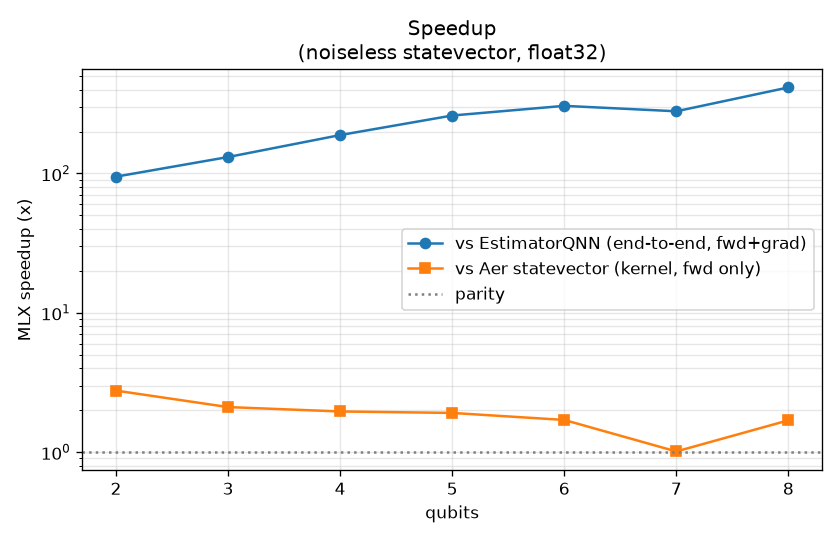
~1e-6 (float32), and it is ~100–400× faster end-to-end than driving Qiskit's
EstimatorQNN from Python. See Validation for the evidence.
Install
uv add mlx-quantum
# or
pip install mlx-quantum
Requires Python ≥ 3.13 and Apple Silicon. The library depends only on MLX and NumPy; Qiskit is optional and used solely to cross-validate/benchmark.
Quickstart
QuantumLayer is a trainable mlx.nn.Module. Drop it into a model and train:
import mlx.core as mx
import mlx.nn as nn
from mlx_quantum import QuantumLayer

class HybridMLP(nn.Module):
    def __init__(self):
        super().__init__()
        self.pre = nn.Linear(8, 4)
        self.qnn = QuantumLayer(num_qubits=4, reps=2)   # trainable quantum layer
        self.post = nn.Linear(4, 3)

    def __call__(self, x):
        x = mx.tanh(self.pre(x)) * mx.pi                # encode into rotation angles
        return self.post(self.qnn(x))
The quantum weights are ordinary MLX parameters — nn.value_and_grad and any
optimizer update them automatically:
loss_and_grad = nn.value_and_grad(model, loss_fn)
loss, grads = loss_and_grad(model, x, y)
optimizer.update(model, grads)
Building custom circuits
QuantumLayer runs a hardware-efficient ansatz, but the simulator primitives are
public — build any circuit as a plain differentiable function:
import mlx.core as mx
from mlx_quantum import zero_state, apply_1q, apply_2q, expval_all_z, H, ry, CX

def circuit(x, weights):            # x: (batch, n) angles, weights: (n,)
    n = x.shape[1]
    state = zero_state(x.shape[0], n)
    for q in range(n):
        state = apply_1q(state, H, q)
    for q in range(n):
        state = apply_1q(state, ry(x[:, q]), q)          # per-sample encoding
    for q in range(n):
        state = apply_1q(state, ry(weights[q]), q)        # trainable
    for q in range(n - 1):
        state = apply_2q(state, CX, q, q + 1)
    return expval_all_z(state)       # <Z> per qubit, shape (batch, n)

grads = mx.grad(lambda w: mx.sum(circuit(x, w)))(weights)  # just works
Gates provided: H, X, Y, Z, rx, ry, rz, CX, CZ. Add your own — a single-qubit
gate is any (2, 2) complex mx.array; a two-qubit gate is a (2, 2, 2, 2)
tensor [out0, out1, in0, in1].
How it works
A statevector is a complex mx.array of shape (batch,) + (2,) * num_qubits;
qubit ordering is little-endian to match Qiskit exactly (qubit 0 is the fastest
index, so flattening reproduces Qiskit's amplitude order). Gates are
applied as einsum contractions, so the entire simulation is differentiable and
GPU-resident. Because there is no custom vjp and no NumPy round-trip, mx.grad
differentiates the circuit directly — including through complex amplitudes.
Two MLX specifics the implementation works around: the initial state is built as a
constant (not an in-place assignment, which compiles to an unsupported complex
GPU scatter), and gates are contractions rather than take/gather (whose backward
is also a scatter).
Examples
uv run python examples/simple_mlp.py                             # hybrid MLP training
uv run --extra examples python examples/benchmark_vs_qiskit.py   # quick speed + accuracy vs Qiskit
Validation
Two tracks — is it correct, and is the speed claim fair? All measurements are
noiseless statevector, float32. Regenerate with
uv run --extra examples python benchmarks/validate.py (details in
benchmarks/).
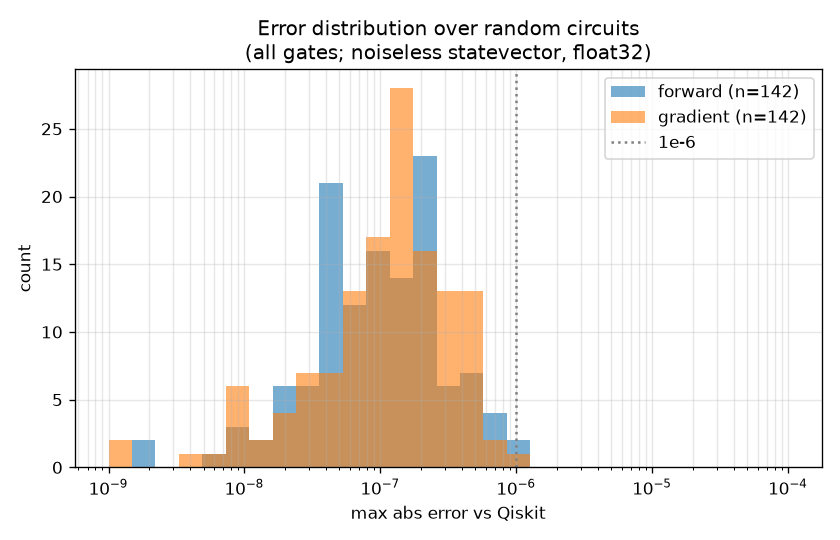
Correctness. Forward values and gradients are compared against Qiskit
(Statevector and ReverseEstimatorGradient) over 142 random circuits covering
every gate (H, X, Y, Z, rx, ry, rz, CX, CZ); per-circuit error stays at ~1e-6.
(The batch-summed gradient error on the accuracy plot climbs to ~1e-5 by 8
qubits — that is float32 accumulation from summing 128 terms into one number,
still ≥5 significant figures, not a modelling error.) Gates are checked for
unitarity, the state norm is checked after every layer, and an asymmetric circuit
pins the little-endian qubit order to Qiskit's.
 |
 |
|---|
Performance. Two honest baselines. End-to-end vs EstimatorQNN driven from
Python (~100–400×), and kernel-level vs Aer's compiled statevector estimator
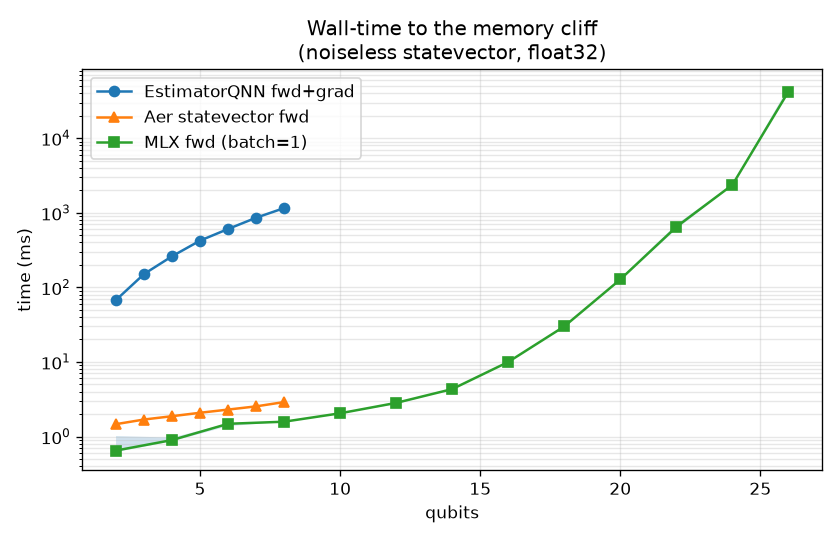
(~1.7–3×, forward only) — so the win is not just deleted orchestration. Wall-time
is shown until MLX hits the memory cliff (~22–26 qubits, single statevector).
 |
 |
|---|
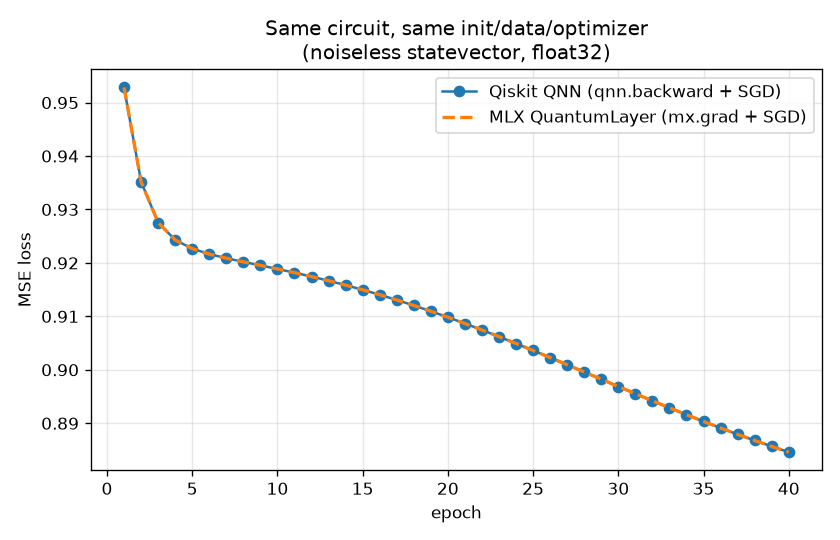
Trains identically. Same circuit, init, data, and optimizer (SGD): the MLX
layer (mx.grad) and the Qiskit QNN (qnn.backward) produce the same loss curve
to ~1e-7 — same training, just faster.
Tests
uv run pytest
Covers gate/statevector correctness, gate unitarity and norm preservation, the little-endian convention, layer training, a finite-difference gradient check, and forward + weight-gradient + input-gradient parity with Qiskit across a random gate sweep (Qiskit-dependent tests skip automatically if Qiskit is absent).
Changelog
See CHANGELOG.md.
License
MIT — see LICENSE.
Release history Release notifications | RSS feed


Download files
Download the file for your platform. If you're not sure which to choose, learn more about installing packages.
Source Distribution
Built Distribution
Filter files by name, interpreter, ABI, and platform.
If you're not sure about the file name format, learn more about wheel file names.
Copy a direct link to the current filters
File details
Details for the file mlx_quantum-0.1.1.tar.gz.
File metadata
- Download URL: mlx_quantum-0.1.1.tar.gz
- Upload date:
- Size: 222.7 kB
- Tags: Source
- Uploaded using Trusted Publishing? No
- Uploaded via: uv/0.11.21 {"installer":{"name":"uv","version":"0.11.21","subcommand":["publish"]},"python":null,"implementation":{"name":null,"version":null},"distro":{"name":"macOS","version":null,"id":null,"libc":null},"system":{"name":null,"release":null},"cpu":null,"openssl_version":null,"setuptools_version":null,"rustc_version":null,"ci":null}
File hashes
| Algorithm | Hash digest | |
|---|---|---|
| SHA256 |
3decc3c79c1d04c32943752f3aafeac3bf51efebde789180fa743e85f888ec94
|
|
| MD5 |
97e6907ee8f39df0bf2beaa76021388b
|
|
| BLAKE2b-256 |
3f40fb845c17b9c6f55681de1159a8e761a7b66a98e7e0f1f73a2eb6d91b3815
|
File details
Details for the file mlx_quantum-0.1.1-py3-none-any.whl.
File metadata
- Download URL: mlx_quantum-0.1.1-py3-none-any.whl
- Upload date:
- Size: 7.6 kB
- Tags: Python 3
- Uploaded using Trusted Publishing? No
- Uploaded via: uv/0.11.21 {"installer":{"name":"uv","version":"0.11.21","subcommand":["publish"]},"python":null,"implementation":{"name":null,"version":null},"distro":{"name":"macOS","version":null,"id":null,"libc":null},"system":{"name":null,"release":null},"cpu":null,"openssl_version":null,"setuptools_version":null,"rustc_version":null,"ci":null}
File hashes
| Algorithm | Hash digest | |
|---|---|---|
| SHA256 |
c5901db6ae5a66cdeae2235bb4a308a74401ec5183d570b2547cad9078bcd328
|
|
| MD5 |
6f2ff615aa1aa348637f5d4a47b8d371
|
|
| BLAKE2b-256 |
4320a68ea8ea701134640d107b345016a2cb1326bd2fd5257148d89c3f909d8a
|






