
mlxVS
cuVS for your Mac: GPU vector search on Apple silicon.


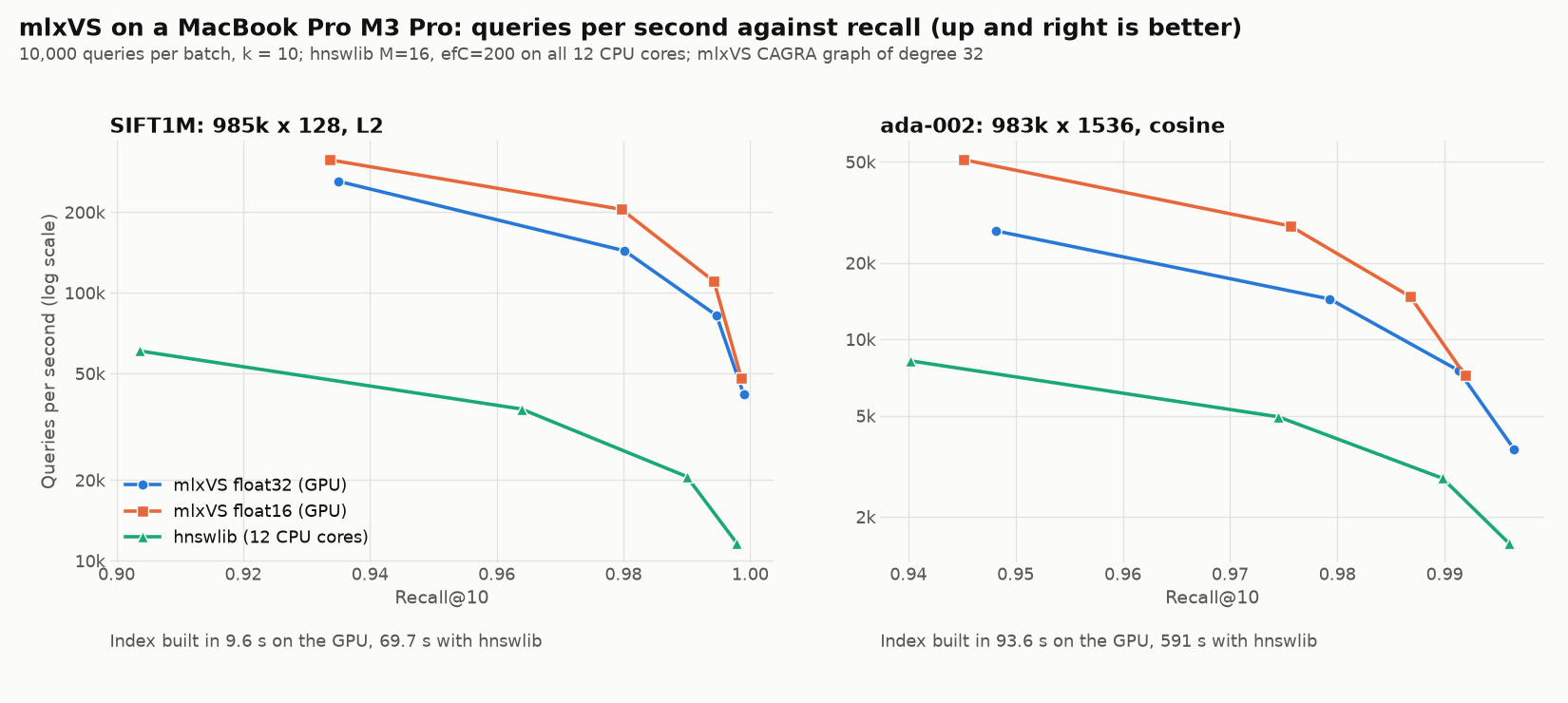
Index a million vectors in 11 seconds, then answer 76,000 queries per second at 97.6% recall, on a MacBook Pro's GPU: 2.7 times the queries per second of HNSW on all 12 CPU cores at the same recall, from an index built 8 times faster. On a million 1536-d OpenAI embeddings: built 6 times faster, twice the queries per second (numbers). mlxVS brings NVIDIA cuVS's operations and parameter names to the Mac, built on MLX: exact k-NN, k-means, NN-Descent, batched all-neighbors graphs, CAGRA graph pruning and search, and export to hnswlib. NumPy or MLX arrays in, any M-series Mac.
import mlxvs
index = mlxvs.CagraIndex.build(vectors, graph_degree=32)   # 1M x 128 in ~10 s
ids, dist = index.search(queries, k=10)                     # ~143k queries/s at 98% recall
index.save("vectors.safetensors")
Use it for approximate nearest-neighbor search, for the k-NN graph behind UMAP, t-SNE, clustering and deduplication, for exact k-NN ground truth, or as the build step of a graph index (HNSW, Vamana, CAGRA).
What's in it
| Function | What it does | cuVS counterpart |
|---|---|---|
brute_force_knn(base, queries, k) |
Exact k-NN: matrix multiply and a fused top-k kernel, tiled over the base | brute_force::search |
kmeans_fit(x, clusters), kmeans_predict(x, centroids, m) |
k-means++ and Lloyd; the m nearest centroids per row |
cluster::kmeans |
nn_descent(rows, k) |
Approximate k-NN graph of the rows, FP16 SIMD-group joins | nn_descent::build |
all_neighbors(rows, k) |
k-NN graph built in overlapping k-means clusters, one on the GPU at a time; reads a NumPy array or memory-mapped file larger than memory where it is | all_neighbors::build |
cagra_build(rows, graph_degree) |
Search graph: k-NN graph (all_neighbors) pruned by cagra_optimize |
cagra::build |
cagra_optimize(knn_graph, graph_degree) |
CAGRA's rank-based pruning (fewest two-hop detours) plus reverse edges | cagra::optimize |
vamana_build(rows, graph_degree), vamana_prune(rows, candidates, graph_degree, alpha=1.2) |
Vamana's robust pruning with JVector's diversity rule (the graph JVector builds), forward then with reverse edges; CagraIndex.build(..., graph="vamana") |
|
graph_search(base, graph, queries, k) |
Approximate k-NN of queries by beam search of a graph: one threadgroup per query for batches, several per query for a few queries (CAGRA's single- and multi-CTA search) | cagra::search |
CagraIndex.build(rows, graph_degree), .search(queries, k), .save(path), CagraIndex.load(path) |
A search index: the dataset (float32 or float16, normalized for cosine) and its CAGRA graph, stored once for search; one .safetensors file |
cagra::build, search, serialize |
CagraIndex.save_hnswlib(path) |
The index in hnswlib's format: build on the GPU, serve with hnswlib on any CPU | cagra::serialize_to_hnswlib |
CagraIndex.save_jvector(path) |
The index in JVector's on-disk format (OnDiskGraphIndex, JVector 4): build on the GPU, search from Java; see examples/jvector |
|
NearestNeighbors(n_neighbors).fit(X).kneighbors(Q) |
scikit-learn's interface over the above, NumPy in and out |
Metrics: "l2" (squared), "cosine", "inner_product". A C API for other languages. Next: see
Roadmap.
1. Install
Needs an Apple-silicon Mac on macOS 14 or later (as MLX) and Python 3.10+.
pip install mlxvs
Wheels for Python 3.10 to 3.14 on Apple silicon, built against the mlx release they pin (MLX has no stable C++
ABI). The latest code from GitHub builds the extension against your mlx wheel; that needs the Xcode Command Line
Tools (xcode-select --install) and takes about a minute:
pip install git+https://github.com/mikepapadim/mlxvs
2. Use
import numpy as np
import mlxvs

base = np.random.rand(1_000_000, 128).astype(np.float32)
queries = base[:10_000]

# exact k-NN: ids [nq, k], distances [nq, k], nearest first
ids, dist = mlxvs.brute_force_knn(base, queries, k=10, metric="l2")

# approximate k-NN graph: every row's 32 nearest other rows
graph, graph_dist = mlxvs.nn_descent(base, k=32, metric="cosine")

# the same graph in overlapping k-means clusters, as many as the GPU's memory asks for
graph, graph_dist = mlxvs.all_neighbors(base, k=32, metric="cosine")

# a search index: the k-NN graph pruned by CAGRA's rules, with the rows stored for search
# (float16: half the memory); itopk_size trades speed for recall
index = mlxvs.CagraIndex.build(base, graph_degree=32, metric="cosine", dtype="float16")
ids, sims = index.search(queries, k=10, itopk_size=64)
index.save("index.safetensors")
index = mlxvs.CagraIndex.load("index.safetensors")

# or serve it from the CPU, anywhere hnswlib runs (Linux servers too): labels are row ids
index.save_hnswlib("index.hnsw")   # then hnswlib.Index(space="cosine", dim=128).load_index("index.hnsw")

graph = np.asarray(graph)  # results are mlx arrays; np.asarray converts without a copy
- Inputs: MLX arrays, NumPy arrays, or anything
np.asarrayaccepts, in any real dtype (computed in float32). - Outputs:
int32ids,-1where fewer neighbors exist;float32distances, squared for"l2", similarities (larger is closer) for"cosine"and"inner_product". help(mlxvs.nn_descent)and the others document every parameter.- Searching many times: use
CagraIndex, or pass the same MLX array tograph_searcheach time. A NumPy array is copied to the GPU on every call, andgraph_searchwith"cosine"recomputes the row norms on every call;CagraIndexstores the rows once, normalized.
Data larger than memory: pass a numpy.memmap. The rows stay on disk; all_neighbors copies one cluster at a time
to the GPU.
rows = np.memmap("embeddings.f32", dtype=np.float32, mode="r").reshape(-1, 1024)
graph, graph_dist = mlxvs.all_neighbors(rows, k=32, metric="cosine", verbose=True)
Coming from scikit-learn, change the import:
nn = mlxvs.NearestNeighbors(n_neighbors=10, metric="euclidean").fit(base)
distances, indices = nn.kneighbors(queries)   # NumPy arrays, scikit-learn's units
distances, indices = nn.kneighbors()          # the base rows' own neighbors
Examples: UMAP from a GPU k-NN graph,
exact ground truth for an ANN benchmark (.fvecs in, .ivecs out), and
build on the GPU, search with JVector (index.save_jvector).
C++: the same functions in include/mlxvs/mlxvs.h, taking mx::array and a trailing
mx::StreamOrDevice s = {} as MLX ops do. In CMake (MLX found through CMAKE_PREFIX_PATH, e.g. Homebrew's):
add_subdirectory(mlxvs)          # or FetchContent
target_link_libraries(app PRIVATE mlxvs)
C, and anything that calls C (Java, Rust, Go, Swift): include/mlxvs/mlxvs_c.h in
libmlxvs_c.dylib (built by cmake --build build, installed by cmake --install build). An index is a handle:
build, search, save and load it, with host arrays in and out. Its .safetensors files are CagraIndex's, so an
index built in Python loads in C and the other way round.
mlxvs_index index;
mlxvs_index_build(rows, n, d, MLXVS_COSINE, NULL, &index);     /* NULL: default parameters */
mlxvs_index_search(index, queries, nq, 10, NULL, ids, distances);
mlxvs_index_save(index, "index.safetensors");
mlxvs_index_free(index);                       /* errors: nonzero status, mlxvs_last_error() */
From Java 22+ without JNI, through the Foreign Function and Memory API:
examples/java_ffm
(java --enable-native-access=ALL-UNNAMED examples/java_ffm/MlxvsExample.java build/libmlxvs_c.dylib).
3. Run the benchmarks
curl -O ftp://ftp.irisa.fr/local/texmex/corpus/sift.tar.gz && tar xzf sift.tar.gz
pip install faiss-cpu pynndescent   # optional CPU baselines
python bench/bench_graph.py sift/sift_base.fvecs --k 32 --clusters 1,8 --baselines faiss,pynndescent
It builds the k-NN graph with each method and scores 2,000 random rows against the exact neighbors.
Search: build a graph, then recall@10 against queries per second over a sweep of itopk_size, optionally against
hnswlib on the CPU.
pip install hnswlib   # optional CPU baseline
python bench/bench_search.py sift/sift_base.fvecs sift/sift_query.fvecs --degree 32 --intermediate 64 \
    --baselines hnswlib
Benchmarks
MacBook Pro M3 Pro (18-core GPU, 12-core CPU, 36 GB), on power. 10,000 queries in one batch, recall@10 scored from
the true distances of the returned ids. mlxVS: CagraIndex, graph degree 32 pruned from 64. hnswlib 0.8: M=16,
ef_construction=200, all 12 cores. Reproduce with bench/bench_search.py.
SIFT1M (985,462 x 128, L2)
| Index | Build | Setting | Recall@10 | Queries/s |
|---|---|---|---|---|
| mlxVS, float32 | 9.6 s | itopk_size 32 |
0.935 | 260,600 |
itopk_size 64 |
0.980 | 143,300 | ||
itopk_size 128 |
0.995 | 82,300 | ||
itopk_size 256 |
0.999 | 41,700 | ||
| mlxVS, float16 | 9.6 s | itopk_size 64 |
0.980 | 204,700 |
itopk_size 128 |
0.994 | 110,300 | ||
| hnswlib (CPU) | 69.7 s | ef 32 |
0.904 | 60,600 |
ef 64 |
0.964 | 36,800 | ||
ef 128 |
0.990 | 20,600 | ||
ef 256 |
0.998 | 11,600 |
ada-002 1M (982,790 x 1536 OpenAI embeddings, cosine)
| Index | Build | Setting | Recall@10 | Queries/s |
|---|---|---|---|---|
| mlxVS, float32 | 93.6 s | itopk_size 32 |
0.948 | 26,700 |
itopk_size 64 |
0.979 | 14,400 | ||
itopk_size 128 |
0.991 | 7,500 | ||
itopk_size 256 |
0.997 | 3,700 | ||
| mlxVS, float16 | 101.5 s | itopk_size 64 |
0.976 | 27,900 |
itopk_size 128 |
0.987 | 14,700 | ||
| hnswlib (CPU) | 591 s | ef 32 |
0.940 | 8,200 |
ef 64 |
0.975 | 4,900 | ||
ef 128 |
0.990 | 2,800 | ||
ef 256 |
0.996 | 1,600 |
One query at a time (SIFT1M, 1,000 queries each timed alone, bench_search.py --latency 1000). A few queries
use the multi-CTA search (several threadgroups per query, algo="auto" picks it): about 0.45 ms whatever the
recall, of which about 0.15 ms is MLX's launch and synchronization. hnswlib on one CPU core is faster at lower
recall, the GPU from about 0.996 up.
| Index | Setting | Recall@10 | Median latency | p95 |
|---|---|---|---|---|
| mlxVS (GPU), multi-CTA | itopk_size 128 |
0.987 | 0.47 ms | 0.49 ms |
itopk_size 256 |
0.996 | 0.45 ms | 0.48 ms | |
itopk_size 512 |
0.999 | 0.45 ms | 0.47 ms | |
| mlxVS (GPU), single-CTA | itopk_size 64 |
0.978 | 0.70 ms | 0.74 ms |
| hnswlib (CPU), 1 thread | ef 128 |
0.989 | 0.35 ms | 0.41 ms |
ef 256 |
0.998 | 0.62 ms | 0.75 ms | |
ef 512 |
1.000 | 1.10 ms | 1.37 ms |
So: build on the GPU (6 to 7x faster), search on the GPU for batches, and for one query at a time on the GPU at high
recall; at lower recall and low load, save_hnswlib and serve from the CPU. bench/plot_bench.py draws the chart
from bench_search.py's output.
Coming from cuVS
| mlxvs | cuVS | Note |
|---|---|---|
nn_descent(rows, k, ...) |
nn_descent::index_params::graph_degree |
cuVS default 64 |
lists of max(64, k) entries |
intermediate_graph_degree |
cuVS default 128 |
max_iterations = 24 |
max_iterations = 20 |
mlxvs samples 16 new neighbors per round and stops early when the lists settle |
termination_threshold = 1e-4 |
termination_threshold = 1e-3 |
tuned for graph quality in JVector; pass 1e-3 for cuVS's behaviour |
all_neighbors(..., n_clusters, overlap_factor) |
all_neighbors::index_params::{n_clusters, overlap_factor} |
overlap 2 as cuVS; n_clusters defaults to 0 (chosen from the GPU's memory), cuVS's to 1 |
algo="brute_force" / "nn_descent" |
all_neighbors::index_params::graph_build_params |
cuVS also offers IVF-PQ |
"cosine" returns the cosine similarity |
CosineExpanded returns 1 - cosine |
similarities are "larger is closer"; "l2" is squared, as L2Expanded |
cagra_build(rows, graph_degree=32, intermediate_graph_degree=64) |
cagra::index_params::{graph_degree, intermediate_graph_degree} |
cuVS defaults 64 and 128; NN-Descent here caps the intermediate degree at 128 |
cagra_optimize(knn_graph, graph_degree) |
cagra::optimize |
rank-based pruning and reverse edges, as cuVS; the reverse half fills from the lowest-rank edges |
graph_search(base, graph, queries, k, ...) |
cagra::search |
takes the dataset and graph directly; CagraIndex is the index object |
itopk_size = 64, search_width = 1 |
search_params::{itopk_size, search_width} |
same defaults; itopk_size at most 256 single-CTA, 1024 multi-CTA |
algo = "auto" |
search_params::algo |
same rule: single-CTA for at least two queries per GPU core (cuVS: per SM) and itopk_size <= 256, else multi-CTA; no multi-kernel mode |
team_size = 0 (automatic) |
search_params::team_size |
same choice by dimension: 8, 16 or 32 lanes per distance |
min_iterations = 0 |
search_params::min_iterations |
same |
max_iterations = 0 (automatic) |
search_params::max_iterations |
same automatic value; stops earlier once every list entry is expanded |
num_random_samplings = 1 |
search_params::num_random_samplings |
same: itopk + width * degree start slots, each the nearest of this many random nodes; no seed nodes yet |
int32 ids |
int64_t ids |
n < 2^31 rows |
Roadmap
- Vamana from search-path candidates, as DiskANN: pruned from k-NN lists only,
vamana_build's graph is a little behind CAGRA's (SIFT1M, degree 32: recall@10 0.977 against 0.982 atitopk_size64). - int8 datasets; filtered search; seed nodes.
save_hnswlibandsave_jvectorin the C API.
How the kernels work: docs/DESIGN.md. Building, testing and code style: CONTRIBUTING.md.
License
Apache-2.0. The NN-Descent kernels are a port of JVector's jvector-gpu module (Apache-2.0, DataStax, Inc.); see
NOTICE.
1 maintainer

Metadata
1 maintainer
Release files for mlxvs 0.5.0
For a detailed explanation of source distributions (sdists) and built distributions (wheels), please see the package formats documentation.
Source distribution (sdist)
| File | Size | Uploaded | Provenance | Actions |
|---|---|---|---|---|
| mlxvs-0.5.0.tar.gz | 77.6 kB | With provenance | Details for mlxvs-0.5.0.tar.gz |
Built distributions (wheels)
| File | Actions Reset | |||
|---|---|---|---|---|
| mlxvs-0.5.0-cp314-cp314-macosx_14_0_arm64.whl | CPython 3.14 | CPython 3.14 | macOS 14.0+ ARM64 | Details for mlxvs-0.5.0-cp314-cp314-macosx_14_0_arm64.whl |
| mlxvs-0.5.0-cp313-cp313-macosx_14_0_arm64.whl | CPython 3.13 | CPython 3.13 | macOS 14.0+ ARM64 | Details for mlxvs-0.5.0-cp313-cp313-macosx_14_0_arm64.whl |
| mlxvs-0.5.0-cp312-cp312-macosx_14_0_arm64.whl | CPython 3.12 | CPython 3.12 | macOS 14.0+ ARM64 | Details for mlxvs-0.5.0-cp312-cp312-macosx_14_0_arm64.whl |
| mlxvs-0.5.0-cp311-cp311-macosx_14_0_arm64.whl | CPython 3.11 | CPython 3.11 | macOS 14.0+ ARM64 | Details for mlxvs-0.5.0-cp311-cp311-macosx_14_0_arm64.whl |
| mlxvs-0.5.0-cp310-cp310-macosx_14_0_arm64.whl | CPython 3.10 | CPython 3.10 | macOS 14.0+ ARM64 | Details for mlxvs-0.5.0-cp310-cp310-macosx_14_0_arm64.whl |
Total release size: 960.8 kB
Release files / mlxvs-0.5.0.tar.gz
| Download URL | mlxvs-0.5.0.tar.gz |
|---|---|
| Size | 77.6 kB |
| Tags | Source |
|
SHA-256 checksum How to use checksums |
916e5a101ecb63033eaeef399c2ac3d4a844ec052a5a67c2821b39fae6e4b65b
|
|
BLAKE2b-256 checksum How to use checksums |
317b1ae16ab6062e6a23ff83129cb2ff842c91017547ead81018f00dd92b9829
|
| Upload date | |
|
Uploaded using Trusted Publishing? What is trusted publishing? |
Yes |
| Uploaded via |
twine/7.0.0 CPython/3.13.16
|
Provenance
Provenance describes where a file came from. On PyPI, provenance is shared via attestations, which provide a verifiable record of the build or publishing details. View details, limitations and caveats.


PyPI Publish Attestation
PyPI verified that this artifact, at this checksum, originated from the publisher listed below.
Signed by GitHub Actions, verified by PyPI on Nov 12, 2026.
Transparency logRelease files / mlxvs-0.5.0-cp314-cp314-macosx_14_0_arm64.whl
| Download URL | mlxvs-0.5.0-cp314-cp314-macosx_14_0_arm64.whl |
|---|---|
| Size | 176.4 kB |
| Tags | CPython 3.14 macOS 14.0+ ARM64 |
|
SHA-256 checksum How to use checksums |
ba27a9ffbfc9d31948d0569b0b97ed67ea9c6f4d1d1447c2d4c964c37d6b869a
|
|
BLAKE2b-256 checksum How to use checksums |
cf819348f192af006cb1c7cec90113d251cf32568d3db624af93687e5857d25d
|
| Upload date | |
|
Uploaded using Trusted Publishing? What is trusted publishing? |
Yes |
| Uploaded via |
twine/7.0.0 CPython/3.13.16
|
Provenance
Provenance describes where a file came from. On PyPI, provenance is shared via attestations, which provide a verifiable record of the build or publishing details. View details, limitations and caveats.
PyPI Publish Attestation
PyPI verified that this artifact, at this checksum, originated from the publisher listed below.
Signed by GitHub Actions, verified by PyPI on Nov 12, 2026.
Transparency logRelease files / mlxvs-0.5.0-cp313-cp313-macosx_14_0_arm64.whl
| Download URL | mlxvs-0.5.0-cp313-cp313-macosx_14_0_arm64.whl |
|---|---|
| Size | 176.3 kB |
| Tags | CPython 3.13 macOS 14.0+ ARM64 |
|
SHA-256 checksum How to use checksums |
286f0de90dd07aaa2117a209634a48e2f71435b499b449311c6f8a5d78f85e55
|
|
BLAKE2b-256 checksum How to use checksums |
aa051ca45c208efdf8d1963c4cb00bae44bb90638f768b957d725330e9d79fe1
|
| Upload date | |
|
Uploaded using Trusted Publishing? What is trusted publishing? |
Yes |
| Uploaded via |
twine/7.0.0 CPython/3.13.16
|
Provenance
Provenance describes where a file came from. On PyPI, provenance is shared via attestations, which provide a verifiable record of the build or publishing details. View details, limitations and caveats.
PyPI Publish Attestation
PyPI verified that this artifact, at this checksum, originated from the publisher listed below.
Signed by GitHub Actions, verified by PyPI on Nov 12, 2026.
Transparency logRelease files / mlxvs-0.5.0-cp312-cp312-macosx_14_0_arm64.whl
| Download URL | mlxvs-0.5.0-cp312-cp312-macosx_14_0_arm64.whl |
|---|---|
| Size | 176.3 kB |
| Tags | CPython 3.12 macOS 14.0+ ARM64 |
|
SHA-256 checksum How to use checksums |
c1f8af042ead5154fb643cb4d4dd82fa3bdef89e57244835016935d3cef08e26
|
|
BLAKE2b-256 checksum How to use checksums |
6f6f52b85fcdd71765353e990c73888ef3579e0b607a9fa852fd1fbac7653cd9
|
| Upload date | |
|
Uploaded using Trusted Publishing? What is trusted publishing? |
Yes |
| Uploaded via |
twine/7.0.0 CPython/3.13.16
|
Provenance
Provenance describes where a file came from. On PyPI, provenance is shared via attestations, which provide a verifiable record of the build or publishing details. View details, limitations and caveats.
PyPI Publish Attestation
PyPI verified that this artifact, at this checksum, originated from the publisher listed below.
Signed by GitHub Actions, verified by PyPI on Nov 12, 2026.
Transparency logRelease files / mlxvs-0.5.0-cp311-cp311-macosx_14_0_arm64.whl
| Download URL | mlxvs-0.5.0-cp311-cp311-macosx_14_0_arm64.whl |
|---|---|
| Size | 177.4 kB |
| Tags | CPython 3.11 macOS 14.0+ ARM64 |
|
SHA-256 checksum How to use checksums |
119e3c8d8ccceb6394f5bd0577b266fe5880ac3a210ad42541eaa6e0b4a8ef3a
|
|
BLAKE2b-256 checksum How to use checksums |
f3b87c6c338732547e39c4e5b2510355472f7212b97bdb25d983b0639eb9cf31
|
| Upload date | |
|
Uploaded using Trusted Publishing? What is trusted publishing? |
Yes |
| Uploaded via |
twine/7.0.0 CPython/3.13.16
|
Provenance
Provenance describes where a file came from. On PyPI, provenance is shared via attestations, which provide a verifiable record of the build or publishing details. View details, limitations and caveats.
PyPI Publish Attestation
PyPI verified that this artifact, at this checksum, originated from the publisher listed below.
Signed by GitHub Actions, verified by PyPI on Nov 12, 2026.
Transparency logRelease files / mlxvs-0.5.0-cp310-cp310-macosx_14_0_arm64.whl
| Download URL | mlxvs-0.5.0-cp310-cp310-macosx_14_0_arm64.whl |
|---|---|
| Size | 176.8 kB |
| Tags | CPython 3.10 macOS 14.0+ ARM64 |
|
SHA-256 checksum How to use checksums |
ac7a40370b6b69aa1bfd234884247ecc92cf43857d077ac1c79eebb775fa6a23
|
|
BLAKE2b-256 checksum How to use checksums |
ff535cf507e88a7700e92a9c49cff5204dfc8b9aa0a484d82c77bbe516d20a44
|
| Upload date | |
|
Uploaded using Trusted Publishing? What is trusted publishing? |
Yes |
| Uploaded via |
twine/7.0.0 CPython/3.13.16
|
Provenance
Provenance describes where a file came from. On PyPI, provenance is shared via attestations, which provide a verifiable record of the build or publishing details. View details, limitations and caveats.
PyPI Publish Attestation
PyPI verified that this artifact, at this checksum, originated from the publisher listed below.
Signed by GitHub Actions, verified by PyPI on Nov 12, 2026.
Transparency logSecurity for mlxvs 0.5.0
Provenance
Provenance describes where a file came from. On PyPI, provenance is shared via attestations, which provide a verifiable record of the build or publishing details. View details, limitations and caveats.
Full provenance
All 6 files in this release have been uploaded with provenance metadata.
Attestation for mlxvs-0.5.0.tar.gz
PyPI Publish Attestation
PyPI verified that this artifact, at this checksum, originated from the publisher listed below.
Signed by GitHub Actions, verified by PyPI on Nov 12, 2026.
Transparency logA note on package security
PyPI is a repository for distributing packages, not a service for auditing them. While third-party security researchers and our staff do their best to detect and remove malicious packages, PyPI cannot guarantee the quality, security or suitability of any given package.
To learn more about protecting yourself from malicious actors, visit our package security documentation.














