
Engine of OpenMMLab projects

Project description






English | 简体中文







What's New
v0.9.0 was released on 2023-10-10.
Highlights:
-
Support training with ColossalAI. Refer to the Training Large Models for more detailed usages.
-
Support gradient checkpointing. Refer to the Save Memory on GPU for more details.
-
Supports multiple visualization backends, including
NeptuneVisBackend,DVCLiveVisBackendandAimVisBackend. Refer to Visualization Backends for more details.
Read Changelog for more details.
Table of Contents
- Introduction
- Installation
- Get Started
- Learn More
- Contributing
- Citation
- License
- Ecosystem
- Projects in OpenMMLab
Introduction
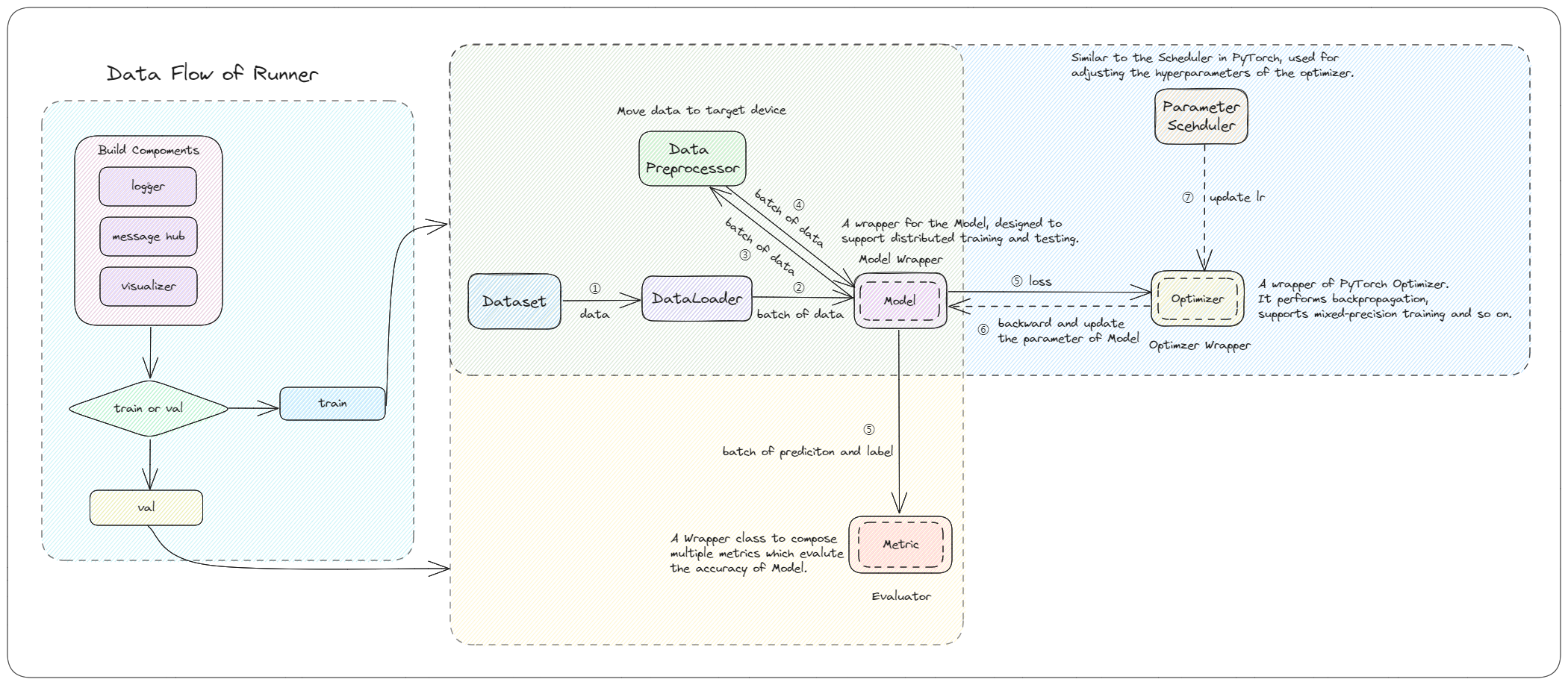
MMEngine is a foundational library for training deep learning models based on PyTorch. It provides a solid engineering foundation and frees developers from writing redundant codes on workflows. It serves as the training engine of all OpenMMLab codebases, which support hundreds of algorithms in various research areas. Moreover, MMEngine is also generic to be applied to non-OpenMMLab projects.
Major features:
-
A universal and powerful runner:
- Supports training different tasks with a small amount of code, e.g., ImageNet can be trained with only 80 lines of code (400 lines of the original PyTorch example).
- Easily compatible with models from popular algorithm libraries such as TIMM, TorchVision, and Detectron2.
-
Open architecture with unified interfaces:
- Handles different algorithm tasks with unified APIs, e.g., implement a method and apply it to all compatible models.
- Provides a unified abstraction for upper-level algorithm libraries, which supports various back-end devices such as Nvidia CUDA, Mac MPS, AMD, MLU, and more for model training.
-
Customizable training process:
- Defines the training process just like playing with Legos.
- Provides rich components and strategies.
- Complete controls on the training process with different levels of APIs.
Installation
Before installing MMEngine, please ensure that PyTorch has been successfully installed following the official guide.
Install MMEngine
pip install -U openmim
mim install mmengine
Verify the installation
python -c 'from mmengine.utils.dl_utils import collect_env;print(collect_env())'
Get Started
Taking the training of a ResNet-50 model on the CIFAR-10 dataset as an example, we will use MMEngine to build a complete, configurable training and validation process in less than 80 lines of code.
Build Models
First, we need to define a model which 1) inherits from BaseModel and 2) accepts an additional argument mode in the forward method, in addition to those arguments related to the dataset.
- During training, the value of
modeis "loss", and theforwardmethod should return adictcontaining the key "loss". - During validation, the value of
modeis "predict", and the forward method should return results containing both predictions and labels.
import torch.nn.functional as F
import torchvision
from mmengine.model import BaseModel

class MMResNet50(BaseModel):
    def __init__(self):
        super().__init__()
        self.resnet = torchvision.models.resnet50()

    def forward(self, imgs, labels, mode):
        x = self.resnet(imgs)
        if mode == 'loss':
            return {'loss': F.cross_entropy(x, labels)}
        elif mode == 'predict':
            return x, labels
Build Datasets
Next, we need to create Datasets and DataLoaders for training and validation. In this case, we simply use built-in datasets supported in TorchVision.
import torchvision.transforms as transforms
from torch.utils.data import DataLoader

norm_cfg = dict(mean=[0.491, 0.482, 0.447], std=[0.202, 0.199, 0.201])
train_dataloader = DataLoader(batch_size=32,
                              shuffle=True,
                              dataset=torchvision.datasets.CIFAR10(
                                  'data/cifar10',
                                  train=True,
                                  download=True,
                                  transform=transforms.Compose([
                                      transforms.RandomCrop(32, padding=4),
                                      transforms.RandomHorizontalFlip(),
                                      transforms.ToTensor(),
                                      transforms.Normalize(**norm_cfg)
                                  ])))
val_dataloader = DataLoader(batch_size=32,
                            shuffle=False,
                            dataset=torchvision.datasets.CIFAR10(
                                'data/cifar10',
                                train=False,
                                download=True,
                                transform=transforms.Compose([
                                    transforms.ToTensor(),
                                    transforms.Normalize(**norm_cfg)
                                ])))
Build Metrics
To validate and test the model, we need to define a Metric called accuracy to evaluate the model. This metric needs to inherit from BaseMetric and implements the process and compute_metrics methods.
from mmengine.evaluator import BaseMetric

class Accuracy(BaseMetric):
    def process(self, data_batch, data_samples):
        score, gt = data_samples
        # Save the results of a batch to `self.results`
        self.results.append({
            'batch_size': len(gt),
            'correct': (score.argmax(dim=1) == gt).sum().cpu(),
        })
    def compute_metrics(self, results):
        total_correct = sum(item['correct'] for item in results)
        total_size = sum(item['batch_size'] for item in results)
        # Returns a dictionary with the results of the evaluated metrics,
        # where the key is the name of the metric
        return dict(accuracy=100 * total_correct / total_size)
Build a Runner
Finally, we can construct a Runner with previously defined Model, DataLoader, and Metrics, with some other configs, as shown below.
from torch.optim import SGD
from mmengine.runner import Runner

runner = Runner(
    model=MMResNet50(),
    work_dir='./work_dir',
    train_dataloader=train_dataloader,
    # a wrapper to execute back propagation and gradient update, etc.
    optim_wrapper=dict(optimizer=dict(type=SGD, lr=0.001, momentum=0.9)),
    # set some training configs like epochs
    train_cfg=dict(by_epoch=True, max_epochs=5, val_interval=1),
    val_dataloader=val_dataloader,
    val_cfg=dict(),
    val_evaluator=dict(type=Accuracy),
)
Launch Training
runner.train()
Learn More
Advanced tutorials
Examples
Common Usage
Design
Migration guide
Contributing
We appreciate all contributions to improve MMEngine. Please refer to CONTRIBUTING.md for the contributing guideline.
Citation
If you find this project useful in your research, please consider cite:
@article{mmengine2022,
  title   = {{MMEngine}: OpenMMLab Foundational Library for Training Deep Learning Models},
  author  = {MMEngine Contributors},
  howpublished = {\url{https://github.com/open-mmlab/mmengine}},
  year={2022}
}
License
This project is released under the Apache 2.0 license.
Ecosystem
- APES: Attention-based Point Cloud Edge Sampling
- DiffEngine: diffusers training toolbox with mmengine
Projects in OpenMMLab
- MIM: MIM installs OpenMMLab packages.
- MMCV: OpenMMLab foundational library for computer vision.
- MMEval: A unified evaluation library for multiple machine learning libraries.
- MMPreTrain: OpenMMLab pre-training toolbox and benchmark.
- MMagic: OpenMMLab Advanced, Generative and Intelligent Creation toolbox.
- MMDetection: OpenMMLab detection toolbox and benchmark.
- MMYOLO: OpenMMLab YOLO series toolbox and benchmark.
- MMDetection3D: OpenMMLab's next-generation platform for general 3D object detection.
- MMRotate: OpenMMLab rotated object detection toolbox and benchmark.
- MMTracking: OpenMMLab video perception toolbox and benchmark.
- MMPose: OpenMMLab pose estimation toolbox and benchmark.
- MMSegmentation: OpenMMLab semantic segmentation toolbox and benchmark.
- MMOCR: OpenMMLab text detection, recognition, and understanding toolbox.
- MMHuman3D: OpenMMLab 3D human parametric model toolbox and benchmark.
- MMSelfSup: OpenMMLab self-supervised learning toolbox and benchmark.
- MMFewShot: OpenMMLab fewshot learning toolbox and benchmark.
- MMAction2: OpenMMLab's next-generation action understanding toolbox and benchmark.
- MMFlow: OpenMMLab optical flow toolbox and benchmark.
- MMDeploy: OpenMMLab model deployment framework.
- MMRazor: OpenMMLab model compression toolbox and benchmark.
- Playground: A central hub for gathering and showcasing amazing projects built upon OpenMMLab.
Release history Release notifications | RSS feed


Download files
Download the file for your platform. If you're not sure which to choose, learn more about installing packages.
Source Distribution
Built Distribution
Filter files by name, interpreter, ABI, and platform.
If you're not sure about the file name format, learn more about wheel file names.
Copy a direct link to the current filters
File details
Details for the file mmengine-0.9.0.tar.gz.
File metadata
- Download URL: mmengine-0.9.0.tar.gz
- Upload date:
- Size: 365.1 kB
- Tags: Source
- Uploaded using Trusted Publishing? No
- Uploaded via: twine/4.0.2 CPython/3.7.17
File hashes
| Algorithm | Hash digest | |
|---|---|---|
| SHA256 |
749ce5243b8a9a997e13814ab144616188494f6cd6fa3a2f1979f402d03ed8a1
|
|
| MD5 |
a8c53fdc820b09fdd1178d92d8875c93
|
|
| BLAKE2b-256 |
87983203086fa5a3b04b9916f698608ae6de914035981119a9fb6967cbba6bca
|
File details
Details for the file mmengine-0.9.0-py3-none-any.whl.
File metadata
- Download URL: mmengine-0.9.0-py3-none-any.whl
- Upload date:
- Size: 449.8 kB
- Tags: Python 3
- Uploaded using Trusted Publishing? No
- Uploaded via: twine/4.0.2 CPython/3.7.17
File hashes
| Algorithm | Hash digest | |
|---|---|---|
| SHA256 |
0a0ce30e4e68593ca1f9430b1c7b7a9cb958757f3cdff9d2a50da69ad166f951
|
|
| MD5 |
589f184971e7c370f3ea41aeb191f1ce
|
|
| BLAKE2b-256 |
30ea269564be8bb5dc3f18634acde03e4cf34450af7d9604101b0602763e763d
|






