
A local-first, infinite memory database and personality engine for AI agents.

Project description
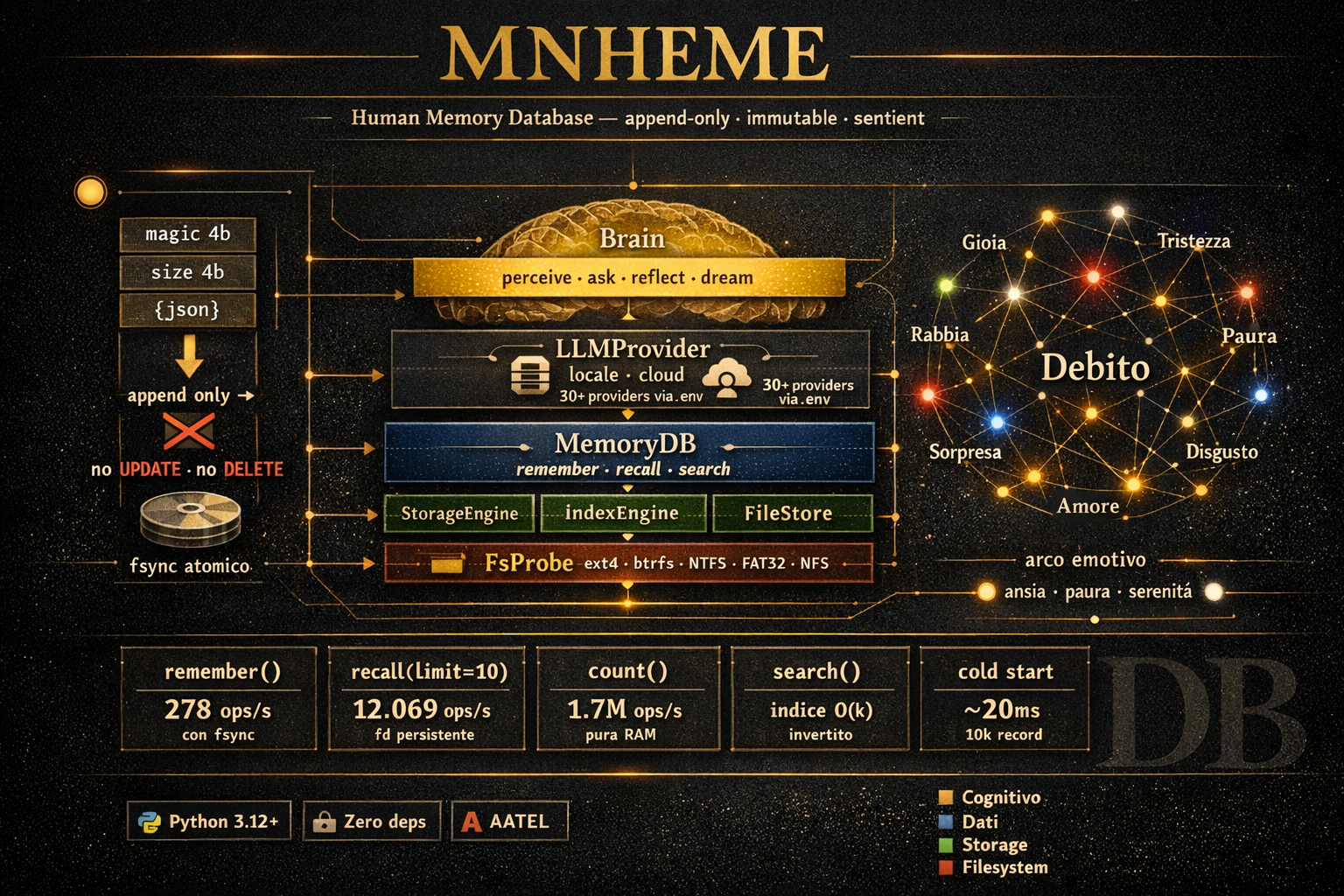
MNHEME — Human Memory Database
USE IT AT YOUR OWN RISK
"Memory is not overwritten. It accumulates in layers."




MNHEME is a database inspired by human memory: append-only, immutable, sentient.
No SQLite. No ORM. Binary engine written from scratch.
An LLM-agnostic brain to perceive, remember, and reflect.
Why MNHEME?
Traditional databases treat data as mutable objects: you write, update, delete. But memories don't work that way. You can't overwrite what you've lived through — you can only remember it differently, with a different feeling, at a different moment.
MNHEME translates this principle into a storage system:
- No
UPDATE— data is immutable after writing - No
DELETE— memories accumulate, they don't disappear - Every memory carries a feeling — not just data, but emotion
- The LLM is the brain — it perceives, associates, reflects on the data
Architecture
┌────────────────────────────────────────────────────┐
│                      Brain                          │
│   perceive · ask(RAG) · reflect · dream · introspect│
└──────────┬──────────────────────────────────────────┘
           │
  ┌────────┴────────────────────────┐
  │         LLMProvider              │
  │  agnostic .env · 30+ providers   │
  │  rate limiting · fallback        │
  └────────┬────────────────────────┘
           │
  ┌────────┴────────────────────────┐
  │          MemoryDB                │
  │  remember · recall · search      │
  │  reflect · export · import       │
  └──────┬──────────┬───────────────┘
         │          │
  ┌──────▼──┐  ┌────▼──────┐  ┌────────────┐
  │ Storage │  │   Index   │  │  FileStore │
  │ Engine  │  │  Engine   │  │  (media)   │
  │ .mnheme │  │  (RAM)    │  │  FsProbe   │
  └─────────┘  └───────────┘  └────────────┘
Layers
| Layer | File | Responsibility |
|---|---|---|
| Brain | brain.py |
LLM cognitive operations |
| LLMProvider | llm_provider.py |
Provider agnostic via .env |
| MemoryDB | mnheme.py |
Public database API |
| StorageEngine | storage.py |
Append-only binary log |
| IndexEngine | index.py |
In-RAM indexes for O(1) lookup |
| FileStore | filestore.py |
Physical file storage (media) |
| FsProbe | fsprobe.py |
Live filesystem detection |
Quickstart
from mnheme import MemoryDB, Feeling, MediaType

# Create or open a database
db = MemoryDB("mind.mnheme")

# Store a memory — append-only, never overwritten
mem = db.remember(
    concept    = "Debt",
    feeling    = Feeling.ANXIETY,
    content    = "I signed the mortgage today. 25 years.",
    note       = "It was a rainy Wednesday.",
    tags       = ["home", "mortgage", "2024"],
)

# Recall memories for a concept
memories = db.recall("Debt")
memories = db.recall("Debt", feeling=Feeling.ANXIETY)
memories = db.recall("Debt", limit=5, oldest_first=True)

# Recall by feeling
all_nostalgic = db.recall_by_feeling(Feeling.NOSTALGIA)

# Full-text search
results = db.search("mortgage")
results = db.search("christmas", in_concept=False)

# Statistics
db.list_concepts()             # concept → emotional distribution
db.feeling_distribution()      # feeling → count
db.concept_timeline("Debt")    # emotional evolution over time
db.count(concept="Debt", feeling="anxiety")
The Brain — LLM as cognitive layer
from mnheme       import MemoryDB
from llm_provider import LLMProvider
from brain        import Brain

db    = MemoryDB("mind.mnheme")
llm   = LLMProvider.from_env(".env")   # reads from .env
brain = Brain(db, llm)
perceive() — raw input → structured memory
# The LLM extracts concept, feeling, tags and enriches the text
r = brain.perceive("I opened the envelope from the bank. My hands were shaking.")

print(r.extracted_concept)   # "Debt"
print(r.extracted_feeling)   # "fear"
print(r.extracted_tags)      # ["bank", "body", "anxiety"]
print(r.enriched_content)    # text enriched with psychological depth
# The memory is already saved in MemoryDB — immutable
ask() — RAG on personal memory
# Answers using ONLY real memories as context
ans = brain.ask("How do I feel about money?")

print(ans.answer)           # answer based on your memories
print(ans.memories_used)    # memories used as RAG context
print(ans.confidence_note)  # "Confidence: high — direct data from memories"
reflect() — emotional analysis over time
ref = brain.reflect("Debt")
print(ref.arc)         # "from silent terror to hard-won serenity"
print(ref.reflection)  # deep analysis of the emotional arc
dream() — dream-like connections
# Samples memories from different feelings, finds the hidden thread
dream = brain.dream(n_memories=8)
print(dream.connections)  # unexpected associations, latent theme
introspect() — psychological portrait
intro = brain.introspect()
print(intro.portrait)          # who you are, patterns, tensions, resources
print(intro.dominant_concepts) # ["Family", "Work", "Debt"]
print(intro.emotional_map)     # {"anxiety": 8, "love": 5, ...}
LLMProvider — agnostic by design
No external SDK. Just stdlib urllib. A single .env.
# .env — fill in what you have, leave the rest empty

# Local — no API key required
LM_STUDIO_URL=http://localhost:1234/v1/chat/completions
LM_STUDIO_MODEL=local-model
LM_STUDIO_RPM=60

# Cloud
GROQ_URL=https://api.groq.com/openai/v1/chat/completions
GROQ_MODEL=llama-3.3-70b-versatile
GROQ_API_KEY=gsk_...
GROQ_RPM=30

# Anthropic (auto-detected from URL)
ANTHROPIC_URL=https://api.anthropic.com/v1/messages
ANTHROPIC_MODEL=claude-opus-4-5
ANTHROPIC_API_KEY=sk-ant-...
ANTHROPIC_RPM=5

# Cascading fallback
USE_MULTI_PROVIDER=true
TEMPERATURE=0.3
llm = LLMProvider.from_env(".env")

# Switch provider at runtime without restarting
llm.use("groq")
llm.use("lm-studio")   # zero cost, local
llm.use("anthropic")

# See all available providers
llm.list_providers()

# Custom priority for fallback
llm = LLMProvider.from_env(".env",
    priority=["lm-studio", "groq", "anthropic"])
Supported providers (30+): LM Studio, Ollama, Anthropic, OpenAI, Groq, Mistral, Codestral, SambaNova, OpenRouter, Google AI Studio, Cerebras, NVIDIA NIM, Hugging Face, GitHub Models, Cohere, Together, Fireworks, Nebius, Hyperbolic, Novita, Upstage, Scaleway, Aliyun, AI21, Inference.net, Cloudflare, Vertex AI, and any custom OpenAI-compatible endpoint.
FileStore — adaptive media storage
# Attach a physical file to a memory
mem, fe = db.remember_file(
    "Family", Feeling.LOVE,
    "/photos/christmas2024.jpg",
    note="Everyone together at lunch"
)

# Attach binary data directly (e.g. API upload)
with open("voice.mp3", "rb") as f:
    mem, fe = db.remember_bytes("Trip", Feeling.NOSTALGIA, f.read(), "voice.mp3")

# Reading
path = db.files.get_path(mem.memory_id)
data = db.files.get_bytes(mem.memory_id)
info = db.files.info()
Adaptive filesystem strategy
MNHEME detects the filesystem at boot and runs live capability probes:
| Filesystem | Strategy | Notes |
|---|---|---|
| ext4, ZFS, NFS, 9p | HARDLINK | zero bytes, same inode |
| btrfs, xfs, APFS | REFLINK | Copy-on-Write, zero blocks |
| NTFS | HARDLINK | via CreateHardLinkW |
| FAT32, exFAT | COPY_ATOMIC | tmp + os.replace() |
| HDFS, S3FS, GCSFuse | COPY_ATOMIC | no local inodes |
Physical .mnheme file format
The database is an append-only binary file:
┌──────────────┬──────────┬───────────────────┐
│  MAGIC (4B)  │ SIZE (4B)│  PAYLOAD (SIZE B) │
└──────────────┴──────────┴───────────────────┘

MAGIC   : [0x4D, 0x4E, 0x45, 0xE0]  — record signature
SIZE    : uint32 big-endian          — payload length
PAYLOAD : JSON UTF-8                 — memory data
Every write is atomic and fsync-ed. Truncated records (crash mid-write) are silently skipped on restart. In-RAM indexes are rebuilt by scanning the file from the beginning.
Benchmarks
Measured on 2,000 records, Python 3.12, 9p filesystem:
| Operation | Average | Throughput |
|---|---|---|
remember() with fsync |
1.8 ms | 552 ops/s |
remember() without fsync |
0.2 ms | 4,632 ops/s |
count() — pure RAM |
~0 ms | 2,774,322 ops/s |
feeling_distribution() |
0.003 ms | 277,865 ops/s |
recall(concept, limit=10) |
1.5 ms | 636 ops/s |
recall_by_feeling(limit=20) |
3.0 ms | 332 ops/s |
recall_all() — 2,000 records |
300 ms | 3 ops/s |
search() full-text |
40 ms | ~49k records/s |
search(limit=5) |
0.1 ms | 8,348 ops/s |
| Cold start (2,000 rec) | 40 ms | 49k rec/s indexed |
File size: ~374 B/record → ~36 MB per 100k records, ~357 MB per 1M records.
# Run benchmarks
python mnheme_benchmark.py --records 5000
python mnheme_benchmark.py --records 10000 --output report.json
REST API (optional)
pip install fastapi uvicorn
uvicorn mnheme_api:app --reload --port 8000
# Swagger: http://localhost:8000/docs
POST /memories              → store a memory
GET  /memories              → all memories (filters: feeling, limit)
GET  /memories/search?q=    → full-text search
GET  /concepts              → concept list with statistics
GET  /concepts/{concept}    → memories for a concept
GET  /concepts/{concept}/timeline  → emotional evolution
GET  /feelings              → feelings with statistics
GET  /feelings/distribution → feeling → count
GET  /stats                 → general statistics
GET  /export                → export JSON
Project structure
mnheme/
├── mnheme.py           # Core — MemoryDB, Feeling, MediaType, Memory
├── storage.py          # Append-only binary engine
├── index.py            # In-RAM indexes
├── fsprobe.py          # Filesystem detection
├── filestore.py        # Physical file storage
├── llm_provider.py     # LLM provider agnostic via .env
├── brain.py            # LLM cognitive layer
├── mnheme_api.py       # FastAPI REST API (optional)
├── mnheme_benchmark.py # Benchmark suite
├── examples.py         # Usage examples
├── .env.example        # Provider configuration template
└── tests/
    ├── test_llm_provider.py
    └── test_fsprobe.py
Supported feelings
joy · sadness · anger · fear · nostalgia · love · melancholy · serenity · surprise · anxiety · gratitude · shame · pride · boredom · curiosity
Media types
TEXT · IMAGE · VIDEO · AUDIO · DOC
Requirements
- Python 3.12+
- No mandatory external dependencies
fastapi+uvicornonly for the REST API (optional)
Local test using LM Studio
# Use LM Studio on localhost:1234 with the model already loaded
python test_local_provider.py

# Custom URL
python test_local_provider.py --url http://localhost:1234

# Force a specific model
python test_local_provider.py --model "mistral-7b-instruct"

# Keep the database instead of deleting it after the test
python test_local_provider.py --db mind.mnheme

# Verbose output with traceback if something goes wrong
python test_local_provider.py --verbose
Advanced human simulator
Real timeline
- Timestamps are no longer "today".
- Each memory computes the exact date based on
birth_date + age_in_days ± random variation of 90 days. - With
--birth-year 1975, a memory at age 8 will have a timestamp around 1983, one at age 35 around 2010. - 8 life phases with distinct emotional distributions: Early childhood (0–5), Childhood (6–11), Adolescence (12–17), Early adulthood (18–29), Adulthood (30–44), Middle age (45–59), Late adulthood (60–79), Old age (80–130).
- Each phase has weights calibrated on real psychological data: adolescence weights embarrassment/shame/love, old age weights gratitude/serenity/nostalgia (Carstensen's positivity effect).
Reminiscence bump
- The temporal distribution of memories is not uniform: 30% falls in the 15–35 age range, reflecting the psychological phenomenon whereby adults disproportionately remember events from that period.
Narrative consciousness
- Maintains used concepts, recurring tags, and a list of "reprocessable" memories. The narrative thread is injected into the prompt: if tags like
work,father,Milanrecur throughout a life, the model knows they may reappear in subsequent memories, creating biographical coherence.
Reprocessings (~20%)
- Memories with heavy feelings (anxiety, fear, anger, shame) are placed in a reworkable queue. With ~20% probability, a new slot is marked as a reprocessing: same concept, changed feeling, written from a growth/healing perspective. The prompt explicitly states "same event seen with different eyes at age X".
Zero LLM bias
- The model never chooses the feeling — it receives it as an explicit constraint slot by slot. The actual distribution depends solely on the per-phase weights. The model only writes narrative content consistent with the assigned feeling and age.
License
AATEL — see LICENSE
Thanks
A special thanks to @KnightNiwrem https://github.com/knightniwrem
whose questions led to discovering a critical bug triggered by a crash during the write phase.
MNHEME — from the Greek muse of memory
"You cannot overwrite what you have lived. You can only remember it differently."
Release history Release notifications | RSS feed

Download files
Download the file for your platform. If you're not sure which to choose, learn more about installing packages.
Source Distribution
Built Distribution
Filter files by name, interpreter, ABI, and platform.
If you're not sure about the file name format, learn more about wheel file names.
Copy a direct link to the current filters
File details
Details for the file mnheme-0.0.1.tar.gz.
File metadata
- Download URL: mnheme-0.0.1.tar.gz
- Upload date:
- Size: 111.3 kB
- Tags: Source
- Uploaded using Trusted Publishing? No
- Uploaded via: twine/6.2.0 CPython/3.10.16
File hashes
| Algorithm | Hash digest | |
|---|---|---|
| SHA256 |
acae45c099a8f91ca7ad127948dd58cef1967e97c45276cd918c7a80172998d1
|
|
| MD5 |
2df818508f831b84504fad62cbab0adc
|
|
| BLAKE2b-256 |
2ca99ccc3a7272573be7ba7b497c0001beb1f08ad5153c91624f99a421ad4922
|
File details
Details for the file mnheme-0.0.1-py3-none-any.whl.
File metadata
- Download URL: mnheme-0.0.1-py3-none-any.whl
- Upload date:
- Size: 76.3 kB
- Tags: Python 3
- Uploaded using Trusted Publishing? No
- Uploaded via: twine/6.2.0 CPython/3.10.16
File hashes
| Algorithm | Hash digest | |
|---|---|---|
| SHA256 |
c78e534279a5d14fe5c87f04be0b32843e7851aecaa47ded7472e490ac21f41d
|
|
| MD5 |
debbc02df78bd712f1de075fe4f9cfde
|
|
| BLAKE2b-256 |
ca8e206d58823fb947fd6dfbac3854933a9fff46415b2ec1a9cf91eeaa82b837
|






