
modal-progress
Live progress from inside Modal containers.
Progress bars per container in a terminal, plain progress lines in a log file.
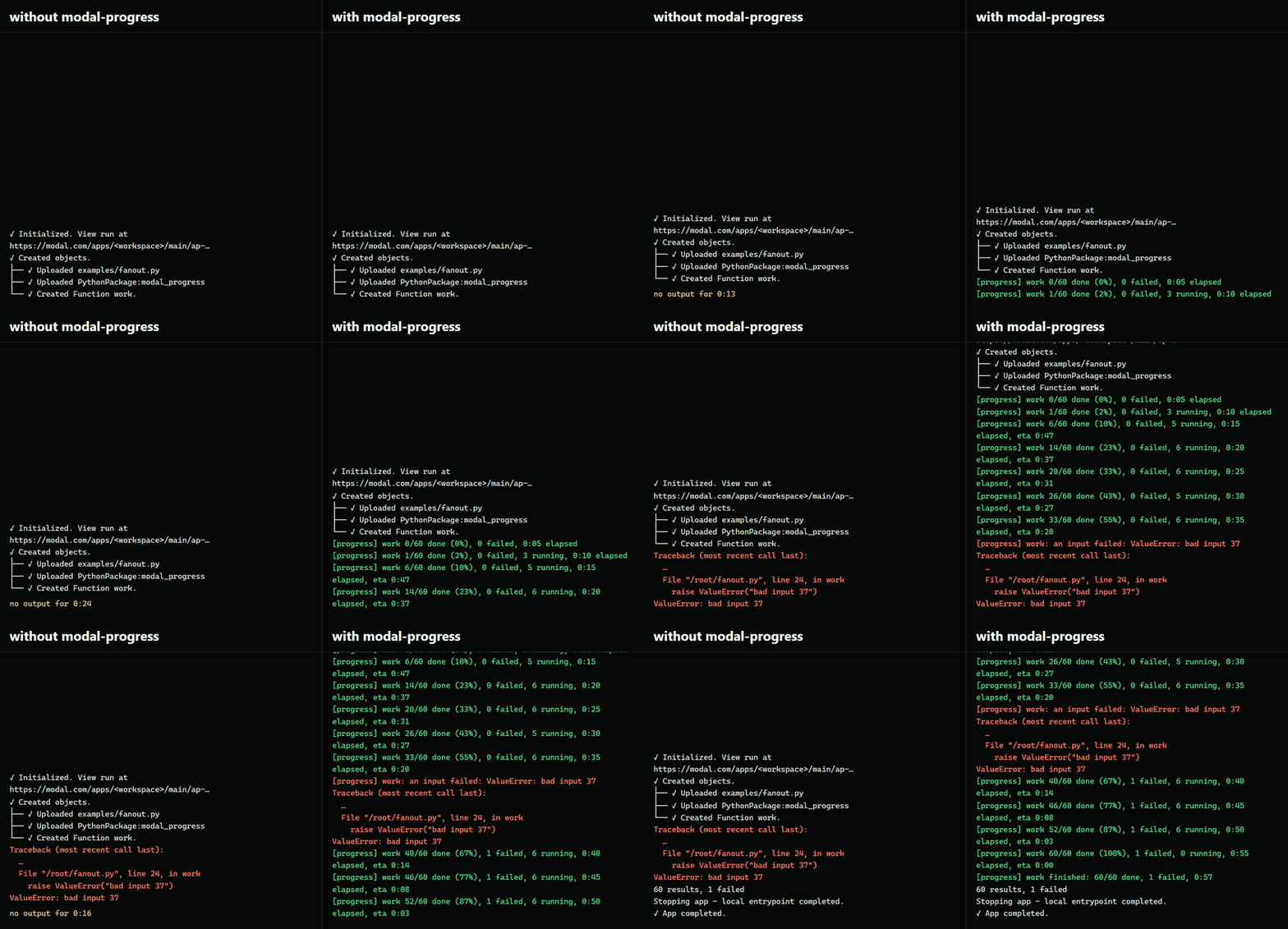
modal run draws .map progress as a live terminal bar. When the output goes to a file or a pipe, which is how coding agents run commands, nothing is printed until the job ends, so there is no way to tell a slow job from a stuck one. modal-progress prints a plain line every few seconds instead, and lets each container report its own progress.
Install
pip install git+https://github.com/EnesYilmazcode/modal-progress
Requires Python 3.10+ and modal 1.x.
Usage
No code changes
Use modal-progress run in place of modal run. Arguments are passed through unchanged.
modal-progress run app.py > log.txt
[progress] work 11/60 done (18%), 0:13 elapsed, eta 1:00
[progress] work 19/60 done (32%), 0:20 elapsed, eta 0:44
[progress] work 29/60 done (48%), 0:25 elapsed, eta 0:27
[progress] work 60/60 done, 0:47
In a terminal it behaves exactly like modal run.
Progress from inside each container
Wrap a loop in bar() inside the function, and wrap the map in watch() on the caller's side.
import modal
from modal_progress import bar, watch

app = modal.App("example")
image = modal.Image.debian_slim().add_local_python_source("modal_progress")

@app.function(image=image)
def work(i: int) -> int:
    for step in bar(range(40), desc=f"input {i}"):
        ...  # one step of work
    return i

@app.local_entrypoint()
def main():
    xs = range(60)
    with watch(app, name="work") as w:
        results = list(w.track(work.map(xs, return_exceptions=True), total=len(xs)))
In a terminal, this shows an overall bar plus one bar per container. In a log file, it prints:
[progress] work 20/60 done (33%), 0 failed, 6 running, 0:25 elapsed, eta 0:31
[progress] work: an input failed: ValueError: bad input 37
[progress] work 40/60 done (67%), 1 failed, 6 running, 0:40 elapsed, eta 0:14
[progress] work finished: 60/60 done, 1 failed, 0:57
Failures are reported the moment they happen. Every line starts with [progress], so it can be filtered with grep. A full example is in examples/fanout.py.
API
| Call | Where | What it does |
|---|---|---|
bar(iterable=None, total=None, desc="", every=0.5) |
container | tqdm-style wrapper. Also supports update(n), set_description(s), close(), and with. Sends at most one update every every seconds. |
report(n, total=None, desc="") |
container | Sets progress for the current input directly, for loops bar() can't wrap. |
watch(app, name="map", mode=None, interval=None, record=None) |
caller | Context manager that collects and draws progress. record writes every event to a JSON lines file. |
w.track(results, total=None) |
caller | Passes map results through and counts them. Exceptions count as failures. |
Configuration
| Variable | Values | Default |
|---|---|---|
MODAL_PROGRESS |
rich, plain, off |
rich in a terminal, plain otherwise. off also stops containers from sending. |
MODAL_PROGRESS_INTERVAL |
seconds between plain lines | 5 |
How it works
Each container sends its latest progress to a Modal Queue named modal-progress, in a partition keyed by the app ID, batched every 0.25 seconds from a background thread. watch() reads that partition and combines it with the map's results as they come back. A bar() update costs about 0.2 µs, so it can wrap tight loops.
modal-progress run needs no queue. It hooks Modal's own count of finished inputs and prints it as plain lines when stdout isn't a terminal.
Limitations
- Uses three private Modal internals:
App._get_container_app()to find the app ID in a container, Modal's live display to add the bars to it, and its map progress callback formodal-progress run. All are guarded, so if one changes you lose progress output, not the job. Tested on modal 1.6.1. - Works with
modal runandapp.run(). A deployed function called from a different app reports to its own app's partition, so the caller won't see it. - Progress shows up within about a second of happening.
Development
pip install -e ".[dev]"
python -m pytest -q
python -m modal_progress demo        # simulated map, no Modal account needed
modal run examples/fanout.py         # real map on Modal
License
MIT
1 maintainer

Metadata
1 maintainer
Release files for modal-progress 0.1.0
For a detailed explanation of source distributions (sdists) and built distributions (wheels), please see the package formats documentation.
Source distribution (sdist)
| File | Size | Uploaded | |
|---|---|---|---|
| modal_progress-0.1.0.tar.gz | 15.3 kB | Details |
Built distribution (wheel)
| File | Interpreter | ABI | Platform | Reset |
|---|---|---|---|---|
| modal_progress-0.1.0-py3-none-any.whl | Python 3 | none | any | Details |
Total release size: 31.6 kB
Release files / modal_progress-0.1.0.tar.gz
| Download URL | modal_progress-0.1.0.tar.gz |
|---|---|
| Size | 15.3 kB |
| Tags | Source |
|
SHA-256 checksum How to use checksums |
3191842ec10c6cbae2292e5b6f7a6c0eff10a97e20f41944837e893fc529eaa4
|
|
BLAKE2b-256 checksum How to use checksums |
c9a8e203f81a34cda3130ba45f78fad0238f4962483c92a212b035de85504e3d
|
| Upload date | |
|
Uploaded using Trusted Publishing? What is trusted publishing? |
No |
| Uploaded via |
twine/7.0.0 CPython/3.13.1
|
Release files / modal_progress-0.1.0-py3-none-any.whl
| Download URL | modal_progress-0.1.0-py3-none-any.whl |
|---|---|
| Size | 16.3 kB |
| Tags | Python 3 |
|
SHA-256 checksum How to use checksums |
ab294f40d101c0930384333007eb48ced2a7ba732e37a95bd84eb464f8c1c404
|
|
BLAKE2b-256 checksum How to use checksums |
bf9f91e02f3276ec938b6334b1fadb2e0aa7a8a930753c77202ad3301083f24b
|
| Upload date | |
|
Uploaded using Trusted Publishing? What is trusted publishing? |
No |
| Uploaded via |
twine/7.0.0 CPython/3.13.1
|













