
ModeBench
Can a model find more than one correct solution to the same problem? ModeBench evaluates correctness and solution diversity using executable tasks with canonical outcome identities.
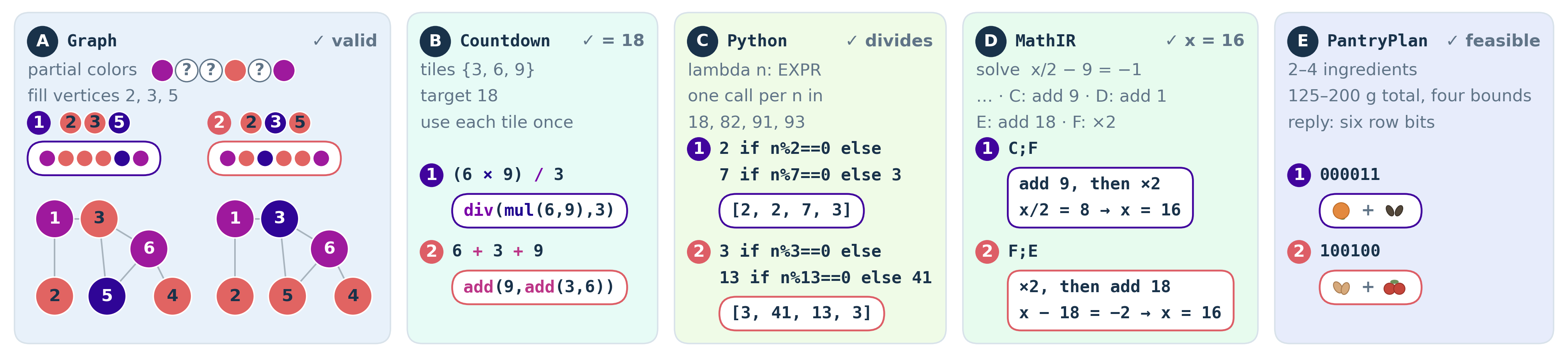
Five domains, five task levels, and 72 frozen dataset splits containing 15,552 rows. Evaluate saved model responses on CPU without PyTorch, CUDA, or a training framework. Re:Max / Re:Dr provides the separate optimization and training implementation.
| Domain | What is checked | What defines a mode |
|---|---|---|
| Graph coloring | Every graph edge and fixed color | Complete color vector |
| Countdown | Exact arithmetic and use of the given operands | Normalized executed expression tree |
| Python factors | A restricted function returns proper divisors on the given inputs | Returned divisor vector |
| MathIR | Restricted equation actions execute correctly | Exact normalized state trajectory |
| PantryPlan | Ingredient and nutritional feasibility constraints | Ingredient support |
Mode identity is prompt-local. Different wording alone does not create a different mode; different Python programs can produce the same divisor vector.
Performance · Installation · Evaluation · Metrics · Datasets · Levels and results · Reproducibility · Contributing · Changelog · Citation
Performance
Mean pass@8 across the five domains for Qwen2.5-Instruct before RL training. Each cell uses 128 held-out prompts per domain and four independent groups of eight responses. These are frozen measurements; the detailed levels and results section also reports diversity and Re:Dr/Re:Max training results.
| Level | Qwen 0.5B | Qwen 3B | Qwen 7B | Qwen 14B |
|---|---|---|---|---|
| 1 | 0.387 | 0.436 | 0.532 | 0.518 |
| 2 | 0.276 | 0.368 | 0.429 | 0.495 |
| 3 | 0.344 | 0.359 | 0.468 | 0.472 |
| 4 † | 0.194 | 0.272 | 0.398 | 0.411 |
| 5 | 0.169 | 0.150 | 0.318 | 0.359 |
† Level 4 is not admitted overall: MathIR failed its difficulty-matching criterion. Levels change the task populations and sometimes prompt guidance. The grid uses native chat with temperature 1, top-p 1, a 192-token limit, boxed-direct Graph prompts and guided decoding elsewhere; it is not directly comparable to a differently sampled training evaluation.
Recompute the retained base-model scores and verify every README table from the checkout:
python ops/reproduce_base_grid.py
python ops/summarize_levels.py --check
The first command checks 375 cells from saved correctness flags and canonical keys; it does not regenerate model responses. For Re:Dr/Re:Max and other training comparisons, use ReMax's installed remax results compare command. Its comparison guide distinguishes runnable training, saved-key recomputation, and summary-only results.
Installation
The supported runtime is Linux, CPython 3.10–3.12. Windows users can use a Linux environment under WSL. Native Windows and macOS are not qualified: verifier deadlines, process cleanup, and memory limits use Linux/POSIX facilities. Evaluation is CPU-only.
Install a regular package, then run the complete offline walkthrough:
git clone https://github.com/liv-daliberti/modeBench.git
cd modeBench
python3 -m venv .venv
source .venv/bin/activate
python -m pip install .
modebench walkthrough --directory demo
head -n 1 demo/tasks.jsonl
modebench evaluate demo/responses.jsonl --run demo/run.json --output demo/report.json
modebench report demo/report.json
The walkthrough contains one task from each of the five domains, four saved responses per task, run metadata, and expected.json. Inspect tasks.jsonl for the questions; edit a copy of responses.jsonl to supply your own saved responses. These are handwritten examples, with two correct modes, one wrong answer, and one malformed answer per task. No model calls or downloads occur, and the core package works outside the checkout.
The report prints one row per domain with these values:
level domain          k accuracy pass@k distinct@k PCMD reportable
1     countdown       4 0.5      1      2          1    false
All five rows have the same scores. reportable=false is expected: one eligible prompt is below the default threshold of 30. This walkthrough demonstrates the interface; it is a custom-reference example, not a full benchmark result. Choose a fresh output filename for each run; existing outputs and walkthrough directories are never overwritten.
| Installation from checkout | Includes |
|---|---|
python -m pip install . |
All five verifiers, metrics, CLI, frozen split registry, and offline walkthrough |
python -m pip install '.[data]' |
Also Parquet loading and dataset construction dependencies |
python -m pip install '.[dev]' |
Also the regression suite |
The wheel and source distribution contain the same runtime resources; the checkout additionally supplies frozen Parquet files, scientific evidence, and construction scripts. CI uploads both distributions as the distributions artifact. They can be installed directly with pip install /path/to/package.whl or pip install /path/to/package.tar.gz; add [data] to that path for dataset loading. Versioned releases are built and tested once, attached to GitHub Releases, and published to PyPI through Trusted Publishing. Once version 0.4.0 is available there, install it with python -m pip install modebench==0.4.0; the source installation above also works before publication completes.
Supported direct dependency ranges are SymPy >=1.12,<2, and, for data, datasets >=2.16.1,<6 and huggingface-hub >=0.19.4,<2. CI checks the minimum combination using compatibility constraints, and current resolver-selected versions. When using datasets 2.16, use those constraints: its older Arrow/NumPy integration requires them. This tests the endpoints, not every possible dependency combination. The recorded Python 3.10 environment is another reproducible installation choice.
Discover and inspect real tasks
python -m pip install '.[data]'
modebench datasets list
modebench datasets card --config level1_countdown
modebench datasets fetch --config level1_countdown
modebench datasets inspect --config level1_countdown --row 0 --offline
list prints 72 split records ordered by level and domain; --json gives their hashes and row counts. fetch prints verified: true and the cache data directory. inspect shows ID level1_countdown/eval/0, 128 total rows, the dataset hash, and registered messages. Answers are omitted unless you explicitly use --show-reference; never send that inspection output to a model.
Downloads use a pinned public Git commit and must match SHA-256 identities shipped in the package. The cache defaults to $XDG_CACHE_HOME/modebench (or ~/.cache/modebench), partitioned by registry hash. Every reuse verifies the bytes. --cache-dir PATH selects a different base, and --offline forbids downloads. Failed or corrupt downloads never become usable cache entries. A corrupt existing entry produces an error with its path; remove that file explicitly and fetch it again. Transfers have a 32 MiB cap and bounded network waits.
prepare, datasets inspect, and frozen evaluate use --data-root when supplied, otherwise the checkout's data/ if present, otherwise the verified cache (downloading a missing split unless --offline). Use --cache-dir to select the cache explicitly even inside a checkout. Dataset discovery and downloading need only the core package; reading Parquet needs the data extra.
Evaluation
Use the typed public API to load a frozen task, render its prompt, and grade a saved response:
from modebench.api import load_tasks, make_prompt, grade

task = next(load_tasks("level1_countdown", data_root="data"))
messages = make_prompt(task)
# Send only `messages` to your model, then grade its returned text.
result = grade(task, "YOUR_MODEL_RESPONSE")
print(result["status"], result["canonical_key"], result["detail"])
Outside a checkout, omit data_root to use the verified cache; cache_dir and offline=True are supported. Reading frozen tasks requires the data extra. Task contains the reference for grading; only make_prompt(task) belongs in a model request.
For saved response files, the same API exposes typed evaluation options, receipts, reports, and streaming details:
from modebench.api import EvaluationOptions, evaluate_file, read_report, iter_results

receipt = evaluate_file(
    "responses.jsonl", "results.json",
    options=EvaluationOptions(min_defined_prompts=30),
)
report = read_report(receipt.output)
print(report.status, report.cells)
for prompt in iter_results(receipt.output):
    print(prompt["id"], prompt["accuracy"])
read_report verifies the detailed-result journal hash. iter_results verifies it before yielding results in input order. Both read v3 and v4 receipts. Type information ships in the package (py.typed); new integrations should use modebench.api instead of private helpers or historical adapters.
Keep answer, support counts, and certified solutions out of model requests. Match saved responses by stable prompt ID, not asynchronous completion order. Preserve raw generations, refusals, and malformed answers; collection failures need a declared protocol and must not silently reduce the draw budget.
Custom-reference evaluation: write one JSON object per prompt to a JSONL file:
{"id":"example","level":1,"domain":"countdown","answer":{"verifier":"countdown","numbers":[1,2,3],"target":6},"responses":["1+2+3","1*2*3","1+2","bad"]}
modebench evaluate INPUT.jsonl --output OUTPUT.json
| Field | Contract |
|---|---|
id |
Stable prompt identity; string recommended, unique within level/domain |
level |
Integer 1–5 or "level1" through "level5" |
domain |
graph_coloring, countdown, python_factors, mathir, or pantry_plan (pantry is an alias) |
answer |
Exact executable reference from the frozen row, as an object or JSON-encoded string |
responses |
Nonempty list of raw response strings, including failed answers |
Use one input file per model and generation condition. Grouping uses level, domain, and response count k. The evaluator rejects unknown record fields, malformed references, domain/verifier mismatches, duplicate JSON fields, and nonfinite numbers before grading. CLI errors identify the input line and prompt. Integer counts and positive integer thresholds are enforced by the metric API too.
Custom references are labeled dataset.kind: "custom" and references_authenticated: false. Use --run RUN.json to record model, generation, and prompt metadata; without it, those details are explicitly unreported. An inline run object on every record is also supported. Inline metadata must match the shared run exactly; mixed models, revisions, generation settings, or prompt conditions are rejected. Arbitrary record fields such as model_id are rejected rather than silently ignored.
File evaluations use modebench-saved-responses-v4: a compact final receipt contains the input SHA-256, software identity, run metadata, dataset identity, aggregation settings, and cell scores. Per-response diagnostics live in a separate JSONL journal whose path, SHA-256, and record count are bound into the receipt. Unverified responses have a null canonical key; evaluator failures also invalidate aggregate scores, as described below. For Level 1 Pantry, graded_text is the deterministic allocation projected from the submitted six-bit support mask. Use modebench.api.grade or the CLI for this interface; the low-level key validator does not apply that projection.
Streaming, interruption, and parallel workers
modebench evaluate responses.jsonl --run run.json --output results.json \
  --progress-every 100
# After an interrupted run, repeat the same command with --resume:
modebench evaluate responses.jsonl --run run.json --output results.json --resume
modebench report results.json
Input is streamed one JSONL record at a time. All records and references are validated before any candidate grading. Duplicate IDs are checked on disk. Each completed prompt is committed to a SQLite checkpoint and appended to results.json.work/results.jsonl; progress events go to stderr and the final summary goes to stdout. --progress-every 0 disables progress. Final receipts are published atomically and never overwrite an existing output. A partial journal alone is not a completed benchmark result.
The default checkpoint directory is OUTPUT.work/; --work-dir PATH selects another fresh directory. Resume verifies the input bytes and records, options, run metadata, dataset identities, software/dependency fingerprints, resource policy, and stored prompt/result hashes. It rebuilds a damaged or missing journal from committed checkpoints, then continues without regrading completed prompts. An interruption during input validation restarts validation. Changed responses, configuration, references, or software require a fresh evaluation. A completed evaluator failure is retained on resume; resume is not a selective retry policy.
--workers N supports 1–8 isolated verifier workers, with bounded pending work and ordered results. The default is 1. Worker count can change on resume; execution history records it. Tests compare serial, interrupted/resumed, and parallel scores and detailed results, including abrupt process termination and worker cleanup. Concurrency consumes additional memory and may not improve throughput on every machine.
Retain the receipt and its journal together, preserving the relative path in prompt_results.path. The SQLite ledger is needed to resume, but not to read a completed report. Checkpoints contain raw responses and references: allocate disk space and handle them like the original inputs. Durability relies on filesystem locking and fsync; use a local filesystem with those guarantees. An existing final receipt means publication completed: read it or choose a fresh output rather than using --resume to overwrite it. Keep input files immutable during a run. Input records are capped at 16 MiB and 4,096 responses per prompt; worker limits below still apply.
Measured on a shared Linux host with 10,000 repeated walkthrough prompts (40,000 responses):
| Execution | Parent peak RSS | Parent + workers peak RSS | Responses/second |
|---|---|---|---|
| Previous in-memory CLI | 292.5 MB | 339.2 MB | 312.8 |
| Streaming, one worker | 60.1 MB | 106.9 MB | 219.1 |
| Streaming, two workers | 61.2 MB | 152.1 MB | 295.3 |
Serial streaming parent memory was 59.1 MB at 1,000 prompts. Durable per-prompt commits trade throughput and disk space for recovery; the two-worker 10,000-prompt checkpoint occupied about 109 MB, including its 18 MB journal. These are single development measurements with repeated tasks and warm caches, not general performance guarantees. Process-tree RSS can double-count shared pages. Measurement records preserve the methods and limitations. Reproduce on your own storage and workload before selecting concurrency:
python ops/benchmark_evaluation.py --sizes 1000 10000 --workers 1 2 \
  --output outputs/performance.json
Evaluate a frozen split
Export registered requests with stable IDs and prompt/dataset hashes. Reference answers and support counts are never included:
modebench prepare --config level1_countdown --output outputs/requests.jsonl
Send each messages list to your model. Save the exported records to a response file with a responses list added to each record. Preserve IDs and hashes. IDs have the form level1_countdown/eval/0: configuration, split, and zero-based row index. They are stable within the frozen split identity.
Copy examples/run.json to your run directory and replace its illustrative values with the actual settings:
{
  "model": {"id": "your-model", "revision": "exact-model-revision"},
  "generation": {"temperature": 0.7, "top_p": 0.95, "max_tokens": 192, "seed": 43},
  "prompt_condition": "registered_hints_v1"
}
Then evaluate against the frozen references:
modebench evaluate outputs/responses.jsonl --config level1_countdown \
  --run outputs/run.json --output outputs/metrics.json
--split defaults to eval; train and dev are also accepted where available. --data-root selects an explicit directory; otherwise the checkout or verified cache is used. Frozen evaluation compares the local manifest against the registry shipped inside the package, verifies Parquet bytes, resolves each prompt ID, and supplies its reference internally. Do not include answer in frozen response records. Optional supplied level, domain, problem, messages, prompt_sha256, and dataset_sha256 must match the frozen source and registered prompt.
Frozen records must have the same draw count per prompt; failures remain in the response lists. An optional generation.draws_per_prompt in run metadata is checked against every record in either mode. Complete split coverage is required by default. For an intentional subset, use --allow-partial; results list selected and missing IDs, counts, and complete: false. Missing prompts are not imputed. Frozen evaluation requires registered_hints_v1; changed prompt conditions belong in custom mode. Frozen reference binding does not mean every dataset is an admitted benchmark condition: Level 4 and diagnostic qualifications remain attached to the results.
Result identities and compatibility
| Field | Meaning |
|---|---|
software |
ModeBench version, verifier contract, package-source hashes, Python/dependency versions, Git commit/dirty state when available |
input_sha256, records_sha256 |
File bytes and canonical JSON records; the in-memory API supplies only the record digest |
run, run_sha256 |
Declared model/revision, generation settings, prompt condition, and metadata digest |
dataset |
Custom versus frozen binding; frozen split metadata, hashes, coverage, and missing IDs |
evaluation |
Aggregation, equal prompt weighting, support threshold, and empirical pass@k convention |
cells[*].protocol_notes |
Level 4 admission and MathIR matching caveats |
prompt_results |
In v4, path/hash/count of the detailed JSONL journal; each entry contains prompt/reference hashes, prompt profile, scores, and graded attempts |
Generation settings are user-declared, not proof that a model produced the responses. Prompt hashes identify the expected registered messages, not the actual transport used. Custom records need problem plus declared run metadata to compute a prompt hash; otherwise it is null. Model identity/revision strings and a nonempty generation-settings object are required whenever run metadata is supplied. Record any unavailable provider revision explicitly, with the collection date; do not invent one.
Version 0.4 keeps the existing evaluate command and in-memory modebench.cli.evaluate import. Accepted responses and canonical identities remain checked against the frozen baseline. The file receipt advances from v3 to v4 to separate aggregate metadata from detailed results; the in-memory API still returns nested v3 results. Use read_report and iter_results for schema-independent consumers. Consumers must check evaluation.status before reading scores. Legacy key-only Python verification still returns None for candidate mistakes but raises VerifierExecutionError for execution failures.
The Python API also supports evaluate(records, run=metadata, data_root="data", config="level1_countdown", split="eval", allow_partial=False) through modebench.evaluation.
Wrong answers versus evaluator failures
Every public grade / grade_response result includes a status, verified, canonical_key, graded_text, and diagnostic detail:
| Status | Meaning | Registered scoring policy |
|---|---|---|
correct |
The answer verifies | Count success and its canonical mode |
incorrect |
Allowed answer syntax, wrong output or violated task constraints | Count a failed draw |
malformed |
Unparseable answer or disallowed candidate syntax | Count a failed draw |
timeout |
Worker execution or parent request deadline exceeded | Fail the evaluation; suppress all aggregate scores |
invalid_reference |
Invalid task/reference, not a model mistake | Reject input; never count a failed draw |
worker_failure |
Worker crashed, bad protocol reply, startup error, or unexpected backend exception | Fail the evaluation; suppress all aggregate scores |
resource_limit |
Operational request/response or memory cap exceeded | Fail the evaluation; suppress all aggregate scores |
The policy identity is wrong-or-malformed-count-as-failure; verifier-errors-suppress-all-aggregates-v1. A run containing any unscorable attempt has evaluation.status: "failed", null accuracy/pass/distinct/PCMD aggregates, and reportable: false. Attempt diagnostics remain in the result journal (nested in legacy v3 receipts); healthy prompts are not silently substituted for the failed run. The metric API rejects attempts with evaluator-failure statuses too. Invalid references are normally rejected during input preflight, before any responses are graded.
CLI exit codes are 0 for completed evaluation, 2 for input/usage errors, and 3 for evaluator failure. Execution failures write a diagnostic receipt, including failures during reference validation. modebench report also exits 3 for a failed receipt. Fix the evaluation environment or reference and rerun under a recorded protocol; do not replace the failure with an incorrect answer or silently retry only that draw.
All five domains and reference validation run in isolated worker processes. Python candidate execution has a 0.25-second wall deadline; other operations have 2 seconds. The parent bounds startup and pipe I/O with a 5-second request deadline and reaps failed workers; the next request can start a new worker. Workers have a 1 GiB address-space cap. These are operational limits, not promises about throughput or a general-purpose sandbox for arbitrary programs.
| Boundary | Limit |
|---|---|
| Raw response / serialized reference | 131,072 characters / 64 KiB |
| Worker request / reply | 1 MiB / 256 KiB |
| Countdown and graph candidate extraction | 160 characters |
| Python candidate | 240 characters, 64 AST nodes; up to 8 reference inputs, each at most 1,000 |
| MathIR candidate | 160 characters, at most 4 steps; expression tree depth/node bounds |
| Pantry candidate | 512 characters, at most 16 ingredients; bounded quantities and isolated support projection |
Candidate grammar limits preserve the existing benchmark syntax and normally produce malformed. Operational exhaustion is unscorable. The resource audit records observed reference sizes and domain bounds across all 15,552 frozen rows. Tests cover deadline interruption, partial and blocked pipe I/O, memory exhaustion, worker termination, restart, cleanup, and unexpected backend failures in every domain.
Troubleshooting
| Symptom | Resolution |
|---|---|
| CLI not found | Activate the environment or run python -m modebench.cli. |
Missing datasets |
Install the data or dev extra. |
| Unknown split | Use eval, not test; check split availability below. |
| Dataset hash mismatch | Restore the file from the same revision; keep variants under separate identities. |
| Output already exists | Read the completed report or choose a fresh destination. Resume only interrupted runs without a final receipt. |
| Checkpoint exists / identity mismatch | Use --resume with the original input and configuration, or choose a fresh destination for a changed experiment. |
| Detailed-result hash mismatch | Restore the original journal; an interrupted run can rebuild it from its checkpoint with --resume. |
| PCMD is null or unreportable | Check verified draws and eligible-prompt support; missing PCMD is not zero. |
| CLI exits 3 / evaluator failure | Inspect failure or attempt status/detail; fix the cause and rerun without treating it as model failure. |
| Native Windows or macOS worker errors | Use the supported Linux runtime; WSL provides one on Windows. |
| Offline cache miss | Fetch the same configuration/split once without --offline, then retry. |
| Changed response count / missing prompts | Preserve failed draws; use --allow-partial only for an explicitly declared subset. |
Metrics
For a prompt with k draws, let K verify and let n_m count verified responses in mode m.
| Metric | Per-prompt definition | Aggregation |
|---|---|---|
| Accuracy | K / k |
Equal mean over prompts |
| Empirical pass@k | 1 if any response verifies, otherwise 0 |
Equal mean over prompts |
| Distinct@k | Number of distinct verified modes | Equal mean over prompts |
| PCMD | 1 - sum(n_m * (n_m - 1)) / (K * (K - 1)) |
Equal mean over prompts with K >= 2 |
PCMD measures success-conditional diversity. Counts {A: 2, B: 1} give 2/3; one repeated mode gives zero. Fewer than two successes gives null, not zero. Eligibility depends on correctness, so always report accuracy, defined_prompts, prompts, support, and reportable alongside PCMD.
The default reporting threshold is 30 eligible prompts. A value may exist with reportable: false; respect that flag in tables and figures. --min-defined-prompts changes the threshold and should be registered before analysis. Empirical pass@k describes the saved groups, not the combinatorial estimator for subsampling a larger pool.
Repeated groups and uncertainty
The CLI treats each prompt's response list as one group. The Python metric API supports repeated groups:
from modebench.metrics import POOLED, PER_GROUP, prompt_mode_diversity

draws = [{"attempts": [
    {"verified": True, "canonical_key": "A"},
    {"verified": True, "canonical_key": "B"},
    {"verified": False, "canonical_key": None},
]}]
assert prompt_mode_diversity(draws, POOLED) == 1.0
assert prompt_mode_diversity(draws, PER_GROUP) == 1.0
POOLED pools a prompt's groups; PER_GROUP averages its defined group scores. Do not flatten four groups of eight and label the resulting pass@32 as pass@8. Never pool mode counts across prompts.
standard_error is the sample standard deviation of defined prompt scores divided by the square root of their count. It is null for one defined prompt and is not a paired comparison interval. Finite-sample eligibility changes the population being compared.
rarefied_distinct_at_2 equals 1 + PCMD. effective_modes is 1 / (1 - mean_PCMD), computed after aggregation; it is null when PCMD is undefined or equals one, and is not an unbiased mode-count estimate.
Datasets
Files are organized as data/<level>/<domain>/<split>.parquet. Configuration names remain level1_countdown, level2_mathir, and so on. The manifest records every configuration, split, row count, original subset, and hash. load_split verifies the Parquet SHA-256 and row count. The public load_tasks API handles verified downloads and caching outside the checkout.
| Configurations | Train | Dev | Eval |
|---|---|---|---|
| Level 1 Countdown, graph coloring, MathIR, Python factors | 384 | — | 128 |
| Level 1 PantryPlan | 384 | 64 | 128 |
| Levels 2–5, all five domains | 384 | 128 | 128 |
| Level 1 graph-coloring single-answer diagnostic | — | — | 128 |
modebench datasets card --config CONFIG displays the packaged dataset card: task and mode definitions, fields, split hashes/counts, authors, source terms, intended use, and limitations. Cards cover all 25 cells and the separate single-answer diagnostic.
A dash means absent. The diagnostic lives under data/level1/graph_coloring/unique_answer/ and uses configuration level1_graph_coloring_unique_answer; it is separate from the main benchmark.
Rows contain problem, answer, modebench_task, answer_mode_count, and answer_mode_split, plus domain-specific metadata. Python factors expects one restricted lambda n: EXPR; MathIR uses equation actions/menu selections; Level 1 Pantry uses a six-bit support mask with deterministic quantity projection. Other Pantry levels use allocation responses.
Prompts default to registered_hints_v1, matching the bundled data. The optional python_level3_neutral_v1 changes Level 3 Python wording; its separately calibrated dataset is not included. Switching conditions changes the experiment. Structured chat messages do not reproduce training-time syntax masks; record free versus constrained decoding.
Level 4 MathIR is not difficulty-matched, and Level 4 as a whole is not admitted. The other four Level 4 domains passed their matching checks. All five Level 5 domains are admitted according to the retained manifests. Admission reflects a recorded calibration procedure, not a theorem of equal difficulty. See the Levels 1–3 and Levels 4–5 source records.
To materialize a frozen configuration for the separate training repository:
python ops/materialize_training_data.py --config level1_countdown --output outputs/countdown
This creates train/ with subset train and eval/ with subset multi_answer, preserving frozen rows and refusing an existing destination. Basic-domain generators remain in ops/; consult their --help. Pantry construction requires an explicit ingredient-table JSON via --ingredients. Full higher-level construction, fitting, and admission workflows are not consolidated; generated variants require separate identities and admission evidence.
Levels and results
Levels identify separately constructed task distributions with shared correctness and mode definitions. They are not a guarantee that every larger-numbered level has more variables, more modes, or lower success for every model. “Tuning” here means selecting dataset construction parameters and mixtures with frozen reference models; it does not mean training those models on the benchmark.
| Level | What it represents | How it was tuned / admitted |
|---|---|---|
| 1 — Native baseline | Small executable tasks with multiple certified solution modes. The original evaluation sets anchor the baseline experiments. | Exact verification/enumeration and domain-specific construction; this is the starting distribution, not a scale-matched level. Separate Level-1 development/confirmation reserves were used for later construction. |
| 2 — Harder for the same model | Structural variants that preserve the verifier and canonical mode definition. | Support-count histograms matched to designated Level-1 references, with disjoint identities. Before treatment training, frozen Qwen2.5-0.5B development pass@8 had to be 0.10–0.90 and lower than the paired Level-1 reference. The final admission also records Falcon3-1B checks. |
| 3 — Calibrated at 3B | A mixture of construction settings intended to make Qwen2.5-3B perform like the fixed Qwen2.5-0.5B Level-1 reference. | Fit on development outcomes, then confirm on held-out tasks. Absolute differences must be ≤0.04 pass@1 and ≤0.08 pass@8 in each domain. All five pass; Graph/Python were revised in adaptive round 2, while the other domains retain round-1 evidence. |
| 4 — Calibrated at 7B, with a failed domain | The analogous construction target for Qwen2.5-7B. | Same two tolerances. Graph, Countdown, Python, and PantryPlan pass; MathIR fails pass@1. The packaged release marks the overall level not admitted. Its frozen tasks remain available for explicitly qualified analysis. |
| 5 — Calibrated at 14B | The analogous construction target for Qwen2.5-14B. | Same two tolerances, development fitting, fresh confirmation, and original-grader replay. All five domains pass; the composite release records each domain's recipe and protocol identities. |
For Level 2, support matching uses native Level-1 training histograms and designated development/confirmation reserves in Graph, Countdown, Python, and MathIR. PantryPlan uses its native splits; its 64-row development histogram is doubled for a 128-row target. The construction reserves are different from the native Level-1 test population used in the experiment tables.
For Levels 3–5, the fit chooses mixtures of generated difficulty settings within support-count cells (also task-family cells for PantryPlan). Development correctness determines the mixture; fixed ordering and integer allocation select rows without ranking held-out outcomes. Recipes and split identities are frozen before candidate confirmation. The recorded four-tier fit searches weights in increments of 1/20, minimizing tolerance-normalized pass@1/pass@8 errors. Distinct@8 and PCMD are not fitting objectives. Revisions use new candidate confirmation evidence; they are not a single untouched, all-five-domain experiment. The construction summary preserves the historical sources and Level-3 information boundary.
Scale calibration (Levels 3–5) uses native chat, temperature 1, top-p 1, four groups of eight responses, and a 192-token limit. Graph uses boxed-direct answers; the other domains use solution guidance and decoding constrained to legal syntax. Changing those prompts or removing hints changes the measured condition. The current CLI grades saved responses; it does not reproduce the original generation masks.
What changes inside each domain?
These counts and ranges describe the 128 frozen evaluation rows in each cell, not all possible generator outputs. Mixture fitting can select smaller structures at a later level if that better meets the reference target.
| Domain | Level 1 | Level 2 | Level 3 | Level 4 | Level 5 |
|---|---|---|---|---|---|
| Graph | 4–6 vertices; 3 uncolored vertices | 5–6 vertices; 4 hidden | 5 vertices; 3 hidden, with calibrated topology/anchor presets | 5–6 vertices; 3–4 hidden, bridge mixtures | 6–7 vertices; 3–4 hidden, density-graded topology |
| Countdown | 3 operands, values 2–12 | 4 operands, values 2–14; shallow/product target preferences | Mixed 3/4 operands, values 2–99 | 4 operands, values 2–192 | 4 operands, values 5–188; separately fitted target mixture |
| Python factors | 4 executed inputs, values 6–96 | 4 inputs, values 6–192, including an input above 96 | 4 inputs, values 60–254; minimum-input/factor-band mixtures | 6 inputs, values 25–998; hidden-prime ladder with appended prime squares | 4 inputs, values 48–996; exceptional-factor construction |
| MathIR | Mixed linear equation families, including one- and two-sided variables | Two-sided-variable families with symmetric/cancelling-coefficient preferences | Fixed-sign and rational-equation mixtures | Rational-equation mixture; not difficulty-matched | Structural rational families, including coefficient-sum/difference denominators |
| PantryPlan | 6 ingredients; base nutritional/dietary constraints; support-mask response projected to quantities | 6 ingredients; stronger dietary/composition constraints; allocation response | Mixtures with 6–8 ingredients | Six-ingredient bridge mixtures with changed composition | Separate 6–8-ingredient mixtures and composition laws |
MathIR retains five canonical trajectories per prompt in these evaluation splits. The other domains' mode counts vary by task. Larger input values or more ingredients do not by themselves establish equal difficulty, and support histograms need not match the native test sets across levels. Exact split identities and observed structure are recorded in the construction summary.
Recorded tuning outcomes
These are construction/confirmation measurements, not the later native evaluation grid. All rates below are fractions; pass@1 is per-response correctness. Displayed values are rounded; linked JSON retains full precision.
Level-2 development admission and Levels 3–5 held-out matching
Level 2: frozen models evaluated paired Level-1 construction references and Level-2 development tasks, with eight responses per prompt. Every listed Level-2 value is in [0.10, 0.90] and below its paired reference. The final source also records a Falcon3-1B check.
| Domain | Qwen2.5-0.5B L1 → L2 pass@8 | Falcon3-1B L1 → L2 pass@8 |
|---|---|---|
| Graph | 0.430 → 0.148 | 0.539 → 0.172 |
| Countdown | 0.148 → 0.109 | 0.141 → 0.133 |
| Python | 0.906 → 0.727 | 0.414 → 0.320 |
| MathIR | 0.258 → 0.188 | 0.133 → 0.117 |
| PantryPlan | 0.266 → 0.250 | 0.250 → 0.125 |
Levels 3–5: each entry is pass@1 / pass@8. The reference is a fixed Qwen2.5-0.5B measurement on historical Level-1 confirmation tasks. Candidates use 3B, 7B, and 14B respectively, with 128 prompts × four groups × eight responses per domain. Both absolute differences must be within 0.04 / 0.08.
| Domain | Fixed L1 reference | L3, Qwen 3B | L4, Qwen 7B | L5, Qwen 14B |
|---|---|---|---|---|
| Graph | 0.2078 / 0.5625 | 0.1687 / 0.5371 | 0.2102 / 0.5352 | 0.1980 / 0.5176 |
| Countdown | 0.0127 / 0.0859 | 0.0251 / 0.1152 | 0.0205 / 0.0879 | 0.0300 / 0.1016 |
| Python | 0.2109 / 0.7695 | 0.1982 / 0.7285 | 0.2236 / 0.7715 | 0.2141 / 0.7129 |
| MathIR | 0.0437 / 0.2402 | 0.0688 / 0.2266 | 0.0864 / 0.2090 † | 0.0803 / 0.2773 |
| PantryPlan | 0.0586 / 0.2598 | 0.0469 / 0.1934 | 0.0872 / 0.1953 | 0.0784 / 0.2402 |
† Level-4 MathIR fails the pass@1 gate: 0.0864258 − 0.0437012 = 0.0427246, exceeding 0.04. Its pass@8 gate passes. All other displayed candidate cells pass both gates. The public package retains Level 4 as not admitted overall; MathIR results are descriptive and must not be labeled difficulty-matched.
The Level-3 release is adaptive round 2: Graph and Python have new confirmation measurements; Countdown, MathIR, and PantryPlan retain their earlier confirmation evidence. The Level-1 reference was not resampled. These tolerances establish empirical matching, not a statistical equivalence test. Calibration values, source hashes, and information boundaries retain the details.
Untrained-model results across levels
The frozen grid contains 375 model/domain/level cells. The table gives mean pass@8 over all five domains for four Qwen2.5-Instruct scales measured at every level. Each cell uses 128 native held-out prompts and four independent groups of eight responses. Scores are averaged over groups within prompts, then prompts, then domains; this is not pass@32.
| Level | Qwen 0.5B | Qwen 3B | Qwen 7B | Qwen 14B |
|---|---|---|---|---|
| 1 | 0.387 | 0.436 | 0.532 | 0.518 |
| 2 | 0.276 | 0.368 | 0.429 | 0.495 |
| 3 | 0.344 | 0.359 | 0.468 | 0.472 |
| 4 † | 0.194 | 0.272 | 0.398 | 0.411 |
| 5 | 0.169 | 0.150 | 0.318 | 0.359 |
† Includes the unmatched MathIR condition. This grid uses native chat, temperature 1, top-p 1, a 192-token limit, boxed-direct Graph prompts, and guided, syntax-constrained decoding for the other domains. It is a separate measurement from tuning and from training evaluation; the saved-response CLI does not generate those constrained samples.
Qwen2.5-7B by level and domain: correctness, distinct modes, and PCMD
The same 7B model is shown across all 25 cells. PCMD pools the 32 responses within each prompt and then averages prompts with at least two verified responses. Eligible gives that count out of 128. A dash suppresses PCMD when fewer than 30 prompts qualify; it is not zero.
| Level | Domain | pass@8 | distinct@8 | PCMD | Eligible |
|---|---|---|---|---|---|
| 1 | Graph | 0.680 | 1.014 | 0.344 | 98/128 |
| 1 | Countdown | 0.428 | 0.508 | 0.259 | 67/128 |
| 1 | Python | 1.000 | 1.062 | 0.023 | 128/128 |
| 1 | MathIR | 0.330 | 0.338 | 0.020 | 46/128 |
| 1 | PantryPlan | 0.225 | 0.354 | 0.329 | 30/128 |
| 2 | Graph | 0.344 | 0.447 | 0.404 | 50/128 |
| 2 | Countdown | 0.117 | 0.117 | — | 14/128 |
| 2 | Python | 0.996 | 1.020 | 0.010 | 128/128 |
| 2 | MathIR | 0.414 | 0.424 | 0.043 | 61/128 |
| 2 | PantryPlan | 0.271 | 0.387 | 0.260 | 36/128 |
| 3 | Graph | 0.521 | 0.756 | 0.375 | 73/128 |
| 3 | Countdown | 0.225 | 0.279 | 0.232 | 32/128 |
| 3 | Python | 1.000 | 1.027 | 0.013 | 128/128 |
| 3 | MathIR | 0.400 | 0.408 | 0.028 | 54/128 |
| 3 | PantryPlan | 0.191 | 0.273 | — | 27/128 |
| 4 | Graph | 0.490 | 0.781 | 0.447 | 71/128 |
| 4 | Countdown | 0.084 | 0.088 | — | 13/128 |
| 4 | Python | 1.000 | 1.094 | 0.032 | 128/128 |
| 4 | MathIR | 0.221 | 0.223 | 0.026 | 31/128 |
| 4 | PantryPlan | 0.195 | 0.256 | — | 29/128 |
| 5 | Graph | 0.418 | 0.537 | 0.268 | 60/128 |
| 5 | Countdown | 0.117 | 0.123 | — | 16/128 |
| 5 | Python | 0.781 | 0.814 | 0.033 | 103/128 |
| 5 | MathIR | 0.156 | 0.158 | — | 20/128 |
| 5 | PantryPlan | 0.117 | 0.154 | — | 18/128 |
All measured models, domains, support counts, standard errors, and receipt identities are in the frozen grid. Model coverage is 17 models at Levels 1–4 and seven Qwen scales at Level 5, so an all-model average would change its population. The table above uses the same four models and five domains throughout.
Training experiments on Levels 1–3
Qwen2.5-0.5B-Instruct, final recorded step 3072, seeds 43–47, four groups of eight responses on 128 held-out prompts per domain. Re:Dr adds verified-mode replay to Dr.GRPO; Re:Max adds it to MaxRL. Training implementations and broader cohorts live in Re:Max. These are recorded experiments, not new training runs.
For a complete common correctness population, pass@8 weights Graph, Countdown, Python, and PantryPlan equally within each seed and then averages the five seeds. MathIR is excluded consistently because one Level-3 MaxRL terminal evaluation is conflicted. PCMD averages eligible seeds within each of Graph, MathIR, and PantryPlan, then weights those three domains equally. The seed counts are shown in that order; every contributing seed needs at least 30 eligible prompts. Countdown and Python are excluded from this overview because some method/level combinations lack eligible seeds; all five domains appear below. These PCMD means are descriptive: their contributing seed populations differ, so differences are not paired treatment-effect estimates or confidence intervals.
| Level | Method | pass@8 (4 domains) | PCMD (3 domains) | PCMD seeds: Graph / MathIR / Pantry |
|---|---|---|---|---|
| 1 | Dr.GRPO | 0.374 | 0.001 | 5 / 5 / 5 |
| 1 | Re:Dr | 0.724 | 0.304 | 5 / 5 / 5 |
| 1 | MaxRL | 0.455 | 0.029 | 5 / 5 / 5 |
| 1 | Re:Max | 0.753 | 0.283 | 5 / 5 / 5 |
| 2 | Dr.GRPO | 0.329 | 0.117 | 1 / 3 / 1 |
| 2 | Re:Dr | 0.570 | 0.179 | 5 / 5 / 5 |
| 2 | MaxRL | 0.388 | 0.089 | 5 / 5 / 2 |
| 2 | Re:Max | 0.543 | 0.187 | 5 / 5 / 4 |
| 3 | Dr.GRPO | 0.417 | 0.126 | 3 / 5 / 1 |
| 3 | Re:Dr | 0.626 | 0.238 | 5 / 5 / 5 |
| 3 | MaxRL | 0.526 | 0.128 | 5 / 4 / 2 |
| 3 | Re:Max | 0.613 | 0.225 | 5 / 5 / 5 |
Training results for every domain and level
Each entry is pass@8 / PCMD [eligible PCMD seeds]. Pass@8 uses all five terminal seeds unless marked *. PCMD uses only the eligible seeds shown; — [0] means insufficient support. These are absolute endpoint means, not paired replay effects.
| Level | Domain | Dr.GRPO | Re:Dr | MaxRL | Re:Max |
|---|---|---|---|---|---|
| 1 | Graph | 0.323 / 0.001 [5] | 0.969 / 0.560 [5] | 0.537 / 0.087 [5] | 0.945 / 0.526 [5] |
| 1 | Countdown | 0.480 / 0.007 [5] | 0.672 / 0.487 [5] | 0.582 / 0.022 [5] | 0.666 / 0.511 [5] |
| 1 | Python | 0.172 / — [0] | 0.528 / 0.000 [2] | 0.172 / — [0] | 0.681 / 0.312 [4] |
| 1 | MathIR | 0.512 / 0.001 [5] | 0.796 / 0.018 [5] | 0.445 / 0.000 [5] | 0.789 / 0.006 [5] |
| 1 | PantryPlan | 0.522 / 0.000 [5] | 0.729 / 0.334 [5] | 0.531 / 0.000 [5] | 0.721 / 0.317 [5] |
| 2 | Graph | 0.202 / 0.111 [1] | 0.762 / 0.346 [5] | 0.434 / 0.112 [5] | 0.739 / 0.325 [5] |
| 2 | Countdown | 0.131 / — [0] | 0.156 / — [0] | 0.118 / — [0] | 0.158 / — [0] |
| 2 | Python | 0.812 / 0.000 [5] | 0.887 / 0.181 [5] | 0.812 / 0.000 [5] | 0.850 / 0.088 [5] |
| 2 | MathIR | 0.502 / 0.000 [3] | 0.994 / 0.000 [5] | 0.785 / 0.000 [5] | 0.958 / 0.001 [5] |
| 2 | PantryPlan | 0.170 / 0.241 [1] | 0.475 / 0.189 [5] | 0.189 / 0.156 [2] | 0.426 / 0.237 [4] |
| 3 | Graph | 0.426 / 0.015 [3] | 0.982 / 0.420 [5] | 0.764 / 0.004 [5] | 0.980 / 0.336 [5] |
| 3 | Countdown | 0.099 / — [0] | 0.179 / 0.110 [1] | 0.122 / — [0] | 0.134 / — [0] |
| 3 | Python | 1.000 / 0.000 [5] | 1.000 / 0.418 [5] | 1.000 / 0.000 [5] | 1.000 / 0.425 [5] |
| 3 | MathIR | 0.756 / 0.000 [5] | 0.995 / 0.053 [5] | 0.859* / 0.000 [4] | 0.998 / 0.052 [5] |
| 3 | PantryPlan | 0.141 / 0.363 [1] | 0.343 / 0.243 [5] | 0.216 / 0.380 [2] | 0.338 / 0.285 [5] |
*Level-3 MaxRL MathIR correctness uses four seeds; seed 45 has conflicted terminal draws and is omitted. The retained Level-2 Re:Max PantryPlan diversity archive lacks seed 46, while its correctness endpoint is available; it is not imputed. Per-seed values, draw metadata, gaps, and source hashes support these summaries. Some later manuscript analyses use a 20-prompt PCMD threshold; these tables consistently use the retained 30-prompt rule and therefore can differ from those figures.
Coverage limits: the complete grid supplies untrained-model measurements on Levels 1–5; this training summary covers Levels 1–3 only. It contains no Level-4/5 Re:Max or Re:Dr training endpoints. Levels differ in task populations, mode-count distributions, and sometimes prompt guidance, so cross-level differences do not isolate a causal effect of difficulty. Comparisons of a trained policy to an untrained model need the same evaluation protocol.
Regenerate these tables with python ops/summarize_levels.py --write; verify them with python ops/summarize_levels.py --check. This reproduces the tabulated summaries from retained evidence without accessing the research checkout. The extract does not bundle training checkpoints or raw generations, so it does not independently regrade or rerun those experiments.
Reproducibility
make check                          # Tests, conformance, analysis, data hashes, and scoped quality checks
python ops/verify_release.py         # Repository file inventory and hashes
Validation covers the regression suite, 175 frozen response cases across all 25 level/domain cells, 375 frozen base-grid cells, and 72 splits / 15,552 rows. The conformance corpus includes accepted/rejected responses, formatting boundaries, and equal/different canonical identities. Exact arithmetic and separately implemented domain checks review the accepted witnesses and mode distinctions independently of production validators. This is automated independent checking; an external human review is still outstanding.
Fixtures freeze behavior from commit 0ae27d301c144411d6a3b67b9a3d2483d33b02bb, with a locked corpus hash. CI additionally compares the new verifier against the PR base's fixture bytes, so changing expected values alongside a refactor does not erase the baseline. Metric properties cover bounds, permutations, renamed modes, and exact pair-count identities; canonicalization properties and deliberate semantic mutations check that the suite detects drift. Finite fixtures cannot prove equivalence for every possible input.
CI builds a wheel from the sdist, validates package metadata, and runs the regression matrix against regular installs on Python 3.10, 3.11, and 3.12. Six isolated installation combinations cover wheel/sdist, core/data extras, and minimum/current dependencies. Their smoke script runs outside the checkout with no source-path overrides, verifies the import comes from site-packages and is not editable, executes all 175 conformance cases and the five-domain walkthrough, checks typed API resources, dataset cards, resume and parallel equivalence, and exercises offline frozen prepare/inspect/evaluate with dataset extras. The suite does not require live network access to dataset hosting.
To reproduce an installation check locally:
python -m pip install build
python -m build
python ops/check_install.py --artifact dist/modebench-0.4.0-py3-none-any.whl
python ops/check_install.py --artifact dist/modebench-0.4.0.tar.gz --profile data --minimum
This creates and removes a fresh virtual environment and an external working directory for each check. Installing dependencies requires network access or a configured package mirror. The minimum data stack uses the compatibility constraints described above. Versioned PyPI packages and separately hosted dataset releases remain a release-management follow-up; the current dataset URL is already pinned to immutable Git bytes. Future publishing should use PyPA's trusted-publisher workflow after repository ownership and publisher configuration are established.
The verified-key archive retains attempt flags/keys, repeated groups, recorded pass@8/distinct@8, and source receipt hashes. ops/reproduce_base_grid.py compares its recomputed summaries with the frozen results, allowing only final-bit numeric tolerance (rel_tol=1e-14, abs_tol=1e-15); identifiers and counts match exactly. The archive lacks complete raw responses, so this check does not independently regrade generations or reproduce model sampling.
Source provenance records extracted-file identities; the release manifest binds final files. Extraction included uncommitted research changes, so the source commit alone is insufficient. Historical machine paths identify source artifacts and are not runtime dependencies. Equivalence to every historical verifier runtime remains unestablished; fresh model generation and training-checkpoint reproduction are outside these checks.
For reported results, retain raw responses and record the repository commit, dataset configuration/split/hash, selected prompt IDs and exclusions, prompt condition/hash, model revision, decoding settings, seeds/dates, draw/group structure, failures, metric support/threshold, and uncertainty method. Use the repository URL and exact commit in software citations; use the paper citation alongside those software identities.
Repository layout
src/modebench/
  domains/
    countdown/       # arithmetic, expression identities, typed grading
    graph_coloring/  # complete/partial colorings, edge constraints
    python_factors/  # restricted Python, divisor vectors, process adapter
    mathir/          # symbolic equation actions and state trajectories
    pantry_plan/     # allocations, feasibility, support-mask projection
  api.py, api_types.py                  # supported typed public interface
  cli.py, evaluation.py, metrics.py      # shared evaluation contract
  streaming.py, parallel.py, reporting.py # durable file evaluation and reports
  data.py, dataset_cache.py             # shared data access
  verifier.py, verifier_worker.py       # public diagnostics and worker dispatch
  worker_process.py, diagnostics.py     # process lifecycle and failure policy
Each domain owns its reference validation, answer validation, and canonical identities. Prompt profiles and common response extraction remain shared. Earlier imports such as modebench.mathir and modebench.python_modebench resolve to the corresponding domain modules for compatibility; new integrations should use modebench.api, with domain implementation code under modebench.domains.<domain>. The old historical_prompts import aliases registered_prompts. Software fingerprints include nested domain files.
Keep evidence/ and provenance/: they serve different reproducibility needs. Evidence holds the frozen verified-key archive and numerical results used to detect metric drift. Provenance holds dataset origins, attribution, admission records, dependency constraints, the resource audit, and release-file identities. Neither is required to grade a saved response in an installed package, but both belong in the scientific repository. The wheel carries the runtime registry, walkthrough, dataset cards and attribution, type metadata, and applicable license notices.
Contributing
Liv G. d’Aliberti (@liv-daliberti) is the repository maintenance and scientific-review contact, as recorded in CODEOWNERS. The five paper authors are credited in CITATION.cff; this does not make every author a software support contact.
Run make check before submitting changes. Report bugs through GitHub issues with the commit, Python version, domain/level, and a minimal response/reference example.
Explain changes to accepted responses, canonical identities, prompts, splits, or aggregation, and add focused behavioral tests. The packaged src/modebench/frozen_splits.json registry must match data/manifest.json; adding a frozen release is an explicit scientific version change, not a hash repair. Keep frozen datasets and evidence immutable; changed conditions need new identities. Preserve the worker execution boundary for all five domains and keep the core independent of training frameworks. Do not regenerate conformance expected values to make a refactor pass: explain intentional benchmark changes and version their scientific contract explicitly.
After reviewing deliberate file changes, refresh the release inventory with python ops/verify_release.py --refresh, inspect its diff, then verify it again. Updating hashes records changed bytes; it does not establish scientific equivalence.
Software fixes versus benchmark changes
A software fix preserves accepted/rejected responses, canonical identities, registered prompt bytes, dataset hashes, scoring definitions, and admitted conditions. Packaging, diagnostics, performance, recovery, and compatible APIs can receive a software release after conformance and frozen numerical checks pass. Changes to output schemas must be documented and retain explicit schema identities.
A benchmark change alters any of those scientific contracts, including a verifier bug fix that changes which answers score. It requires a new benchmark/condition identity, explicit before/after evidence, versioned fixtures and dataset identities when applicable, scientific review coordinated by the maintainer, and a changelog explanation of which results remain comparable. Never overwrite old datasets or silently refresh reference expectations. A package version alone does not make changed scientific results comparable. Resource or failure-policy changes must be recorded and assessed for changed scoreability.
Formatting and linting are enforced on the new public API, evaluation/recovery/reporting code, and their focused tests. Strict type checks cover api.py, api_types.py, and contracts.py, with positive and deliberately invalid client examples. make quality also validates citation metadata. Legacy domain internals are not yet fully typed or uniformly formatted; expand the checked scope when touching them, with semantic conformance checks alongside changes.
Changelog
- 0.4.0 — Streamed file evaluation with durable per-prompt checkpoints, input/configuration-bound resume, progress, atomic v4 receipts, hash-bound result journals, and optional bounded parallel workers. Added a typed public API, dataset cards, scoped quality checks, citation metadata, ownership/version policies, and CC BY 4.0 licensing for the authors' dataset contributions. In-memory v3 APIs and legacy module aliases remain available; registered benchmark meaning and frozen dataset bytes are unchanged.
- 0.3.0 — Structured verifier failures, isolated resource-bounded verification, frozen conformance coverage, domain packages, verified dataset discovery/cache, five-domain walkthrough, and clean wheel/sdist installation testing.
Citation
Measuring and Mitigating Solution Mode Collapse in RLVR has been accepted at the 6th Workshop on Mathematical Reasoning and AI (MATH-AI), NeurIPS 2026, and submitted to ICLR 2027, where it is under review.
@inproceedings{dAliberti:etal:ModeCollapse:2027,
  author    = {d'Aliberti, Liv G. and Abdulhai, Marwa and Druchyna, Sofiia and Henderson, Peter and Horta Ribeiro, Manoel},
  title     = {Measuring and Mitigating Solution Mode Collapse in {RLVR}},
  booktitle = {International Conference on Learning Representations ({ICLR})},
  year      = {2027},
  note      = {Under review at {ICLR} 2027},
}
CITATION.cff supplies machine-readable citation metadata. Alongside the paper citation, record the ModeBench software version and commit, dataset configuration/split/hash, prompt condition, and verifier contract. The ICLR entry records the submission; it does not claim ICLR acceptance.
License and attribution
Code is licensed under Apache 2.0, with original notices retained. The authors' copyrightable dataset contributions are licensed under CC BY 4.0 on behalf of Liv G. d'Aliberti, Marwa Abdulhai, Sofiia Druchyna, Peter Henderson, and Manoel Horta Ribeiro. Credit the authors and ModeBench, link the license, and indicate changes. The grant covers the frozen task text, executable references, annotations, compilation, and their copies in walkthroughs and fixtures.
PantryPlan's upstream USDA FoodData Central records remain CC0/public domain under the USDA terms; the dataset grant adds no conditions to those elements. Source attribution and scope distinguish project contributions from upstream material. The distribution's combined license expression reflects its software and data components. Model weights, unrelated third-party software, and the manuscript are outside this grant. Historical provenance statements recording an unresolved dataset license describe the earlier export; the current dataset license supersedes that project-level status.
1 maintainer

Metadata
1 maintainer
Release files for modebench 0.4.0
For a detailed explanation of source distributions (sdists) and built distributions (wheels), please see the package formats documentation.
Source distribution (sdist)
| File | Size | Uploaded | |
|---|---|---|---|
| modebench-0.4.0.tar.gz | 540.2 kB | Details |
Built distribution (wheel)
| File | Interpreter | ABI | Platform | Reset |
|---|---|---|---|---|
| modebench-0.4.0-py3-none-any.whl | Python 3 | none | any | Details |
Total release size: 670.8 kB
Release files / modebench-0.4.0.tar.gz
| Download URL | modebench-0.4.0.tar.gz |
|---|---|
| Size | 540.2 kB |
| Tags | Source |
|
SHA-256 checksum How to use checksums |
df75123fd5b431e03fdc290fc0cac3b264587bb8444a43328190c13603c7fd50
|
|
BLAKE2b-256 checksum How to use checksums |
facefc95292b76abb25373c37d08cb5a46f34da83efdae0d2da3e45a33f3b094
|
| Upload date | |
|
Uploaded using Trusted Publishing? What is trusted publishing? |
Yes |
| Uploaded via |
twine/7.0.0 CPython/3.13.14
|
Provenance
Provenance describes where a file came from. On PyPI, provenance is shared via attestations, which provide a verifiable record of the build or publishing details. View details, limitations and caveats.


PyPI Publish Attestation
PyPI verified that this artifact, at this checksum, originated from the publisher listed below.
Signed by GitHub Actions, verified by PyPI on Oct 1, 2026.
Transparency logRelease files / modebench-0.4.0-py3-none-any.whl
| Download URL | modebench-0.4.0-py3-none-any.whl |
|---|---|
| Size | 130.7 kB |
| Tags | Python 3 |
|
SHA-256 checksum How to use checksums |
280fc7d20af3d1dcd182a4968e01e1987fe07e6c9fdde978f719e4e79a8e9f26
|
|
BLAKE2b-256 checksum How to use checksums |
775282356e168206344ad67bafb6ddd3f9e5147afe3376018277ac430db64a87
|
| Upload date | |
|
Uploaded using Trusted Publishing? What is trusted publishing? |
Yes |
| Uploaded via |
twine/7.0.0 CPython/3.13.14
|
Provenance
Provenance describes where a file came from. On PyPI, provenance is shared via attestations, which provide a verifiable record of the build or publishing details. View details, limitations and caveats.
PyPI Publish Attestation
PyPI verified that this artifact, at this checksum, originated from the publisher listed below.
Signed by GitHub Actions, verified by PyPI on Oct 1, 2026.
Transparency log












