
Forensic lineage detection for open-weight LLMs: fingerprint a model from its weights and find out what it really descends from.

Project description
modelDNA


A 23andMe for open-weight models. modelDNA fingerprints an LLM from its weights alone and tells you, with a calibrated probability, which base model it descends from — regardless of what the README claims.
$ modeldna scan some-org/suspicious-model

  SAME_LINEAGE  99.3% likely derived from Qwen/Qwen2.5-14B

  claimed lineage  "from scratch"   [!] INCONSISTENT
  README claims from-scratch training but weights are statistically
  consistent with derivation from Qwen/Qwen2.5-14B (p=0.993)

  signal                                   value   unrelated background
  attention sigma-curve correlation (F1)   0.994              0.30-0.70
  norm/bias vector cosine (F2)             0.995              0.85-0.92
  sampled parameter cosine / PCS (F3)      0.694             -0.01-0.01
  SVD spectrum correlation (F4)            0.897              0.95-0.99
Hugging Face's model lineage graph is self-reported: the base_model
metadata field is optional and unverified, over 60% of Hub models have no
documented parentage at all, and every laundering controversy so far
(Pangu/Qwen 2025, Reflection-70B 2024, Llama3-V 2024) was investigated ad hoc,
by hand. The detection methods are published and validated — modelDNA
packages them into one command.
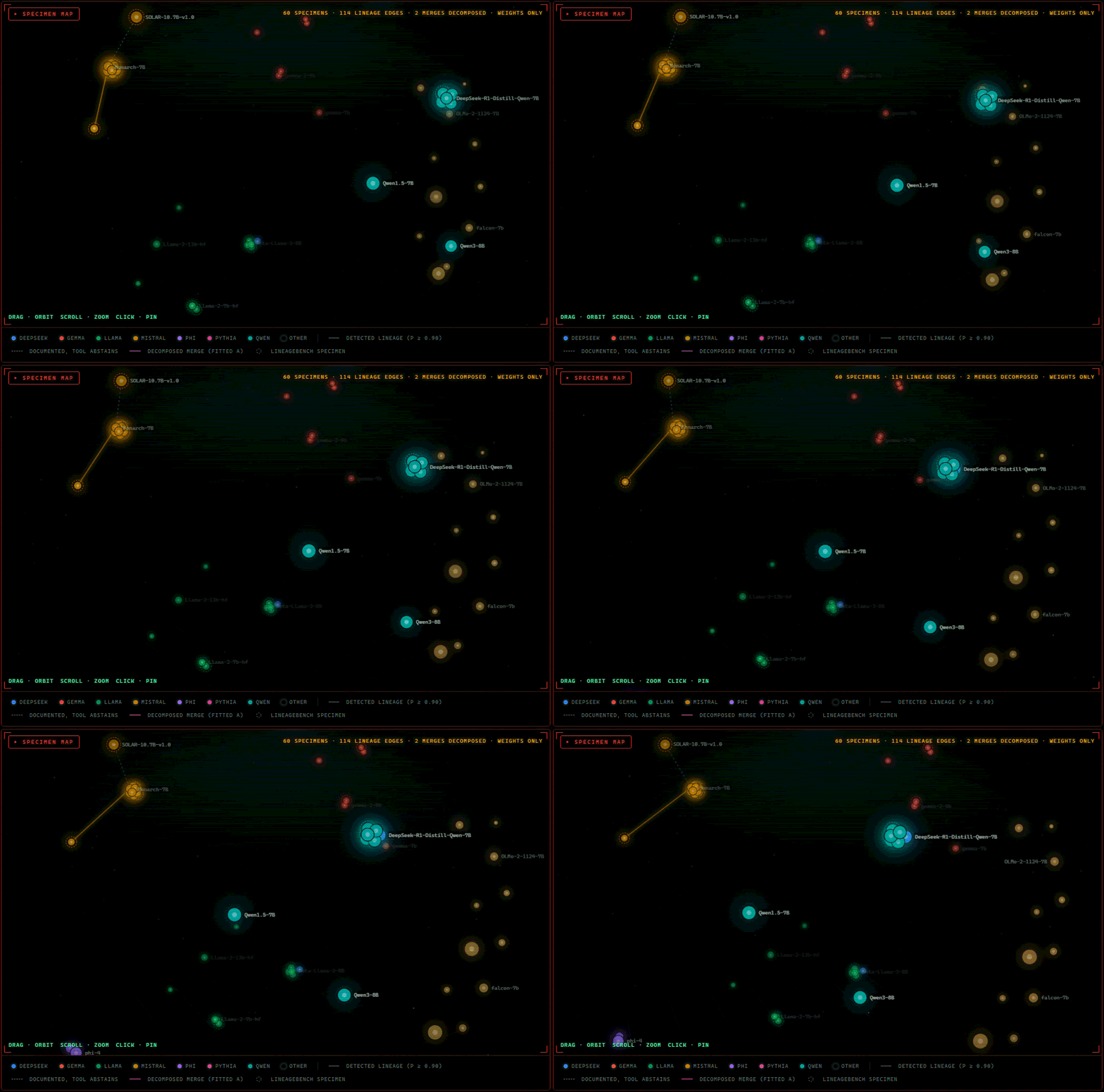
Explore the Atlas — an
interactive family tree of 55 real Hub models reconstructed from weight
evidence alone: hover any edge for the σ-curve, sample-cosine, and spectral
evidence behind it — including the two decomposed merges, drawn as purple
edges labeled with their fitted mixture weights. Regenerate it yourself with python scripts/build_atlas.py.
Scan a model live — paste a Hub repo id into the hosted scanner and get a verdict in a minute or two, no install needed.
Read the tech report
(arXiv:2607.10617) —
modelDNA: Calibrated Lineage Verification and Merge Decomposition from
Sampled Weight Fingerprints (v1.0, July 2026): the fingerprint design, the
calibrated verdict engine, the merge-decomposition math, and every benchmark
number, with sources in paper/.
Build on the data —
the fingerprint DB and inferred lineage graph behind the Atlas, published as
a Hugging Face dataset (models / edges / pairs configs plus the raw
fingerprints and the pullable reference DB), refreshed weekly by CI.
Install
pip install modeldna
Python 3.10+. CPU only — no GPU or torch required.
Quick start
# pull the prebuilt reference DB of known bases (~57 MB, seconds)
modeldna db pull

# …or fingerprint the seed list from the Hub yourself
modeldna db build --limit 10   # quick smoke test, a few minutes
modeldna db build              # full seed list — resumable if interrupted

# scan a model against the DB
modeldna scan mistralai/Mistral-7B-Instruct-v0.3

# test a specific hypothesis pair (the Pangu/Qwen workflow)
modeldna compare suspect-org/model Qwen/Qwen2.5-14B

# what's actually in this merge? estimate the parent mixture
modeldna decompose org/mystery-merge org/hermes-ft org/dolphin-ft \
    --base mistralai/Mistral-7B-v0.1 --layers --mergekit

# machine-readable output, HTML evidence report
modeldna scan org/model --json
modeldna scan org/model --report report.html

# export a fingerprint without judging it
modeldna fingerprint org/model -o fp.json

# raw numbers behind the last verdict
modeldna explain org/model
Local model directories work anywhere a repo id does.
How it works
The safetensors format stores a JSON header (tensor names, shapes, byte offsets) at the start of each shard, and the Hub serves byte ranges over HTTP. modelDNA exploits this to fingerprint a 7B model from roughly 100–300 MB of traffic instead of 15 GB:
- Tier 0 — structure (kilobytes).
config.json, tokenizer hash, and the exact tensor inventory from shard headers. Filters the reference DB down to shape-compatible candidates and catches renamed mirrors outright. - Tier 1 — weight statistics (fast mode, ~100–300 MB). All 1-D tensors (norm gains, attention biases) in full, plus seeded deterministic slices of every attention/MLP projection.
Four signal families are extracted and compared, following the published literature:
| signal | method | after | survives |
|---|---|---|---|
| F1 | per-layer σ-curves of Q/K/V/O projections | arXiv:2507.03014 | SFT, continued pretraining, LoRA-merge |
| F2 | norm-gain / bias vector cosines | arXiv:2507.03014 | heavy training |
| F3 | seeded sampled-parameter cosine (PCS) | HuRef, arXiv:2312.04828 | SFT; the cheapest decisive test |
| F4 | top-k singular-value spectra | arXiv:2511.06390 | permutation / rotation re-parameterization |
Sample positions are pure functions of (seed, canonical role, layer, tensor size), so any two models with matching shapes are sampled at identical element positions — the reference DB stores only the samples, never full weights, which keeps it in the single-digit MB per model.
GGUF repos (the llama.cpp / ollama ecosystem) work the same way: quantized tensors are block-formatted, so an element range maps to a byte range of whole blocks — modelDNA fetches the covering blocks, dequantizes with llama.cpp's reference kernels, and samples the very same positions. A Q4_K_M download compares straight against the fp16 original in the DB; when a repo ships several quants, the highest-fidelity file is used.
A logistic model over the evidence vector produces the calibrated probability, and every reported number ships with the unrelated-pair background distribution measured on the DB itself, because a bare "0.93" convinces nobody.
Merge decomposition
Merges are the hard case for lineage — and the question the model-merging
community actually asks is "what's in this merge?". modeldna decompose
answers it from fingerprints alone:
$ modeldna decompose org/mystery-merge org/hermes-ft org/dolphin-ft --base mistralai/Mistral-7B-v0.1

  MERGE  weights are consistent with a multi-parent merge of the given parents

  candidate                    weight   ± roles   F2 check
  org/hermes-ft                +0.650     0.003      0.646
  org/dolphin-ft               +0.350     0.003      0.353
  mistralai/Mistral-7B (base)  +0.000     0.001     -0.001

  reconstruction cosine 0.99999   best single candidate org/hermes-ft at 0.99977
  mixture removes 94.0% of the residual the best single candidate leaves
The math: mergekit's mainstream methods — linear, slerp, task arithmetic, TIES/DARE — all produce per-tensor weights that are (near-)linear combinations of the parents, and PCS sample positions are pure functions of (seed, role, layer, tensor size), so the same identity holds on the sampled elements. Mixture weights fall out of a least-squares fit on data the fingerprints already contain. Because merge parents are usually fine-tunes of one base (raw cosine 0.99+, hopelessly collinear), the fit is constrained to sum to one — algebraically a regression in task-vector space, where fine-tune directions are nearly orthogonal and the system is well-conditioned.
Validated against real published mergekit configs
(benchmarks/merge_decompose_bench.py, fingerprints cached in the repo):
mlabonne/NeuralPipe-7B-slerp— the per-layer fit recovers the model card's opposite attention/MLP t-curves (anchors[0, .5, .3, .7, 1]and the reverse) at r = 0.999 (attention) and 0.97 (MLP); the only deviations sit at layers where the parents are near-identical, i.e. where the weight is mathematically unidentifiable.mlabonne/Monarch-7B— a dare_ties merge; fitted weights 0.371 / 0.347 / 0.291 vs the published0.36 / 0.34 / 0.30(max error 0.011), base column correctly ~0. The summary hedges to AMBIGUOUS because the Beagle parents themselves share ancestry (task vectors r = 0.987 — the collinearity warning fires), and DARE sparsification bounds the residual shrink: the weights are right, and the hedge is the tool being honest about what the weights alone can prove.- Chain closure:
mlabonne/AlphaMonarch-7Bputs α = 1.000 on its true ancestor Monarch-7B once Monarch is in the candidate list, and 0 on the decoys.
What you get beyond the weights: a per-layer mixture profile (--layers;
gradient/slerp merges show as depth-varying α), an optional base column
(--base) that absorbs un-finetuned mass so task-arithmetic and low-density
DARE merges decompose cleanly, an independent cross-check fitted on the 1-D
norm vectors (F2), a residual statistic that separates "exact merge" from
"merge + fine-tune", and --mergekit to print the nearest linear mergekit
config for the fitted mixture. Parents already in the reference DB are not
re-downloaded.
Verdict classes
Every scan resolves to exactly one class:
| class | meaning |
|---|---|
EXACT_COPY |
weights byte/near-identical to a DB entry (re-upload or renamed mirror) |
QUANTIZED_COPY |
matches a DB entry within quantization noise |
FINE_TUNE |
small parameter delta from one parent (SFT/DPO/LoRA-merged) |
SAME_LINEAGE |
large delta but lineage signals match one parent (continued-pretrain regime) |
LIKELY_MERGE |
evidence splits across ≥2 parents |
SAME_FAMILY_UNRESOLVED |
family-level match, exact parent ambiguous |
NO_MATCH |
no DB parent supported; consistent with independent training or an unindexed base |
INSUFFICIENT |
unsupported format/architecture, or data could not be read |
The tool prefers honest abstention over confident error: thresholds are
conservative, and the README-vs-weights consistency flag fires only when
the repo makes a claim that the weight evidence contradicts at high
confidence.
Exit codes (CI-friendly)
0— weight evidence consistent with the repo's claim (or no claim made)3— weight evidence contradicts the claimed lineage4— lineage unknown (no DB match, or unsupported format)
Reference DB
The fastest way to a working DB is to pull a prebuilt one — fingerprints are small (~55 MB for the full seed list) and derived from public weights:
modeldna db pull # seconds; then a scan only fetches your suspect
db pull fetches the pinned reference-DB release archive from this repo's
GitHub releases (override with --url or MODELDNA_DB_URL; archives are
produced by modeldna db export / the refdb-release workflow). To build it
yourself instead:
modeldna db build fingerprints a seed list of widely-forked bases (Llama,
Qwen, Mistral, Gemma, Phi, DeepSeek, Yi, Falcon, OLMo, …) plus deliberate
hard negatives — OpenLLaMA (same shapes as Llama, independently trained) and
Pythia seed siblings. Gated repos (Llama, Gemma) need a Hugging Face token
with the license accepted on each gated org (huggingface-cli login or
HF_TOKEN) — a read-only token is sufficient, no write scope needed.
The seed list has been run against the live Hub: 37 of 41 entries
indexed, ~55 MB total. The 4 that don't index
(deepseek-ai/deepseek-llm-7b-base, internlm/internlm2-7b,
openbmb/MiniCPM-2B-sft-bf16, openlm-research/open_llama_7b) ship only
PyTorch .bin checkpoints on the Hub, no safetensors — a hard limitation of
the current safetensors-only I/O layer, not a transient failure. Fast mode
plans every byte range it needs up front and fetches them concurrently
(measured: a 7B model in ~2 min on an ordinary connection), so a full build
is a coffee break, not an overnight job. If your connection drops mid-run,
just rerun — db build skips already-indexed entries automatically. Two env
knobs if you need them: MODELDNA_HTTP_CONCURRENCY (parallel range reads,
default 32) and MODELDNA_COALESCE_GAP (merge nearby ranges into one
request, default 64 KiB — raise it on high-latency, high-bandwidth links).
modeldna db list                 # what's indexed
modeldna db info Qwen/Qwen2.5-7B
modeldna db add org/new-base --family my-family
modeldna db remove org/old-base
modeldna db export refdb.tar.gz  # package for publishing / air-gapped machines
modeldna db pull --url refdb.tar.gz --overwrite
There is also a manual fingerprint GitHub Actions workflow: give it Hub
repo ids and it extracts fingerprints on a runner sitting next to the HF
CDN (seconds per model) and uploads them as artifacts — useful for growing
the DB or the benchmark without fetching through your own connection.
The DB lives in ~/.modeldna/db (override with MODELDNA_DB). Entries are
gzipped JSON fingerprints plus a manifest — no weights are ever stored.
Benchmark
benchmarks/synthetic_bench.py runs the evaluation harness on generated
models (independent bases vs fine-tunes, heavy continuations, and fp16
re-casts) and enforces the ship gates in CI: AUROC ≥ 0.99, TPR ≥ 0.95 at
FPR ≤ 1%, and zero false positives on independent same-architecture
controls at the reporting threshold — that last gate is the
defamation-risk surface and is non-negotiable. Current results: AUROC 1.0,
0 false positives, max calibration gap 0.045.
Real-model LineageBench (benchmarks/real_lineagebench.py) runs the
same gates on real Hub weights: 15 suspect models across 6 families whose
parentage is corroborated by the publishing org's own documentation
(fine-tunes, continued-pretrains, official instructs, a merge chain, a
depth-upscale, a GPTQ quantized copy), each judged against all 8 candidate
parents by the actual verdict engine, with 107 wrong-parent and
cross-family comparisons as hard negatives. Results (2026-07-07):
- AUROC 1.0 · TPR@FPR1% 1.0 · 0 false positives at the 0.9 threshold — ship gates PASS. Weakest positive scored 0.9426 (gemma-2b-it); strongest negative 0.6596: clean separation.
- Top-1 parent attribution: 13/13 on the gate pool — every derivative traced to the right base among 8 candidates.
- The two by-design limitation cases behaved exactly as documented: SOLAR
(depth-upscale) → honest
NO_MATCHabstention; GPTQ (quantized-copy) → abstained on packed int4 tensors while still ranking the true parent first. - One caveat, reported not hidden: the merge-chain case (AlphaMonarch)
resolved to the correct family as
SAME_FAMILY_UNRESOLVEDrather thanLIKELY_MERGE— consistent with the stated v0.1 limitation that merges are flagged, not attributed.
The ground truth manifest (benchmarks/lineagebench_pairs.json), the
fingerprint cache, and full per-pair results
(benchmarks/lineagebench_results.json) are committed, so
python benchmarks/real_lineagebench.py --no-fetch reproduces the numbers
without touching the Hub.
LineageBench is published as a named public dataset —
AwaisAdilKhokhar/lineagebench
(ground truth with per-pair citations + this tool's reference results) — and
written up in paper/lineagebench.md. Rebuild and
republish the dataset with python scripts/export_lineagebench.py --push.
Limitations — read before citing a verdict
- Statistical evidence, not proof. Output is always "weights are statistically consistent with derivation from X", never an accusation.
- Distillation is invisible to weight forensics by construction; every weight-space method fails on it. Behavioral methods are on the roadmap and will be labeled experimental.
- Merge attribution needs a candidate list.
modeldna decomposeestimates mixture weights for parents you name; a scan alone flagsLIKELY_MERGEbut cannot enumerate parents the DB has never seen. TIES/DARE sparsification and post-merge fine-tuning show up as residual, not as exact weights; depth-changing merges (passthrough / frankenmerge) are rejected, not decomposed. - Adversarial robustness is bounded. Deliberate permutation/rotation re-parameterization defeats direct-similarity signals (F1–F3); spectral invariants (F4) are the counter, and the report surfaces "low direct similarity, high invariant similarity" as an anomaly pattern that is itself informative. A determined, retraining-scale adversary is out of scope and stated so in every report.
- Depth-upscaled / layer-surgery derivatives are detected as shape mismatches and reported, not resolved (alignment search planned for v0.3).
- Safetensors and GGUF. GGUF repos are fingerprinted by dequantizing
the sampled positions (any ggml quant type, K-quants and IQ included;
llama.cpp's q/k row permutation is undone so positions align with the
original weights). GPTQ/AWQ packed-int4 safetensors still abstain, and
repos that ship exclusively PyTorch
.bin/.ptcheckpoints (deepseek-llm-7b-base,internlm2-7b,open_llama_7b,MiniCPM-2B-sftamong the seed list) can't be fingerprinted at all until.bindecoding is added.
Library use
from modeldna.scan import scan, compare_pair
from modeldna.db.store import ReferenceDB

res = scan("org/model", db=ReferenceDB())
print(res.verdict.verdict, res.verdict.probability)
print(res.to_dict())

fp_a, fp_b, evidence, verdict = compare_pair("org/suspect", "org/alleged-parent")
print(evidence.sigma_r, evidence.pcs_cos_mean)

from modeldna.merge import decompose_targets

dec = decompose_targets("org/mystery-merge", ["org/parent-a", "org/parent-b"],
                        base="org/shared-base", db=ReferenceDB())
print(dec.summary, dec.alphas, dec.gain_vs_single)
Development
git clone https://github.com/AwaisAdilKhokhar/modelDNA
cd modelDNA
pip install -e .[dev]
pytest -q
ruff check src tests benchmarks
python benchmarks/synthetic_bench.py
References
The methods productized here come from, among others:
- HonestAGI, Intrinsic Fingerprint of LLMs (arXiv:2507.03014) — attention σ-curves
- Zeng et al., HuRef (NeurIPS 2024, arXiv:2312.04828) — PCS/ICS comparators
- Ghost in the Transformer (arXiv:2511.06390) — invariant spectral signatures
- Horwitz et al., Model Tree Heritage Recovery (arXiv:2405.18432) and Model Atlas (arXiv:2503.10633) — population-scale lineage recovery
- Are Robust LLM Fingerprints Adversarially Robust? (arXiv:2509.26598) — the threat model
See the technical report (Section 2) for the full research review.
Citing
If you use modelDNA, the atlas dataset, or LineageBench, please cite the technical report (arXiv:2607.10617 · PDF · DOI 10.5281/zenodo.21305586):
@techreport{modeldna2026,
  title         = {modelDNA: Calibrated Lineage Verification and Merge
                   Decomposition from Sampled Weight Fingerprints},
  author        = {Muhammad Awais Bin Adil and Saad Aamir},
  year          = {2026},
  month         = {July},
  eprint        = {2607.10617},
  archivePrefix = {arXiv},
  primaryClass  = {cs.LG},
  doi           = {10.5281/zenodo.21305586},
  url           = {https://arxiv.org/abs/2607.10617},
  note          = {v1.0. Live scanner: huggingface.co/spaces/AwaisAdilKhokhar/modelDNA}
}
License
Apache-2.0
Release history Release notifications | RSS feed

Download files
Download the file for your platform. If you're not sure which to choose, learn more about installing packages.
Source Distribution
Built Distribution
Filter files by name, interpreter, ABI, and platform.
If you're not sure about the file name format, learn more about wheel file names.
Copy a direct link to the current filters
File details
Details for the file modeldna-0.1.0.tar.gz.
File metadata
- Download URL: modeldna-0.1.0.tar.gz
- Upload date:
- Size: 97.4 kB
- Tags: Source
- Uploaded using Trusted Publishing? No
- Uploaded via: twine/6.2.0 CPython/3.14.5
File hashes
| Algorithm | Hash digest | |
|---|---|---|
| SHA256 |
24c59098b02182a4601dca18a5625994b2402ffc58a0b63ac0de8ef7ff1bafd0
|
|
| MD5 |
af36548e5e1eded906faa2802f2780e1
|
|
| BLAKE2b-256 |
437862a827e50dccbd7170a9aa095fa225aed5ac59bf337a3e56c11b1b489e1c
|
File details
Details for the file modeldna-0.1.0-py3-none-any.whl.
File metadata
- Download URL: modeldna-0.1.0-py3-none-any.whl
- Upload date:
- Size: 80.9 kB
- Tags: Python 3
- Uploaded using Trusted Publishing? No
- Uploaded via: twine/6.2.0 CPython/3.14.5
File hashes
| Algorithm | Hash digest | |
|---|---|---|
| SHA256 |
d5d1ffbf1bea35662b1db22075177b06814edd8f5fa34fba2e8fdfcb67bb6899
|
|
| MD5 |
05672f4108d1eaaf98b097b58119b47a
|
|
| BLAKE2b-256 |
9ffe5c8402d59d8b5eaf46a894a1284da2554e15131fb006010f8067a77e117b
|






