
ModelingNeuralDynamics
An Introduction to Modeling Neuronal Dynamics - Christoph Borgers in python




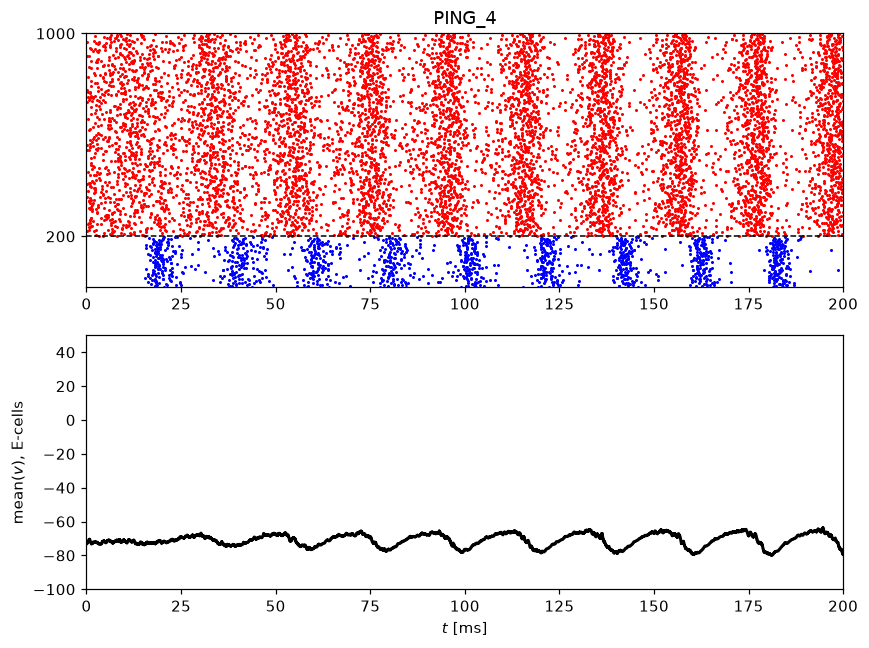
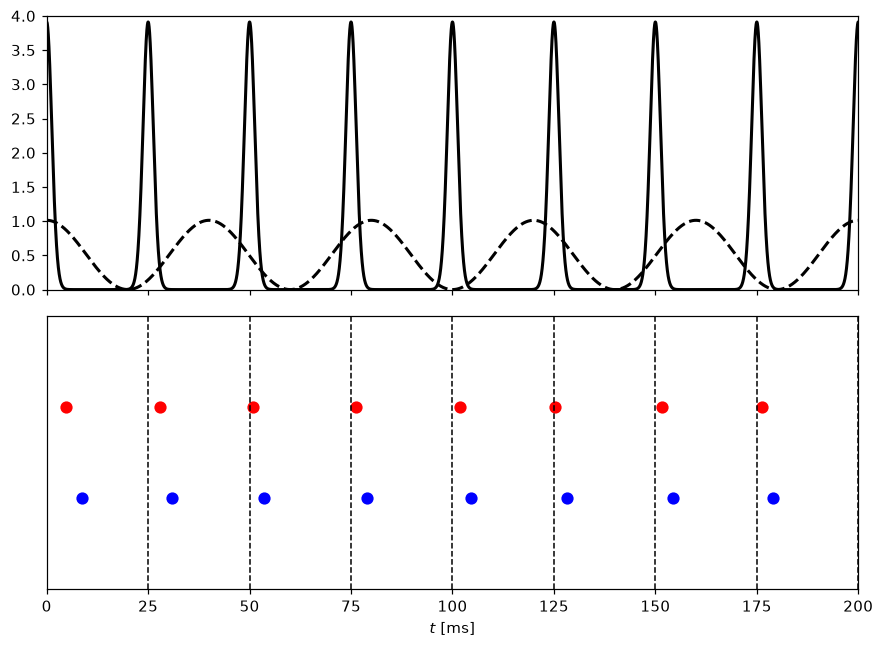
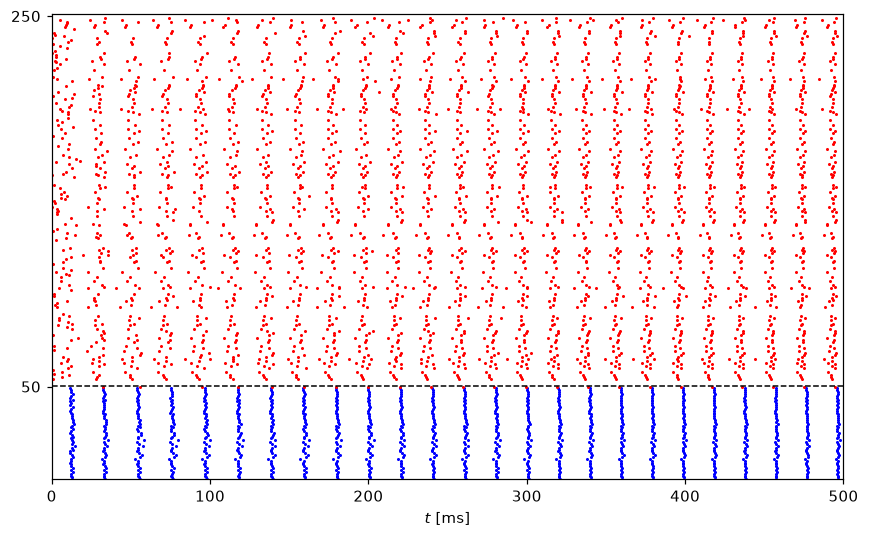
PING gamma rhythm · gamma coherence · PING network with STDP
Installation
The shared helper package used by some chapters is on PyPI:
pip install modelingneuraldynamics
What's supported
Chapters are ported from the book's original MATLAB programs to Python.
Every tracked chapter is now a single, tested chapterNN.ipynb notebook
that installs its own dependencies and opens directly in Colab.
- 38 / 38 tracked chapters converted to notebooks (✅)
- Chapters 2 and 6 have no Python example in the book.
Full chapter-by-chapter status (click to expand)
| # | Chapter | Status | Open |
|---|---|---|---|
| 1 | Modeling a Single Neuron | ✅ Notebook |  guide guide |
| 3 | The Classical HH ODEs | ✅ Notebook | guide |
| 4 | Numerical Solution of HH ODEs | ✅ Notebook | guide |
| 5 | The Simple Model of Neurons in Rodent Brains | ✅ Notebook | guide |
| 7 | Linear Integrate-and-Fire (LIF) Neurons | ✅ Notebook | guide |
| 8 | Quadratic Integrate-and-Fire (QIF) and Theta Neurons | ✅ Notebook | guide |
| 9 | Spike Frequency Adaptation | ✅ Notebook | guide |
| 10 | The Slow-Fast Phase Plane | ✅ Notebook | guide |
| 11 | The Saddle-Node Bifurcation | ✅ Notebook | guide |
| 12 | Two-Dimensional Bifurcation Analysis | ✅ Notebook | guide |
| 13 | Hopf Bifurcations | ✅ Notebook | guide |
| 14 | Model Neurons of Bifurcation Type 2 | ✅ Notebook | guide |
| 15 | Canard Explosions | ✅ Notebook | guide |
| 16 | Model Neurons of Bifurcation Type 3 | ✅ Notebook | guide |
| 17 | Frequency-Current Curves | ✅ Notebook | guide |
| 18 | Bistability Resulting from Rebound Firing | ✅ Notebook | guide |
| 19 | Bursting | ✅ Notebook | guide |
| 20 | Chemical Synapses | ✅ Notebook | guide |
| 21 | Gap Junctions | ✅ Notebook | guide |
| 22 | A Wilson-Cowan Model of an Oscillatory E-I Network | ✅ Notebook | guide |
| 23 | Entrainment by Excitatory Input Pulses | ✅ Notebook | guide |
| 24 | Synchronization by Fast Recurrent Excitation | ✅ Notebook | guide |
| 25 | Phase Response Curves (PRCs) | ✅ Notebook | guide |
| 26 | Phase Locking of Two Oscillators | ✅ Notebook | guide |
| 27 | Phase Locking with Delays | ✅ Notebook | guide |
| 28 | Weakly Coupled Oscillators | ✅ Notebook | guide |
| 29 | Stability of the Synchronous State | ✅ Notebook | guide |
| 30 | The PING Model of Gamma Rhythms | ✅ Notebook | guide |
| 31 | ING Rhythms | ✅ Notebook | guide |
| 32 | M-Current PING and Poisson PING | ✅ Notebook | guide |
| 33 | M-Current PING and PINB | ✅ Notebook | guide |
| 34 | Nested Gamma-Theta Rhythms | ✅ Notebook | guide |
| 35 | Periodic Inhibition | ✅ Notebook | guide |
| 36 | F-I Curves: Pulsed Excitation | ✅ Notebook | guide |
| 37 | Thresholding in PING | ✅ Notebook | guide |
| 38 | Gamma Coherence | ✅ Notebook | guide |
| 39 | Short-Term Depression and Facilitation | ✅ Notebook | guide |
| 40 | Spike-Timing-Dependent Plasticity (STDP) | ✅ Notebook | guide |
Running brian/ chapters on Colab
brian/ holds a separate, Brian2-based implementation, one notebook per
chapter. Every notebook there can also be opened directly in Google
Colab — click a chapter's badge below.
| Chapter | Colab |
|---|---|
| 01 - Modeling a Single Neuron | |
| 04 - Numerical Solution of HH ODEs | |
| 05 - Three Simple Models of Neurons in Rodent Brains | |
| 07 - Linear Integrate and Fire (LIF) Neurons | |
| 08 - Quadratic Integrate and Fire (QIF) and Theta Neurons | |
| 09 - Spike Frequency Adaptation | |
| 20 - Chemical Synapses | |
Introduction
This book is intended as a text for a one-semester course on Mathematical and Computational Neuroscience for upper-level undergraduate and beginning graduate students of mathematics, the natural sciences, engineering, or computer science. An undergraduate introduction to differential equations is more than enough mathematical background. Only a slim, high school-level background in physics is assumed, and none in biology.
Topics include models of individual nerve cells and their dynamics, models of networks of neurons coupled by synapses and gap junctions, origins and functions of population rhythms in neuronal networks, and models of synaptic plasticity.
An extensive online collection of Matlab programs generating the figures accompanies the book.
matlab code gathered from here
Python codes provided by contributors
See the practical Python chapter guides for the concepts, equations, example map, and expected results for every implemented chapter.
1 maintainer

Release files for modelingneuraldynamics 1.1.0
For a detailed explanation of source distributions (sdists) and built distributions (wheels), please see the package formats documentation.
Source distribution (sdist)
| File | Size | Uploaded | |
|---|---|---|---|
| modelingneuraldynamics-1.1.0.tar.gz | 79.0 kB | Details |
Built distribution (wheel)
| File | Interpreter | ABI | Platform | Reset |
|---|---|---|---|---|
| modelingneuraldynamics-1.1.0-py3-none-any.whl | Python 3 | none | any | Details |
Total release size: 97.5 kB
Release files / modelingneuraldynamics-1.1.0.tar.gz
| Download URL | modelingneuraldynamics-1.1.0.tar.gz |
|---|---|
| Size | 79.0 kB |
| Tags | Source |
|
SHA-256 checksum How to use checksums |
22827dc508c02046dfbee755f291619978112a8633d1b4c432448fc112b6f317
|
|
BLAKE2b-256 checksum How to use checksums |
2dbb96b336e4f0f0eadb494aa15bed4c477dfb0543a09f4370bf36509732c22b
|
| Upload date | |
|
Uploaded using Trusted Publishing? What is trusted publishing? |
Yes |
| Uploaded via |
twine/7.0.0 CPython/3.13.14
|
Provenance
Provenance describes where a file came from. On PyPI, provenance is shared via attestations, which provide a verifiable record of the build or publishing details. View details, limitations and caveats.


PyPI Publish Attestation
PyPI verified that this artifact, at this checksum, originated from the publisher listed below.
Signed by GitHub Actions, verified by PyPI on Aug 13, 2026.
Transparency logRelease files / modelingneuraldynamics-1.1.0-py3-none-any.whl
| Download URL | modelingneuraldynamics-1.1.0-py3-none-any.whl |
|---|---|
| Size | 18.5 kB |
| Tags | Python 3 |
|
SHA-256 checksum How to use checksums |
2ec623e3fd2a5395de72b8edaaf842009b5d789fd6cd0346435e7f3bb42eb2c0
|
|
BLAKE2b-256 checksum How to use checksums |
68bb27ac5b350a48da871813435245dd7d9899f84ef7b73b6b025e55645a6296
|
| Upload date | |
|
Uploaded using Trusted Publishing? What is trusted publishing? |
Yes |
| Uploaded via |
twine/7.0.0 CPython/3.13.14
|
Provenance
Provenance describes where a file came from. On PyPI, provenance is shared via attestations, which provide a verifiable record of the build or publishing details. View details, limitations and caveats.
PyPI Publish Attestation
PyPI verified that this artifact, at this checksum, originated from the publisher listed below.
Signed by GitHub Actions, verified by PyPI on Aug 13, 2026.
Transparency log













