
modelstamp
Model files with receipts.





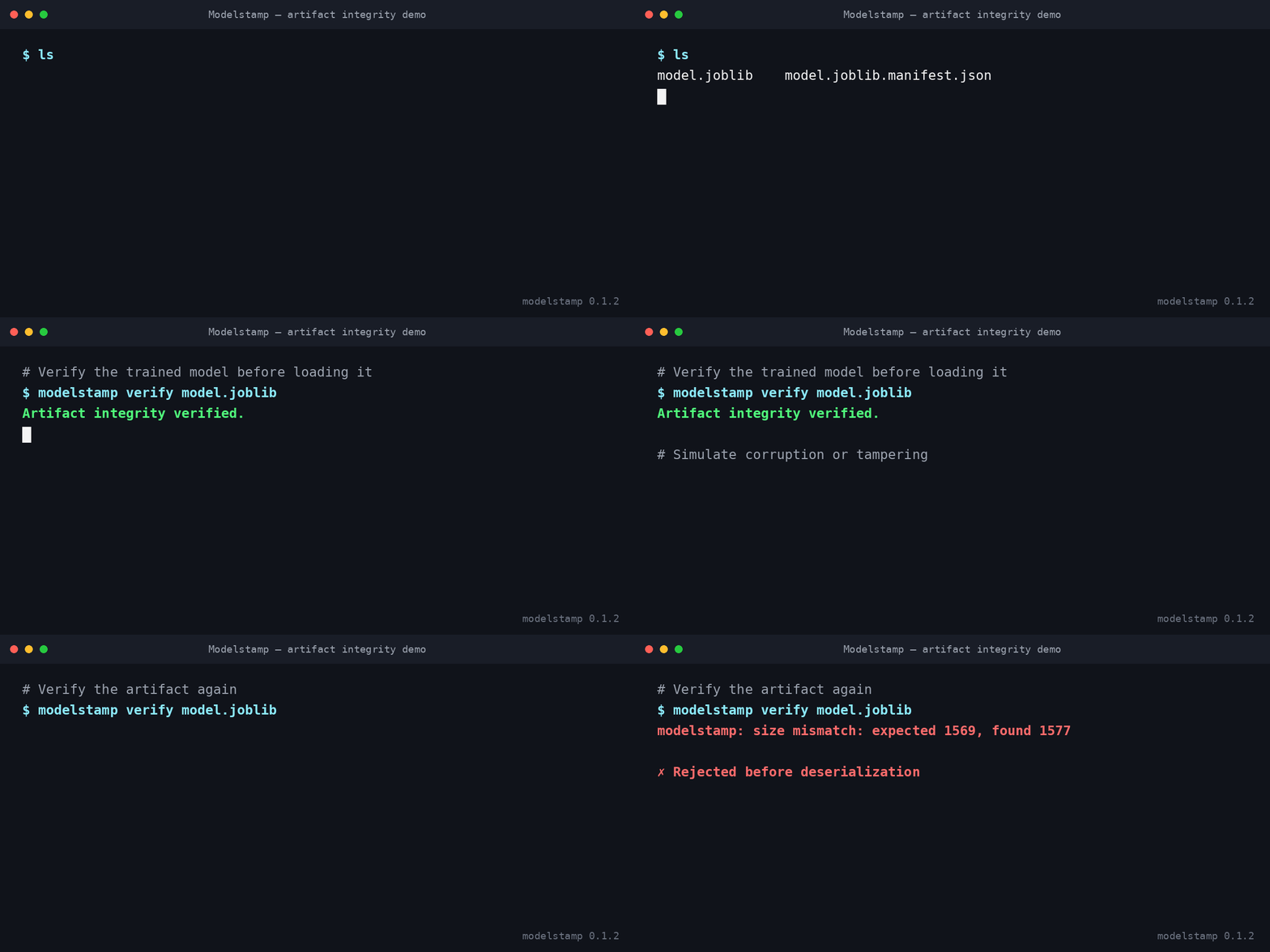
Pre-deserialization verification for persisted Python machine-learning artifacts: detect integrity failures and relevant dependency drift before loading pickle or joblib models.
pip install modelstamp
import modelstamp as ms

model = {"feature_names": ["age", "income"], "weights": [0.3, 0.7]}
ms.save(model, "model.pkl")
restored, manifest = ms.load("model.pkl", on_mismatch="raise")
print(restored, manifest.relevant_packages)
Documentation · Benchmarks · Drift matrix · Preprint · Security policy
modelstamp is a lightweight Python model-persistence layer that records an
artifact's SHA-256 digest, runtime metadata, and artifact-specific dependencies.
It verifies integrity, compares environments, and can authenticate manifests
with HMAC before deserialization. It complements lock files and model registries;
it does not make untrusted pickle or joblib payloads safe to execute.
Loading a persisted model under different dependency versions is unsupported
and may fail or behave differently. The
scikit-learn model-persistence documentation
therefore recommends preserving the training environment alongside the model.
modelstamp packages that practice into a small API.
Research evidence
The current arXiv preprint evaluates 14 controlled environment-drift scenarios, eight controlled trust-boundary scenarios, and verification scaling from 10 MiB to 1 GiB.
Subsequent repository experiments extend that evidence without changing the preprint's historical scope:
- the PyOD baseline compares when dependency-version evidence is evaluated relative to model reconstruction;
- the controlled deserialization-boundary experiment tests whether a relevant pre-load rejection can stop before a harmless reconstruction side effect occurs.
These experiments evaluate verification ordering and its consequence. They do not claim that Modelstamp detects malicious models or makes pickle/joblib safe for untrusted artifacts.
Why modelstamp?
A normal model.pkl remembers the fitted object, but not the environment that
made it work. modelstamp adds the missing receipt:
- Integrity: detect truncated, replaced, or corrupted artifacts.
- Compatibility: identify Python and relevant dependency changes.
- Traceability: record model details, metadata, time, and optional Git state.
- Familiarity: keep using pickle or joblib through
save()andload().
When to use it
Modelstamp is designed for scikit-learn and other persisted Python ML models when you need artifact-level integrity checks, dependency-drift detection, or reproducibility metadata without adopting a full model registry.
It complements lock files and registries: those tools recreate environments or manage model lifecycles, while Modelstamp connects one artifact to its digest and recorded runtime. It does not make untrusted pickle or joblib payloads safe to execute and does not currently provide asymmetric public-key signatures.
See the guides for dependency drift, joblib artifact verification, CI/CD checks, and comparisons with related tools.
Optional joblib support
Install joblib support explicitly when it is not already available in the model environment:
pip install "modelstamp[joblib]"
Save and load
import modelstamp as ms

manifest = ms.save(
    model,
    "model.joblib",
    metadata={"validation_roc_auc": 0.883},
)

model, manifest = ms.load("model.joblib")
Saving creates two files:
model.joblib
model.joblib.manifest.json
The manifest records:
- SHA-256 and byte size of the artifact
- pickle or joblib serialization backend
- model class and scikit-learn pipeline components
- Python, platform, and relevant package versions
- creation time and optional Git commit/worktree status
- caller-provided JSON metadata
load() verifies the artifact before deserializing it. It then compares the
current runtime with the saved runtime and warns when a relevant dependency has
changed.
Relevance follows the persisted model type rather than every installed package. For example, LightGBM's scikit-learn-compatible estimators track scikit-learn alongside LightGBM, NumPy, and SciPy, so embedded sklearn drift is visible before loading. The CI-enforced dependency-drift matrix documents 14 CI-enforced cross-environment, relevant-dependency, and noise-control cases.
Operations targeting the same artifact are serialized across local processes. During loading, verification and deserialization use the same open file so a concurrent replacement cannot bypass the digest check.
Mismatch policy
# Default: verify, then warn about environment changes.
model, manifest = ms.load("model.joblib")

# Refuse to load when the runtime differs.
model, manifest = ms.load("model.joblib", on_mismatch="raise")

# Verify integrity but skip the environment warning.
model = ms.load(
    "model.joblib",
    on_mismatch="ignore",
    return_manifest=False,
)
Integrity failures always raise ArtifactIntegrityError; on_mismatch does not
disable the digest check.
Inspect without loading
manifest = ms.inspect("model.joblib")
report = ms.check("model.joblib")
ms.verify("model.joblib")
The same operations are available from the command line:
modelstamp inspect model.joblib
modelstamp check model.joblib
modelstamp verify model.joblib
You can also use python -m modelstamp in environments where the console
script is not on PATH. inspect validates the manifest structure but does
not authenticate its contents; use verify or check when trust matters.
check exits with status 0 for a clean artifact, 1 for a compatibility or
integrity mismatch, and 2 when the manifest cannot be read.
Signed manifests
A checksum detects accidental corruption, but someone who can replace both files can also create a matching checksum. For artifacts crossing a trust boundary, sign the manifest with a secret key:
import os
import modelstamp as ms

key = os.environ["MODELSTAMP_SIGNING_KEY"].encode()
ms.save(
    model,
    "model.joblib",
    signing_key=key,
    key_id="production-2026-q3",
)
model, manifest = ms.load("model.joblib", signing_key=key)
The signature is an HMAC-SHA-256 over the complete manifest, including the artifact digest. A signed artifact cannot be loaded or verified without its key. Supplying a key also rejects an unsigned manifest, preventing silent downgrades. Keep the key outside source control and separate from the artifact.
HMAC is symmetric, so anyone who can verify with the shared secret can also
forge a valid manifest. modelstamp does not currently provide asymmetric
public-key verification such as Ed25519 or Sigstore.
For CLI verification, name the environment variable containing the key:
modelstamp verify model.joblib --signing-key-env MODELSTAMP_SIGNING_KEY
For key rotation, verify through a registry. The authenticated key_id chooses
the correct secret without changing old artifacts:
keys = {
    "production-2026-q2": old_key,
    "production-2026-q3": current_key,
}
model, manifest = ms.load("model.joblib", signing_keys=keys)
See the signing and key-rotation guide for the migration and security model.
Complete scikit-learn example
from pathlib import Path

from sklearn.datasets import load_iris
from sklearn.linear_model import LogisticRegression
from sklearn.pipeline import make_pipeline
from sklearn.preprocessing import StandardScaler

import modelstamp as ms

X, y = load_iris(return_X_y=True)
pipeline = make_pipeline(StandardScaler(), LogisticRegression(max_iter=500))
pipeline.fit(X, y)

path = Path("iris.joblib")
ms.save(pipeline, path, metadata={"dataset": "iris"})
restored, manifest = ms.load(path)
print(restored.predict(X[:3]))
print(manifest.relevant_packages)

# Safe inspection does not deserialize the model.
print(ms.check(path))

# Corruption is detected before pickle/joblib can execute anything.
path.write_bytes(path.read_bytes() + b"changed")
try:
    ms.verify(path)
except ms.ArtifactIntegrityError as exc:
    print(f"Rejected: {exc}")
Additional standalone examples cover a scikit-learn pipeline, tamper detection,
and HMAC-authenticated manifests in the
examples/
directory.
The model-risk case study provides a runnable trust-boundary matrix for tampering, unsigned replacement, HMAC enforcement, shared-key forgery, and rollback/replay.
API at a glance
| Operation | Purpose | Deserializes the model? |
|---|---|---|
save(model, path) |
Save an artifact and its environment receipt | No |
load(path) |
Verify, compare environments, and load | Yes |
verify(path) |
Check artifact size and SHA-256 | No |
check(path) |
Check integrity and runtime compatibility | No |
inspect(path) |
Read schema-validated, unauthenticated manifest metadata | No |
Security boundary
Pickle and joblib can execute code during loading. The SHA-256 recorded by
modelstamp detects accidental changes and mismatched sidecars; it is not a
digital signature and does not make an untrusted model safe. Only load artifacts
from sources you trust. For a safer serialization format, consider skops.io or
ONNX where they fit your model.
Security issues should be reported according to the security policy.
Supported Python versions
Python 3.8 through 3.13 are declared for the initial release. The package has no required runtime dependency; joblib is optional.
Development
python -m pip install ".[dev]"
pytest
ruff format --check .
ruff check .
python -m build
twine check dist/*
mkdocs build --strict
GitHub Actions runs the test suite on Python 3.8 through 3.13. Publishing is
configured for PyPI Trusted Publishing and runs when a GitHub release is
published. Production releases must use a protected v* tag whose commit is
contained in main; the PyPI deployment also requires maintainer approval.
pyproject.toml is the runtime source of truth for the package version;
modelstamp.__version__ reads the resulting installed distribution metadata.
Release preparation also keeps the human-facing version and date in
CITATION.cff synchronized.
Maintainers should follow the release checklist. A merge
to main does not publish to PyPI by itself, and lockfile-only maintenance does
not require a package release.
Property-based tests exercise malformed manifest structures. Verification throughput for representative artifact sizes is recorded in BENCHMARKS.md, while cross-version compatibility behavior is covered by the dependency-drift matrix.
Contributions are welcome. See the contribution guide for the local development and pull-request workflow.
Citation
The Modelstamp preprint describes the threat model, controlled evaluation, and performance results:
Anagha Dhekne. "Modelstamp: Pre-Deserialization Verification of Machine-Learning Artifacts and Runtime Environment State." arXiv:2609.01781, 2026.
For software citation metadata and the archived release, use
CITATION.cff and the
Zenodo software DOI.
Maintainer
License
MIT
1 maintainer

Metadata
1 maintainer
Release files for modelstamp 0.1.5
For a detailed explanation of source distributions (sdists) and built distributions (wheels), please see the package formats documentation.
Source distribution (sdist)
| File | Size | Uploaded | |
|---|---|---|---|
| modelstamp-0.1.5.tar.gz | 321.2 kB | Details |
Built distribution (wheel)
| File | Interpreter | ABI | Platform | Reset |
|---|---|---|---|---|
| modelstamp-0.1.5-py3-none-any.whl | Python 3 | none | any | Details |
Total release size: 341.7 kB
Release files / modelstamp-0.1.5.tar.gz
| Download URL | modelstamp-0.1.5.tar.gz |
|---|---|
| Size | 321.2 kB |
| Tags | Source |
|
SHA-256 checksum How to use checksums |
1523cb9a95714d646a4c2ad0eb0ecc5e019e6e826180eb18ca1e82dfd265b714
|
|
BLAKE2b-256 checksum How to use checksums |
a18e1e2fa8cf15f6adbd130ab70dd9b6ccfa825ee052cac86c017009b54d5e0a
|
| Upload date | |
|
Uploaded using Trusted Publishing? What is trusted publishing? |
Yes |
| Uploaded via |
twine/7.0.0 CPython/3.13.14
|
Provenance
Provenance describes where a file came from. On PyPI, provenance is shared via attestations, which provide a verifiable record of the build or publishing details. View details, limitations and caveats.


PyPI Publish Attestation
PyPI verified that this artifact, at this checksum, originated from the publisher listed below.
Signed by GitHub Actions, verified by PyPI on Sep 3, 2026.
Transparency logRelease files / modelstamp-0.1.5-py3-none-any.whl
| Download URL | modelstamp-0.1.5-py3-none-any.whl |
|---|---|
| Size | 20.5 kB |
| Tags | Python 3 |
|
SHA-256 checksum How to use checksums |
3036d4efbf11566c3837b2bd871906aa58e3fd75f18f2590fb11ef8e9ca6662d
|
|
BLAKE2b-256 checksum How to use checksums |
45e75a3dea3ca9cb7bd72aacf34b233a50eddcb637b2465704d66c8d455c05ab
|
| Upload date | |
|
Uploaded using Trusted Publishing? What is trusted publishing? |
Yes |
| Uploaded via |
twine/7.0.0 CPython/3.13.14
|
Provenance
Provenance describes where a file came from. On PyPI, provenance is shared via attestations, which provide a verifiable record of the build or publishing details. View details, limitations and caveats.
PyPI Publish Attestation
PyPI verified that this artifact, at this checksum, originated from the publisher listed below.
Signed by GitHub Actions, verified by PyPI on Sep 3, 2026.
Transparency log













