
modern-yolonas
A clean, minimal reimplementation of YOLO-NAS — no factories, no registries, no OmegaConf. Just PyTorch.






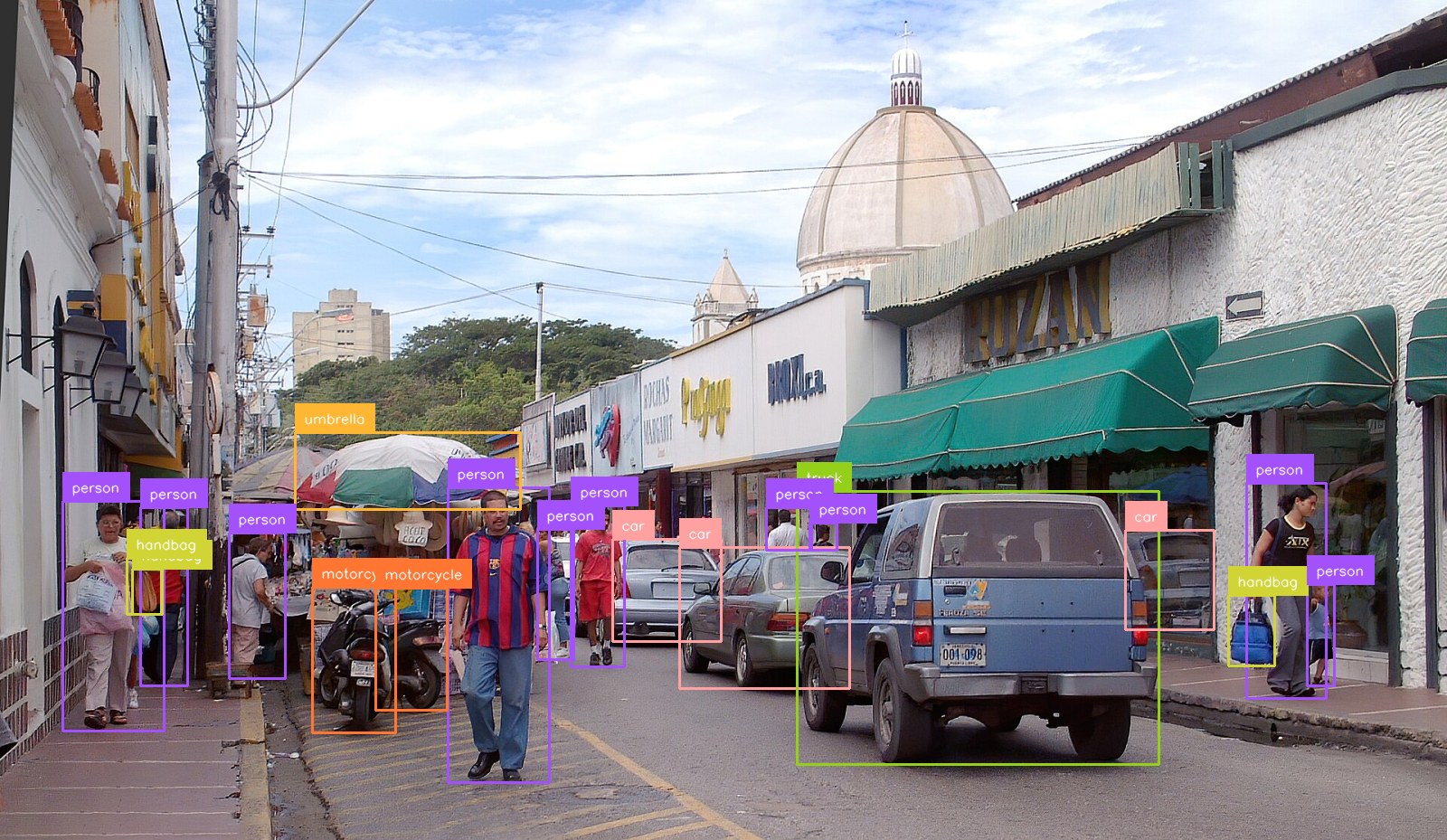
YOLO-NAS-L, confidence 0.40. Source photo by Wilfredor, CC0.
Live demo · Documentation · Changelog · Contributing · Issues
modern-yolonas is YOLO-NAS object detection rewritten so you can read the whole thing:
a model variant is a function, a config is a dataclass, and there is no layer of indirection
that exists only to be configurable. state_dict keys match
super-gradients exactly, so the original
pretrained COCO checkpoints load with strict=True.
Detections come back as supervision Detections,
so every annotator, tracker, zone and metric in that ecosystem works on them out of the box.
Training runs on Lightning, and the model exports to ONNX and OpenVINO — including a
self-contained graph for Frigate.
🚀 Updates
- [2026-09-18]
v0.5.0— training moved to PyTorch Lightning; quantization (yolonas quantizefor PTQ,yolonas qatfor QAT) ontorch.ao.quantizationFX graph mode; accuracy is now measured by this project rather than quoted; two mAP bugs and a mosaic bug fixed; license changed from MIT to Apache-2.0 for the source. - [2026-09-18]
v0.4.0—YoloNASDetectorreturnssupervision.Detections, so results slice and plug into the supervision ecosystem directly. - [2026-02-05]
v0.1— initial release: S/M/L architectures, pretrained weight loading, training, COCO evaluation, and ONNX export.
🏆 Model Zoo
Box AP on COCO val2017, all 5000 images, at 640×640. There is nothing to download by hand —
yolo_nas_s(pretrained=True) and YoloNASDetector("yolo_nas_s") fetch and cache Deci's COCO
checkpoints on first use (they carry Deci's own non-commercial terms — see License below).
| Model | Params | GFLOPs | Latency (ms) | AP | AP50 | AP75 | APS | APM | APL |
|---|---|---|---|---|---|---|---|---|---|
| YOLO-NAS-S | 19.05M | 33.9 | 8.22 | 47.3 | 64.4 | 51.8 | 28.5 | 52.9 | 63.6 |
| YOLO-NAS-M | 51.18M | 94.2 | 14.08 | 51.3 | 68.3 | 56.0 | 33.6 | 57.0 | 68.1 |
| YOLO-NAS-L | 66.98M | 129.0 | 17.89 | 52.0 | 69.1 | 56.9 | 34.5 | 57.4 | 68.5 |
Every column is measured here, not quoted — regenerate the whole table with
uv run examples/model_table.py --coco <coco-root> --half.
How these numbers were measured, and what they do and do not mean
Latency is PyTorch FP16 on an RTX 3060 Laptop, batch 1, model forward only (no preprocessing, no NMS), median of 30 runs. TensorRT on the same GPU is roughly an order of magnitude faster. Leaderboards that publish T4 TensorRT latency are not measuring the same thing, so those columns should not be read side by side.
Accuracy is measured with NMS at IoU 0.70, which a sweep found to be the optimum.
postprocess still defaults to 0.65 for interactive use, where fewer overlapping boxes
matters more than a tenth of AP.
The weights are Deci's pretrained COCO checkpoints, so this measures the architecture as reimplemented here, not weights trained by this project. Deci publishes 47.5 / 51.5 / 52.2, so roughly 0.2 is unaccounted for — the model table lists the protocol differences that were tested and ruled out, and does not guess at the rest. Numeric agreement with super-gradients is verified far more tightly: class scores are bit-identical.
📦 Installation
uv add modern-yolonas
# or
pip install modern-yolonas
Optional extras: [onnx], [openvino], [fiftyone], [benchmark], [serve], [demo], [tensorboard], [wandb].
⚡ Quick Start
YoloNASDetector picks CUDA when it is available and falls back to CPU, so the examples below run
anywhere. Pass device="cuda", "cpu" or a torch.device to choose explicitly.
Detect objects in an image
import cv2
from modern_yolonas import YoloNASDetector

det = YoloNASDetector("yolo_nas_s")

image = cv2.imread("image.jpg")
detections = det(image)  # an sv.Detections

for box, score, name in zip(detections.xyxy, detections.confidence, detections.data["class_name"]):
    x1, y1, x2, y2 = box
    print(f"{name}: {score:.2f} [{x1:.0f}, {y1:.0f}, {x2:.0f}, {y2:.0f}]")

# Save annotated image
cv2.imwrite("output.jpg", det.annotate(image, detections))
Because the result is a supervision container, filtering is slicing:
people = detections[detections.class_id == 0]
confident = detections[detections.confidence > 0.5]
big = detections[detections.box_area > 5000]
and it plugs straight into the rest of the ecosystem:
import supervision as sv

zone = sv.PolygonZone(polygon=my_polygon)
inside = detections[zone.trigger(detections)]

heatmap_annotator = sv.HeatMapAnnotator()
frame = heatmap_annotator.annotate(frame, detections)
Detect objects in a video
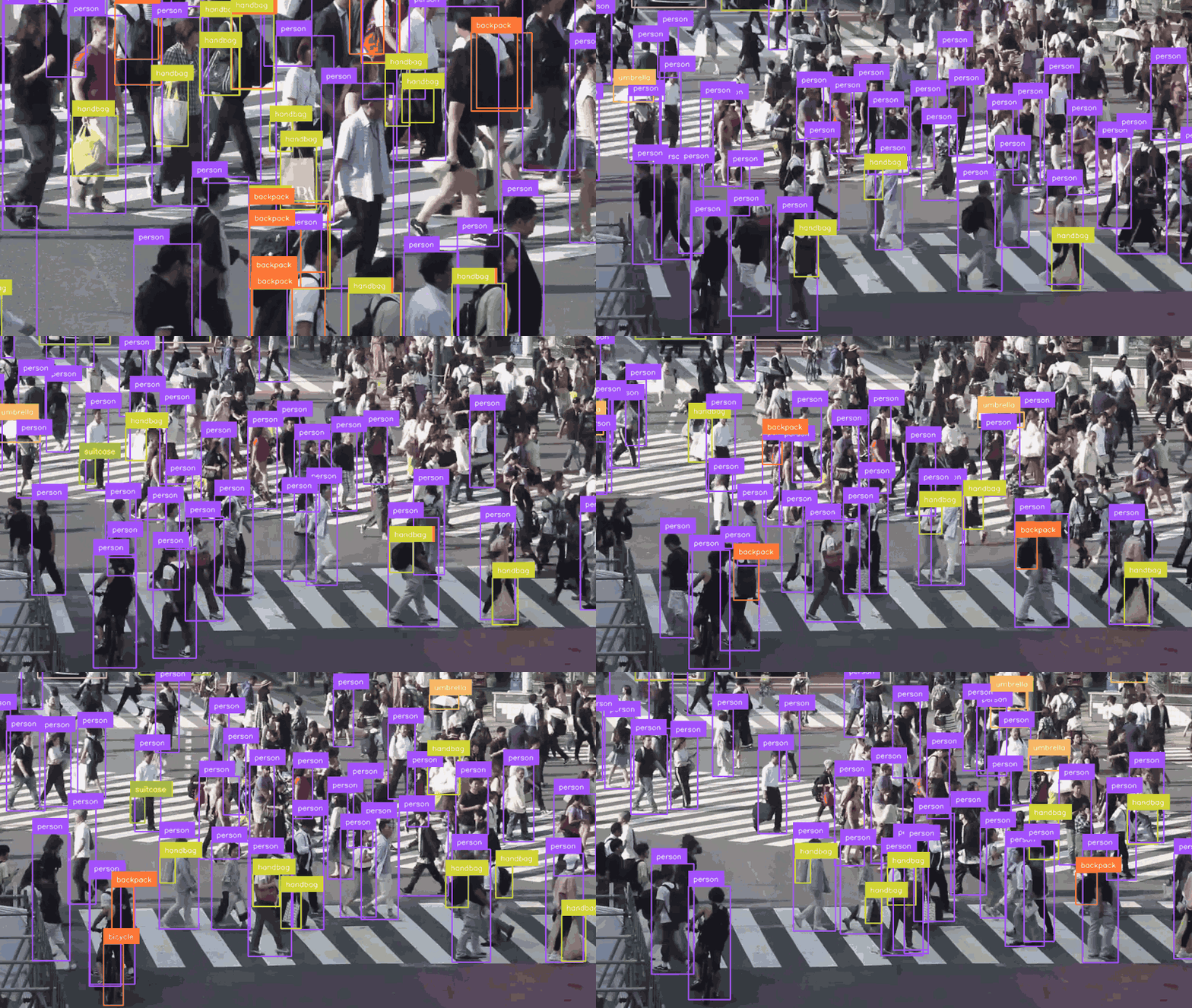
YOLO-NAS-L at confidence 0.25, ~70 detections per frame. Clip by Basile Morin, CC BY-SA 4.0 — so this clip, unlike the rest of the repository, is CC BY-SA rather than Apache-2.0.
from modern_yolonas import YoloNASDetector

det = YoloNASDetector("yolo_nas_s")

# Option 1: Write annotated video directly
stats = det.detect_video_to_file("input.mp4", "output.mp4")
print(f"{stats['total_detections']} detections across {stats['total_frames']} frames")

# Option 2: Iterate frames for custom logic
for frame_idx, frame, detections in det.detect_video("input.mp4"):
    print(f"Frame {frame_idx}: {len(detections)} objects")
    # detections.xyxy, .confidence, .class_id are numpy arrays
    # det.annotate(frame, detections) returns the annotated BGR frame
Live webcam detection
import cv2
from modern_yolonas import YoloNASDetector

det = YoloNASDetector("yolo_nas_s")

for frame_idx, frame, detections in det.detect_video(source=0):  # 0 = default camera
    cv2.imshow("YOLO-NAS", det.annotate(frame, detections))
    if cv2.waitKey(1) & 0xFF == ord("q"):
        break
cv2.destroyAllWindows()
Low-level model API
import torch
from modern_yolonas import yolo_nas_s

model = yolo_nas_s(pretrained=True).eval().cuda()
x = torch.randn(1, 3, 640, 640).cuda()
pred_bboxes, pred_scores = model(x)
# pred_bboxes: [1, 8400, 4] — x1y1x2y2 pixel coordinates
# pred_scores: [1, 8400, 80] — class probabilities
🖥️ CLI
Full reference: CLI docs.
# Detect in images
yolonas detect --model yolo_nas_s --source image.jpg --conf 0.25
yolonas detect --model yolo_nas_l --source images/ --output results/

# Detect in video
yolonas detect --model yolo_nas_s --source video.mp4 --output results/
yolonas detect --model yolo_nas_m --source video.mp4 --skip-frames 2 --conf 0.3

# Training
yolonas train --model yolo_nas_s --data /path/to/dataset --format yolo --epochs 100

# Evaluation
yolonas eval --model yolo_nas_s --data /path/to/coco --split val2017

# Export (needs the extras: pip install "modern-yolonas[onnx]" / [openvino])
yolonas export --model yolo_nas_s --format onnx --output model.onnx
yolonas export --model yolo_nas_s --format openvino --output model.xml

# Export for Frigate (embeds preprocessing + NMS in the graph)
yolonas export --model yolo_nas_s --format onnx --target frigate
yolonas export --model yolo_nas_s --format openvino --target frigate --input-size 320
Frigate integration
The --target frigate export produces a self-contained model that accepts raw uint8 BGR
input and outputs a flat [D, 7] tensor with [batch, x1, y1, x2, y2, confidence, class_id].
detectors:
  ov:
    type: openvino
    device: GPU

model:
  model_type: yolonas
  width: 320
  height: 320
  input_tensor: nchw
  input_pixel_format: bgr
  path: /config/model_frigate.xml
📚 Tutorials
Step-by-step notebooks in tutorials/:
| Topic | Notebook | Description |
|---|---|---|
| Roboflow | roboflow/01_explore_dataset.ipynb |
Download from Roboflow + explore |
roboflow/02_finetune.ipynb |
Fine-tune + evaluate + visualize | |
| FiftyOne | fiftyone/01_explore_dataset.ipynb |
Load from FiftyOne Zoo + explore |
fiftyone/02_finetune.ipynb |
Fine-tune + evaluate + visualize | |
| Export | export_onnx.ipynb |
ONNX export from any checkpoint |
| Quantization | quantization_ptq.ipynb |
Post-Training Quantization |
quantization_qat.ipynb |
Quantization-Aware Training | |
| Inference | inference_onnx.ipynb |
ONNX Runtime inference |
Examples
Start with the notebook — install, detect, visualize, and inspect the raw model output in one pass:
Or the standalone scripts in examples/:
parity_check.py— verify this implementation matches super-gradients (writesdocs/benchmarks/parity.md)bench_devices.py— latency across CPU / Intel iGPU / NVIDIA dGPU and FP32 / FP16 / INT8 (writesdocs/benchmarks/latency_matrix.md)detect_image.py— run detection on a single imagedetect_video.py— run detection on a video filedetect_webcam.py— live webcam detection
🛠️ Development
uv sync --dev
uv run pre-commit install

uv run pytest tests/ -v
uv run ruff check src/ tests/
Contributions are welcome. Please read CONTRIBUTING.md — it lists the API design principles a change is reviewed against — and the Code of Conduct.
📄 License
Apache-2.0 — applies to the source code only. See LICENSE.
Pretrained weights notice: the pretrained COCO weights downloaded by this library (via
pretrained=True) are provided by Deci AI and are subject to
Deci's YOLO-NAS license,
which restricts commercial use and redistribution. The Apache-2.0 license of this repository
does not cover them. If you train your own weights from scratch, those are entirely yours.
🙏 Acknowledgments
This project is a clean-room reimplementation of the YOLO-NAS architecture originally
developed by Deci AI and published in their
super-gradients library (Apache-2.0). The model
architecture, module structure and state_dict key naming were derived from the
super-gradients source to enable pretrained weight compatibility.
It also builds directly on supervision, PyTorch Lightning and OpenVINO.
Thanks to everyone who has contributed — in particular Alan Neves, whose work on augmentations, metrics, gradient accumulation, the ONNX export path and super-gradients parity shaped much of the training stack.
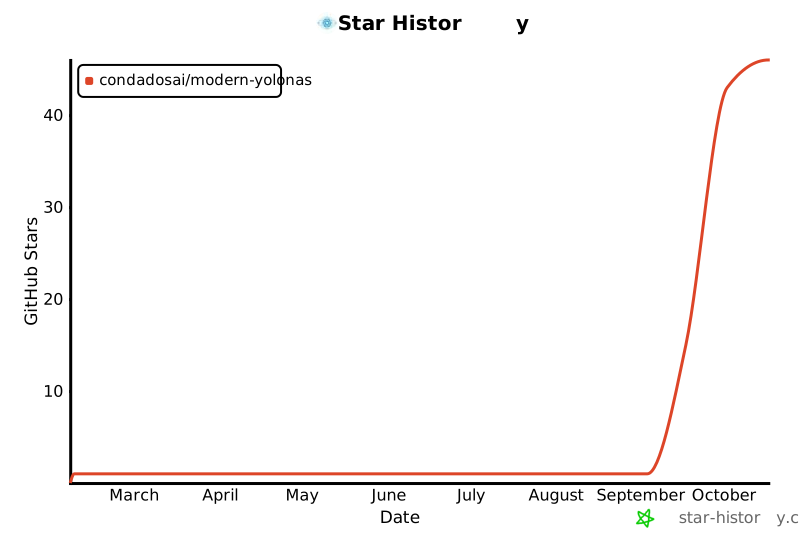
⭐ Star History
📖 Citation
If you use modern-yolonas in your research or project, please cite it:
@software{condados2026modernyolonas,
  author       = {Condados, Luis and Neves, Alan},
  title        = {modern-yolonas: A Clean Reimplementation of YOLO-NAS},
  year         = {2026},
  url          = {https://github.com/CondadosAI/modern-yolonas},
  license      = {Apache-2.0}
}
1 maintainer

Metadata
1 maintainer
Release files for modern-yolonas 0.5.0
For a detailed explanation of source distributions (sdists) and built distributions (wheels), please see the package formats documentation.
Source distribution (sdist)
| File | Size | Uploaded | |
|---|---|---|---|
| modern_yolonas-0.5.0.tar.gz | 6.9 MB | Details |
Built distribution (wheel)
| File | Interpreter | ABI | Platform | Reset |
|---|---|---|---|---|
| modern_yolonas-0.5.0-py3-none-any.whl | Python 3 | none | any | Details |
Total release size: 7.0 MB
Release files / modern_yolonas-0.5.0.tar.gz
| Download URL | modern_yolonas-0.5.0.tar.gz |
|---|---|
| Size | 6.9 MB |
| Tags | Source |
|
SHA-256 checksum How to use checksums |
87d272b75c6d3e493d391461b4259b0fb61ef1940f31edd3788f13f1794e8286
|
|
BLAKE2b-256 checksum How to use checksums |
55508a0e28930842b6e61769c9fba05765a9d8f7faa3eaf4a9bd155afcce54cf
|
| Upload date | |
|
Uploaded using Trusted Publishing? What is trusted publishing? |
Yes |
| Uploaded via |
twine/7.0.0 CPython/3.13.14
|
Provenance
Provenance describes where a file came from. On PyPI, provenance is shared via attestations, which provide a verifiable record of the build or publishing details. View details, limitations and caveats.


PyPI Publish Attestation
PyPI verified that this artifact, at this checksum, originated from the publisher listed below.
Signed by GitHub Actions, verified by PyPI on Sep 19, 2026.
Transparency logRelease files / modern_yolonas-0.5.0-py3-none-any.whl
| Download URL | modern_yolonas-0.5.0-py3-none-any.whl |
|---|---|
| Size | 111.1 kB |
| Tags | Python 3 |
|
SHA-256 checksum How to use checksums |
c9a459ec101ef4c0fdac8dc944cffb650d0c06e15833f5d1f8db12465cddb048
|
|
BLAKE2b-256 checksum How to use checksums |
8436af08c9f1ee84effbea101edead545fb0cb06b13536feb5a3cd83eb932714
|
| Upload date | |
|
Uploaded using Trusted Publishing? What is trusted publishing? |
Yes |
| Uploaded via |
twine/7.0.0 CPython/3.13.14
|
Provenance
Provenance describes where a file came from. On PyPI, provenance is shared via attestations, which provide a verifiable record of the build or publishing details. View details, limitations and caveats.
PyPI Publish Attestation
PyPI verified that this artifact, at this checksum, originated from the publisher listed below.
Signed by GitHub Actions, verified by PyPI on Sep 19, 2026.
Transparency log













