
MOFA-FLEX




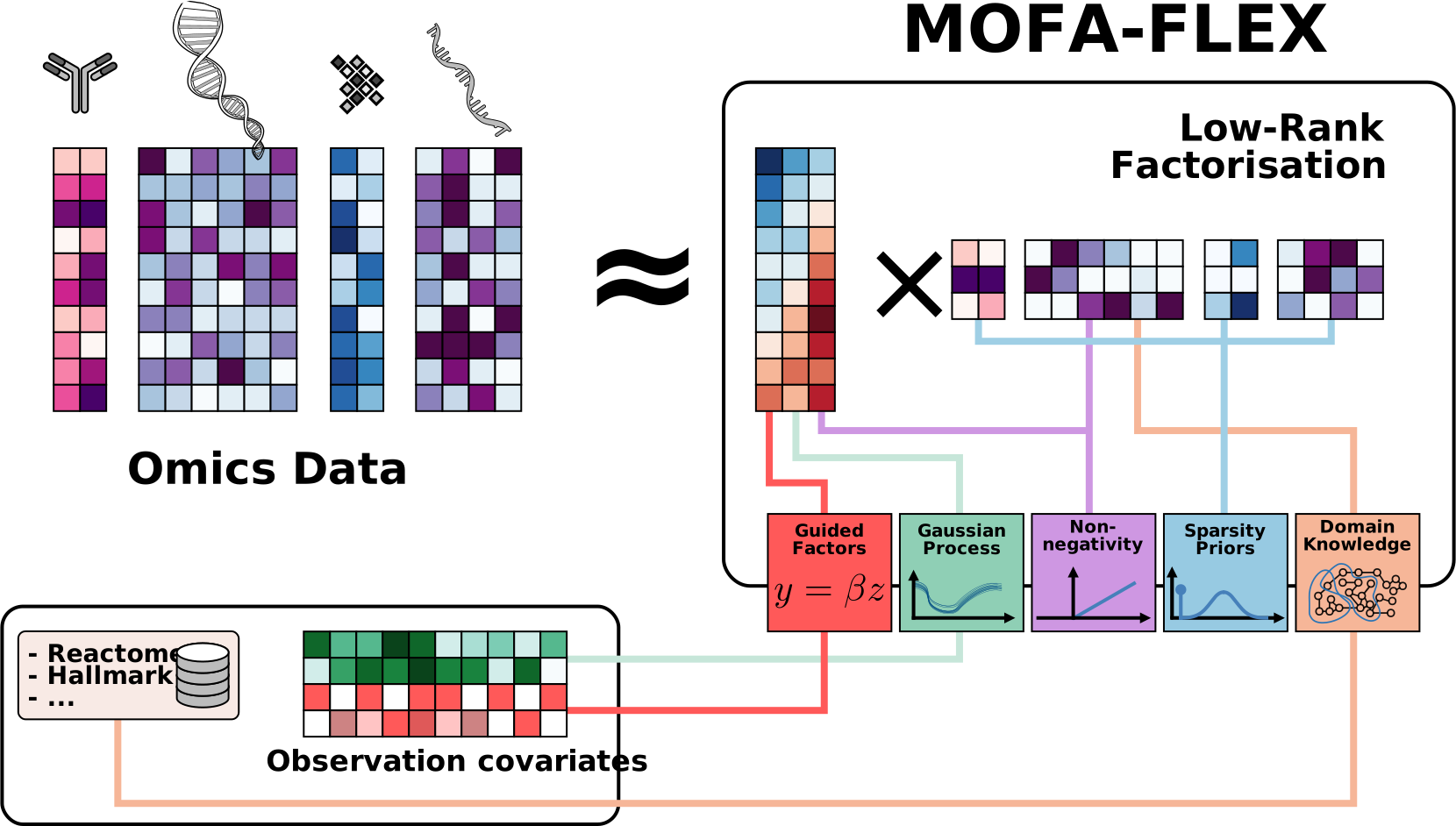
MOFA-FLEX is a versatile factor analysis framework designed to streamline the construction and training of complex matrix factorisation models for omics data. It is built on a probabilistic programming-based Bayesian factor analysis framework that integrates concepts from multiple existing methods while remaining modular and extensible. MOFA-FLEX generalises widely used matrix factorisation tools by incorporating flexible prior options (including structured sparsity priors for multi-omics data and covariate-informed priors for spatio-temporal data), non-negativity constraints, and diverse data likelihoods - allowing users to mix and match components to suit their specific needs. Additionally, MOFA-FLEX introduces a novel module for integrating prior biological knowledge in the form of gene sets or, more generally, variable sets, enabling the inference of interpretable latent factors linked to specific molecular programs.
Getting started
Please refer to the documentation. In particular, the
Installation
You need to have Python 3.11 or newer installed on your system. If you don't have Python installed, we recommend installing Micromamba.
There are several alternative options to install MOFA-FLEX:
- Install the latest release of MOFA-FLEX from PyPI:
pip install mofaflex
- Install the latest development version:
pip install git+https://github.com/bioFAM/mofaflex.git@main
Release notes
See the changelog.
Contact
For questions and help requests, you can reach out in the discussions. If you found a bug, please use the issue tracker.
Citation
If you use MOFA-FLEX in your work, please cite
Qoku A, Rohbeck M, Walter FC, Kats I, Stegle O, and Buettner F. MOFA-FLEX: A Factor Model Framework for Integrating Omics Data with Prior Knowledge. Preprint at bioRxiv (2025). DOI: 10.1101/2025.11.03.686250.
BibTeX
@article {mofaflex,
	author = {Qoku, Arber and Rohbeck, Martin and Walter, Florin Cornelius and Kats, Ilia and Stegle, Oliver and Buettner, Florian},
	title = {MOFA-FLEX: A Factor Model Framework for Integrating Omics Data with Prior Knowledge},
	eprint = {2025.11.03.686250},
	year = {2025},
	doi = {10.1101/2025.11.03.686250},
	URL = {https://www.biorxiv.org/content/early/2025/11/04/2025.11.03.686250},
	archiveprefix = {bioRxiv}
}
1 maintainer

Metadata
1 maintainer
Release files for mofaflex 0.1.2
For a detailed explanation of source distributions (sdists) and built distributions (wheels), please see the package formats documentation.
Source distribution (sdist)
| File | Size | Uploaded | |
|---|---|---|---|
| mofaflex-0.1.2.tar.gz | 32.1 MB | Details |
Built distribution (wheel)
| File | Interpreter | ABI | Platform | Reset |
|---|---|---|---|---|
| mofaflex-0.1.2-py3-none-any.whl | Python 3 | none | any | Details |
Total release size: 32.2 MB
Release files / mofaflex-0.1.2.tar.gz
| Download URL | mofaflex-0.1.2.tar.gz |
|---|---|
| Size | 32.1 MB |
| Tags | Source |
|
SHA-256 checksum How to use checksums |
2518c0d9a519675f113c544587374bc9c36c7be919f8cf94364389a50c764331
|
|
BLAKE2b-256 checksum How to use checksums |
9f86d933ce812750894a63978456a5a4fb15fb00b48bcac6d0f0c180a45437a9
|
| Upload date | |
|
Uploaded using Trusted Publishing? What is trusted publishing? |
Yes |
| Uploaded via |
twine/6.1.0 CPython/3.13.13
|
Provenance
Provenance describes where a file came from. On PyPI, provenance is shared via attestations, which provide a verifiable record of the build or publishing details. View details, limitations and caveats.


PyPI Publish Attestation
PyPI verified that this artifact, at this checksum, originated from the publisher listed below.
Signed by GitHub Actions, verified by PyPI on Jul 8, 2026.
Transparency logRelease files / mofaflex-0.1.2-py3-none-any.whl
| Download URL | mofaflex-0.1.2-py3-none-any.whl |
|---|---|
| Size | 105.0 kB |
| Tags | Python 3 |
|
SHA-256 checksum How to use checksums |
e7abd80c955ec15806d8d131b84b68740a3e973f844313fcf190aeaa7cd1e274
|
|
BLAKE2b-256 checksum How to use checksums |
202919a66d27058d855de50f5299a9ab83827a2fa2f3c5251da387260d650139
|
| Upload date | |
|
Uploaded using Trusted Publishing? What is trusted publishing? |
Yes |
| Uploaded via |
twine/6.1.0 CPython/3.13.13
|
Provenance
Provenance describes where a file came from. On PyPI, provenance is shared via attestations, which provide a verifiable record of the build or publishing details. View details, limitations and caveats.
PyPI Publish Attestation
PyPI verified that this artifact, at this checksum, originated from the publisher listed below.
Signed by GitHub Actions, verified by PyPI on Jul 8, 2026.
Transparency log













