
English · Español
mograph




An MCP server that drives Adobe Illustrator and After Effects, and moves artwork between them as editable shape layers.
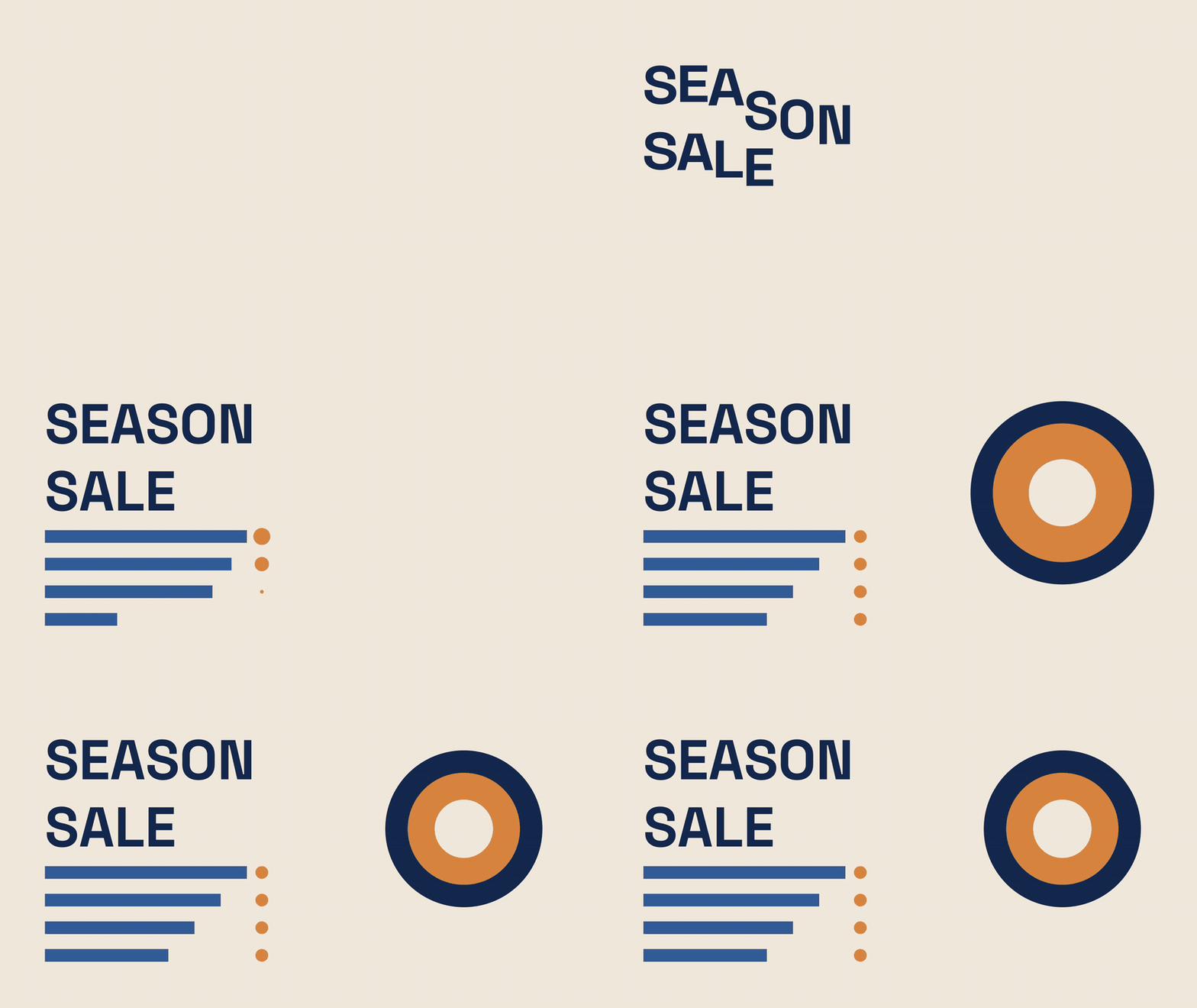
Nothing above was drawn by hand. The artwork was built in Illustrator, moved
into After Effects with ai_to_ae_push, animated with ae_animate — the
letters rise in sequence, the bars wipe open from their left edge, the badge
overshoots and settles — and rendered with ae_aerender. Every step is a tool
call in this server.
Point an AI agent at a storyboard and it can read the artwork, clean it up, transfer a frame into After Effects as real shape layers — bezier curves, strokes, gradients, the group hierarchy rebuilt as parented nulls — animate it, and then render both sides to tell you how far apart they are.
Not affiliated with Adobe. "Adobe", "Illustrator" and "After Effects" are trademarks of Adobe Inc. This is an independent project that automates applications you already own, through Adobe's own scripting interfaces.
What it looks like in use
You talk to your agent; it calls the tools. A session usually goes:
You:   Look at the open Illustrator document and tell me what's in frame 3.
       → ai_see_document returns the render inline, ai_frame_tree the structure

You:   That price list should be six groups, not 40 loose paths. Fix it.
       → ai_cluster_items proposes, you approve, ai_apply_clusters applies

You:   Push frame 3 into After Effects, skip the subtitles.
       → ai_to_ae_push rebuilds it as shape layers, roles labelled

You:   Animate the rows in, staggered from the bottom.
       → ae_set_anchors, then ae_animate with anticipation and settle

You:   How close is it to the original?
       → ai_to_ae_verify renders both and answers with a number
Four of those sequences ship as MCP Prompts, so a client can offer them as a starting point rather than making you remember the order.
Status
| Windows | macOS | |
|---|---|---|
Illustrator (ai_*) |
✅ tested end to end (COM) | ⚠️ implemented, never run (osascript) |
After Effects (ae_*) |
✅ tested (CEP + WebSocket) | ⚠️ should work — CEP is cross-platform — but untested |
Illustrator → After Effects (ai_to_ae_*) |
✅ tested against real client files | ⚠️ untested |
| Unit tests | ✅ | ✅ (no Adobe needed, run anywhere) |
Verified against Illustrator 2026 (30.x) and After Effects 2026 on Windows 11. Older releases are likely to work — the panel declares After Effects 16.0 and up, and the Illustrator side uses long-standing ExtendScript — but they have not been run, so treat that as unverified rather than supported.
macOS is written and has never been run. That is not a soft "should be
fine". The known risks are itemised in AGENTS.md.
Protocol: MCP revision 2026-07-28 on the official Python SDK 2.x
(mcp>=2,<3). Transport is stdio only — this drives desktop applications, so it
is bound to one machine by design.
Install
Requires Python 3.10+ and the Adobe applications you intend to drive.
pip install mograph-mcp
mograph-mcp register codex     # or: claude, zcode
mograph-mcp doctor             # what this machine can and cannot do
register --print shows the config instead of writing it, for a client that is
not one of the three. For Claude Code, claude mcp add mograph -- mograph-mcp
works directly.
Whatever route you take, the entry needs a generous per-tool timeout. After
Effects takes 20–40 seconds to answer the first script of a cold session, and a
client that gives up at its own default aborts while the server is still
working — which reads as a hang rather than as a slow first call. register
sets it where the client supports it.
Illustrator needs nothing else. After Effects needs the panel below.
After Effects: the panel
After Effects has no COM interface, so this reaches it through a small CEP extension that runs inside the application and connects back to the server over a local WebSocket. Two ways to install it, and the difference is worth a moment.
Signed package — recommended
Download mograph-bridge.zxp from
Releases:
mograph-mcp install-panel --zxp mograph-bridge.zxp
It loads with PlayerDebugMode off, so nothing about your Adobe installation
changes. The command hands the package to Adobe's own installer
(UnifiedPluginInstallerAgent, which ships with Creative Cloud, or ExManCmd).
Useful flags: --print shows the command without running it, --installer <path> points at a tool in an unusual place, --list asks Adobe what it
believes is installed.
The certificate is self-signed, so the installer reports an unverified
publisher. That is accurate — a certificate from a public authority costs money
and buys nothing here except an Adobe Exchange listing. Build your own with
python scripts/sign_panel.py if you would rather not trust this one, or use
ZXPInstaller to install the same file by hand.
Folder copy — for development
mograph-mcp install-panel
Faster, and what you want while changing the panel itself. Adobe treats a copied
folder as unsigned, so this enables PlayerDebugMode — a setting that lets
CEP load unsigned extensions, all of them and not just this one, and that
stays on after the panel is removed. It lowers a defence in your Adobe
installation, so it is worth doing on purpose rather than by default.
Either way
Restart After Effects and open Window → Extensions → mograph bridge. It should say "Connected and authenticated" once your MCP client has started the server.
Skipping the panel is fine — everything on the Illustrator side works without
it. Details, the manual install and what each disconnect code means are in
docs/panel.md.
What it can do
The authoritative list is whatever the server returns from tools/list. By
family:
Illustrator (ai_*, 57 tools). Documents, layers and items; export.
Inspection and triage of a delivered file (ai_inspect_document,
ai_audit_for_animation, ai_audit_structure). Grouping derived from
geometry, for when a file's hierarchy does not match what the eye reads as one
thing (ai_cluster_items + ai_apply_clusters). Naming that survives the trip
(ai_auto_name_items, ai_propagate_names). Reading frames and comparing them
(ai_frame_tree, ai_diff_frames, ai_track_frames). Layout and reframing.
After Effects (ae_*, 59 tools). Projects, comps, layers; effects and
expressions; keyframes, easing and interpolation. ae_animate writes
entrances and exits with anticipation, overshoot and settle — the parts that are
not in a storyboard and are what stop an interpolation looking dead.
ae_stagger orders layers by where they actually are in the comp, walking
the parent chain. Anchors and parenting, render queue, and headless rendering
with ae_aerender (wait=False returns a handle instead of holding the call
open; ae_render_status polls it).
Between them (ai_to_ae_*, 2 tools). ai_to_ae_push and ai_to_ae_verify.
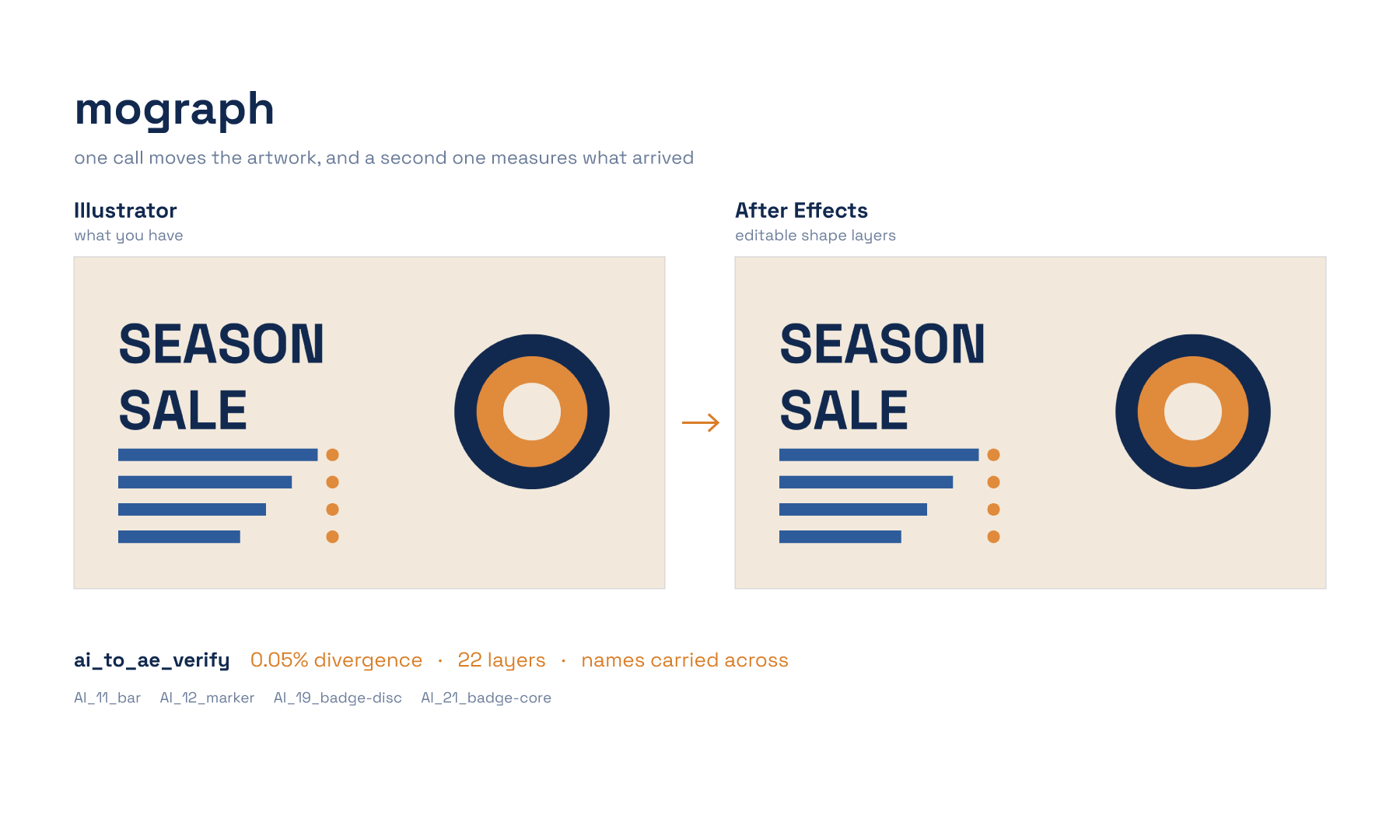
The right-hand panel is what After Effects returned after the push; the 0.05%
is what ai_to_ae_verify measured between the two renders. The layer names
travelled because the source had named groups — that is the whole difference.
The coordinate maths — the Y flip, artboard-to-comp scaling, bezier handles to
tangents, gradient endpoints — lives in mapping.py as pure functions with unit
tests, so it is verifiable without either application.
Renders come back as images
ai_see_document, ae_see_frame and ai_contact_sheet return the PNG inline,
not just a path on disk. A path only works if the client happens to have
filesystem access and happens to think of reading it, and the protocol promises
neither — a poor foundation for the tools everything else is verified with.
Images are downscaled to max_dim=1024 on the long side by default; the file
path is still in the reply, and max_dim=0 returns the path alone.
Field notes are served on demand
Many tools carry substantial notes — the traps, why each default is what it is,
what breaks. Loading all of that into every session would cost thousands of
tokens before the first question, so tools/list carries what a tool does and
when to use it, and the rest is fetched only if you want it:
docs://guia— which tools have extended notesdocs://tools/<name>— the full notes for one
Three recipes to start from
The tool list says what each tool does. It cannot say which one comes next, and the order is where the costly mistakes live — grouping before looking, pushing every frame instead of the last, parenting before anchoring. Those sequences are MCP Prompts:
- Prepare a delivered Illustrator file — inspect, clean and group before animating anything
- Turn a storyboard into motion — a run of frames to keyframes
- Push artwork to After Effects and verify it — the transfer, and the part people skip
- Review an animation you just built — look at it, measure what you see, and fix what a verify score cannot show
Configuration
The full tool set is ~18,500 tokens of tools/list, paid at connect time. A
session that will only touch one application does not need the other half:
MOGRAPH_TOOLS=ai            # Illustrator only  -> 57 tools, ~9,000 tokens
MOGRAPH_TOOLS=ae            # After Effects only
MOGRAPH_TOOLS=ai,symbiosis  # Illustrator plus the transfer
MOGRAPH_TOOLS=all           # everything (default)
An invalid name is a startup error rather than an empty server: exposing zero tools looks exactly like a broken installation.
Every tool ships annotations and a readable title, so a client can
auto-approve reads and ask only about mutations. Failures arrive as protocol
errors, not as successful calls with a failure buried in the body.
| Variable | Default | What it does |
|---|---|---|
MOGRAPH_WORKSPACE |
~/mograph |
Where files land. A root declared by the client wins over it |
MOGRAPH_TOOLS |
all |
Which tool families to expose |
MOGRAPH_WS_PORT |
9123 |
Bridge port; must match the panel |
MOGRAPH_ALLOW_RAW_SCRIPT |
1 |
0 drops ai_run_script and ae_run_script |
MOGRAPH_PORT_TAKEOVER |
0 |
1 kills whatever holds the bridge port |
MOGRAPH_BRIDGE_AUTH |
1 |
0 accepts an unauthenticated panel — unsafe |
MOGRAPH_AI_APPNAME |
Adobe Illustrator |
macOS only, if the app name differs |
Security
Local only, the bridge is authenticated, and two tools can run arbitrary
code. The server mints a token per run, writes it where only a local process
can read it, and refuses both a second panel connection and any browser-origin
handshake. The full threat model is in SECURITY.md.
Known limitations
- Gradients keep their geometry and lose their middle stops. Measured: a two-stop gradient, linear or radial, arrives with a mean channel error of 0.2/255 — angle, extent and centre exact. A three-stop one arrives at 19.8/255, because only the first and last colours survive. After Effects does not expose a shape layer's multi-stop gradient to scripting at all, so this is a limit of the host. The push reports every gradient it flattened and names the colours it dropped. Patterns, brushes and mesh objects are skipped with a warning.
- After Effects' first call of a session takes 20–40s; the bridge waits 60s
(
MOGRAPH_EVAL_TIMEOUT). - One panel at a time, by design — a second connection is refused rather than silently displacing the first.
- No live feedback. Nothing reacts to events in the applications; every exchange starts from a tool call.
- macOS is untested. See the table above.
Troubleshooting
The AE tools say no panel is connected. Open After Effects and the mograph bridge panel. Code 4401 means After Effects is still running the old
main.js from memory — restart it. 4409 means another server already holds a
panel. mograph-mcp doctor names which panels are installed, which port each
dials, and whether a session token is present.
The bridge port is busy. The error names the PID holding it. Stop that
process, or set MOGRAPH_PORT_TAKEOVER=1.
Illustrator does not connect. On Windows, COM launches it. On macOS, if
several versions are installed and it picks the wrong one, set
MOGRAPH_AI_APPNAME="Adobe Illustrator 2026". Error -1743 is the Automation
permission prompt: approve it in System Settings → Privacy & Security →
Automation.
Shapes land in the wrong place after a push. The mapping scales the artboard onto the comp; if their aspect ratios differ, it distorts. Use a comp the same size as the artboard.
A gradient lost a colour. See Known limitations. Check degraded in the
push reply, which names each flattened layer and the colours it dropped.
Development
python -m pip install -e ".[dev]"
python -m pytest tests/ -q        # no Adobe required
python -m ruff check .
With both applications open and the panel connected:
python scripts/smoke_fidelity_ai.py   # Illustrator only, does not touch the bridge port
python scripts/smoke_fidelity_ae.py   # round trip, reads bezier + stroke back out of AE
python scripts/smoke_gradient.py      # gradient round trip, axis included
python scripts/smoke_stroke.py        # dashes, draw-on, and the shape of the ease
dev_reload swaps backend code in place without restarting the client, which
covers most of the debugging loop. It cannot add or rename a tool — the list is
handed to the client once, at connect time.
CONTRIBUTING.md has the ground rules,
AGENTS.md the accumulated field notes about how these two
applications actually behave, CHANGELOG.md what changed in
each version, and ROADMAP.md what is known to be left.
Licence
Apache-2.0. "Adobe", "Illustrator" and "After Effects" are trademarks
of Adobe Inc.; this project is not affiliated with them and ships no Adobe code.
See NOTICE.
1 maintainer

Download files
Download the file for your platform. If you're not sure which to choose, learn more about installing packages.
Source Distribution
Built Distribution
Filter files by name, interpreter, ABI, and platform.
If you're not sure about the file name format, learn more about wheel file names.
Copy a direct link to the current filters
File details
Details for the file mograph_mcp-0.10.0.tar.gz.
File metadata
- Download URL: mograph_mcp-0.10.0.tar.gz
- Upload date:
- Size: 380.4 kB
- Tags: Source
- Uploaded using Trusted Publishing? Yes
- Uploaded via: twine/7.0.0 CPython/3.13.15
File hashes
| Algorithm | Hash digest | |
|---|---|---|
| SHA256 |
2133aafd7cc6122eb4b40dd0ad800d63867acaea461a1b661cd79541812fc68e
|
|
| MD5 |
a9d069a20ce5d1511d0001044446f93b
|
|
| BLAKE2b-256 |
91d104ce6c4651387d48defdd27651d5f8acffd1398933ee0690fd058eb525dc
|
File details
Details for the file mograph_mcp-0.10.0-py3-none-any.whl.
File metadata
- Download URL: mograph_mcp-0.10.0-py3-none-any.whl
- Upload date:
- Size: 293.4 kB
- Tags: Python 3
- Uploaded using Trusted Publishing? Yes
- Uploaded via: twine/7.0.0 CPython/3.13.15
File hashes
| Algorithm | Hash digest | |
|---|---|---|
| SHA256 |
4869b55f4964d50215e2aac415b319b2cb341f1244200765e4a0a5afee90f721
|
|
| MD5 |
eb39b6498379dcd4f87033c6620453e3
|
|
| BLAKE2b-256 |
9a93f85a5ffe57b73c53f6762f0a1d9981b47d15e07cc031d0d306be890a09e5
|







