
MOL — The Cognitive Programming Language with auto-tracing pipelines

Project description
MOL — The IntraMind Programming Language









The pipeline language for AI, data, and automation — with auto-tracing built in.
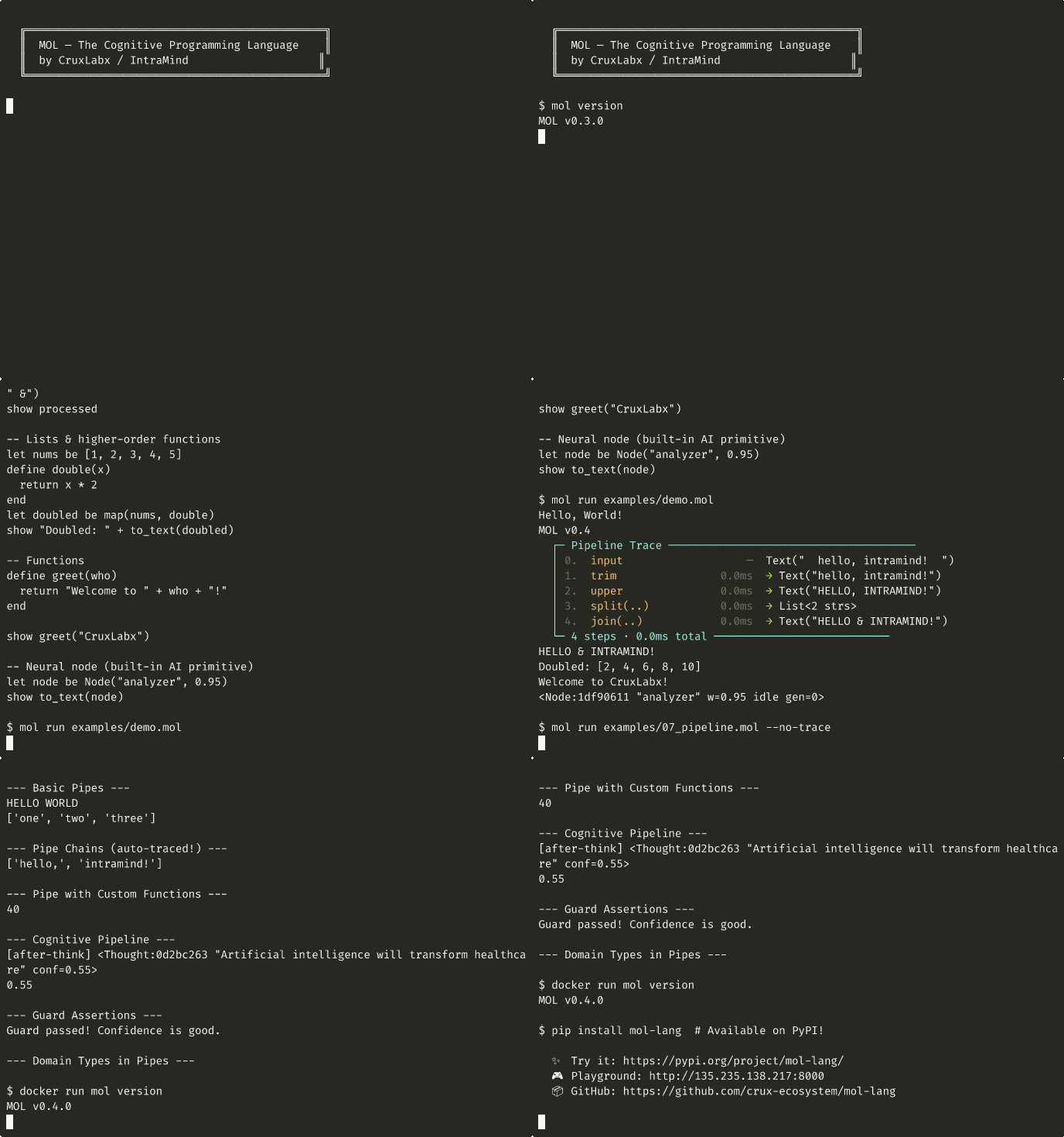
Why MOL Exists
Every AI pipeline today is glue code — Python scripts stitching together LangChain, LlamaIndex, vector DBs, and LLMs with no visibility into what happens between steps. MOL fixes this.
| Problem | How Python/JS Handle It | How MOL Handles It |
|---|---|---|
| Pipeline Debugging | Add print() everywhere, use logging libs |
Auto-tracing built into |> — every step timed & typed automatically |
| Data Flow Visibility | No native pipe operator | |> operator — data flows left-to-right, traced at every stage |
| Type Safety for AI | Generic dicts, no domain types | First-class types: Thought, Memory, Node, Document, Chunk, Embedding |
| RAG Boilerplate | 50+ lines of setup code | One expression: doc |> chunk(512) |> embed |> store("index") |
| Safety Rails | Hope for the best | guard assertions + access control at the language level |
| Portability | Rewrite in each language | Transpiles to Python and JavaScript from single .mol source |
The Killer Feature: |> with Auto-Tracing
No other language has this combination:
| Language | Pipe Operator | Auto-Tracing | AI Domain Types | RAG Built-in |
|---|---|---|---|---|
| Python | No | No | No | No |
| Elixir | |> |
No | No | No |
| F# | |> |
No | No | No |
| Rust | No | No | No | No |
| MOL | |> |
Yes | Yes | Yes |
Use Cases
MOL is purpose-built for domains where pipeline visibility and readable code directly reduce debugging time and onboarding cost.
🔬 AI & ML Pipelines
Every RAG pipeline is invisible glue code. MOL makes every stage visible — automatically.
let index be doc |> chunk(512) |> embed("model-v1") |> store("kb")
let answer be retrieve(query, "kb", 5) |> think("answer this")
guard answer.confidence > 0.5 : "Low confidence"
Auto-trace output — zero configuration, every step timed:
  ┌─ Pipeline Trace ──────────────────────────────────────
  │ 0.  input                   ─  <Document "data.txt">
  │ 1.  chunk(512)          0.1ms  → List<5 Chunks>
  │ 2.  embed("model-v1")   0.2ms  → List<5 Embeddings>
  │ 3.  store("kb")         0.0ms  → <VectorStore "kb">
  └─ 3 steps · 0.4ms total ───────────────────────────
📊 Data Processing & ETL
Smart higher-order functions eliminate boilerplate. Filter, transform, and aggregate with one-liner pipes.
let sales be load_data("sales.json")

-- Top performers: filter → sort → extract
let top_reps be sales |>
  filter("closed") |>
  where(fn(s) -> s["amount"] > 15000) |>
  sort_by("amount") |>
  pluck("rep")

-- Revenue summary
let total be sales |> filter("closed") |> pluck("amount") |> sum_list
let avg be sales |> pluck("amount") |> mean
🛠️ DevOps & Automation
Log analysis, monitoring, SLA validation — with guard assertions and built-in statistics.
let logs be load_data("app.log")

let errors be logs |>
  where(fn(l) -> l["level"] == "ERROR") |>
  group_by("service")

let p95 be logs |> pluck("latency") |> percentile(95)
guard p95 < 1000 : "P95 latency exceeds SLA"
Why Teams Choose MOL
| Benefit | How |
|---|---|
| 60-80% less debugging time | Auto-tracing replaces manual print()/logging |
| Lower onboarding cost | Reads like English, not like Perl |
| Audit-ready pipelines | Every execution is traced and timed |
| Safe scripting | Sandboxed execution for production environments |
| No vendor lock-in | Transpiles to Python or JavaScript |
📖 See full examples: Use Cases Documentation
🚀 v2.0 — Kernel-Grade Evolution
MOL v2.0 introduces 5 major systems that transform MOL from a scripting language into kernel-grade infrastructure for Neural Kernel and De-RAG / Sovereign Memory.
| Feature | What It Does | Functions Added |
|---|---|---|
| 🛡️ Memory Safety | Rust-inspired borrow checker with own, borrow, transfer, release, lifetime |
6 new AST constructs |
| 📐 Native Vectors | First-class Vector type with SIMD-like ops, ANN search, quantization |
25 functions (vec_*) |
| 🔐 Integrated Encryption | Homomorphic encryption (Paillier), symmetric crypto, zero-knowledge proofs | 15 functions (he_*, sym_*, zk_*) |
| ⚡ JIT Tracing | Self-optimizing hot-path detection, type specialization, inline caching | 7 functions (jit_*) |
| 🌐 Swarm Runtime | Multi-node distributed execution, consistent hashing, MapReduce | 12 functions (swarm_*) |
Total: 210 stdlib functions (up from 162 in v1.1)
Memory Safety — Own, Borrow, Release
-- Declare owned variable (exclusive ownership)
let own buffer be [1, 2, 3, 4, 5]

-- Multiple immutable borrows are allowed
let ref reader1 be borrow buffer
let ref reader2 be borrow buffer

-- Transfer ownership (original becomes invalid)
transfer buffer to new_owner

-- Lifetime scopes auto-drop at end
lifetime request_scope do
    let own temp be "scoped resource"
end
Native Vector Engine — De-RAG Nanosecond Retrieval
-- Create and operate on vectors as primitives
let a be vec(1.0, 0.0, 0.0)
let b be vec(0.0, 1.0, 0.0)
show vec_cosine(a, b)            -- 0.0
show vec_distance(a, b)          -- 1.414

-- Text to vector embedding + ANN search
let idx be vec_index("knowledge_base", 32)
vec_index_add(idx, vec_from_text("quantum computing", 32), "quantum")
vec_index_add(idx, vec_from_text("machine learning", 32), "ml")
let results be vec_index_search(idx, vec_from_text("deep learning", 32), 2)
Integrated Encryption — Compute on Ciphertext
-- Homomorphic encryption: add encrypted values without decrypting
let keys be crypto_keygen(512)
let enc_a be he_encrypt(42, keys)
let enc_b be he_encrypt(18, keys)
let enc_sum be he_add(enc_a, enc_b)
show he_decrypt(enc_sum, keys)   -- 60 (computed on ciphertext!)

-- Zero-knowledge proofs
let commitment be zk_commit("secret")
show zk_verify("secret", commitment["commitment"], commitment["blinding"])
Self-Optimizing JIT — Hot-Path Recompilation
-- JIT automatically traces and optimizes hot functions
define fibonacci(n)
    let a be 0
    let b be 1
    let i be 0
    while i < n do
        let temp be b
        set b to a + b
        set a to temp
        set i to i + 1
    end
    return a
end

-- After 50+ calls, JIT specializes for int fast-paths
show jit_stats()
show jit_hot_paths()
Swarm Runtime — The Network IS the Computer
-- Initialize a 5-node simulated cluster
let cluster be swarm_init(5, 2)

-- Shard data across nodes via consistent hashing
let data be ["weight_1", "weight_2", "weight_3", "weight_4"]
swarm_shard(data, cluster, "hash")

-- MapReduce over the swarm
let mapped be swarm_map(cluster, fn(d) -> len(d))
let total be swarm_reduce(mapped, fn(acc, v) -> acc + v)

-- Dynamic scaling
swarm_add_node(cluster)
swarm_rebalance(cluster)
Installation
Quick Start
pip install mol-lang
mol version
⚠️ Getting
externally-managed-environmenterror? (Python 3.12+ on Ubuntu/Debian/Fedora) Your OS blocks system-wide pip installs (PEP 668). Use one of these instead:
Option A: Use pipx (installs in isolation)
# Ubuntu/Debian
sudo apt install pipx && pipx ensurepath

# macOS
brew install pipx && pipx ensurepath

# Windows (PowerShell)
python -m pip install --user pipx && python -m pipx ensurepath

# Then install MOL:
pipx install mol-lang
Option B: Use a Virtual Environment
# Linux/macOS
python3 -m venv mol-env && source mol-env/bin/activate

# Windows (PowerShell)
python -m venv mol-env; mol-env\Scripts\Activate.ps1

pip install mol-lang
Then use anywhere:
mol run hello.mol
mol repl
mol version
3. Docker
# Run a program
docker run --rm -v "$(pwd)":/app ghcr.io/crux-ecosystem/mol run /app/hello.mol

# Interactive REPL
docker run --rm -it ghcr.io/crux-ecosystem/mol repl

# Start the online playground
docker run --rm -p 8000:8000 ghcr.io/crux-ecosystem/mol playground
Image size: ~144 MB (Python 3.12-slim based)
4. From Source
git clone https://github.com/crux-ecosystem/mol-lang.git
cd mol-lang
python3 -m venv .venv
source .venv/bin/activate
pip install -e .
5. With LSP Support (for VS Code)
pipx install 'mol-lang[lsp]'
# or in a venv:
pip install mol-lang[lsp]
Then install the VS Code extension from mol-vscode/ or copy it:
cp -r mol-vscode/ ~/.vscode/extensions/mol-language-0.5.0
6. Online Playground (No Install)
Try MOL directly in your browser: https://mol.cruxlabx.in
🔒 Sandbox Mode: The playground runs in a secure sandbox. File I/O, network requests, server binding, and concurrency primitives are disabled. Install MOL locally for full access to all 143 stdlib functions.
Security
The MOL playground implements multiple layers of security:
| Protection | Details |
|---|---|
| Sandbox Mode | 26 dangerous functions blocked (file I/O, network, server, concurrency) |
| Execution Timeout | Code killed after 5 seconds to prevent infinite loops |
| Rate Limiting | 30 requests/minute per IP address |
| Code Size Limit | Maximum 10KB input code |
| Output Truncation | Output capped at 50K characters |
| Recursion Limit | Python recursion depth enforced |
| Loop Detection | Built-in infinite loop detector (1M iterations) |
| CORS Restricted | Only authorized origins allowed |
Check the security policy at: GET /api/security
To report security issues: open a GitHub issue or contact kaliyugiheart@gmail.com.
Quick Start
Hello World
show "Hello from MOL!"
mol run hello.mol
Your First Pipeline
-- A full RAG ingestion pipeline in ONE expression
let doc be Document("notes.txt", "MOL is built for IntraMind pipelines.")

let index be doc |> chunk(30) |> embed |> store("my_index")

show index
Output:
  ┌─ Pipeline Trace ──────────────────────────────────────
  │ 0.  input                   ─  <Document:a3f2 "notes.txt" 39B>
  │ 1.  chunk(..)           0.1ms  → List<2 Chunks>
  │ 2.  embed               0.2ms  → List<2 Embeddings>
  │ 3.  store(..)           0.0ms  → <VectorStore:b7c1 "my_index" 2 vectors>
  └─ 3 steps · 0.3ms total ───────────────────────────
<VectorStore:b7c1 "my_index" 2 vectors>
Zero configuration. Every step timed, typed, and traced automatically.
Language Overview
Variables & Types
-- Inferred type
let name be "IntraMind"
let count be 42

-- Explicit type annotation (mismatch = compile error)
let x : Number be 10
let msg : Text be "hello"
let flag : Bool be true

-- Reassignment
set count to count + 1
Control Flow
if score > 90 then
  show "excellent"
elif score > 70 then
  show "good"
else
  show "needs work"
end

while count < 10 do
  set count to count + 1
end

for item in range(5) do
  show to_text(item)
end
Functions
define greet(name)
  return "Hello, " + name + "!"
end

show greet("Mounesh")
Comments
-- This is a comment
show "code"  -- inline comment
Pipeline Operator |>
The core of MOL. Data flows left → right through functions:
-- Single stage
"hello world" |> upper              -- "HELLO WORLD"

-- With arguments
"a,b,c" |> split(",")              -- ["a", "b", "c"]

-- Multi-stage chain (auto-traced when 3+ stages)
"  HELLO  " |> trim |> lower |> split(" ")

-- With custom functions
define double(x)
  return x * 2
end

5 |> double |> add_ten |> double    -- 40
Pipeline Definitions
Named, reusable pipelines:
pipeline preprocess(data)
  return data |> trim |> lower
end

let clean be "  RAW INPUT  " |> preprocess
show clean   -- "raw input"
Auto-Tracing
Any pipe chain with 3+ stages automatically prints a trace:
  ┌─ Pipeline Trace ──────────────────────────────────────
  │ 0.  input                   ─  Text("  HELLO  ")
  │ 1.  trim                0.0ms  → Text("HELLO")
  │ 2.  lower               0.0ms  → Text("hello")
  │ 3.  split(..)           0.0ms  → List<1 strs>
  └─ 3 steps · 0.0ms total ───────────────────────────
Disable tracing with --no-trace:
mol run program.mol --no-trace
Domain Types
Core Types (v0.1.0)
| Type | Purpose | Constructor |
|---|---|---|
Thought |
Cognitive unit with confidence score | Thought("idea", 0.9) |
Memory |
Persistent key-value with decay | Memory("key", value) |
Node |
Neural graph vertex with weight | Node("label", 0.5) |
Stream |
Real-time data buffer | Stream("feed") |
RAG Types (v0.2.0)
| Type | Purpose | Constructor |
|---|---|---|
Document |
Text document with source metadata | Document("file.txt", "content...") |
Chunk |
Text fragment from a document | Chunk("text", 0, "source") |
Embedding |
Vector embedding (64-dim, deterministic) | Embedding("text", "model") |
VectorStore |
In-memory vector index with similarity search | Created via store() |
Domain Commands
trigger "event_name"           -- Fire an event
listen "event_name" do ... end -- Listen for events
link nodeA to nodeB            -- Connect nodes
process node with 0.3          -- Activate & adjust
evolve node                    -- Next generation
access "mind_core"             -- Request resource (checked!)
sync stream                    -- Synchronize data
emit "data"                    -- Emit to stream
Guard Assertions
Inline safety checks that halt execution on failure:
guard confidence > 0.8 : "Confidence too low for production"
guard len(data) > 0 : "Empty dataset"
guard answer |> assert_not_null
RAG Pipeline (Full Example)
-- 1. Create a document
let doc be Document("kb.txt", "Machine learning enables computers to learn. Deep learning uses neural networks.")

-- 2. Ingest: chunk → embed → store (ONE expression)
doc |> chunk(50) |> embed |> store("knowledge")

-- 3. Query
let results be retrieve("What is deep learning?", "knowledge", 3)

-- 4. Synthesize answer
let answer be results |> think("answer the question")

-- 5. Validate quality
guard answer.confidence > 0.5 : "Low confidence"

show answer.content
Safety Rails
Access Control
access "mind_core"      -- ✅ Allowed
access "memory_bank"    -- ✅ Allowed
access "secret_vault"   -- 🔒 DENIED — MOLSecurityError
Default allowed: mind_core, memory_bank, node_graph, data_stream, thought_pool.
Type Enforcement
let x : Number be "hello" -- 🚫 MOLTypeError at declaration
Standard Library (162 functions)
| Category | Functions |
|---|---|
| General | len, type_of, to_text, to_number, range, abs, round, sqrt, max, min, sum, print |
| Functional | map, filter, reduce, flatten, unique, zip, enumerate, count, find, find_index, take, drop, group_by, chunk_list, every, some |
| Math | floor, ceil, log, sin, cos, tan, pi, e, pow, clamp, lerp |
| Statistics | mean, median, stdev, variance, percentile |
| Collections | sort, sort_by, sort_desc, binary_search, reverse, push, pop, keys, values, contains, join, slice |
| Strings | split, upper, lower, trim, replace, starts_with, ends_with, pad_left, pad_right, repeat, char_at, index_of, format |
| Hashing & Encoding | hash, uuid, base64_encode, base64_decode |
| Random | random, random_int, shuffle, sample, choice |
| Map Utilities | merge, pick, omit |
| Type Checks | is_null, is_number, is_text, is_list, is_map |
| Serialization | to_json, from_json, inspect |
| Time | clock, wait |
| RAG Pipeline | load_text, chunk, embed, store, retrieve, cosine_sim |
| Cognitive | think, recall, classify, summarize |
| Debug | display, tap, assert_min, assert_not_null |
CLI
# Core
mol run <file.mol>                    # Run a program
mol run <file.mol> --no-trace         # Run without pipeline tracing
mol parse <file.mol>                  # Show AST tree
mol transpile <file.mol>              # Transpile to Python
mol transpile <file.mol> -t js        # Transpile to JavaScript
mol repl                              # Interactive REPL
mol version                           # Show version

# Package Manager (v0.5.0)
mol init                              # Initialize mol.json manifest
mol install <package>                 # Install a package
mol uninstall <package>               # Remove a package
mol list                              # List installed packages
mol search <query>                    # Search available packages
mol publish                           # Publish your package

# Browser/JS Compilation (v0.5.0)
mol build <file.mol>                  # Compile to standalone HTML (browser)
mol build <file.mol> --target js      # Compile to JavaScript
mol build <file.mol> --target node    # Compile to Node.js module
mol build <file.mol> -o output.html   # Custom output path

# LSP Server
mol lsp                               # Start language server (for editors)
Transpilation
mol transpile pipeline.mol --target python > output.py
mol transpile pipeline.mol --target js > output.js
Pipe chains are desugared into nested function calls:
-- MOL
"hello" |> upper |> split(" ")
# Python output
split(upper("hello"), " ")
// JavaScript output
split(upper("hello"), " ")
VS Code Extension & LSP
Full IDE support included in mol-vscode/:
- LSP Server — Autocomplete (112 stdlib + keywords), hover docs, diagnostics, signature help, go-to-definition, document symbols
- Syntax Highlighting — TextMate grammar
- Auto-closing — Brackets and quotes
- Code Folding —
if...end,define...end,pipeline...end - 20+ Snippets — Quick templates
Install
pipx install 'mol-lang[lsp]'
cp -r mol-vscode/ ~/.vscode/extensions/mol-language-0.5.0
# Restart VS Code
Packages & use Statement (v0.5.0)
MOL ships with 7 built-in packages:
| Package | Functions |
|---|---|
std |
len, type_of, range, map, filter, reduce, sort, ... |
math |
sqrt, pow, sin, cos, pi, e, floor, ceil, ... |
text |
split, upper, lower, trim, replace, join, ... |
collections |
flatten, unique, zip, group_by, sort_by, ... |
crypto |
hash, uuid, base64_encode, base64_decode |
random |
random, random_int, shuffle, sample, choice |
rag |
chunk, embed, store, retrieve, cosine_sim, think |
-- Import everything
use std

-- Import specific functions
use math : sqrt, pi

-- Alias
use text as T
Concurrency (v0.7.0)
Spawn & Await
let task be spawn do
  sleep(1000)
  "result"
end
show "main continues..."
let result be await task
Parallel Map
let results be parallel(items, fn(x) -> process(x))
Channels
let ch be channel()
spawn do
  send(ch, "hello")
end
let msg be receive(ch)
Race & Wait All
let winner be race([task1, task2])    -- first to finish
let all be wait_all([task1, task2])   -- wait for all
Power Features (v0.6.0)
Lambda Expressions
let double be fn(x) -> x * 2
let result be [1, 2, 3] |> map(fn(x) -> x * x)
Pattern Matching
let grade be match score with
  | s when s >= 90 -> "A"
  | s when s >= 80 -> "B"
  | [x, y] -> f"pair({x}, {y})"
  | _ -> "default"
end
Null Safety
let timeout be config ?? 30 -- fallback if null
String Interpolation
let msg be f"Hello {name}, you have {count} items"
Destructuring
let [first, ...rest] be [1, 2, 3, 4]
let {x, y} be {"x": 10, "y": 20}
Error Handling
try
  let data be risky_operation()
rescue e
  show f"Error: {e}"
ensure
  cleanup()
end
Default Parameters
define greet(name, greeting be "Hello")
  show f"{greeting}, {name}!"
end
greet("World")          -- Hello, World!
greet("MOL", "Welcome") -- Welcome, MOL!
Built-in Testing
test "arithmetic" do
  assert_eq(2 + 2, 4)
  assert_true(10 > 5)
end
Run tests with: mol test (discovers all .mol files) or mol test myfile.mol.
Browser/JS Compilation (v0.5.0)
Compile MOL programs to standalone HTML or JavaScript:
mol build app.mol                  # → app.html (runs in browser)
mol build app.mol --target js      # → app.js (standalone JS)
mol build app.mol --target node    # → app.node.js (Node.js module)
Compiled output includes the complete MOL runtime (90+ stdlib functions ported to JavaScript). No dependencies required.
Project Structure
MOL/
├── mol/                        # Language implementation
│   ├── __init__.py             # Package metadata (v0.5.0)
│   ├── grammar.lark            # Lark EBNF grammar specification
│   ├── parser.py               # LALR parser + AST transformer
│   ├── ast_nodes.py            # 45+ AST node dataclasses
│   ├── interpreter.py          # Visitor-pattern interpreter with auto-tracing
│   ├── types.py                # Domain types (8 types)
│   ├── stdlib.py               # 90+ built-in functions
│   ├── transpiler.py           # Python & JavaScript transpiler
│   ├── lsp_server.py           # Language Server Protocol (LSP) server
│   ├── package_manager.py      # Package manager (init/install/publish)
│   ├── wasm_builder.py         # Browser/JS compilation
│   ├── runtime.js              # JavaScript runtime (90+ functions)
│   └── cli.py                  # CLI interface
├── docs/                       # MkDocs Material documentation source
├── examples/                   # 16 example programs
├── tutorial/                   # 6 tutorial files + cheatsheet
├── tests/test_mol.py           # 202 tests (all passing)
├── mol-vscode/                 # VS Code extension + LSP client
├── mkdocs.yml                  # MkDocs configuration
├── pyproject.toml              # Python project config
├── Dockerfile                  # Docker image (144 MB)
├── LANGUAGE_SPEC.md            # Formal language specification
├── CHANGELOG.md                # Version history
├── ROADMAP.md                  # Development roadmap
└── LICENSE                     # License
Architecture
┌─────────────┐     ┌──────────────┐     ┌─────────────┐     ┌──────────────┐
│  .mol file  │ ──▶ │  Lark LALR   │ ──▶ │     AST     │ ──▶ │ Interpreter  │
│  (source)   │     │  Parser      │     │  (35+ node  │     │  (Visitor +  │
│             │     │              │     │   types)    │     │  Auto-Trace) │
└─────────────┘     └──────────────┘     └──────┬──────┘     └──────────────┘
                                                │
                                    ┌───────────┼───────────┐
                                    ▼           ▼           ▼
                              ┌──────────┐ ┌──────────┐ ┌──────────┐
                              │  Python  │ │   JS     │ │  (more)  │
                              │  Output  │ │  Output  │ │          │
                              └──────────┘ └──────────┘ └──────────┘
Testing
source .venv/bin/activate
python tests/test_mol.py
202 tests covering: variables, arithmetic, control flow, functions, recursion, lists, maps, strings, domain types, typed declarations, access control, events, pipes, guards, pipelines, chunking, embedding, vector search, full RAG integration, functional programming (map/filter/reduce), math functions, statistics, string algorithms, hashing, sorting, type checks, lambdas, pattern matching, null coalescing, string interpolation, destructuring, error handling, default parameters, built-in testing, spawn/await, channels, parallel map, race, concurrency patterns, field/index mutation, zero-arg lambdas, try/rescue with return, JSON functions, struct methods, and module system.
Version History
| Version | Highlights |
|---|---|
| v1.1.0 (current) | Smart functions & developer experience: 162 stdlib functions, smart HOFs (filter("active"), sort_by("name")), ==/!= operators, 19 new functions (where, select, reject, pluck, compact, first, last, sum_list, min_list, max_list, contains), better error messages, 202 tests |
| v1.0.0 | First stable release: 143 stdlib functions, structs, pattern matching, generators, concurrency, modules, WASM, LSP, sandboxed playground, 181 tests, community infrastructure |
| v0.10.0 | Security hardening: sandboxed playground, 26 dangerous functions blocked, execution timeout, rate limiting, code size limits, CORS restrictions, /api/security endpoint, 181 tests |
| v0.9.0 | Self-hosted codebase, web API server, IntraMind AI core, field/index mutation, serve(), json_parse/stringify, 147 tests |
| v0.8.0 | Structs with methods, generators/iterators, file I/O, HTTP fetch, modules (use/export), 123 tests |
| v0.7.0 | spawn/await, channels, parallel(), race(), wait_all(), sleep(), 102 tests |
| v0.6.0 | Pattern matching, lambdas, ?? null safety, f"" interpolation, destructuring, try/rescue/ensure, default params, mol test |
| v0.5.0 | Package manager, use statement, browser/JS compilation, JS runtime |
| v0.4.0 | Docker support (144MB), LSP server, VS Code extension, 16 examples |
| v0.3.0 | 90+ stdlib functions, MkDocs docs, online playground |
| v0.2.0 | RAG types (Document, Chunk, Embedding, VectorStore), full RAG pipeline |
| v0.1.0 | Core language: pipes ` |
See CHANGELOG.md for full details.
Roadmap
See ROADMAP.md for the full plan.
📊 Benchmarks — MOL vs The World
We ran 5 independent benchmarks comparing MOL against Python, JavaScript, Elixir, Rust, and F# across real AI/data tasks. Full methodology, raw data, and reproducible scripts are in research/.
1. Lines of Code — 27–54% Fewer Lines
| Language | Avg LOC | Avg Tokens | Avg Imports | Reduction vs MOL |
|---|---|---|---|---|
| MOL | 7.2 | 72.8 | 0 | — |
| Python | 9.8 | 75.3 | 1.3 | +36% more code |
| JavaScript | 11.5 | 141.7 | 1.0 | +60% more code |
| Elixir | 11.7 | 141.3 | 0.0 | +63% more code |
| Rust | 15.5 | 182.7 | 0.8 | +115% more code |
Measured across 6 equivalent tasks: data pipeline, RAG pipeline, statistics, safety guards, functional pipeline, error handling.
2. Standard Library — 143 Zero-Import Functions
| Metric | MOL | Python | JavaScript | Elixir | Rust |
|---|---|---|---|---|---|
| Built-in functions | 143 | 32 | 56 | 62 | 27 |
| Categories covered | 16/16 | 5/16 | 7/16 | 8/16 | 3/16 |
6 categories ONLY MOL provides with zero imports:
- ⚡ Statistics —
mean,median,stdev,variance,percentile - 🧠 AI Domain Types —
Thought,Memory,Node,Stream,Document,Chunk,Embedding,VectorStore - 🔍 RAG Pipeline —
chunk,embed,store,retrieve,think,recall - 📐 Vector Operations — 25 functions:
vec_cosine,vec_softmax,vec_relu,vec_quantize,vec_index_search... - 🔐 Encryption — 15 functions:
he_encrypt,he_add,zk_commit,zk_verify,sym_encrypt... - 👁️ Auto-Tracing — Built-in: 3+ stage pipes auto-traced with timing
3. Security — 10/10 Built-in Features
| Feature | MOL | Python | JS | Elixir | Rust |
|---|---|---|---|---|---|
| Sandbox Mode | ✅ | ❌ | ⚠️ | ✅ | ❌ |
| Guard Assertions | ✅ | ✅ | ❌ | ✅ | ✅ |
| Dunder Blocking | ✅ | ❌ | ✅ | ✅ | ✅ |
| Homomorphic Encryption | ✅ | ❌ | ❌ | ❌ | ❌ |
| Zero-Knowledge Proofs | ✅ | ❌ | ❌ | ❌ | ❌ |
| Rate Limiting | ✅ | ❌ | ❌ | ❌ | ❌ |
| Built-in Score | 10/10 | 2/10 | 3/10 | 6/10 | 5/10 |
4. Innovation Score — 100/100
12 weighted features evaluated. MOL: 100/100 (6 exclusive capabilities).
| MOL | Python | JS | Elixir | Rust | F# | |
|---|---|---|---|---|---|---|
| Score | 100 | 6 | 13 | 22 | 21 | 28 |
MOL-exclusive features (no other compared language has these built-in):
- 🔭 Auto-Tracing Pipelines
- 🧠 First-Class AI Domain Types
- 🔍 Built-in RAG Pipeline
- 🔐 Homomorphic Encryption
- 🛡️ Zero-Knowledge Proofs
- 📐 Native Vector Engine
5. Execution Performance — Honest Trade-offs
MOL is an interpreted language running on CPython. Average overhead: 109x vs native Python. This is the cost of auto-tracing, type safety, and observability.
But MOL isn't competing on raw speed. In real AI workloads, LLM inference takes 100–5000ms. MOL's interpreter overhead is negligible compared to I/O-bound operations. MOL wins on:
- 27–54% less code to write and maintain
- Zero-config observability (no OpenTelemetry setup)
- 143 built-in functions (no dependency management)
- 10/10 security out of the box
📄 Full research paper:
research/paper.tex— LaTeX paper with all methodology, data, and 12 academic references.📊 Reproducible benchmarks:
research/benchmarks/— Runpython run_all.pyto regenerate all data.📈 10 publication charts:
research/figures/— PNG + SVG figures for every benchmark.
Documentation
Full documentation available at: https://crux-ecosystem.github.io/mol-lang/
Community
Join the MOL community — we're building a dev circle of language developers, security researchers, AI engineers, and tool builders.
- Discord: Join the MOL server — chat with the team, get help, share projects
- GitHub Discussions: Ask questions, share ideas
- Issue Tracker: Report bugs, request features
- Security: See SECURITY.md — report vulnerabilities, earn Hall of Fame credit
- Contributing: See CONTRIBUTING.md for all contribution tracks
- Code of Conduct: See CODE_OF_CONDUCT.md
Authors
Built for IntraMind by CruxLabx.
Creator: Mounesh Kodi
Contributors & Security Researchers
MOL is stronger because of the people who contribute code, report bugs, and responsibly disclose vulnerabilities.
🏆 Security Hall of Fame
| Researcher | Contribution | Version |
|---|---|---|
| a11ce | Discovered & reported Full RCE vulnerability (Python class hierarchy traversal) | Fixed in v2.0.1 |
🤝 How to Contribute
We're building a community of developers, security researchers, and language enthusiasts. See CONTRIBUTING.md for guidelines.
- Security Researchers — Found a vulnerability? Report it via SECURITY.md. You'll be credited in the Hall of Fame.
- Language Developers — Add new stdlib functions, improve the parser, or build tooling.
- Documentation — Help write tutorials, guides, and examples.
- Community — Share MOL, write blog posts, or help others in Discussions.
License
Proprietary — CruxLabx / IntraMind. All rights reserved.
Release history Release notifications | RSS feed


Download files
Download the file for your platform. If you're not sure which to choose, learn more about installing packages.
Source Distribution
Built Distribution
Filter files by name, interpreter, ABI, and platform.
If you're not sure about the file name format, learn more about wheel file names.
Copy a direct link to the current filters
File details
Details for the file mol_lang-2.0.4.tar.gz.
File metadata
- Download URL: mol_lang-2.0.4.tar.gz
- Upload date:
- Size: 160.0 kB
- Tags: Source
- Uploaded using Trusted Publishing? No
- Uploaded via: twine/6.2.0 CPython/3.12.3
File hashes
| Algorithm | Hash digest | |
|---|---|---|
| SHA256 |
b6a588acddb66542f8d865dab64110bcb27853695ff9be2c8e0d6e692da2a361
|
|
| MD5 |
efae699160a87a1c35b6badce5636a3e
|
|
| BLAKE2b-256 |
5d1cb94b79f281ed5e849e13062ff186def92e9e1949a1ac7aff0825fe856c72
|
File details
Details for the file mol_lang-2.0.4-py3-none-any.whl.
File metadata
- Download URL: mol_lang-2.0.4-py3-none-any.whl
- Upload date:
- Size: 129.1 kB
- Tags: Python 3
- Uploaded using Trusted Publishing? No
- Uploaded via: twine/6.2.0 CPython/3.12.3
File hashes
| Algorithm | Hash digest | |
|---|---|---|
| SHA256 |
cae0e435d743cbd32fa14419769f5d19acdbd69b5c864e2d9e969e249217da0c
|
|
| MD5 |
309f4fd7b867d6eb6d55ba3bc867e0db
|
|
| BLAKE2b-256 |
5041adb3d92d955b5862071348c9b3cedc329bfd2e1caa01bef6680c87ea7f27
|






