
🧬 MoleCode
An LLM-native, graph-explicit molecular language
MoleCode presents molecules as code so LLMs can read, write, edit, and reason on chemistry directly — instead of reconstructing structure from cryptic strings.
Paper (arXiv:2605.16480) · GitHub · AtomFlow
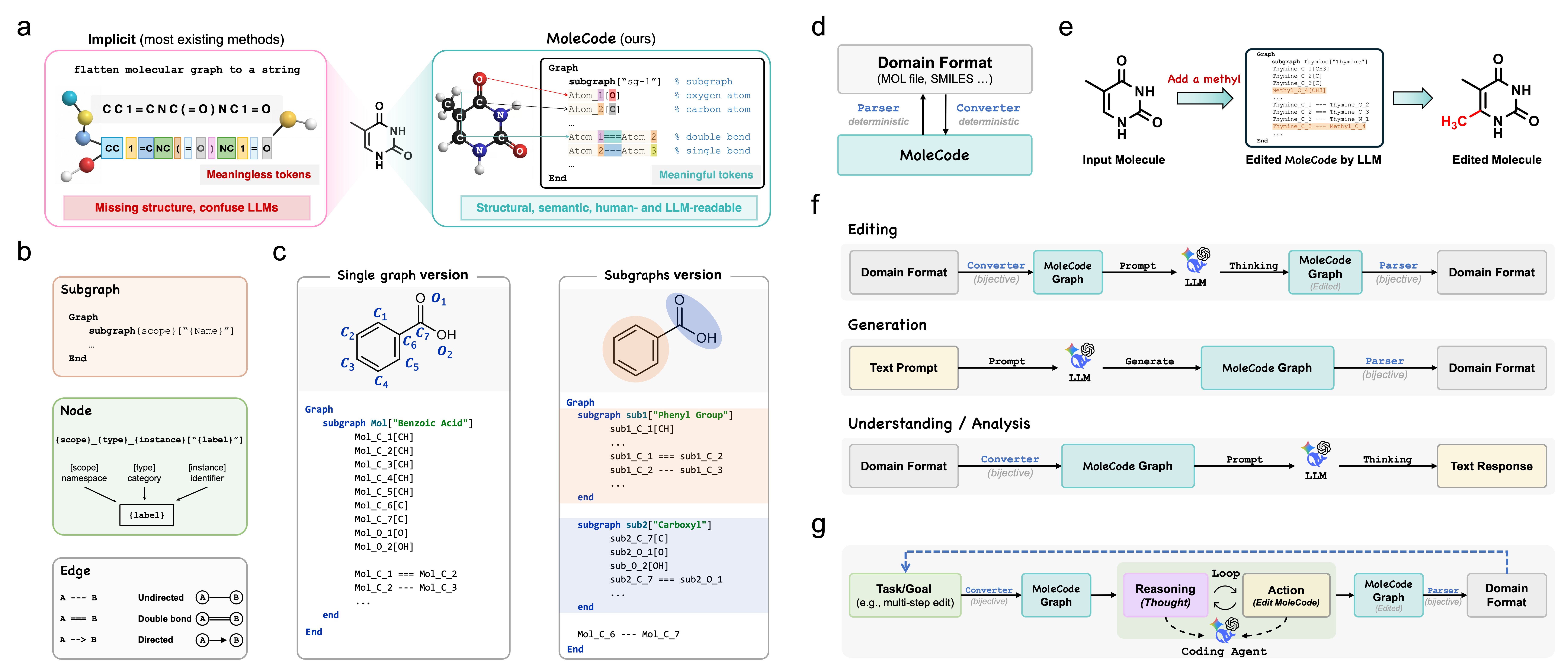
What is MoleCode?
A molecule is a graph: atoms are nodes, bonds are edges. Yet LLMs are usually fed molecules as linear strings (SMILES) where the graph is implicit — so the model must rebuild the structure from syntax before it can reason.
MoleCode makes the structure the language. Every atom and bond is a typed declaration with a persistent identifier, serialized as a Mermaid graph, and deterministically, losslessly inter-convertible with SMILES / MOL via RDKit (no learned model). One grammar spans small molecules, polymers, and Markush structures.
Install
pip install molecode
Quick start
from rdkit import Chem
from molecode import mol_to_mermaid, mermaid_to_mol, mol_to_smiles

# SMILES -> MoleCode graph
graph = mol_to_mermaid(Chem.MolFromSmiles("CC(=O)Oc1ccccc1C(=O)O"), name="Aspirin")
print(graph)

# MoleCode graph -> SMILES (lossless round-trip)
assert mol_to_smiles(mermaid_to_mol(graph)) == Chem.CanonSmiles("CC(=O)Oc1ccccc1C(=O)O")
Three domains, one grammar:
from molecode.polymer import polymer_to_mermaid, mermaid_to_psmiles   # polymers (×n repeat unit)
from molecode.markush import MoleCodeGraph, molecode_isomorphic        # Markush ({R1}/{Boc} nodes)
from molecode.prompts import MOLECULE_SYSTEM_PROMPT, MARKUSH_SYSTEM_PROMPT  # LLM system prompts
from molecode import LLMClient                                         # optional OpenAI-compatible client
Why it matters
- Generalization, not memorization. On novel molecules SMILES accuracy falls to ~20% while MoleCode holds ~76–80% (same model, same knowledge).
- Cheaper reasoning. Sub-linear chain-of-thought growth — ~5× lower total token cost per query than SMILES.
- Scales to big, repetitive objects. Full-chain SMILES collapses toward 0% as polymer chains grow; MoleCode stays flat.
For coding agents
MoleCode also ships as an Agent Skill (Claude Code auto-discovers it; Codex
reads AGENTS.md) with a CLI for SMILES/PSMILES/Markush ↔ MoleCode conversion,
validation, isomorphism comparison, and OCSR (molecule image → MoleCode). See the
repository.
Citation
@article{yan2026molecode,
  title={MoleCode unlocks structural intelligence in large language models},
  author={Yan, Zhiyuan and Liu, Chen and Zhao, Boxuan and Lin, Kaiqing and Zhao, Jixiang and Wang, Yimi and Lv, Liuzhenghao and Li, Hao and Zhang, Shanzhuo and Yuan, Li and others},
  journal={arXiv preprint arXiv:2605.16480},
  year={2026}
}
License
MIT © 2026 AtomFlow-AI
1 maintainer

Metadata
1 maintainer
Release files for molecode 0.1.0
For a detailed explanation of source distributions (sdists) and built distributions (wheels), please see the package formats documentation.
Source distribution (sdist)
| File | Size | Uploaded | |
|---|---|---|---|
| molecode-0.1.0.tar.gz | 56.3 kB | Details |
Built distribution (wheel)
| File | Interpreter | ABI | Platform | Reset |
|---|---|---|---|---|
| molecode-0.1.0-py3-none-any.whl | Python 3 | none | any | Details |
Total release size: 114.8 kB
Release files / molecode-0.1.0.tar.gz
| Download URL | molecode-0.1.0.tar.gz |
|---|---|
| Size | 56.3 kB |
| Tags | Source |
|
SHA-256 checksum How to use checksums |
b67855f1c83135c12398cecb239be0b57d1bc07a7dde6b0d5ed6feaf6989316d
|
|
BLAKE2b-256 checksum How to use checksums |
919dcf601e30329946b174d1c8fff1181f441e98f3502a330812f8d66e16930a
|
| Upload date | |
|
Uploaded using Trusted Publishing? What is trusted publishing? |
No |
| Uploaded via |
twine/6.2.0 CPython/3.11.15
|
Release files / molecode-0.1.0-py3-none-any.whl
| Download URL | molecode-0.1.0-py3-none-any.whl |
|---|---|
| Size | 58.5 kB |
| Tags | Python 3 |
|
SHA-256 checksum How to use checksums |
712783aa3e7cca02a5d012e872efb35c6704091861dba44175eae7cb9af060ee
|
|
BLAKE2b-256 checksum How to use checksums |
827aaf555e6e7dbc1dda5ea046c0864f61fa265cbb6bbe0a58916a4bb8f41ef8
|
| Upload date | |
|
Uploaded using Trusted Publishing? What is trusted publishing? |
No |
| Uploaded via |
twine/6.2.0 CPython/3.11.15
|













