

Monolithium
🗿 Minecraft Alpha Monoliths Seed Cruncher 🗿






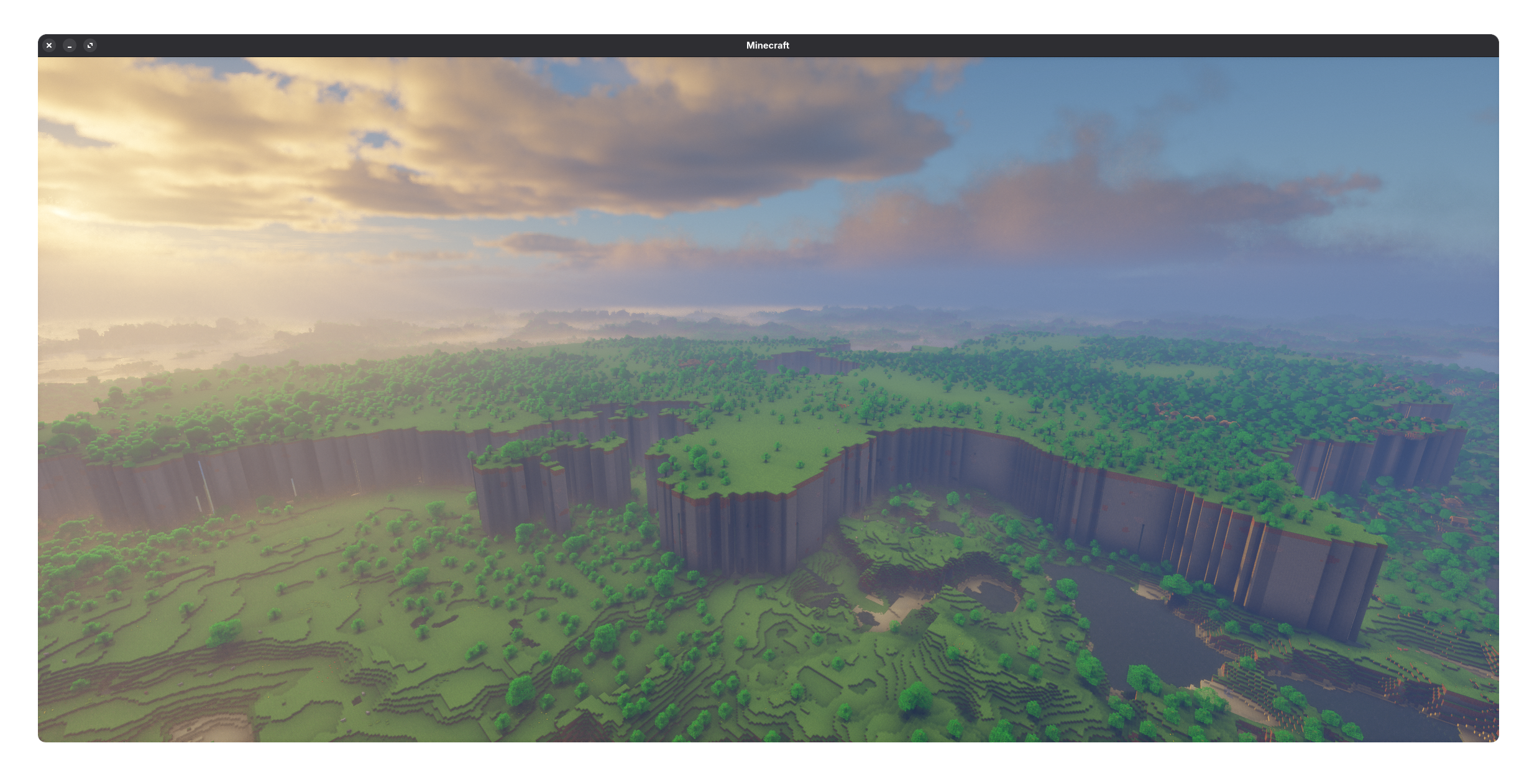
Seed: 26829160 • (x: 0, y: 0) • Area: 1,044,848 blocks squared • First Millionaire
Using Moderner Beta Alpha v1.1.2_01 Terrain on MC 1.21 • Distant Horizons • Bliss Shaders
🔥 Description
Monoliths are a terrain generation bug that happened in the ancient Minecraft Infdev through Alpha 1.1.2_01 versions. They are a rare, often large, flat and tall structures, almost entirely made of stone, with a hidden ocean of water until bedrock beneath them.
Hidden in plain sight for 15 years, I wanted to know how rare they actually are, and find the biggest one!
- This repository contains a brute-force search algorithm in Rust with a basic Python package for statistical analysis, alongside the most interesting findings of the journey.
- Feel free to contribute speed, documentation, cuda port improvements.
Warn: This is a side project, I may have time to port the readme to a mkdocs website in the future.
Note: For a more technical explanation, see kahomayo/monolith-renderer 😉
📦 Installation
Install Git and astral-sh/uv, open a terminal in some directory and run:
git clone https://github.com/Tremeschin/Monolithium && cd Monolithium- Rust part:
uv run rustlith (commands)
You can pass any --<feature> explained in Cargo.toml for speedups, like --fast!
🔥 Commands
You can run any of rustlith (command) --help for options and information!
🔴 Find all Monoliths in a world
This will search a 8,388,608 blocks square in both positive X and Z directions. Note that all monoliths repeats every such value on any coordinate - there are 9 copies of each within the Far Lands on any given world!
rustlith search --depth seed --value 617
🟡 Find seeds with spawn monoliths
This will search for seeds that contains monoliths close to spawn.
- Search 0 through 100k seeds:
rustlith search linear -t 100000 - Search 50k random seeds:
rustlith search random -t 50000
🟢 2Pass heuristic method
This heuristic finds seeds with great potential for large monoliths, by only looking at the much rarer hill noise values, and discarding most seeds with poor x, y, z fractional parts offsets.
rustlith search --radius 8192 random -t 5000000 --candidates --fast(potential)- For each output, run
rustlith search --step 512 seed -v <n>(real area)
There's a couple improvements to this method:
- Since this discards millions seeds a second, rayon work-stealing parallelism becomes an overhead. Passing
--chunks 1000tosearchmakes each work block process multiple seeds instead of one. - The
hillwraps around2**19blocks, so--radius 262144searches "the whole world"'s potential. - For long searches, filter out candidates with at least
--area nto ignore bad shuffling seeds. - Largest monoliths are basically guaranteed to hit a lattice point multiple of
1024 - At
world::good_perlin_fracts, one can tweak the treshholds for a "good" seed.
Full command idea that broke many records:
# or 'cargo run --release --features candidates --features fast' in monolithium dir
$ QUALITY=250.0 rustlith --candidates --fast \
  search --chunks 1000 --hill --step 1024 --area 2200000 \
  random --total 100000000 \
> candidates.txt

# Many minutes/hours later..
$ rustlith search --depth --step 512 --threaded \
  file -i candidates.txt \
> final.txt
With enough --total seeds, checking the best ones almost guarantees a record :)
🟠 Fast spawn search
Instead of initializing a world from zero per work chunks loop, this method reutilizes most perlin noises data in a incremental way, rolling down all octaves and appending a new one with the current RNG state.
As such, --chunks plays more than one role here, theoretical max performance at total_seeds/cpu_threads:
$ AREA_STEP=8 rustlith --fast --sister-perlin --deque-octaves \
  search --chunks 1000 --area 500000 \
  random -t 50000000
⭐️ Showcase
🔵 Largest monoliths anywhere
| Area | Seed | X | Z | Date | Found by | Agent |
|---|---|---|---|---|---|---|
| 3,550,912 | 236166155494461 | 6724170 | 8223828 | 2026/11/01 | Tremeschin | Gemini 4 Argon |
| 3,119,151 | 94116384388573 | 3185395 | 1401244 | 2025/10/06 | Tremeschin | - |
| 3,099,536 | 1184681998931 | 7361728 | 4530048 | 2025/10/18 | Ferra | - |
| 3,047,088 | 24388692462 | 2942560 | 4232256 | 2025/10/18 | Ferra | - |
| 3,012,432 | 1102581481210 | 6025536 | 4676000 | 2025/10/18 | Ferra | - |
| 2,987,360 | 34786730572 | 4236288 | 5081952 | 2025/10/18 | Ferra | - |
| 2,950,096 | 530268432158 | 1384896 | 8037440 | 2025/10/18 | Ferra | - |
| 2,892,928 | 873667255313 | 5711040 | 1334432 | 2025/10/18 | Ferra | - |
| 2,890,848 | 143779371652733 | 265920 | 5994240 | 2025/09/20 | akatz-ai | - |
| 2,649,984 | 130449915832690 | 786608 | 4163520 | 2025/09/20 | akatz-ai | - |
| 2,316,064 | 19907909658842 | 1572070 | 3668360 | 2025/09/18 | Tremeschin | - |
| 2,033,040 | 250673273362854 | 7337600 | 5768320 | 2025/09/18 | Tremeschin | - |
| 1,992,096 | 281351900698438 | 4716910 | 4718668 | 2025/09/18 | Tremeschin | - |
🔵 Largest monoliths near spawn
| Area | Seed | Date | Found by |
|---|---|---|---|
| 2,420,304 | 213457002840989 | 2025/10/29 | NathanVH8 |
| 2,240,624 | 38078992166078 | 2025/10/19 | NathanVH8 |
| 1,993,040 | 269943915147763 | 2025/10/18 | NathanVH8 |
| 1,975,712 | 35668441367715 | 2025/10/08 | NathanVH8 |
| 1,745,664 | 4609608251 | 2025/08/13 | Tremeschin |
| 1,584,112 | 1847066092 | 2025/08/13 | Tremeschin |
| 1,420,816 | 2045872561 | 2025/08/13 | Tremeschin |
| 1,371,824 | 3847304212 | 2025/08/13 | Tremeschin |
| 1,369,360 | 1593912439 | 2025/08/13 | Tremeschin |
| 1,345,520 | 4563197188 | 2025/08/13 | Tremeschin |
| 1,305,472 | 4432659853 | 2025/08/13 | Tremeschin |
🔵 Lowest seed visible from spawn
Drum rolls.. 617. This seed contains a visible Monolith from spawn 🤯
🔵 Monoliths repeat every 8,388,608 blocks
For every monolith in a world there's 9x exact copies of them within the Far Lands:
- A monolith at spawn appears on:
(-x, x) • ( 0, x) • ( x, x)(-x, 0) • ( 0, 0) • ( x, 0)(-x, -x) • ( 0, -x) • ( x, -x)
Sadly, the Far Lands override the monoliths, there's no such thing as a Far Monolith 😿
🔵 How rare are they?
Spoiler: Not much, certain seeds are more likely to generate monoliths (anthropic principle confirmed?), but most contains at least half a million monolith complexes within the Far Lands (12,550,824 blocks squared).
🚀 Speeds
Monolithium is written in heavily parallelized Rust with the help of crates like Rayon for fearless concurrency and Ahash fast hashing, fully utilizing all available CPU resources one throws at it.
🦀 For a Ryzen 9 5900X 12c/24t, 2x3200 MT/s DDR4 CL16 2Rx8 system, one might expect:
- 3.75 minutes to find all monoliths in a seed, probing every 128 blocks.
- Search 2,028,000 seeds per second for spawn monoliths (approximated)
- Search 634,000 seeds per second for spawn monoliths (accurate)
Such speeds scales about linearly with your hardware - for better or worse!
🔎 Future work
- Investigate the correlation of Perlin coefficients to the likeliness and size of Monoliths.
- Is it more efficient for CUDA to stream perlin coefficients than inline JavaRNG on CPU?
- Make statistical analysis (Average size, Distribution) of Monoliths in seeds.
- Make a
HashMap<(int, int), Monolith>to avoid recomputing areas. - Throw 2x Epyc 9965 at the code. I have a spare one for sure iirc.
- Does perimeter correlate with area for faster area ranking?
♻️ Credits
- User @kahomayo for
monolith-rendererto understand the underlying mathematics. - YouTuber @AntVenom For the Breaking Minecraft playlist inspiration.
1 maintainer

Metadata
1 maintainer
Release files for monolithium 1.4.0
For a detailed explanation of source distributions (sdists) and built distributions (wheels), please see the package formats documentation.
Built distribution (wheel)
| File | Interpreter | ABI | Platform | Actions Reset |
|---|---|---|---|---|
| monolithium-1.4.0-py3-none-any.whl | Python 3 | none | any | Details for monolithium-1.4.0-py3-none-any.whl |
Release files / monolithium-1.4.0-py3-none-any.whl
| Download URL | monolithium-1.4.0-py3-none-any.whl |
|---|---|
| Size | 74.4 kB |
| Tags | Python 3 |
|
SHA-256 checksum How to use checksums |
5a9ec2b13d2d2a55149b3205893597195fa2051c2ac2a50abf182862336bd2c3
|
|
BLAKE2b-256 checksum How to use checksums |
edfe18981e34fc89acde4a13a8d191fa6cc272ccf0f20f77a008343e6ae2d724
|
| Upload date | |
|
Uploaded using Trusted Publishing? What is trusted publishing? |
Yes |
| Uploaded via |
twine/7.0.0 CPython/3.13.16
|
Provenance
Provenance describes where a file came from. On PyPI, provenance is shared via attestations, which provide a verifiable record of the build or publishing details. View details, limitations and caveats.


PyPI Publish Attestation
PyPI verified that this artifact, at this checksum, originated from the publisher listed below.
Signed by GitHub Actions, verified by PyPI on Nov 1, 2026.
Transparency logSecurity for monolithium 1.4.0
Provenance
Provenance describes where a file came from. On PyPI, provenance is shared via attestations, which provide a verifiable record of the build or publishing details. View details, limitations and caveats.
Full provenance
1 file in this release has been uploaded with provenance metadata.
Attestation for monolithium-1.4.0-py3-none-any.whl
PyPI Publish Attestation
PyPI verified that this artifact, at this checksum, originated from the publisher listed below.
Signed by GitHub Actions, verified by PyPI on Nov 1, 2026.
Transparency logA note on package security
PyPI is a repository for distributing packages, not a service for auditing them. While third-party security researchers and our staff do their best to detect and remove malicious packages, PyPI cannot guarantee the quality, security or suitability of any given package.
To learn more about protecting yourself from malicious actors, visit our package security documentation.














