






SLayer
An expressive, embeddable semantic layer for AI agents and humans.
SLayer enables AI-powered data analytics on top of your warehouse. Agents get a governed, shared surface through which they access your data and metrics and give you reliable answers.
SLayer handles database connectivity (read-only), SQL translation, common data transformations, and row-level security, so LLMs and humans don't have to. Adapt it to your workflows, not the other way around. Manage definitions easily with an agent or by yourself.
SLayer can be used as a standalone tool or imported as a Python library, easily embeddable into any Python app. Use it for powering analytical MCP servers or APIs or simply to query databases semantically.
SLayer is at the core of Motley and is maintained with ♡ by the same team.
How SLayer is different
Traditionally, semantic layers were a part of the BI stack, where every metric and its aggregation had to be predefined. Agents need more flexibility because users ask questions that involve metric combinations (like ratios), transforms (like time shifts), or different aggregations of the same metric (like average instead of sum).
SLayer allows to define a column revenue once and query it using expressions like sum(revenue), avg(revenue), sum(revenue) / count(*), time_shift(sum(revenue), -1, 'year') etc.; multi-stage queries are also supported.
SLayer is focused on the common agentic search → inspect → query flow. It has a search tool for efficient discovery and a memory store for linking the relevant business context.
Agents, apps and humans can talk to SLayer via MCP, REST API, CLI, Python, Flight SQL, or Postgres-based SQL API. SLayer supports most popular databases.
SLayer fits next to your existing data stack. It also provides importers for dbt, Cube, and Ossie configs.
See docs for more.
Example
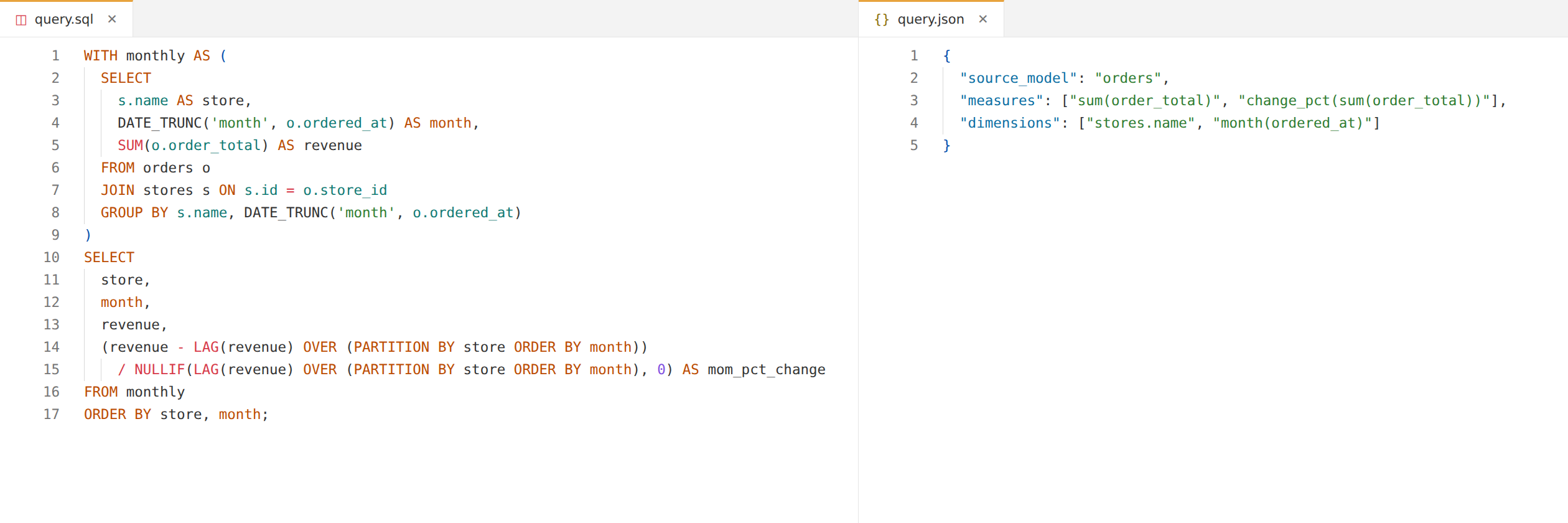
Question (run on the built-in demo Jaffle Shop database): "show monthly revenue by store, with month-over-month % change"
Side by side, here's LLM-generated SQL and the equivalent SLayer query.
Quickstart
We recommend using uv, especially if you don't work in a Python project.
uv tool install 'motley-slayer[all]'
If slayer isn't found on PATH afterwards, run uv tool update-shell and reopen your terminal.
Using demo dataset
# With the Jaffle Shop demo preloaded (zero-config quickstart)
claude mcp add slayer_demo -- slayer mcp --demo
Using your own data
Set up your datasource, substituting the correct database, username, hostname, and db_name.
slayer datasources create 'postgresql://user:${DB_PASSWORD}@hostname/db_name'
The password will be read by SLayer at init time, not saved to disk nor exposed to Claude.
Then add SLayer to Claude Code:
claude mcp add slayer -- slayer mcp --ingest-on-startup
Now SLayer MCP will be visible in Claude Code next time you start it. Make sure to launch Claude Code from a shell where DB_PASSWORD is exported — the MCP subprocess inherits its environment from the launching process.
Read more on how to get started with MCP, CLI, REST API, Python in the docs.
Usage reporting
The slayer command sends anonymous, aggregated usage statistics (command, tool and query-feature counts, versions) at most once a day — never queries, names, data or credentials; library use sends nothing. Opt out with SLAYER_USAGE_REPORTING=off, DO_NOT_TRACK=1 or slayer usage-reporting disable; see Usage reporting for every field.
License
MIT
2 maintainers


Metadata
2 maintainers
Release files for motley-slayer 1.7.0
For a detailed explanation of source distributions (sdists) and built distributions (wheels), please see the package formats documentation.
Source distribution (sdist)
| File | Size | Uploaded | Provenance | Actions |
|---|---|---|---|---|
| motley_slayer-1.7.0.tar.gz | 1.1 MB | With provenance | Details for motley_slayer-1.7.0.tar.gz |
Built distribution (wheel)
| File | Interpreter | ABI | Platform | Actions Reset |
|---|---|---|---|---|
| motley_slayer-1.7.0-py3-none-any.whl | Python 3 | none | any | Details for motley_slayer-1.7.0-py3-none-any.whl |
Total release size: 2.4 MB
Release files / motley_slayer-1.7.0.tar.gz
| Download URL | motley_slayer-1.7.0.tar.gz |
|---|---|
| Size | 1.1 MB |
| Tags | Source |
|
SHA-256 checksum How to use checksums |
58197621495b49aef7cc1e0b2d6426369eb61e337d7b442e5cd77b69a7a627bf
|
|
BLAKE2b-256 checksum How to use checksums |
321466c13817a8b1e6842f2bd7700514e812c55ddd841f7e7127f194267bd989
|
| Upload date | |
|
Uploaded using Trusted Publishing? What is trusted publishing? |
Yes |
| Uploaded via |
twine/7.0.0 CPython/3.13.16
|
Provenance
Provenance describes where a file came from. On PyPI, provenance is shared via attestations, which provide a verifiable record of the build or publishing details. View details, limitations and caveats.


PyPI Publish Attestation
PyPI verified that this artifact, at this checksum, originated from the publisher listed below.
Signed by GitHub Actions, verified by PyPI on Nov 5, 2026.
Transparency logRelease files / motley_slayer-1.7.0-py3-none-any.whl
| Download URL | motley_slayer-1.7.0-py3-none-any.whl |
|---|---|
| Size | 1.3 MB |
| Tags | Python 3 |
|
SHA-256 checksum How to use checksums |
3805c8c88208785d8463d282a9ae8cec4391d6a47ebef1a876a1ef11ec63dc28
|
|
BLAKE2b-256 checksum How to use checksums |
f0612a300cff177401a257ce8ee30e6799f9826a7e5c63e1ed6549106949753d
|
| Upload date | |
|
Uploaded using Trusted Publishing? What is trusted publishing? |
Yes |
| Uploaded via |
twine/7.0.0 CPython/3.13.16
|
Provenance
Provenance describes where a file came from. On PyPI, provenance is shared via attestations, which provide a verifiable record of the build or publishing details. View details, limitations and caveats.
PyPI Publish Attestation
PyPI verified that this artifact, at this checksum, originated from the publisher listed below.
Signed by GitHub Actions, verified by PyPI on Nov 5, 2026.
Transparency logSecurity for motley-slayer 1.7.0
Provenance
Provenance describes where a file came from. On PyPI, provenance is shared via attestations, which provide a verifiable record of the build or publishing details. View details, limitations and caveats.
Full provenance
Both files in this release have been uploaded with provenance metadata.
Attestation for motley_slayer-1.7.0.tar.gz
PyPI Publish Attestation
PyPI verified that this artifact, at this checksum, originated from the publisher listed below.
Signed by GitHub Actions, verified by PyPI on Nov 5, 2026.
Transparency logA note on package security
PyPI is a repository for distributing packages, not a service for auditing them. While third-party security researchers and our staff do their best to detect and remove malicious packages, PyPI cannot guarantee the quality, security or suitability of any given package.
To learn more about protecting yourself from malicious actors, visit our package security documentation.














