
Tools for re-griding periodic volumetric quantum chemistry data for machine-learning purposes.

Project description
mp-pyrho
Installation
pip install mp-pyrho
Tools for re-griding volumetric quantum chemistry data for machine-learning purposes.



If you use this package in your research, please cite the following:
Shen, J.-X., Munro, J. M., Horton, M. K., Huck, P., Dwaraknath, S., & Persson, K. A. (2022).
A representation-independent electronic charge density database for crystalline materials.
Sci Data, 9(661), 1–7. doi: 10.1038/s41597-022-01746-z
Regridding data using PyRho
The PGrid Class
The PGrid object is defined by an N-dimensional numpy array grid_data and a N lattice vector given as a matrix lattice. The input array is a scalar field that is defined on a regularly spaced set of grid points starting at the origin. For example, you can construct a periodic field as follows:
import numpy as np
from pyrho.pgrid import PGrid
from pyrho.vis.scatter import get_scatter_plot


def func(X, Y):
    return np.sin(X) * np.cos(2 * Y)


a = np.linspace(0, np.pi, 27, endpoint=False)
b = np.linspace(0, np.pi, 28, endpoint=False)
X, Y = np.meshgrid(a, b, indexing="ij")
data = func(X, Y)
pg2d = PGrid(grid_data=data, lattice=[[np.pi, 0], [0, np.pi]])
The data can be examined using the helper plotting function which supports up to 3-D.
import matplotlib as mpl

mpl.rc("image", cmap="viridis")
get_scatter_plot(pg2d.grid_data, pg2d.lattice, marker_size=40)
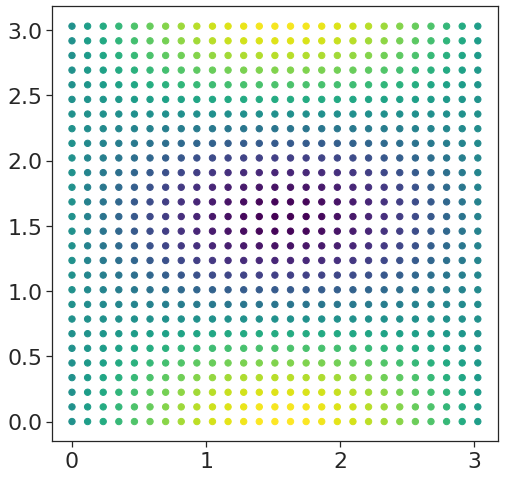
The period data in the PGrid object must be fixed-scaled so if you half the number of points in the domain, the range of the data will stay the same. This is different from how the charge density is stored in codes like VASP where the values at each point change based on the number of grid points used to store the data.
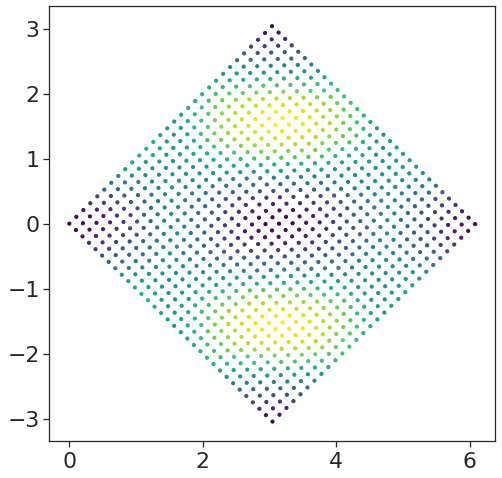
The regridding capabilities allow the user to obtain the data in any arbitrary representation. For example, if we want to shift to the middle of the unit-cell and create a ((1,1), (1,-1)) super-cell, with a 30 by 32 grid, we can run:
pg_2x = pg2d.get_transformed([[1, 1], [1, -1]], origin=[0.5, 0.5], grid_out=[30, 32])
get_scatter_plot(pg_2x.grid_data, pg_2x.lattice, skips=1, opacity=1, marker_size=10)
Up-sampling with Fourier interpolation
The up-sampling capabilities allow the user to exploit the periodicity of the data to obtain a higher-resolution grid. As an example, we can take a sparsely sampled periodic data in 1-D:
def func1(X):
    return np.sin(6 * X)


a = np.linspace(0, np.pi, 10, endpoint=False)
data = func1(a)

pg1d = PGrid(grid_data=data, lattice=[[np.pi]])
get_scatter_plot(pg1d.grid_data, pg1d.lattice, marker_size=50)
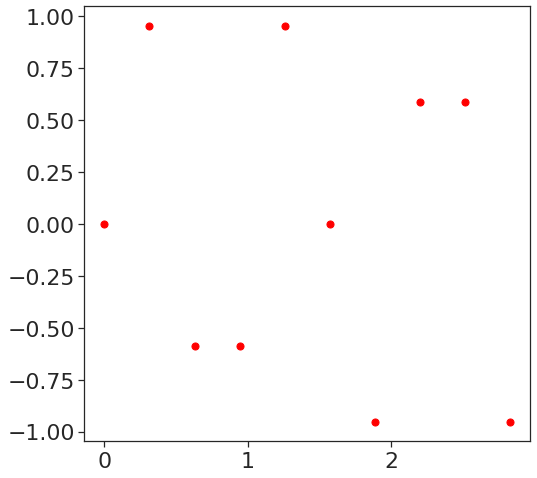
This does not really resemble the np.sin(6*X) function we used to generate the data.
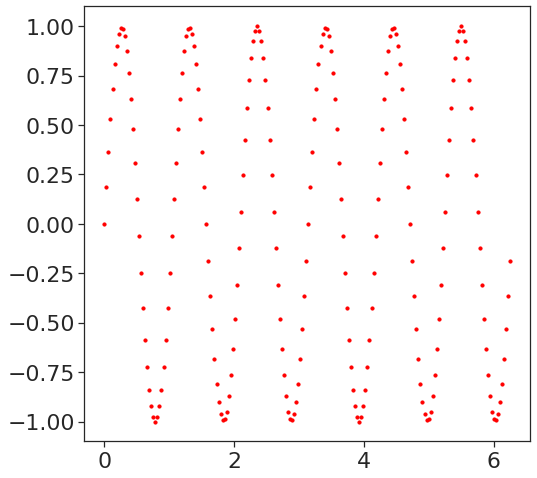
However, if we use an up-sample factor of 8, we can obtain a more dense representation:
pg1d_fine = pg1d.get_transformed(
    sc_mat=[[2]],
    grid_out=[
        200,
    ],
    up_sample=8,
)
get_scatter_plot(pg1d_fine.grid_data, pg1d_fine.lattice, marker_size=10)
The ChargeDensity class
The ChargeDensity object can use the from_file construction method from pymatgen.io.vasp.outputs.Chgcar as shown below.
from pymatgen.io.vasp import Chgcar
from pyrho.charge_density import ChargeDensity

cden_uc = ChargeDensity.from_file(
    "../test_files/CHGCAR.uc.vasp"
)
cden_sc = ChargeDensity.from_file(
    "../test_files/CHGCAR.sc1.vasp"
)
chgcar_sc = Chgcar.from_file(
    "../test_files/CHGCAR.sc1.vasp"
)
cden_transformed = cden_uc.get_transformed(
    [[1, 1, 0], [1, -1, 0], [0, 0, 1]],
    grid_out=cden_sc.grid_shape,
    up_sample=2,
)
The normalized_data property contains a dictionary keyed with the same keys as Chgcar.data (typically "total" and "diff" for spin charge densities).
This quantity is the fixed scalar field that should remain fixed after the transformation.
data = cden_uc.normalized_data["total"]
print(
    f"The normalized charge density data is has a range of {data.min():0.3f} --> {data.max():0.3f} e-/Ang^3"
)
The normalized charge density data is has a range of -0.188 --> 0.572 e-/Ang^3
Note that the PAW transformation sometimes results in negative charge densities.
trans_data = cden_transformed.normalized_data["total"]
print(
    f"The transformed normalized charge density data is has a range of {trans_data.min():0.3f} --> {trans_data.max():0.3f} e-/Ang^3"
)
The transformed normalized charge density data is has a range of -0.188 --> 0.572 e-/Ang^3
sc_data = cden_sc.normalized_data["total"]
print(
    f"The reference normalized charge density data is has a range of {sc_data.min():0.3f} --> {sc_data.max():0.3f} e-/Ang^3"
)
The reference normalized charge density data is has a range of -0.188 --> 0.570 e-/Ang^3
Credits
Jimmy-Xuan Shen: Project lead
Wennie Wang: For naming the package
Release history Release notifications | RSS feed


Download files
Download the file for your platform. If you're not sure which to choose, learn more about installing packages.
Source Distribution
Built Distribution
Filter files by name, interpreter, ABI, and platform.
If you're not sure about the file name format, learn more about wheel file names.
Copy a direct link to the current filters
File details
Details for the file mp_pyrho-0.5.1.tar.gz.
File metadata
- Download URL: mp_pyrho-0.5.1.tar.gz
- Upload date:
- Size: 2.4 MB
- Tags: Source
- Uploaded using Trusted Publishing? No
- Uploaded via: twine/6.1.0 CPython/3.13.7
File hashes
| Algorithm | Hash digest | |
|---|---|---|
| SHA256 |
f77fd7383d08f07c94896885fb6183413a8ff0befa3dca9791db0bdf4dd02d58
|
|
| MD5 |
558c252ceddc25a860ac1704bd45c894
|
|
| BLAKE2b-256 |
e471fe2a483fdb5e25f91aa65b06b8e799be06ea1ffd38799e9c0a3b6652ec4e
|
File details
Details for the file mp_pyrho-0.5.1-py3-none-any.whl.
File metadata
- Download URL: mp_pyrho-0.5.1-py3-none-any.whl
- Upload date:
- Size: 18.5 kB
- Tags: Python 3
- Uploaded using Trusted Publishing? No
- Uploaded via: twine/6.1.0 CPython/3.13.7
File hashes
| Algorithm | Hash digest | |
|---|---|---|
| SHA256 |
934d90c6be35eeccc6b0d550771410b0801dbf4488aca96517f958b5045dd161
|
|
| MD5 |
64eb320453881ff48121bf1a75e3944b
|
|
| BLAKE2b-256 |
51267461a015cf35925e193f4afbe5b066a5fdb5eb76e87e80c63f50f614c3f4
|






