
mpl_sankey
This is a simple package to produce sankey plots with matplotlib.
It is an alternative to the matplotlib.sankey
module, which sacrifices some
flexibility in exchange for a much simpler interface.
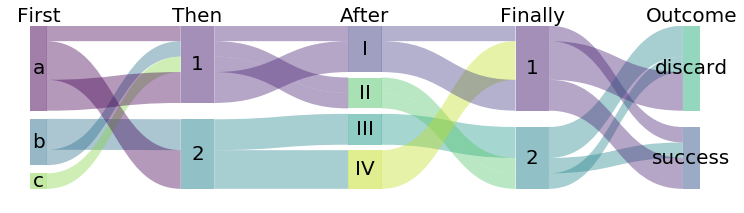
Specifically, this package only produces standard horizontal sankey plots, but it does so automatically from data, rather than requiring the user to figure out the spatial distribution of nodes/flows.
How it works
There is a single method, sankey(), which accepts one argument data and
several optional keyword arguments.
data must be a 2-dimensional tabular object with at least 3 columns: best
results are obtained with pandas.DataFrames, but numpy.arrays and simple
lists of lists are also accepted.
- each row corresponds to a "flow"
- the first column stores the weights (that is, the tickness of each flow
drawn), and must be an
intorfloat - each other column denotes a node (by its label, which can have any type) where the flow passes, at each stage
- if
datais apandas.DataFrame, then the column names are represented on top of each stage
Example
from mpl_sankey import sankey
from matplotlib import pyplot as plt
import pandas as pd

data = pd.DataFrame([[1, 'a', 1, 'I', 1, 'success'],
                     [2, 'b', 2, 'III', 2, 'discard'],
                     [1, 'b', 1, 'II', 2, 'success'],
                     [1, 'c', 1, 'II', 2, 'discard'],
                     [2.5, 'a', 2, 'IV', 1, 'discard'],
                     [2, 'a', 1, 'I', 1, 'success']],
                    columns=['Weight', 'First', 'Then', 'After', 'Finally', 'Outcome'])

plt.figure(figsize=(12, 3))
sankey(data, cmap=plt.get_cmap('viridis'))
plt.savefig('featured.png', bbox_inches='tight')
Find more in the Examples notebook.
Installation and dependencies
You can install this package through PyPi with pip install mpl_sankey, or
just clone the repo from github.
The package requires pandas (and, obviously, matplotlib) to work.
1 maintainer

Metadata
1 maintainer
Release files for mpl-sankey 0.1.0
For a detailed explanation of source distributions (sdists) and built distributions (wheels), please see the package formats documentation.
Source distribution (sdist)
| File | Size | Uploaded | Provenance | |
|---|---|---|---|---|
| mpl_sankey-0.1.0.tar.gz | 7.7 kB | Without provenance | Details |
Built distribution (wheel)
| File | Interpreter | ABI | Platform | Reset |
|---|---|---|---|---|
| mpl_sankey-0.1.0-py3-none-any.whl | Python 3 | none | any | Details |
Total release size: 15.8 kB
Release files / mpl_sankey-0.1.0.tar.gz
| Download URL | mpl_sankey-0.1.0.tar.gz |
|---|---|
| Size | 7.7 kB |
| Tags | Source |
|
SHA-256 checksum How to use checksums |
278cb3f0b6ac48ba05060574603aabdb7cb7012048868c7617ba3075d7235bc4
|
|
BLAKE2b-256 checksum How to use checksums |
311fb6237144c709425175a359cd6626733d026052ac0964bb02eca0c3ff0beb
|
| Upload date | |
|
Uploaded using Trusted Publishing? What is trusted publishing? |
No |
| Uploaded via |
twine/3.4.1 importlib_metadata/4.0.1 pkginfo/1.7.0 requests/2.25.1 requests-toolbelt/0.9.1 tqdm/4.60.0 CPython/3.9.1+
|
Release files / mpl_sankey-0.1.0-py3-none-any.whl
| Download URL | mpl_sankey-0.1.0-py3-none-any.whl |
|---|---|
| Size | 8.1 kB |
| Tags | Python 3 |
|
SHA-256 checksum How to use checksums |
0b68485e0228fcf00309256df7354d98d65fc3563dd42f037d428a423c8d8d2c
|
|
BLAKE2b-256 checksum How to use checksums |
4fb8b0cac85b930e4a8d687a23527625cb403b0bce7fb736b15c75a40ed261e2
|
| Upload date | |
|
Uploaded using Trusted Publishing? What is trusted publishing? |
No |
| Uploaded via |
twine/3.4.1 importlib_metadata/4.0.1 pkginfo/1.7.0 requests/2.25.1 requests-toolbelt/0.9.1 tqdm/4.60.0 CPython/3.9.1+
|
Security for mpl-sankey 0.1.0
Provenance
Provenance describes where a file came from. On PyPI, provenance is shared via attestations, which provide a verifiable record of the build or publishing details. View details, limitations and caveats.
No provenance found
None of the files in this release were uploaded with provenance metadata.
A note on package security
PyPI is a repository for distributing packages, not a service for auditing them. While third-party security researchers and our staff do their best to detect and remove malicious packages, PyPI cannot guarantee the quality, security or suitability of any given package.
To learn more about protecting yourself from malicious actors, visit our package security documentation.














