







Doing non-Cartesian MR Imaging has never been so easy
Introduction
MRI-NUFFT is an open-source Python library that provides state-of-the-art non-Cartesian MRI tools: trajectories, data loading and fast and memory-efficient operators to be used on laptops, clusters, and MRI consoles.
In particular, it provides a unified interface for computing Non-Uniform Fast Fourier Transform (NUFFT), using the specialized backend of your choice ((cu)finufft, gpunufft, torchkbnufft, … ), and with integrated MRI-specific features such as:
MRI-nufft is a nice and polite piece of software, that will return the same type of array (e.g numpy, cupy, torch) provided at input, without extra copies for conversions.
On top of that we ship a variety of non-Cartesian trajectories commonly used by the MRI community, and even tools to helps you develop new ones.
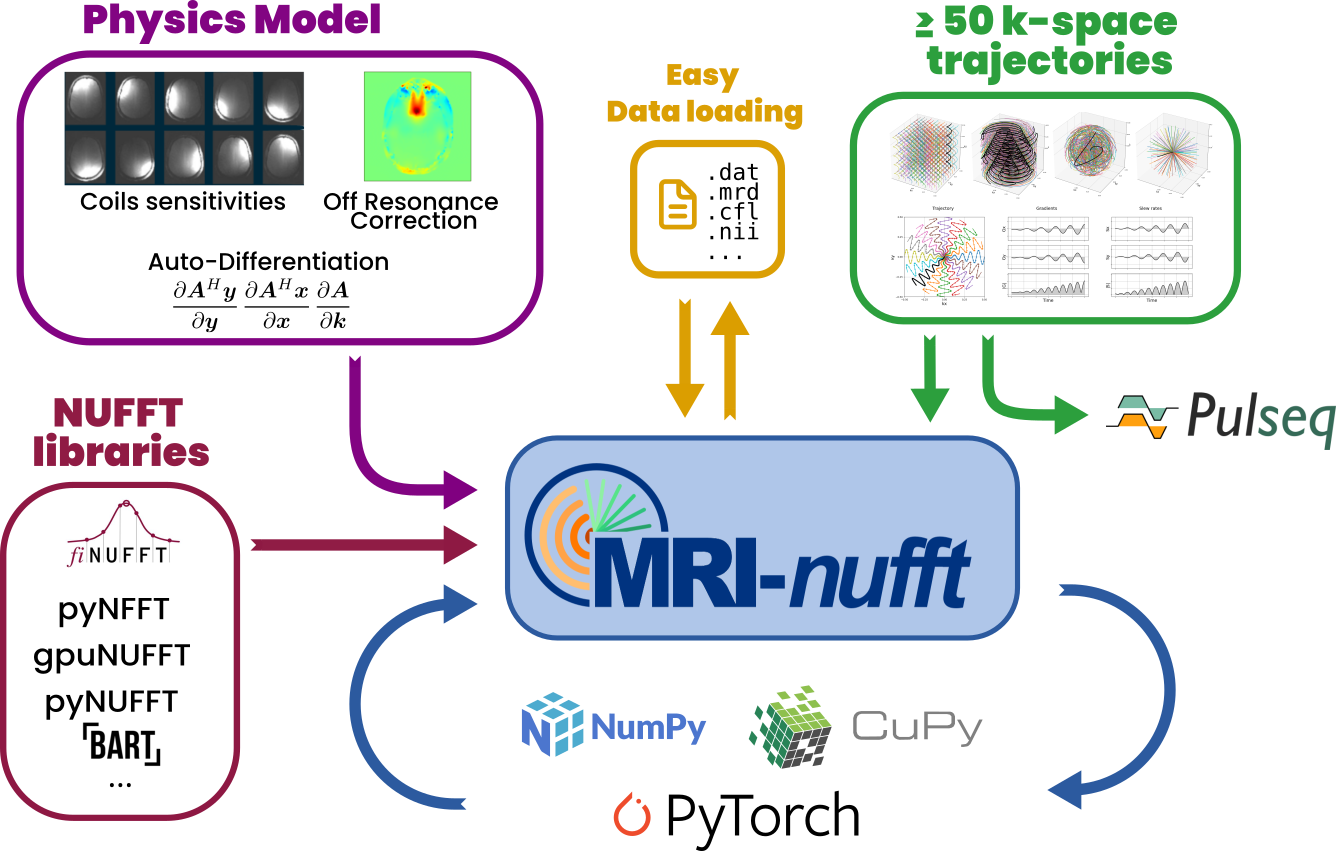
Modularity and Integration of MRI-nufft with the python computing libraries.
Usage
from scipy.datasets import face # For demo
import numpy as np
import mrinufft

# Create 2D Radial trajectories for demo
samples_loc = mrinufft.initialize_2D_radial(Nc=100, Ns=500)
# Get a 2D image for the demo (512x512)
image = np.complex64(face(gray=True)[256:768, 256:768])

## The real deal starts here ##
# Choose your NUFFT backend (installed independently from the package)
# pip install mri-nufft[finufft] will be just fine here
nufft =  mrinufft.get_operator("finufft",
    samples_loc, shape=image.shape, density="voronoi", n_coils=1
)

kspace_data = nufft.op(image)  # Image -> Kspace
image2 = nufft.adj_op(kspace_data)  # Kspace -> Image

pinv = nufft.pinv_solver(kspace_data) # get a Pseudo inverse (least square minimization)
For improved image quality, embed these steps in a more complex reconstruction pipeline (for instance using PySAP).
Want to see more ?
Check the Documentation
Or go visit the Examples
Installation
Recommended: uv
You can install MRI-nufft in a virtual environment using uv with:
uv venv # create a virtual env if needed
uv add mri-nufft[finufft,cufinufft,extra,autodiff]
Regular pip install
MRI-nufft is available on PyPi and can be installed with:
pip install mri-nufft
Additionally, you will have to install at least one NUFFT computation backend. See the Documentation for more guidance. Typically we recommend:
pip install mri-nufft[finufft]
pip install mri-nufft[cufinufft] # if you have a NVIDIA GPU and CUDA>=12
Benchmark
A benchmark of NUFFT backend for MRI applications is available in https://github.com/mind-inria/mri-nufft-benchmark
Who is using MRI-NUFFT?
Here are several project that rely on MRI-NUFFT:
Add yours by opening a PR or an issue, let us know how you use MRI-nufft !
How to cite MRI-NUFFT
We published MRI-NUFFT at JOSS
Comby et al., (2025). MRI-NUFFT: Doing non-Cartesian MRI has never been easier. Journal of Open Source Software, 10(108), 7743, https://doi.org/10.21105/joss.07743
@article{Comby2025, doi = {10.21105/joss.07743},
    author = {Comby, Pierre-Antoine and Daval-Frérot, Guillaume and Pan, Caini and Tanabene, Asma and Oudjman, Léna and Cencini, Matteo and Ciuciu, Philippe and GR, Chaithya},
    title = {MRI-NUFFT: Doing non-Cartesian MRI has never been easier}, journal = {Journal of Open Source Software},
    url = {https://doi.org/10.21105/joss.07743},
    year = {2025},
    publisher = {The Open Journal},
    volume = {10},
    number = {108},
    pages = {7743},
}
Contributing
We warmly welcome contributions ! Check out our guidelines , Don’t hesitate to look for unsolved issues
1 maintainer

Metadata
1 maintainer
Release files for mri-nufft 1.5.1
For a detailed explanation of source distributions (sdists) and built distributions (wheels), please see the package formats documentation.
Source distribution (sdist)
| File | Size | Uploaded | |
|---|---|---|---|
| mri_nufft-1.5.1.tar.gz | 3.7 MB | Details |
Built distribution (wheel)
| File | Interpreter | ABI | Platform | Reset |
|---|---|---|---|---|
| mri_nufft-1.5.1-py3-none-any.whl | Python 3 | none | any | Details |
Total release size: 3.8 MB
Release files / mri_nufft-1.5.1.tar.gz
| Download URL | mri_nufft-1.5.1.tar.gz |
|---|---|
| Size | 3.7 MB |
| Tags | Source |
|
SHA-256 checksum How to use checksums |
8c7a9395dc193a3a9561563203b1f70ecf99931b55f38db664e180ccca3b9660
|
|
BLAKE2b-256 checksum How to use checksums |
5fbe479c83c5c300aa7b25fde488ad607ed596e4ea8331ee674d67ee770dfe66
|
| Upload date | |
|
Uploaded using Trusted Publishing? What is trusted publishing? |
Yes |
| Uploaded via |
twine/6.1.0 CPython/3.13.12
|
Provenance
Provenance describes where a file came from. On PyPI, provenance is shared via attestations, which provide a verifiable record of the build or publishing details. View details, limitations and caveats.


PyPI Publish Attestation
PyPI verified that this artifact, at this checksum, originated from the publisher listed below.
Signed by GitHub Actions, verified by PyPI on May 28, 2026.
Transparency logRelease files / mri_nufft-1.5.1-py3-none-any.whl
| Download URL | mri_nufft-1.5.1-py3-none-any.whl |
|---|---|
| Size | 194.0 kB |
| Tags | Python 3 |
|
SHA-256 checksum How to use checksums |
dd6b55d28058782c25bcd77aaa2ab68918b69bbf028e0950d7bbf694fdf1dd42
|
|
BLAKE2b-256 checksum How to use checksums |
820a31975612df575945df26f424697240f516c7870b0af30d39990d3d415657
|
| Upload date | |
|
Uploaded using Trusted Publishing? What is trusted publishing? |
Yes |
| Uploaded via |
twine/6.1.0 CPython/3.13.12
|
Provenance
Provenance describes where a file came from. On PyPI, provenance is shared via attestations, which provide a verifiable record of the build or publishing details. View details, limitations and caveats.
PyPI Publish Attestation
PyPI verified that this artifact, at this checksum, originated from the publisher listed below.
Signed by GitHub Actions, verified by PyPI on May 28, 2026.
Transparency log













