
MTFT — Modular Time Field Theory


MTFT is a research toolkit for arithmetic weights, modular geometry, spectral dynamics and tests of proposed connections to physics. Its central objects are
[ w_n=\sum_{d\mid n}\frac{\log d}{d},\qquad X_0(143),\qquad 143=11\times13. ]
The software has grown from stiffness and phenomenology tools into an exact arithmetic and modular-surface laboratory: Hecke operators, canonical rings, periods and Hodge structures, spin characteristics, field dynamics, Yukawa tensors, anomaly tests and model-selection gates. It also includes experimental cryptography, arithmetic computation, sonification and visualization tools.
Research status: integer-derived formulas, numerical certificates and physical hypotheses have different evidence requirements. MTFT does not yet supply a validated Standard Model or a general simulator of matter. The new interaction atlas provides external SM targets against which future MTFT derivations can be checked. Its reference parameters are not MTFT predictions.
Start here: Capability index · SM interaction atlas · Research and correction registers · Release history · Examples
Install
python -m pip install --upgrade mtft
For development, including changes not yet released on PyPI:
git clone https://github.com/Kaizoku-Ronin/mtft.git
cd mtft
python -m venv .venv
# Linux/macOS:
source .venv/bin/activate
# Windows PowerShell instead:
# .venv\Scripts\Activate.ps1
python -m pip install -e ".[dev,full]"
| Dependency set | Purpose |
|---|---|
| Base package | NumPy, SymPy and mpmath arithmetic/numerical engines |
mtft[full] |
SciPy solvers/quadrature and Matplotlib plots |
mtft[viz] |
Matplotlib and Plotly visualization helpers |
mtft[dev] |
pytest, coverage and Ruff |
mtft[lhc] |
uproot and Awkward for the optional ROOT/LHCb analysis bridge |
| PARI/GP, installed separately | Recompute GP-dependent modular-symbol and period data |
| MadGraph5_aMC@NLO, installed separately | Optional SM process-diagram/code generation |
The bundled SM atlas works offline with the base install. Many geometry engines can use frozen data without PARI/GP; regenerating those records is separate work.
Quick start
import mtft
from mtft.interactions import load_catalog, select_vertices

C = mtft.X0(143)
print(C.genus)                         # 13
print(mtft.dedekind_eta(1j))
print(mtft.filtered_moment_identity(0.18174, N=3))

# Inspect the SM reference without computing an MTFT amplitude.
catalog = load_catalog()
print(len(select_vertices(catalog, sector="qcd")))  # 8 for this model

# Existing phenomenology comparison, with its own assumptions and inputs:
print(mtft.falsify.honest_report())
python -m mtft info
python -m mtft report
python -m mtft.legend search Hodge
python -m mtft.legend card surface_higgs_slope_level
python -m mtft.interactions render -o atlas-output/index.html
Open atlas-output/index.html in a browser. Search vertices, inspect diagrams
and symbolic tensors, filter sectors, follow related MTFT research and export
the reference or evidence ledger. The atlas contains 153 reference vertices
from a pinned stock model and explicitly lists its omissions. It does not
represent every possible SM process diagram. See the
atlas guide for evidence statuses, import limits,
scope, licenses and MadGraph integration.
A prebuilt offline atlas is also included: download the HTML file and open it directly, without installing MTFT.
What the package can do
The table groups the complete module surface by task. The generated module index links every public module to its source and entry points, covering both older tools and current research code.
| Work area | Capabilities and principal modules |
|---|---|
| Arithmetic foundations | Constants, divisor-log weights, filtered moments and combinatorial ancestry: constants, arithmetic, combinatorial |
| Modular functions and curves | SL(2,ℤ), eta/modular forms, X₀(N), newform data and X₀(143) anchors: modular, modular_curve, forms, x0_143, levels, coset_reps |
| Riemann and ensembles | Explicit formula, ζ′/Speiser diagnostics, Dirichlet curvature, Li coefficients and compressed Weil forms: riemann, arithmetic_wick, critical_ensemble, weil |
| Weight moments and information geometry | Closed-form moments, statistical metrics, curvature and stiffness landscapes: moments, curvature, info_geometry, jacobian, tower |
| Spectral dynamics | Marked primon gas, KMS diagnostics, internal/coupled chains, gap extraction and exceptional-point studies: marked_gas, marked_gap, chain, coupled, ep, expansion, exception_spectrum |
| Mellin and L-function channels | Bulk/skeleton peel, Dirichlet channels, GL(2) diagnostics and analytic benchmarks: peel, lchannels, gl2_peel, hardy_ramanujan |
| Hecke and integral arithmetic | Manin symbols, Hecke blocks, Eisenstein congruences, cuspidal torsion, codifferents and integer lattices: hecke, eisenstein, cuspidal, codifferent, integral_lattice, quadratic_forms |
| Canonical geometry | Canonical ideals, quadrics, Atkin–Lehner descent, mod-p and Petri gates: canonical |
| Periods and Hodge geometry | Period matrices, symplectic frames, polarization, Bergman density, Hamiltonian channels and stability: periods, hodge_polarization, al_morphology |
| Homology, spin and theta | Integral homology, affine spin actions, Arf parity, theta functions and finite Kakeya diagnostics: homology, thetachar, thetafun, kakeya |
| Discrete and boundary geometry | Origami/dimers, insertion calculus, boundary diagnostics and finite graph tools: origami, boundary |
| Modular-surface geometry | Manin meshes, cycle lattices, exact transport, Hodge frames, marked/oldform sectors, CRT dessins, spin circles and Hopf bookkeeping: surface |
| Fields on the surface | Yang–Mills partition functions, line operators, Ising models, Hamiltonian evolution, FEM Laplace/Bochner spectra, Petersson and HYM normalization: surface.gauge, .ising, .dynamics, .spectral, .magnetic, .petersson, .hym |
| Fluxes and Yukawa tensors | Spin/CM data, Riemann–Roch spaces, canonical multiplication tensors, flux scans and condensation: surface.arithspin, .rrspace, .yukawa, .smflux, .condensation |
| Parent-theory gates | Parent records, anomaly polynomials, charge lattices, discrete/bordism tests, tensor factorization, mode/chirality gates and compactification: research |
| Product-surface research | Vector Higgs operators, X₀(143)×E slopes/indices, Künneth selection rules and torus theta factors: research.vector_higgs, .product_surface, .yukawa_triangle, .theta_torus, .unified_parent, .involutions |
| SM interaction reference | Pinned UFO vertices, tensor/parameter data, SVG/HTML diagrams and an evidence ledger: interactions |
| Physics phenomenology | Particle data/embeddings, Hosotani mechanism, Koide relations, decay, dimensional bridges, cosmology/dark-sector models and comparison reports: particles, hosotani, koide, decay, dimensional_bridge, cosmology, dark_sector, falsify, verify |
| Lattice, algebra and materials | Lattice gauge experiments, Burning Ship models, Lie-algebra closure/SVD gates and material-property diagnostics: lattice, burning_ship, liealg, tano_metric |
| Quantum and experimental cryptography | Qudits/holonomy gates, arithmetic codes, SL(2,ℤ)-sponge experiments and Jacobian orders: quantum, crypto, monster_hash; research implementations, not a security certification |
| Arithmetic computation | Primitive signatures, Turing-machine decompositions, halting diagnostics and the package's exact-polynomial certificate: arithmetic_machine, busy_beaver, jc_counterexample |
| Provenance and usability | Epistemic metadata, constant ledgers, estimator standards, PARI runner, plots and sonification: legend, ledger, ledger_peel, estimator_standards, gprun, viz, music |
| Experimental data bridge | Optional ROOT-file/LHCb analysis via uproot and Awkward: lhcb_analysis |
The original three-ensemble route remains available:
| Assembly | Object | Tools |
|---|---|---|
| Laplace | Weighted theta sums and filtered curvature | weighted_theta, filtered_moment_identity, peel |
| Dirichlet | −ζ(β)ζ′(β+1) and its log curvature | dirichlet_curvature, hadamard_zetaprime_check, marked_gas |
| Critical | Li coefficients from log ξ | li_criterion_report, critical_ensemble |
| Weil extension | Compressed explicit-formula quadratic form | weil |
Finite scans and truncated tests remain diagnostics unless their documented theorem or error bound supports a stronger conclusion.
Read the evidence and corrections
The Legend is a curated map, with tags Df, Pp, Pr, Conj, Heur, Cert
and labels such as EXACT, CERTIFIED, DIAGNOSTIC, PHENO and GIVEN.
It does not yet contain a hand-written entry for every callable.
python -m mtft.legend status
python -m mtft.legend trace alpha_inverse
python -m mtft.legend trace sm_interaction_atlas
The atlas trace terminates at external SM reference inputs. Its data is not presented as an arithmetic derivation. A passed software test verifies its stated calculation, not an unrestricted claim of physical validity.
For the current v1.0.x research line (v1.0.0 ships the matter programme, Matter-01 to GC-02 with the corrections CC-36 to CC-70, and Sphereland, listed in the v1.0.0 changelog; the parent-action gates, the blow-up branch and CC-35 came in v0.34.0, and later work goes to Unreleased), start with:
- Matter programme map and ledger: the pieces of the Standard-Model-building programme in dependency order, and every claim with its class, status, module, test and correction.
- Compendium implementation notes: exact inputs, operator conventions, rank qualifications and independent routes.
- CC-33 tensor coefficient correction: the corrected six-dimensional gravitational-anomaly obstruction.
- CC-26 normalization retraction: an earlier Yukawa normalization claim and its corrected interpretation.
- Wave C gates, chirality register and product-surface register.
Historical results and frozen handoffs stay in studies/. They may contain
superseded hypotheses and release-specific scripts; their original bytes and
correction trail matter. New atlas mappings require explicit evidence.
Visuals and long calculations
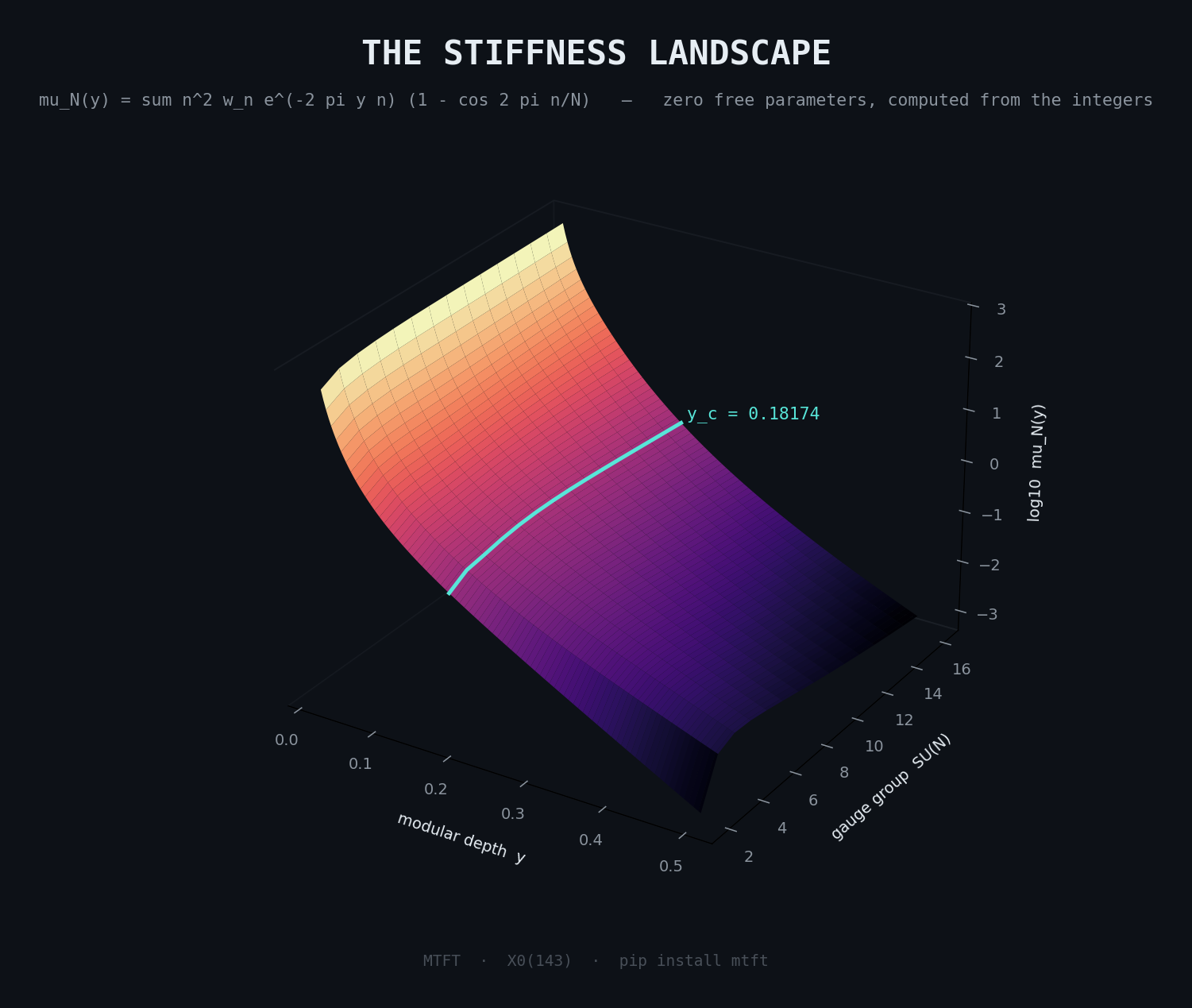
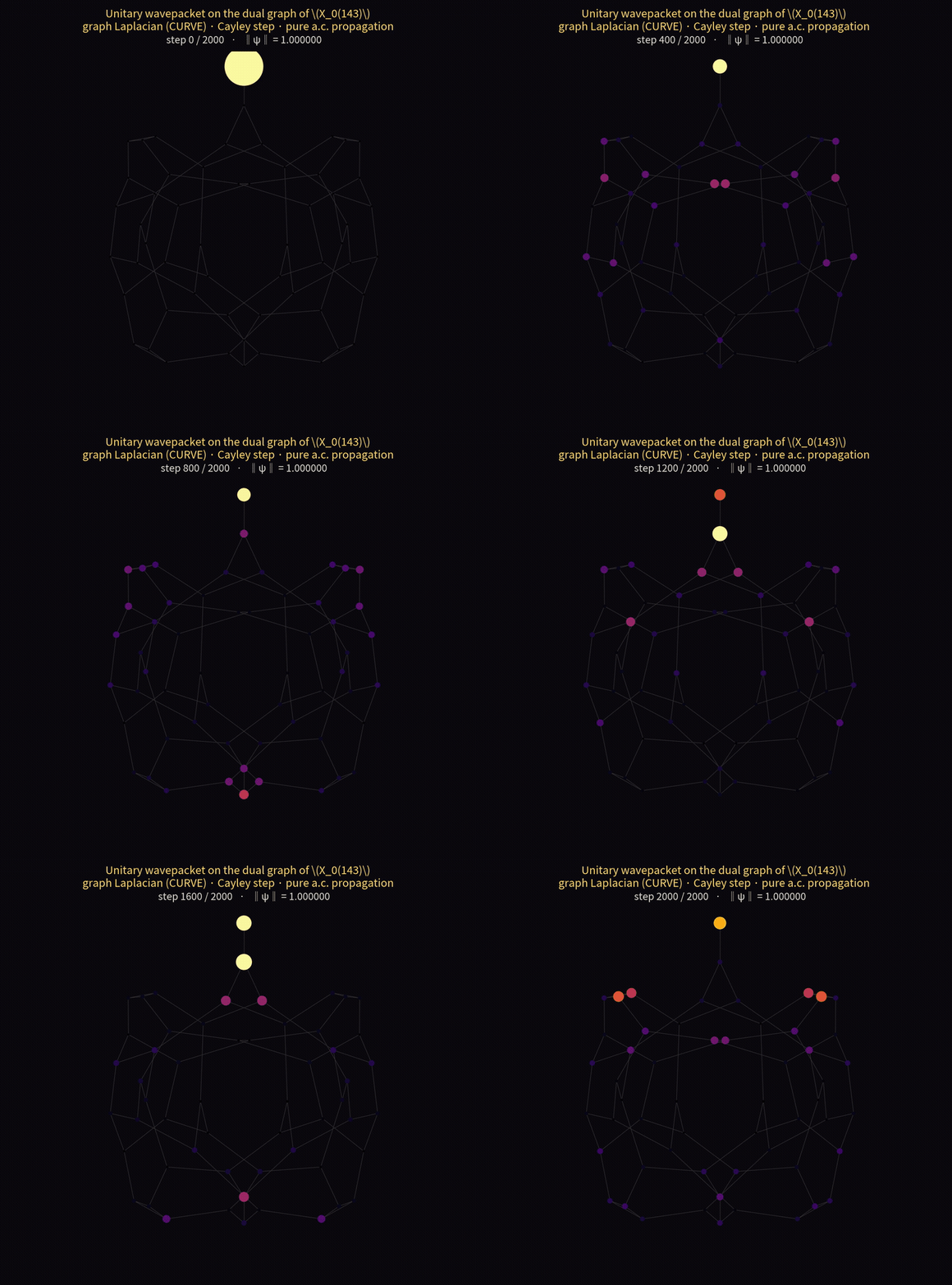
The visualization gallery includes the stiffness navigator, modular-surface and tiling components, arithmetic fingerprints and drawn-loop tools. The graph-clock wavepacket animation is a model evolution on the X₀(143) dual graph, not a simulation of experimentally established matter:
Sphereland is the visual companion: a single self-contained page of twenty-five instruments, from spheres and the laws of motion through knots one dimension up and the modular torus to mass gaps. Every panel is labelled by layer (structure, model, derived, hypothesis), and its numbers are computed in the page or certified by the check scripts beside it. It lives in the repository only, not in the sdist or the wheel.
For long PARI/GP work:
python -m mtft.gprun
The local browser runner locates gp (or the executable specified by MTFT_GP),
freezes the input script, stamps its hash and GP version, streams output to
disk, and records exit status. See PARI scripts and
the study guide. Hours-long studies are separate from
routine tests; choose a study's documented parameters and preserve its logs.
Test and maintain
# Atlas and its integration:
python -m pytest tests/test_interactions.py tests/test_tier11_and_legend.py -q
# Routine suite excluding tests marked slow (some unmarked tests still take minutes):
python -m pytest tests/ -m "not slow" -q
# The existing release gate:
python -m pytest tests/ -q
# Update or check the module index:
python scripts/build_capability_index.py
python scripts/build_capability_index.py --check
Optional dependencies and PARI/GP affect skips. Some research tests also use
their own opt-ins, such as MTFT_SLOW=1 for the full theta census. Follow the
test/study's instructions rather than treating one command as every archived
experiment. No fixed test-count badge is maintained here.
Release notes are organized in docs/changelog/,
with a separate unreleased record. Publishing
uses the existing release workflow; the package version,
__init__ version and CITATION.cff must agree before a release.
Citation and license
See CITATION.cff and LICENSE (MIT).
The external MadGraph reference retains its
upstream license.
Matter-01: electromagnetic U(1) reference
The Matter-01 report records a massive tree-level
e- e+ -> gamma gamma benchmark, an independent scalar oracle, conditional
mode/gauge normalization, and a B3 vacuum audit. Electron mass and alpha are
supplied reference inputs; a physical MTFT electron and massless photon remain
OPEN. The audit also distinguishes net family indices from full cohomology.
Open the offline U(1) lab or scientific overview. Reproduce the focused gate:
python -m pip install -r studies/matter01/requirements.txt
python studies/matter01/run_all.py
# After installing this source checkout with pip install -e .:
python -m mtft.matter benchmark --sqrt-s-gev 0.01 --cos-theta 0.37 --output benchmark.json
python -m mtft.matter report --output qed_report.json
The focused gate does not substitute for the full MTFT release suite. Source,
checks, logs and derivations are in
studies/matter01/.
Matter-02: exact collinear modes and a bulk coupling
The Matter-02 report specifies a cusp blow-up representative and computes its actual cohomology dimensions. An exact holomorphic lepton–Higgs coupling has rank at least three. Physical family selection, a Higgs vacuum, normalized masses and the photon mass kernel remain open. Both index orientations are documented explicitly.
Open the mode lab, or reproduce the focused certificates, regressions and figures with:
python studies/matter02/run_all.py
python -m mtft.matter.collinear --output collinear_report.json
The standard-library cohomology and Yukawa scripts are under
studies/matter02/; the photon audit uses the repository's existing SymPy
dependency.
Matter-03: a paired Higgs branch and the light-mode gate
The Matter-03 report excludes a nonzero single
directed Higgs vacuum in the unchanged full B3 background and constructs a
paired classical branch. Its specific deformed charged complex retains 237
degree-one classes per electric-charge sign. Even an arbitrary aligned pair
in the same spaces retains at least 160; family selection requires a further
change to the construction. A Higgs scale and physical surface metrics remain
open. The new mtft.matter.kinetics API normalizes lower-index superpotential
tensors only with explicitly supplied Grams, direction, vev and parent factor.
Open the offline Higgs lab or run:
python studies/matter03/run_all.py
python -m mtft.matter.higgs_vacuum --output higgs_vacuum.json
python -m mtft.matter.charged_modes --output charged_modes.json
The study guide identifies the exact conditional proofs, finite diagnostics and focused regressions. No observed masses are implied, and the focused gate is not the full release certification.
The matter programme: Matter-04 to GC-02
python -m mtft matter puzzle (or the generated programme map) lines up the
ten pieces of the Standard-Model-building programme in dependency order, with their statuses, sub-puzzles,
pre-registered tests and recorded negatives. The ledger lists every claim with its
class, status, module and test; corrections are append-only (CC-36 to CC-70; CC-69, the lattice action's repair, is a Legend entry); the latest waves are VE-01, the vacuum energy, and GC-02, the two-scale matching. The
integration notes are written for the audit, and every wave is in
the v1.0.0 changelog, one report per wave in docs/SM/.
python -m mtft matter puzzle --open      # what is still open
python -m mtft matter ledger --status caveat
python -m mtft matter atlas              # PG-01's vacuum atlas, with the Wilson-line torus census
python -c "from mtft.matter import ledger, puzzle; print(ledger.check(), puzzle.check())"
Two offline pages draw fields on a torus: the force on the Wilson-line torus (PG-01, section 5) and field-line islands at the Farey rationals.
1 maintainer

Metadata
1 maintainer
Release files for mtft 1.0.0
For a detailed explanation of source distributions (sdists) and built distributions (wheels), please see the package formats documentation.
Source distribution (sdist)
| File | Size | Uploaded | Provenance | Actions |
|---|---|---|---|---|
| mtft-1.0.0.tar.gz | 10.4 MB | With provenance | Details for mtft-1.0.0.tar.gz |
Built distribution (wheel)
| File | Interpreter | ABI | Platform | Actions Reset |
|---|---|---|---|---|
| mtft-1.0.0-py3-none-any.whl | Python 3 | none | any | Details for mtft-1.0.0-py3-none-any.whl |
Total release size: 14.0 MB
Release files / mtft-1.0.0.tar.gz
| Download URL | mtft-1.0.0.tar.gz |
|---|---|
| Size | 10.4 MB |
| Tags | Source |
|
SHA-256 checksum How to use checksums |
228a36b90a46160fcd91af50299feefe470a7185d6e4aea613d818658611fd2e
|
|
BLAKE2b-256 checksum How to use checksums |
6da0cb79a253f856c247f818d6d3a785bb4caf7e602214475bc6a7db69d1e01e
|
| Upload date | |
|
Uploaded using Trusted Publishing? What is trusted publishing? |
Yes |
| Uploaded via |
twine/7.0.0 CPython/3.13.16
|
Provenance
Provenance describes where a file came from. On PyPI, provenance is shared via attestations, which provide a verifiable record of the build or publishing details. View details, limitations and caveats.


PyPI Publish Attestation
PyPI verified that this artifact, at this checksum, originated from the publisher listed below.
Signed by GitHub Actions, verified by PyPI on Oct 24, 2026.
Transparency logRelease files / mtft-1.0.0-py3-none-any.whl
| Download URL | mtft-1.0.0-py3-none-any.whl |
|---|---|
| Size | 3.6 MB |
| Tags | Python 3 |
|
SHA-256 checksum How to use checksums |
c5ac2ba0f5b97e60caaeb55f33353f5cb42cba0dafc954849aa0b819605b74a8
|
|
BLAKE2b-256 checksum How to use checksums |
47484c8eb3604831e32b03d1361466348e77d3decd59be2d39b6c6f07171f30a
|
| Upload date | |
|
Uploaded using Trusted Publishing? What is trusted publishing? |
Yes |
| Uploaded via |
twine/7.0.0 CPython/3.13.16
|
Provenance
Provenance describes where a file came from. On PyPI, provenance is shared via attestations, which provide a verifiable record of the build or publishing details. View details, limitations and caveats.
PyPI Publish Attestation
PyPI verified that this artifact, at this checksum, originated from the publisher listed below.
Signed by GitHub Actions, verified by PyPI on Oct 24, 2026.
Transparency logSecurity for mtft 1.0.0
Provenance
Provenance describes where a file came from. On PyPI, provenance is shared via attestations, which provide a verifiable record of the build or publishing details. View details, limitations and caveats.
Full provenance
Both files in this release have been uploaded with provenance metadata.
Attestation for mtft-1.0.0.tar.gz
PyPI Publish Attestation
PyPI verified that this artifact, at this checksum, originated from the publisher listed below.
Signed by GitHub Actions, verified by PyPI on Oct 24, 2026.
Transparency logA note on package security
PyPI is a repository for distributing packages, not a service for auditing them. While third-party security researchers and our staff do their best to detect and remove malicious packages, PyPI cannot guarantee the quality, security or suitability of any given package.
To learn more about protecting yourself from malicious actors, visit our package security documentation.















