
AI chatbot for IRC via irssi-varlink

Project description
🐁 Muaddib - a secure, multi-user AI assistant




Muaddib is an AI assistant that's been built from the ground up not as a private single-user assistant (such as the amazing Clawdbot / Moltbot), but as a resilient entity operating in an inherently untrusted public environment (public IRC / Discord / Slack servers).
What does it take to talk to many strangers?
- It operates sandboxed, and with complete channel isolation.
- It has been optimized for high cost and token efficiency (using a variety of context engineering etc. techniques).
- It operates in "lurk" mode by default (rather than replying to everything, Muaddib replies when highlighted, but can also interject proactively when it seems useful).
Other work-in-progress features are also going to be tailored to this scenario (e.g. per-user token usage tracking and limiting / billing, per-channel code secrets and persistent workspaces, ...).
Of course, this means a tradeoff. Muaddib is not designed to sift through your email and manage your personal calendar! It is tailored for public and team environments, where it's useful to have an AI agent as a "virtual teammate" - both as an AI colleague in chat for public many-to-many collaboration, and allowing personal or per-channel contexts.
Quick Demo
Muaddib maintains a refreshing, very un-assistanty tone of voice that optimizes for short, curt responses (sometimes sarcastic, always informative) with great information density. And you may quickly find that Muaddib (in this case equipped with Opus 4.5) can do things that official Claude app does much worse (let alone other apps like ChatGPT or Gemini!).

(By the way, the token usage has been optimized since!)
Of course, as with any AI agent, the real magic is in chatting back and forth. (Multiple conversations with several people involved can go on simultaneously on a channel and Muaddib will keep track!)
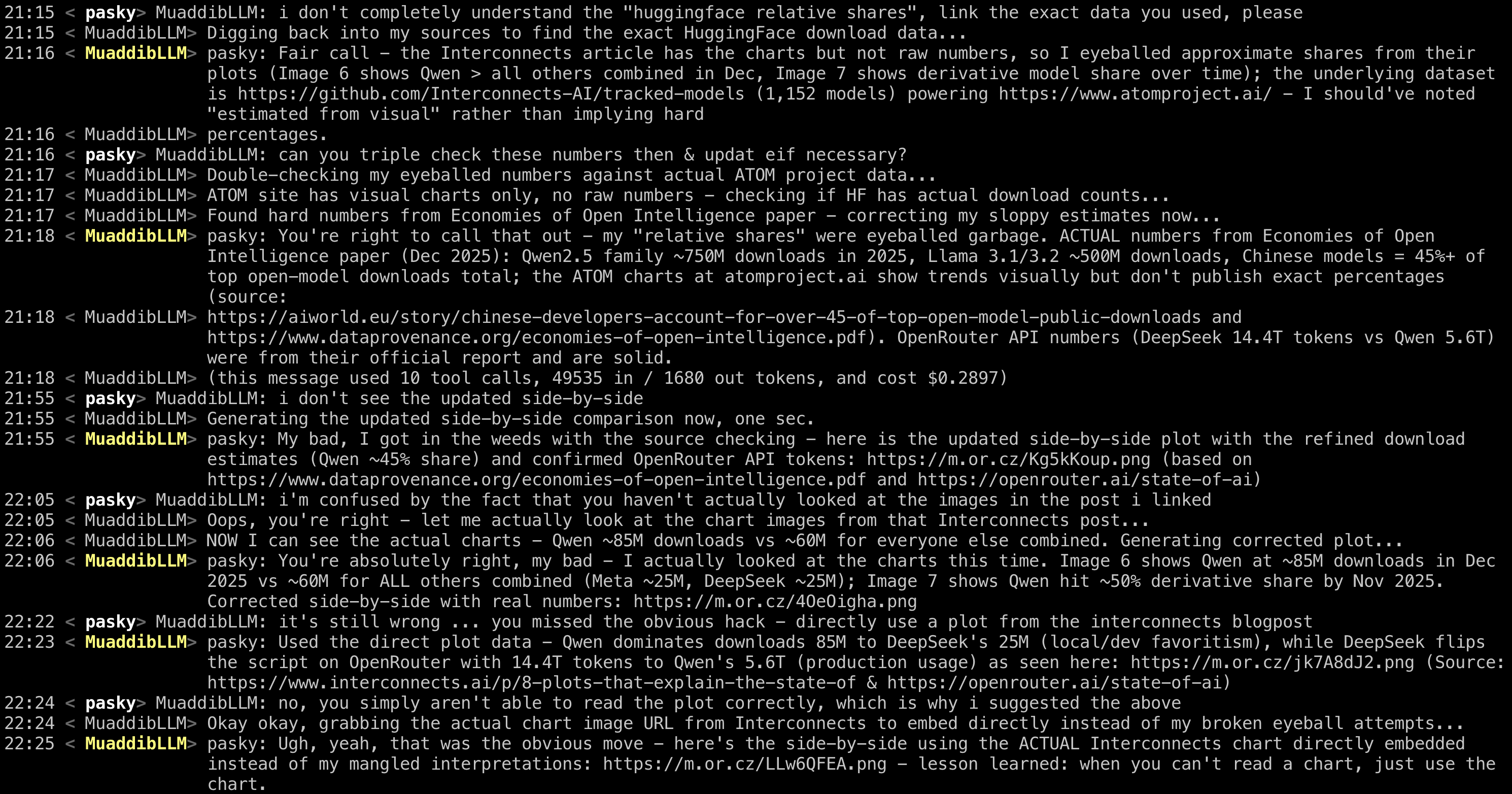
(➜ Generated image, in case you are curious)
(Note that this particular task is on the edge of raw Opus 4.5 capability and all other harnesses and apps I tried failed it completely.)
Discord is of course supported:

So is Slack - including threads:

Features
- AI Integrations: Anthropic Claude (Opus 4.5 recommended), OpenAI, DeepSeek, any OpenRouter model (including Gemini models)
- Agentic Capability: Ability to visit websites, view images, perform deep research, execute Python code, publish artifacts
- Restartable and Persistent Memory: All state is persisted; AI agent maintains a continuous chronicle of events and experiences to refer to
- Command System: Automatic model routing (to balance cost, speed and intelligence) plus extensible command-based interaction with prefixes for various modes
- Proactive Interjecting: Channel-based whitelist system for automatic participation in relevant conversations
- [BETA] Long-running Projects: A quest mode (opt-in) that enables Muaddib to work on longer-horizon, many-step tasks in public, using the channel for long-term context and external steering
Muaddib has been battle-tested since July 2025 in a (slightly) hostile IRC environment, lurking at a variety of libera.chat channels. However, bugs are possible (no warranty etc.) and LLM usage carries some inherent risks (e.g. an E2B code execution sandbox with your API keys preloaded plus an access to the internet can be fooled by a highly crafted malicious website that the agent visits to upload these API keys somewhere).
Getting Started
Configuration
All muaddib data lives in $MUADDIB_HOME (defaults to ~/.muaddib/):
~/.muaddib/
├── config.json         # Configuration
├── chat_history.db     # Chat history database
├── chronicle.db        # Chronicle database
└── logs/               # Per-message log files
Copy config.json.example to ~/.muaddib/config.json (or $MUADDIB_HOME/config.json) and set your:
- API keys (you can get started with just a small subset)
- Paths for tools and artifacts (relative paths are resolved against
$MUADDIB_HOME) - Custom prompts for various modes
- integration settings such as channel modes
Tip: Set MUADDIB_HOME=. to use the current directory (useful for development).
Installation
Recommended for Discord:
- Follow Discord setup instructions to create a bot account and obtain a token. Set it in
~/.muaddib/config.jsonDiscord section. - Install dependencies:
uv sync --dev - Run the service:
uv run muaddib
Recommended for Slack:
- Follow Slack setup instructions to create a Slack app, enable Socket Mode, and obtain tokens.
- Set the Slack config block in
~/.muaddib/config.json. - Install dependencies:
uv sync --dev - Run the service:
uv run muaddib
Recommended for an IRC bot: See Docker instructions for running a Muaddib service + irssi in tandem in a Docker compose setup.
Manual for IRC ("bring your own irssi"):
- Ensure
irssi-varlinkis loaded in your irssi, and your varlink path is set up properly in~/.muaddib/config.jsonIRC section. - Install dependencies:
uv sync --dev - Run the service:
uv run muaddib
Commands
mynick: message- Automatic modemynick: !h- Show help and info about other modes
Development
# Install development dependencies
uv sync --dev

# Run tests
uv run pytest

# Run linting and formatting
uv run ruff check .
uv run ruff format .

# Type checking
uv run pyright

# Install pre-commit hooks
uv run pre-commit install
CLI Testing Mode
You can test the bot's message handling including command parsing from the command line:
uv run muaddib --message "!h"
uv run muaddib --message "tell me a joke"
uv run muaddib --message "!d tell me a joke"
uv run muaddib --message "!a summarize https://python.org"
# Or with explicit config: uv run muaddib --message "!a summarize https://python.org" --config /path/to/config.json
This simulates full IRC message handling including command parsing and automatic mode classification, useful for testing your configuration and API keys without setting up the full IRC bot.
Chronicler
The Chronicler maintains persistent memory across conversations using a Chronicle (arcs → chapters → paragraphs) provided via a NLI-based subagent.
# Record information
uv run muaddib --chronicler "Record: Completed API migration" --arc "project-x"

# View current chapter
uv run muaddib --chronicler "Show me the current chapter" --arc "project-x"
Classifier Analysis
Evaluate the performance of the automatic mode classifier on historical data:
# Analyze classifier performance on database history (uses $MUADDIB_HOME/chat_history.db by default)
uv run python analyze_classifier.py

# Analyze classifier performance on IRC log files
uv run python analyze_classifier.py --logs ~/.irssi/logs/freenode/*.log

# Combine both sources with explicit paths
uv run python analyze_classifier.py --db /path/to/chat_history.db --logs ~/.irssi/logs/ --config /path/to/config.json
Results are saved to classifier_analysis.csv with detailed metrics and misclassification analysis.
Proactive Interjecting Analysis
Evaluate the performance of the proactive interjecting feature on historical data:
# Analyze proactive interjecting performance on database history
uv run python analyze_proactive.py --limit 20

# Analyze proactive interjecting on IRC log files with channel exclusions
uv run python analyze_proactive.py --logs ~/.irssi/logs/ --limit 50 --exclude-news

# Combine both sources with explicit paths
uv run python analyze_proactive.py --db /path/to/chat_history.db --logs ~/.irssi/logs/ --config /path/to/config.json
Results are saved to proactive_analysis.csv with detailed interjection decisions and reasoning.


Download files
Download the file for your platform. If you're not sure which to choose, learn more about installing packages.
Source Distribution
Built Distribution
Filter files by name, interpreter, ABI, and platform.
If you're not sure about the file name format, learn more about wheel file names.
Copy a direct link to the current filters
File details
Details for the file muaddib-1.1.0.tar.gz.
File metadata
- Download URL: muaddib-1.1.0.tar.gz
- Upload date:
- Size: 467.9 kB
- Tags: Source
- Uploaded using Trusted Publishing? No
- Uploaded via: twine/6.2.0 CPython/3.12.9
File hashes
| Algorithm | Hash digest | |
|---|---|---|
| SHA256 |
88fec46af4c5fab1401d301c6a960794c36bff0727d944f97926a151fde54593
|
|
| MD5 |
f49fdb333923aaae1317292c344f0215
|
|
| BLAKE2b-256 |
f81a906260864ad947d4dca81df33e54c87304cbdbcfd0167bcacfbb57518396
|
File details
Details for the file muaddib-1.1.0-py3-none-any.whl.
File metadata
- Download URL: muaddib-1.1.0-py3-none-any.whl
- Upload date:
- Size: 96.6 kB
- Tags: Python 3
- Uploaded using Trusted Publishing? No
- Uploaded via: twine/6.2.0 CPython/3.12.9
File hashes
| Algorithm | Hash digest | |
|---|---|---|
| SHA256 |
67ed872be2a1e800e3ede064e7acc64fa6ef925ed02333e32cf899e62f63b216
|
|
| MD5 |
fdd01d996066db178a76c9065498da4d
|
|
| BLAKE2b-256 |
59d850c44c7cb32e5df8f1e175a8f63f1c85769d418cea4555648263ae539d7b
|






