
multidim-mcp
Structured thinking grids for AI agents — a standalone MCP server, pure standard library.
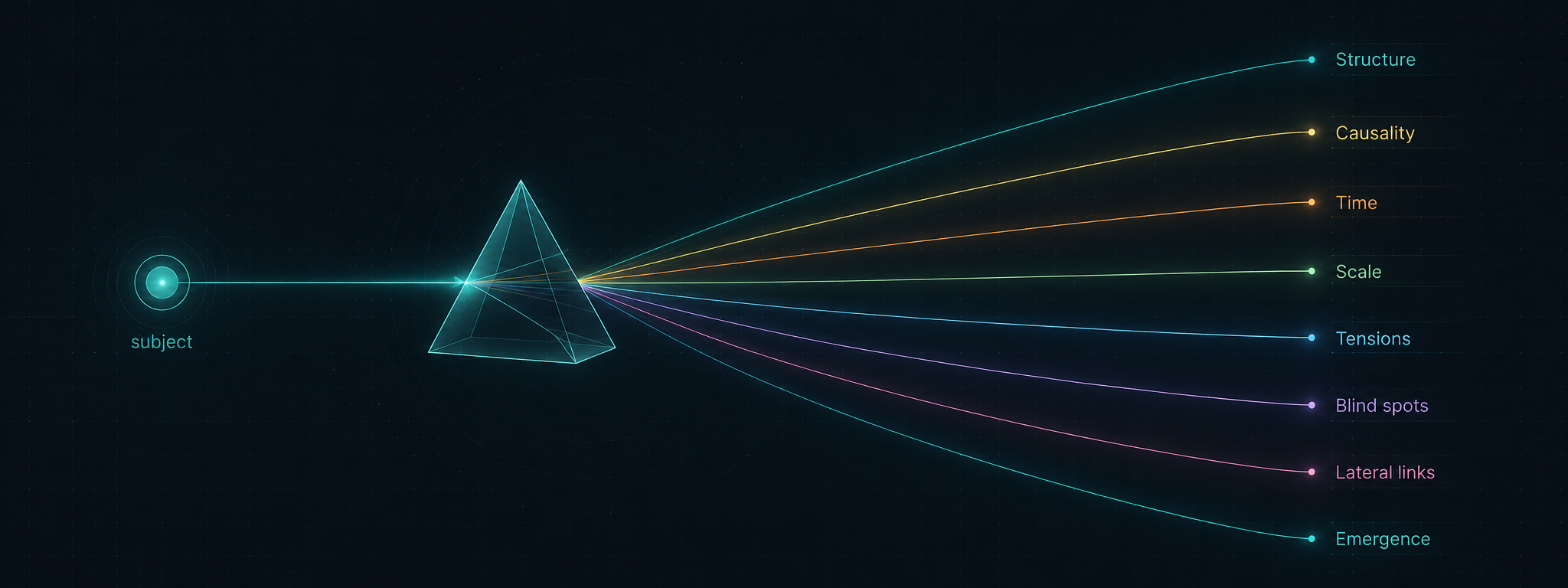
Multidim routes a subject to a set of analysis lenses (a context) and returns a hierarchical grid — axes, sub-lenses, mandatory questions — for the calling LLM to fill in. The thinking stays with the caller: the server provides structure, never cognition. It calls no LLM, makes no network requests, and the same input always produces the same frame.
- Zero dependencies — Python 3.9+, standard library only.
- Deterministic v2 contract — every frame carries a self-verifiable
frame_hash; a filled analysis is checked section by section with actionable error codes. - Learned traps — lessons you record once become mandatory questions injected into every future frame whose subject matches.
- Hardened store — atomic writes, native cross-process locking, additive
migrations, backed-up resets, and a guard that refuses to ever touch a foreign
~/.multidimstore.
See the difference
An agent analyses "Should we migrate the billing service from MySQL to
PostgreSQL?". Every section is filled, every sentence reads fine. Here is what
multidim_validate returns on that first pass:
overall verdict: REJECT

REJECT  alternatives        NOT_ENOUGH_ALTERNATIVES, ALTERNATIVE_DUPLICATES_PRIMARY
REJECT  hypotheses          HYPOTHESIS_NOT_FALSIFIABLE
REJECT  second_order_risks  SECOND_ORDER_REPEATS_FIRST
REJECT  cross_talk          GENERIC_DENSITY_HIGH
REJECT  synthesis           SYNTHESIS_WITHOUT_REFERENCES
WARNING premortem           PREMORTEM_SIMILAR_TO_RISKS
The only alternative restated the hypothesis, the hypothesis carried no test that could prove it wrong, the second-order effect repeated the first one word for word, and the conclusion referenced none of the work above. None of that is visible when you read the answer; all of it is reported here, by name.
Redo the rejected sections and the same checker returns ACCEPT. Edit the frame
to delete the rule you find inconvenient, and it refuses the whole submission —
the frame carries a hash of its own content.
Full transcript, including what the fixed sections look like and what this
deliberately does not check: DEMO.md. Reproduce it in one
command: python demo.py.
Quickstart
pip install multidim-mcp        # from PyPI
pip install .                   # or from a source checkout
Register the server with any MCP client (stdio transport):
{
  "mcpServers": {
    "multidim": {
      "command": "multidim-mcp"
    }
  }
}
Or run it directly: python -m multidim_mcp, or without installing: uvx multidim-mcp.
The server is listed in the official MCP Registry as
io.github.Cherridsaid/multidim-mcp.
Tools
| Tool | Role |
|---|---|
multidim_analyze |
Build the grid for a subject (depth: core / deep / full; format: text or deterministic v2 JSON frame) |
multidim_contexts |
List every known context with its axes and sub-lenses |
multidim_validate |
Deterministic, stateless check of a filled analysis against its v2 frame — ACCEPT / WARNING / REJECT per section |
multidim_learn |
Create or enrich a context (keywords, axes, traps) — the only write door |
How it works
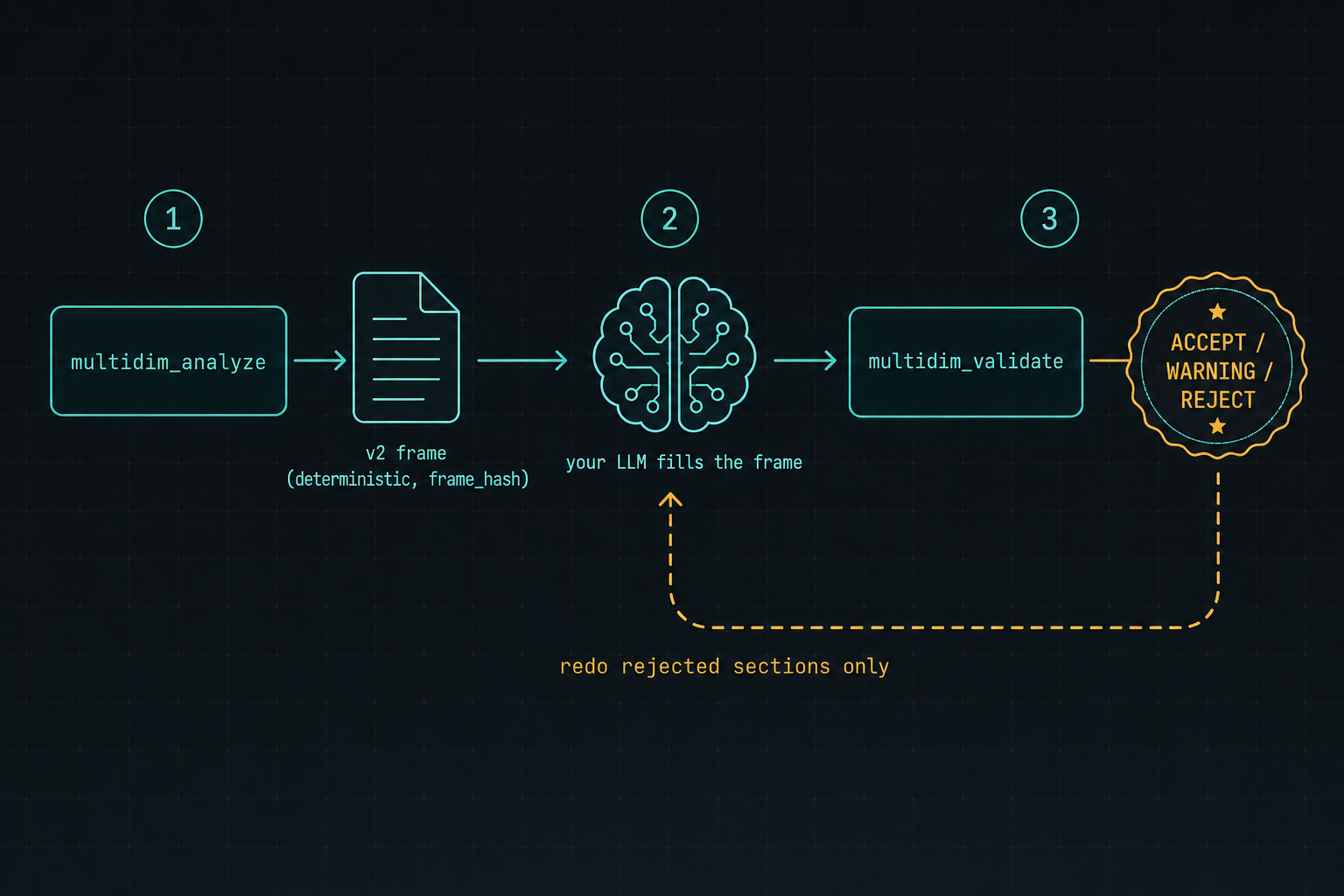
multidim_analyzedetects the best context for your subject (word-boundary keyword matching, accent-folded) and returns a v2 frame: required sections, section schemas, validation rules, mandatory questions — including every learned trap whose triggers match the subject.- Your LLM fills the frame, section by section.
multidim_validaterebuilds the frame from the store, refuses a tampered or stale one (frame_hash), then checks the analysis: structural completeness, falsification tests on hypotheses, alternatives that genuinely differ from the primary, second-order effects distinct from first-order, a pre-mortem that does not copy the risk list, a synthesis that references real identifiers, and a filler-phrase density cap. Only rejected sections are redone, within the frame'smax_validation_rounds.
The four seed contexts are neutral and deterministic: generic (8 general
lenses), code_review, technical_writing, decision.
Storage
The store lives on a dedicated per-user data path (MULTIDIM_MCP_HOME overrides
it) and is created on first run from the neutral seeds. Writes are atomic and
serialized across processes with the OS's native file locking; a corrupt store is
backed up before any reset, never silently discarded. A tripwire refuses every
read or write that would resolve into a foreign personal ~/.multidim store.
Maintainers publishing forks can extend the neutrality guard with their own
private markers via MULTIDIM_MCP_EXTRA_FORBIDDEN (comma-separated), without
hardcoding them into public source.
Transparency
- Not an AI system. multidim-mcp contains no model and performs no inference: it is deterministic, rule-based software. Under the EU AI Act (Reg. 2024/1689) it is not an AI system in the sense of Art. 3(1), and as free and open-source software it falls under the Art. 2(12) exemption. It collects no data and makes no network calls.
- Illustrations in this README were generated with GPT and keep their C2PA provenance metadata intact.
Development
python run_tests.py      # full suite, stdlib only
python smoke_install.py  # packaging smoke test (wheel + venv + entry point)
python demo.py           # the analyse -> validate -> fix -> accept cycle of DEMO.md
CI runs both on Ubuntu and Windows across Python 3.9 / 3.11 / 3.13.
License
1 maintainer

Metadata
1 maintainer
Release files for multidim-mcp 0.2.0
For a detailed explanation of source distributions (sdists) and built distributions (wheels), please see the package formats documentation.
Source distribution (sdist)
| File | Size | Uploaded | |
|---|---|---|---|
| multidim_mcp-0.2.0.tar.gz | 103.6 kB | Details |
Built distribution (wheel)
| File | Interpreter | ABI | Platform | Reset |
|---|---|---|---|---|
| multidim_mcp-0.2.0-py3-none-any.whl | Python 3 | none | any | Details |
Total release size: 165.4 kB
Release files / multidim_mcp-0.2.0.tar.gz
| Download URL | multidim_mcp-0.2.0.tar.gz |
|---|---|
| Size | 103.6 kB |
| Tags | Source |
|
SHA-256 checksum How to use checksums |
45883313c9c268b66a5b25a6af899e5a12c92d9eac07e2ca14a515ce2a15ae76
|
|
BLAKE2b-256 checksum How to use checksums |
0d4c780500d1fcc1f283992b6e213320711f6e55e68ca3680127d18af02eab4c
|
| Upload date | |
|
Uploaded using Trusted Publishing? What is trusted publishing? |
Yes |
| Uploaded via |
twine/7.0.0 CPython/3.13.14
|
Provenance
Provenance describes where a file came from. On PyPI, provenance is shared via attestations, which provide a verifiable record of the build or publishing details. View details, limitations and caveats.


PyPI Publish Attestation
PyPI verified that this artifact, at this checksum, originated from the publisher listed below.
Signed by GitHub Actions, verified by PyPI on Aug 26, 2026.
Transparency logRelease files / multidim_mcp-0.2.0-py3-none-any.whl
| Download URL | multidim_mcp-0.2.0-py3-none-any.whl |
|---|---|
| Size | 61.9 kB |
| Tags | Python 3 |
|
SHA-256 checksum How to use checksums |
1722640e935c74c5541a4ee800df3936e1741bcaf43885726e385e2f98d7dc22
|
|
BLAKE2b-256 checksum How to use checksums |
310a90bc622b671c32f57ce8dfccf2b31fac77f6551505f0789794227f63653a
|
| Upload date | |
|
Uploaded using Trusted Publishing? What is trusted publishing? |
Yes |
| Uploaded via |
twine/7.0.0 CPython/3.13.14
|
Provenance
Provenance describes where a file came from. On PyPI, provenance is shared via attestations, which provide a verifiable record of the build or publishing details. View details, limitations and caveats.
PyPI Publish Attestation
PyPI verified that this artifact, at this checksum, originated from the publisher listed below.
Signed by GitHub Actions, verified by PyPI on Aug 26, 2026.
Transparency log













