
MultiprocessingSpider
Description
MultiprocessingSpider is a simple and easy to use web crawling and web scraping framework.
Architecture
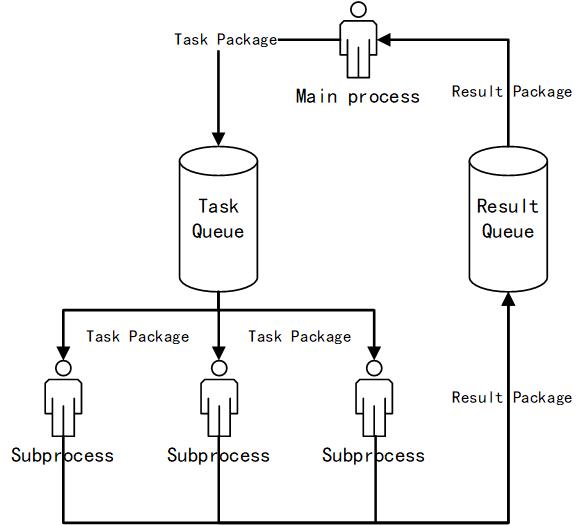
Dependencies
- requests
Installation
pip install MultiprocessingSpider
Basic Usage
MultiprocessingSpider
from MultiprocessingSpider.spiders import MultiprocessingSpider
from MultiprocessingSpider.packages import TaskPackage, ResultPackage


class MyResultPackage(ResultPackage):
    def __init__(self, prop1, prop2, sleep=True):
        super().__init__(sleep)
        self.prop1 = prop1
        self.prop2 = prop2


class MySpider(MultiprocessingSpider):
    start_urls = ['https://www.a.com/page1']

    proxies = [
        {"http": "http://111.111.111.111:80"},
        {"http": "http://123.123.123.123:8080"}
    ]

    def router(self, url):
        return self.parse

    def parse(self, response):
        # Parsing task or new page from "response"
        ...
        # Yield a task package
        yield TaskPackage('https://www.a.com/task1')
        ...
        # Yield a url or a url list
        yield 'https://www.a.com/page2'
        ...
        yield ['https://www.a.com/page3', 'https://www.a.com/page4']

    @classmethod
    def subprocess_handler(cls, package, sleep_time, timeout, retry):
        url = package.url
        # Request "url" and parse data
        ...
        # Return result package
        return MyResultPackage('value1', 'value2')

    @staticmethod
    def process_result_package(package):
        # Processing result package
        if 'value1' == package.prop1:
            return package
        else:
            return None


if __name__ == '__main__':
    s = MySpider()

    # Start the spider
    s.start()

    # Block current process
    s.join()

    # Export results to csv file
    s.to_csv('result.csv')

    # Export results to json file
    s.to_json('result.json')
FileSpider
from MultiprocessingSpider.spiders import FileSpider
from MultiprocessingSpider.packages import FilePackage


class MySpider(FileSpider):
    start_urls = ['https://www.a.com/page1']

    stream = True

    buffer_size = 1024

    overwrite = False

    def router(self, url):
        return self.parse

    def parse(self, response):
        # Parsing task or new page from "response"
        ...
        # Yield a file package
        yield FilePackage('https://www.a.com/file.png', 'file.png')
        ...
        # Yield a new url or a url list
        yield 'https://www.a.com/page2'
        ...
        yield ['https://www.a.com/page3', 'https://www.a.com/page4']


if __name__ == '__main__':
    s = MySpider()

    # Add a url
    s.add_url('https://www.a.com/page5')

    # Start the spider
    s.start()

    # Block current process
    s.join()
FileDownloader
from MultiprocessingSpider.spiders import FileDownloader


if __name__ == '__main__':
    d = FileDownloader()

    # Start the downloader
    d.start()

    # Add a file
    d.add_file('https://www.a.com/file.png', 'file.png')

    # Block current process
    d.join()
More examples → GitHub
License
GPLv3.0
This is a free library, anyone is welcome to modify : )
Release Note
v1.1.2
Refactor
- Remove property "name" from "FileDownloader".
- Complete class "UserAgentGenerator" in "MultiprocessingSpider.Utils".
- Continue to optimize the setter method of each property. An exception will be raised if the value is invalid. "sleep_time" now can be set to 0.
- Change the sleep strategy of subprocess, subprocess will sleep after receiving the task package to prevent multiple requests from being sent at the same time.
v1.1.1
Bug Fixes
- Fix "start_urls" invalidation.
v1.1.0
Features
- Add overwrite option for "FileSpider".
- Add routing system. After overriding "router" method, you can yield a single url or a url list in your parse method.
Bug Fixes
- Fix retry message display error.
Refactor
- Optimize setter method. Now you can do this: spider.sleep_time = ' 5'.
- Will not resend request when "status_code" is not between 200 and 300.
a) MultiprocessingSpider
- Rename property "handled_url_table" to "handled_urls".
- Remove method "parse", add "example_parse_method".
- "User-Agent" in "web_headers" is now generated randomly.
- Change url_table parsing order, current rule: "FIFP" (first in first parse).
b) FileDownloader
- Remove "add_files" method.
v1.0.0
- The first version.
1 maintainer

Metadata
1 maintainer
Release files for MultiprocessingSpider 1.1.2
For a detailed explanation of source distributions (sdists) and built distributions (wheels), please see the package formats documentation.
Source distribution (sdist)
| File | Size | Uploaded | Provenance | Actions |
|---|---|---|---|---|
| MultiprocessingSpider-1.1.2.tar.gz | 26.7 kB | Without provenance | Details for MultiprocessingSpider-1.1.2.tar.gz |
Built distribution (wheel)
| File | Interpreter | ABI | Platform | Actions Reset |
|---|---|---|---|---|
| MultiprocessingSpider-1.1.2-py3-none-any.whl | Python 3 | none | any | Details for MultiprocessingSpider-1.1.2-py3-none-any.whl |
Total release size: 54.2 kB
Release files / MultiprocessingSpider-1.1.2.tar.gz
| Download URL | MultiprocessingSpider-1.1.2.tar.gz |
|---|---|
| Size | 26.7 kB |
| Tags | Source |
|
SHA-256 checksum How to use checksums |
ff9ad77b59c567ca5cbd81be17b398f2bc153c9a80f2494970f03f5b9105e79e
|
|
BLAKE2b-256 checksum How to use checksums |
7014d0828b44a5ced215a93b4015558da303c608da5558a3a8a7cb39adc50f9c
|
| Upload date | |
|
Uploaded using Trusted Publishing? What is trusted publishing? |
No |
| Uploaded via |
twine/3.1.1 pkginfo/1.5.0.1 requests/2.22.0 setuptools/41.2.0 requests-toolbelt/0.9.1 tqdm/4.41.0 CPython/3.8.1
|
Release files / MultiprocessingSpider-1.1.2-py3-none-any.whl
| Download URL | MultiprocessingSpider-1.1.2-py3-none-any.whl |
|---|---|
| Size | 27.5 kB |
| Tags | Python 3 |
|
SHA-256 checksum How to use checksums |
d644da61239beb03e337251770399a4d0f1a0941a0457b523b2fb54d25093c38
|
|
BLAKE2b-256 checksum How to use checksums |
93c4cf3ddf874d0fcf7df369cc7dfb0ec7708fbc1740fc5504b0992478fbcfb9
|
| Upload date | |
|
Uploaded using Trusted Publishing? What is trusted publishing? |
No |
| Uploaded via |
twine/3.1.1 pkginfo/1.5.0.1 requests/2.22.0 setuptools/41.2.0 requests-toolbelt/0.9.1 tqdm/4.41.0 CPython/3.8.1
|
Security for MultiprocessingSpider 1.1.2
Provenance
Provenance describes where a file came from. On PyPI, provenance is shared via attestations, which provide a verifiable record of the build or publishing details. View details, limitations and caveats.
No provenance found
None of the files in this release were uploaded with provenance metadata.
A note on package security
PyPI is a repository for distributing packages, not a service for auditing them. While third-party security researchers and our staff do their best to detect and remove malicious packages, PyPI cannot guarantee the quality, security or suitability of any given package.
To learn more about protecting yourself from malicious actors, visit our package security documentation.














