
Create aggregate bioinformatics analysis reports across many samples and tools

Reason this release was yanked:
bug
Project description

Aggregate bioinformatics results across many samples into a single report
Find documentation and example reports at https://seqera.io/multiqc/



MultiQC is a tool to create a single report with interactive plots for multiple bioinformatics analyses across many samples.
Reports are generated by scanning given directories for recognised log files. These are parsed and a single HTML report is generated summarising the statistics for all logs found. MultiQC reports can describe multiple analysis steps and large numbers of samples within a single plot, and multiple analysis tools making it ideal for routine fast quality control.
A very large number of Bioinformatics tools are supported by MultiQC. Please see the MultiQC website for a complete list. MultiQC can also easily parse data from custom scripts, if correctly formatted / configured - a feature called Custom Content.
More modules are being written all the time. Please suggest any ideas as a new issue (please include example log files).
Installation
You can install MultiQC using uv (no separate Python installation required):
uv tool install multiqc
Alternatively, install from PyPI using pip:
pip install multiqc
Or install using Conda from Bioconda (set up your channels first):
conda install multiqc
If you would like the development version from GitHub instead, you can install it with uv or pip:
uv tool install git+https://github.com/MultiQC/MultiQC.git
pip install --upgrade --force-reinstall git+https://github.com/MultiQC/MultiQC.git
MultiQC is also available via Docker and Singularity images, Galaxy wrappers, and many more distribution methods. See the documentation for details.
Usage
Once installed, you can use MultiQC by navigating to your analysis directory (or a parent directory) and running the tool:
multiqc .
That's it! MultiQC will scan the specified directory (. is the current dir)
and produce a report detailing whatever it finds.
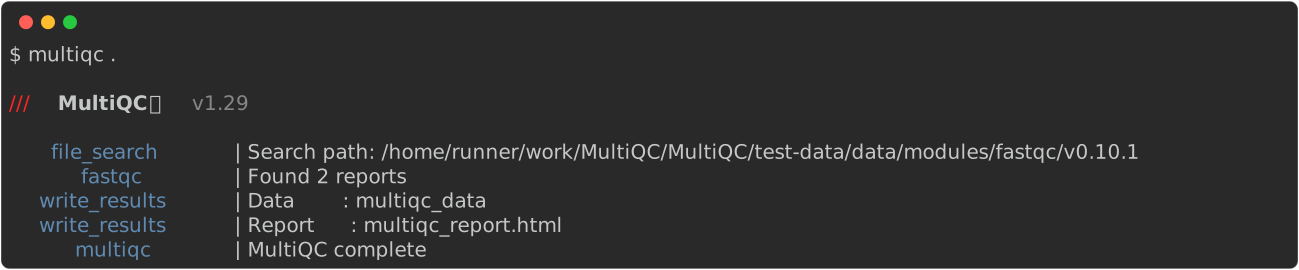
The report is created in multiqc_report.html by default. Tab-delimited data
files are also created in multiqc_data/, containing extra information.
These can be easily inspected using Excel (use --data-format to get yaml
or json instead).
For more detailed instructions, run multiqc -h or see the
documentation.
Citation
Please consider citing MultiQC if you use it in your analysis.
MultiQC: Summarize analysis results for multiple tools and samples in a single report.
Philip Ewels, Måns Magnusson, Sverker Lundin and Max Käller
Bioinformatics (2016)
doi: 10.1093/bioinformatics/btw354
PMID: 27312411
@article{doi:10.1093/bioinformatics/btw354,
 author = {Ewels, Philip and Magnusson, Måns and Lundin, Sverker and Käller, Max},
 title = {MultiQC: summarize analysis results for multiple tools and samples in a single report},
 journal = {Bioinformatics},
 volume = {32},
 number = {19},
 pages = {3047},
 year = {2016},
 doi = {10.1093/bioinformatics/btw354},
 URL = { + http://dx.doi.org/10.1093/bioinformatics/btw354},
 eprint = {/oup/backfile/Content_public/Journal/bioinformatics/32/19/10.1093_bioinformatics_btw354/3/btw354.pdf}
}
Contributions & Support
Contributions and suggestions for new features are welcome, as are bug reports! Please create a new issue for any of these, including example reports where possible. Pull-requests for fixes and additions are very welcome. Please see the contributing notes for more information about how the process works.
MultiQC has extensive documentation describing how to write new modules, plugins and templates.
If in doubt, feel free to get in touch with the author directly: @ewels (phil.ewels@seqera.io)
Contributors
MultiQC is developed and maintained by Phil Ewels (@ewels) at Seqera Labs. It was originally written at the National Genomics Infrastructure, part of SciLifeLab in Sweden.
A huge thank you to all code contributors - there are a lot of you! See the Contributors Graph for details.
MultiQC is released under the GPL v3 or later licence.
Release history Release notifications | RSS feed


Download files
Download the file for your platform. If you're not sure which to choose, learn more about installing packages.
Source Distribution
Built Distribution
Filter files by name, interpreter, ABI, and platform.
If you're not sure about the file name format, learn more about wheel file names.
Copy a direct link to the current filters
File details
Details for the file multiqc_celescope-1.34.dev0.tar.gz.
File metadata
- Download URL: multiqc_celescope-1.34.dev0.tar.gz
- Upload date:
- Size: 5.4 MB
- Tags: Source
- Uploaded using Trusted Publishing? No
- Uploaded via: twine/6.1.0 CPython/3.13.7
File hashes
| Algorithm | Hash digest | |
|---|---|---|
| SHA256 |
709bc88ceead5358943b6fd878ffc1d21f72d6f994af0bae1324d06a6f2291b2
|
|
| MD5 |
7b73e1669739c9470753c8fc38abb4a0
|
|
| BLAKE2b-256 |
3b18eee6712af85b26b96ad6697443c6785cdec27302e87b2f5773d0af81feb4
|
File details
Details for the file multiqc_celescope-1.34.dev0-py3-none-any.whl.
File metadata
- Download URL: multiqc_celescope-1.34.dev0-py3-none-any.whl
- Upload date:
- Size: 5.7 MB
- Tags: Python 3
- Uploaded using Trusted Publishing? No
- Uploaded via: twine/6.1.0 CPython/3.13.7
File hashes
| Algorithm | Hash digest | |
|---|---|---|
| SHA256 |
7d06e760951f7109229c7a95abc57ba6f429cb5baf3dcf4e8c4ea814b11fcc8a
|
|
| MD5 |
b02107e4b55180ec851fe6a209e3a9ff
|
|
| BLAKE2b-256 |
4583effb5fecd0a9751d249cfd99a7c484b1c8aa4efbdafb7db8e5956e43ae3e
|






