


munkres







The Munkres (Hungarian) algorithm for the assignment problem: given a cost for every (worker, job) pair, find the one-to-one assignment with the lowest total cost. Pure Python, no dependencies, fully typed, thread-safe.
            Job A  Job B  Job C
Worker 0      4      1      3
Worker 1      2      0      5        ->   0->B (1)   1->A (2)   2->C (2)   total 5
Worker 2      3      2      2
Install
pip install munkres        # once 2.0 is on PyPI; until then:
pip install git+https://github.com/iameishit/Paldita-munkres
Needs Python 3.10+. numpy and pandas are optional: if you have them, arrays and DataFrames are accepted as input.
Quick start
from munkres import Munkres

cost = [[4, 1, 3],
        [2, 0, 5],
        [3, 2, 2]]

pairs = Munkres().compute(cost)
print(pairs)                                   # [(0, 1), (1, 0), (2, 2)]
print(sum(cost[r][c] for r, c in pairs))       # 5
compute returns (row, column) pairs sorted by row. Rectangular matrices
work too: min(rows, columns) pairs are returned.
Forbidding a pairing
from munkres import DISALLOWED, Munkres

cost = [[4, DISALLOWED, 3],
        [2, 0, DISALLOWED],
        [3, 2, 2]]
print(Munkres().compute(cost))                 # [(0, 2), (1, 1), (2, 0)]
float("inf") means the same as DISALLOWED.
Maximising profit instead of minimising cost
from munkres import Munkres, make_cost_matrix

profit = [[5, 9, 1], [10, 3, 2], [8, 7, 4]]
pairs = Munkres().compute(make_cost_matrix(profit))
print(sum(profit[r][c] for r, c in pairs))     # 23
When there is no valid assignment
Impossible constraints raise immediately (they used to hang forever in 1.x), and the exception tells you why:
from munkres import DISALLOWED as D, Munkres, UnsolvableMatrix

try:
    Munkres().compute([[1, D, D], [1, D, D], [1, 2, 3]])
except UnsolvableMatrix as error:
    print(error)       # No complete assignment exists: rows [0, 1] can only be matched to columns [0] ...
    print(error.rows, error.cols)              # (0, 1) (0,)
numpy and pandas
import numpy as np
from munkres import Munkres

print(Munkres().compute(np.array([[4, 1, 3], [2, 0, 5], [3, 2, 2]])))
Inputs are never modified. Fraction and Decimal costs work as well.
More than compute()
A richer result: solve
from munkres import solve

result = solve([[4, 1, 3], [2, 0, 5]])         # 2 workers, 3 jobs
print(result.pairs)                            # ((0, 1), (1, 0))
print(result.total)                            # 3
print(result.unmatched_cols)                   # (2,)
maximize=True maximises (exactly, even for Decimal/Fraction).
Gating (max_cost=, or min_profit= when maximising) refuses bad pairs and
leaves rows unmatched instead, which is what object tracking needs:
from munkres import solve

cost = [[1, 9, 9], [9, 2, 9], [9, 9, 8]]
print(solve(cost, max_cost=3).pairs)           # ((0, 0), (1, 1))
profit = [[5, 9, 1], [10, 3, 2], [8, 7, 4]]
print(solve(profit, maximize=True).total)      # 23
With a pandas DataFrame you get your labels back:
import pandas as pd
from munkres import solve

frame = pd.DataFrame([[4, 1], [2, 0]], index=["w1", "w2"], columns=["jobA", "jobB"])
print(solve(frame).labelled())                 # [('w1', 'jobB'), ('w2', 'jobA')]
Why is there no answer? diagnose
from munkres import DISALLOWED as D, diagnose

problem = diagnose([[1, D, D], [1, D, D], [1, 2, 3]])
print(problem.rows, problem.cols)              # (0, 1) (0,)
Watch it think: trace
from munkres import solve

trace = solve([[4, 1, 3], [2, 0, 5], [3, 2, 2]], trace=True).trace
print(trace.to_text().splitlines()[0])         # Hungarian algorithm on a 3x3 matrix (10 steps)
trace.to_html() gives a static page you can open or share.
Drop-in for SciPy, and a matrix builder
from munkres import build_cost_matrix, linear_sum_assignment, solve

rows, cols = linear_sum_assignment([[4, 1, 3], [2, 0, 5], [3, 2, 2]])
print(rows, cols)                              # [0, 1, 2] [1, 0, 2]
workers, jobs = [(0, 0), (5, 5)], [(1, 1), (6, 4)]
cost = build_cost_matrix(workers, jobs, lambda w, j: abs(w[0] - j[0]) + abs(w[1] - j[1]))
print(solve(cost).pairs)                       # ((0, 0), (1, 1))
Analysing a problem
from munkres import bottleneck, counterfactual, k_best, shadow_prices, tolerance

m = [[4, 1, 3], [2, 0, 5], [3, 2, 2]]
print(shadow_prices(m).total)                  # 5
print(counterfactual(m, 0, 0))                 # 1
print(tolerance(m, 0, 1))                      # 1
print([a.total for a in k_best(m, 3)])         # [5, 6, 6]
print(bottleneck([[1, 5], [5, 9]]).pairs)      # ((0, 1), (1, 0))
shadow_prices: the LP duals, a certificate anyone can re-check that the answer is optimal.counterfactual(m, i, j): what forcing a pair would cost.tolerance(m, i, j): how much a chosen pair's cost may rise before the answer changes.k_best(m, k): the k best assignments (Murty's algorithm).bottleneck(m): make the worst single pair as good as possible.
Related problems
from munkres import soft_assignment, stable_matching, transport

men = {"A": ["x", "y", "z"], "B": ["y", "x", "z"], "C": ["x", "y", "z"]}
women = {"x": ["B", "A", "C"], "y": ["C", "A", "B"], "z": ["A", "B", "C"]}
print(stable_matching(men, women))             # {'A': 'z', 'B': 'x', 'C': 'y'}
plan = transport([3, 2], [2, 3], [[1, 5], [4, 2]])
print(plan.flows)                              # {(0, 0): 2, (0, 1): 1, (1, 1): 2}
print(plan.total_cost)                         # 11
print(round(soft_assignment([[0.0, 1.0, 1.0], [1.0, 0.0, 1.0], [1.0, 1.0, 0.0]], 0.05)[0][0], 3))  # 1.0
stable_matching: preferences instead of costs (Gale-Shapley, proposer-optimal).transport: ship quantities from suppliers to consumers at least cost.sinkhorn/soft_assignment: entropic optimal transport, a soft, differentiable matching.
Command line
munkres costs.csv --maximize --json
printf '4,1,3\n2,0,5\n3,2,2\n' | munkres - --trace
Matrix files are comma- or space-separated; an empty cell, D, x or inf forbids a pairing.
python -m munkres with no arguments runs a built-in self-check.
Input rules
| input | result |
|---|---|
| ragged rows | ValueError |
NaN, -inf |
ValueError |
| a non-number cell | TypeError |
| empty matrix (no rows or no columns) | [] |
DISALLOWED, +inf |
pairing forbidden |
| impossible constraints | UnsolvableMatrix (a ValueError) with a Hall's-theorem witness |
Performance
Pure-Python O(n²·m). Measured on one machine: 200x200 in ~0.1 s, 500x500 in ~0.8 s, 1000x1000 in ~4 s
(about 5-50x faster than munkres 1.1.4 on random matrices, and on par when almost all costs tie; numbers in docs/BENCHMARKS.md, reproducible with
python tools/benchmark.py).
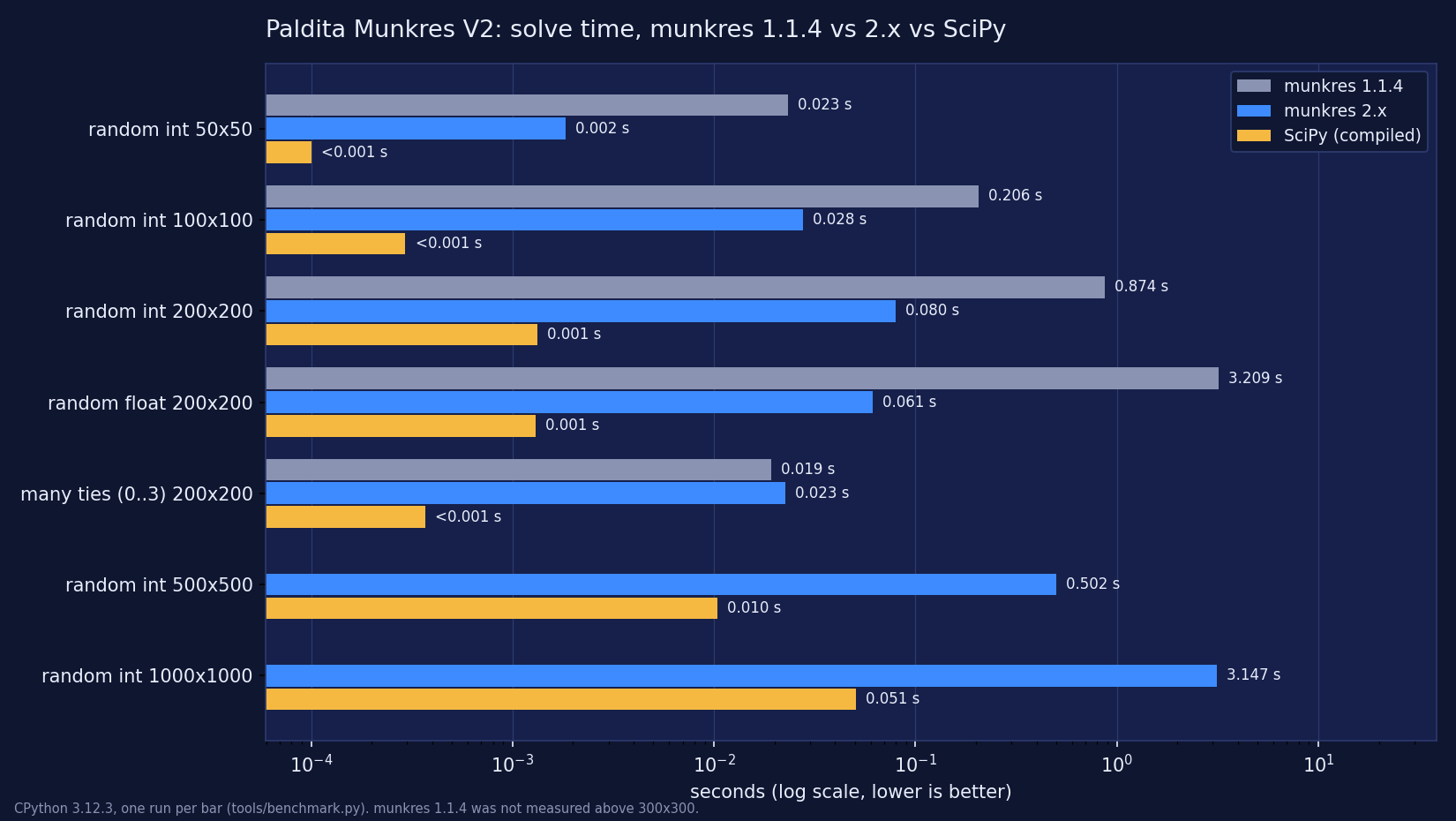
For very large or latency-critical problems use a compiled solver such as
scipy.optimize.linear_sum_assignment; this library's niche is zero dependencies, DISALLOWED support, exact
Decimal/Fraction arithmetic and clear errors. munkres.linear_sum_assignment has the same call signature, so
switching either way is a one-line change.
Migrating from 1.x
2.0 keeps the Munkres().compute(), make_cost_matrix, print_matrix,
DISALLOWED and UnsolvableMatrix API, and Munkres().compute() is not deprecated. What changed:
- ragged matrices now raise
ValueError(they used to be silently mis-solved); NaN/-infraiseValueError(they used to hang),+inf=DISALLOWED;- impossible matrices raise
UnsolvableMatrix(they used to hang); - Python 3.10+ only;
setup.pyis gone (pyproject.toml).
See CHANGELOG.md for the full list.
What's new in 2
Faster, typed, thread-safe, and impossible matrices now raise a clear error immediately. New: solve()
with gating, labels and traces, optimality certificates, k-best, bottleneck, stable matching, transportation,
Sinkhorn and a munkres command. Full details: V2_RELEASE.txt and
CHANGELOG.md. Documentation: docs/index.md.
Development
See CONTRIBUTING.md. In short: pip install -e . and
tools/audit.sh.
Credits and license
Created by Brian M. Clapper (2008-2020); maintained and extended since 2026 by Eishit Nigam. Licensed under the Apache License 2.0; see NOTICE.
1 maintainer

Metadata
1 maintainer
Release files for munkres 2.0.0
For a detailed explanation of source distributions (sdists) and built distributions (wheels), please see the package formats documentation.
Source distribution (sdist)
| File | Size | Uploaded | |
|---|---|---|---|
| munkres-2.0.0.tar.gz | 104.8 kB | Details |
Built distribution (wheel)
| File | Interpreter | ABI | Platform | Reset |
|---|---|---|---|---|
| munkres-2.0.0-py3-none-any.whl | Python 3 | none | any | Details |
Total release size: 134.8 kB
Release files / munkres-2.0.0.tar.gz
| Download URL | munkres-2.0.0.tar.gz |
|---|---|
| Size | 104.8 kB |
| Tags | Source |
|
SHA-256 checksum How to use checksums |
1491851834cf47f41802c18df57540ed95f47faf92416c060103cca977177667
|
|
BLAKE2b-256 checksum How to use checksums |
b3239252d24cade0b2140a884607ddb82a1f217b678040cacbaf64e3d0bbbf64
|
| Upload date | |
|
Uploaded using Trusted Publishing? What is trusted publishing? |
Yes |
| Uploaded via |
twine/7.0.0 CPython/3.13.14
|
Provenance
Provenance describes where a file came from. On PyPI, provenance is shared via attestations, which provide a verifiable record of the build or publishing details. View details, limitations and caveats.


PyPI Publish Attestation
PyPI verified that this artifact, at this checksum, originated from the publisher listed below.
Signed by GitHub Actions, verified by PyPI on Oct 6, 2026.
Transparency logRelease files / munkres-2.0.0-py3-none-any.whl
| Download URL | munkres-2.0.0-py3-none-any.whl |
|---|---|
| Size | 29.9 kB |
| Tags | Python 3 |
|
SHA-256 checksum How to use checksums |
ac7235ceda92a684afb4ba7e50a912cd59f548b6709cd8087f2a0be3fc030517
|
|
BLAKE2b-256 checksum How to use checksums |
b45bcfe60f5097558d8ca9093c02c43a32396cdaa70d0a97e2401ec92229a41f
|
| Upload date | |
|
Uploaded using Trusted Publishing? What is trusted publishing? |
Yes |
| Uploaded via |
twine/7.0.0 CPython/3.13.14
|
Provenance
Provenance describes where a file came from. On PyPI, provenance is shared via attestations, which provide a verifiable record of the build or publishing details. View details, limitations and caveats.
PyPI Publish Attestation
PyPI verified that this artifact, at this checksum, originated from the publisher listed below.
Signed by GitHub Actions, verified by PyPI on Oct 6, 2026.
Transparency log













