
muteval



Mutation testing for your LLM evals — find out if they'd actually catch a regression.
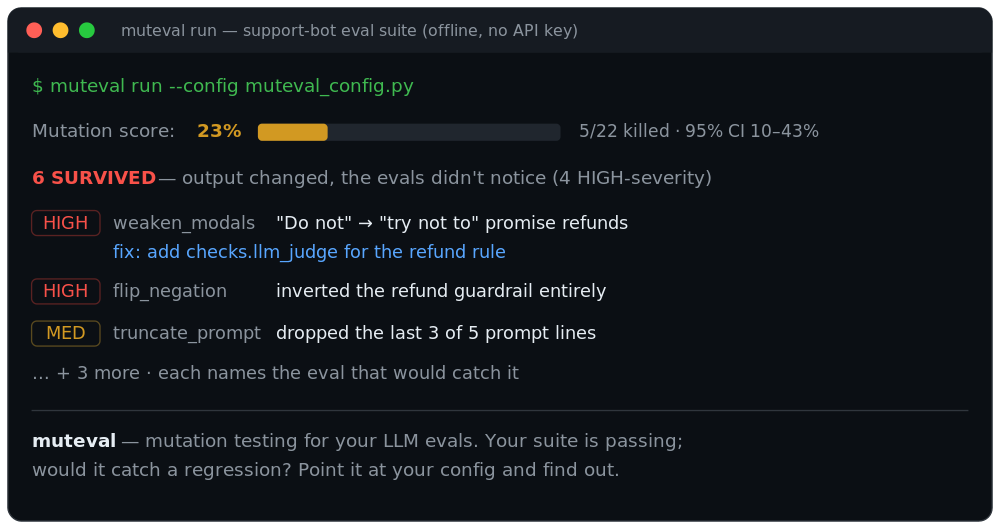
Your evals are passing. That doesn't mean they work.
muteval answers the question every eval suite quietly dodges: would my evals actually fail if my system silently got worse? It deliberately degrades the thing under test, reruns your existing eval suite against each degraded version (a "mutant"), and reports a mutation score — the percentage of injected regressions your evals caught. The ones they miss are survivors — candidate coverage gaps to triage: muteval surfaces them, you decide which ones actually matter (see docs/LIMITATIONS.md).
It's mutmut / Stryker, but for evals.
Mutation score: 33%  [████████░░░░░░░░░░░░░░░░]  (2/6 mutants killed, 95% CI 10-70%)

2 SURVIVED  (output changed but evals didn't notice — real coverage gaps; 1 HIGH-severity):

  #1 [HIGH] SURVIVED  [delete_sentences]
            deleted sentence: "If the answer is not in the context, say you don't know."
            fix: add checks.grounded("context")   ← muteval suggests the eval that would catch it
  #2 [MED]  SURVIVED  [weaken_modals]
            weakened "ONLY" -> "preferably" (near: answer using ONLY the provided context)
Install
pip install muteval        # pure Python, zero required dependencies
pip install -U muteval     # already installed? upgrade (bare install is a no-op)
The core drags in no heavy LLM SDKs. Optional extras, only if you use them:
| Extra | Adds | For |
|---|---|---|
muteval[promptfoo] |
PyYAML | --promptfoo ingestion |
muteval[deepeval] |
deepeval (large tree) | grading via deepeval metrics |
muteval[ragas] |
ragas (large tree) | grading via RAGAS metrics |
Any provider for the system under test: point it at any OpenAI-compatible
endpoint with --base-url (or OPENAI_BASE_URL) — Groq, Gemini-compat, GitHub
Models, Ollama, a local server. Discover what's available anytime with
muteval list (operators, checks, probes).
60-second quickstart (no API key)
muteval init --template rag        # scaffold a config (or --template basic)
muteval check --config muteval_config.py   # validate wiring + baseline first
muteval run   --config muteval_config.py
muteval init writes a runnable config with the four things you supply clearly
marked. muteval check is the doctor — it validates your pipeline, evals, and
baseline before a full run and tells you exactly which layer is broken. Then
run gives you a mutation score and a ranked list of survivors, each with a
suggested eval to close the gap.
Prefer zero-config? Point muteval at a prompt + cases and let it call the model:
export OPENAI_API_KEY=sk-...
muteval run --prompt-file system.txt --cases cases.jsonl --model gpt-4o-mini \
  --judge "the answer is grounded in the provided context" --fail-under 75
Already have a promptfoo suite? Point muteval straight at it — no muteval config file, it reuses your prompt + tests + assertions:
muteval run --promptfoo promptfooconfig.yaml # add --dry-run to preview
It reads the model from your providers: block, so it mutates your prompt against
the model your suite actually uses. Want it in CI? There's a GitHub Action —
see Run in CI.
Want to see it find a coverage gap first, with no API key? Run the offline
demo — it degrades a support-bot prompt and finds the rule the promptfoo suite
forgot to assert (~1s, mock model). It runs from a checkout of the repo (the
examples/ aren't shipped in the wheel):
git clone https://github.com/AshwinUgale/muteval && cd muteval
muteval run --config examples/promptfoo_offline/muteval_config.py --no-color
Already have your own pipeline? Use it as the system under test — a function or a
deployed endpoint — no run() wrapper:
# your own function, called as fn(prompt, case) -> str
muteval run --target mypkg.app:answer --prompt-file system.txt --cases cases.jsonl --check contains:8080

# a deployed service: POSTs {prompt, case} JSON, reads the text output
muteval run --endpoint https://my-app/answer --prompt-file system.txt --cases cases.jsonl --judge "grounded in context"
Re-running is cheap: --cache runs.sqlite memoizes run outputs + eval outcomes,
so an identical re-run makes zero model/judge calls (skipped for noisy suites
with --runs-per-mutant > 1):
muteval run --config muteval_config.py --cache .muteval-cache.sqlite
Slow because it's API-bound? Evaluate mutants in parallel (results are identical to a serial run — order preserved):
muteval run --config muteval_config.py --concurrency 8 --cache .muteval-cache.sqlite
Worried about spend? Cap the model + judge calls; muteval fails closed (exit 2) before overspending (cache hits and skipped judges don't count):
muteval run --config muteval_config.py --max-calls 500
Triage the survivors without re-running (the last run is saved to
.muteval/last_run.json):
muteval results        # ranked survivors (HIGH first) with ids
muteval show 1         # one survivor: operator, suggested fix, baseline→mutant diff
muteval report --html coverage.html   # a shareable standalone report
Beyond mutation coverage, muteval probe audits the eval suite along other
lenses. The load-bearing ones catch real, common defects: judge reliability
(does your LLM judge flip on identical re-runs?) and discrimination (can the
eval tell good outputs from bad, given good/bad exemplars?). The rest are hygiene
checks — statistical adequacy and redundancy — plus, only if you have labels,
human agreement (Cohen's κ via muteval label), the one true validity check.
A report card, no composite score. (A separate judge-bias panel —
position / verbosity / self-preference — is available as a library function for
pairwise A/B judges; it isn't part of the default card because it needs a
pairwise-judge harness.)
muteval probe --config muteval_config.py --html quality.html
Why this exists
Regression tools (promptfoo, deepeval, OpenAI Evals, LangSmith) catch regressions in your system. None tell you whether your evals are good enough to catch those regressions in the first place. That meta-layer is the gap muteval fills — mutation testing is the established answer to "is my test suite any good?" in software engineering, brought to LLM eval suites.
| Tool | Mutates the… | Measures… |
|---|---|---|
| promptfoo red team | input (jailbreaks) | your system's safety |
| Giskard | input (typos, swaps) | your model's robustness |
| deepeval synth data | output / ground truth | a metric's calibration |
| muteval | the system (prompt → context → tools → model) | your eval suite's coverage |
How it works
Describe your system + evals in a small config, then muteval:
- Baseline — confirms your suite passes on the original system. If it doesn't, muteval refuses to score (a red baseline makes every number meaningless) rather than hand you a misleading 100%.
- Mutate — generates mutants by degrading the prompt / retrieved context / tool outputs / model (22 operators).
- Grade — reruns your suite against each mutant. Killed = your evals caught it (good); survived = they missed it (a gap).
- Score —
killed / evaluated, with a 95% confidence interval, severity ranking, near-miss margins, and a suggested fix per survivor.
from muteval import MutEvalConfig, checks

config = MutEvalConfig(
    prompt=SYSTEM_PROMPT,                 # the thing under test
    cases=[{"input": "...", "order_id": "A123"}],
    run=my_run_fn,                        # call your LLM/app -> output text
    evals=[                               # your existing checks, graded by muteval
        checks.contains_case("order_id"),
        checks.grounded("context"),       # LLM-judge preset (any OpenAI-compatible endpoint)
    ],
)
Trustworthy by design
A coverage number you can't trust is worse than none. muteval fails closed:
- Red or errored baseline → no score (status
baseline_failed/errored), CLI exits non-zero, no badge. - Partial mutant errors above a budget →
partial_errors, not a score over a shrunken denominator.--max-error-rate/--allow-mutant-errorsto accept. - Non-determinism → strict-majority verdicts over
runs_per_mutant, Wilson confidence intervals on the score, flaky-mutant flagging. - Cosmetic changes → output-diffing separates real coverage gaps from "observationally unchanged" mutants.
In a controlled, CI-enforced experiment the mutation score rises monotonically with eval-suite coverage — 0% with no evals → 100% with complete coverage — across four domains (support bot, code review, RAG, HR policy). See FINDINGS.md, and docs/LIMITATIONS.md for when to distrust the number.
What it can mutate (22 operators)
Prompt: weaken_modals, flip_negation, drop_instruction_lines,
swap_adjacent_instructions, paraphrase_instruction, delete_sentences,
truncate_prompt, drop_few_shot_example, remove_emphasis,
weaken_numeric_threshold.
Retrieved context (RAG): drop_context_doc, clear_context,
corrupt_context_doc, swap_context_doc, shuffle_context,
duplicate_context_doc, truncate_context_doc.
Model: downgrade_model. Tools (agents): drop_tool_output,
corrupt_tool_output, swap_tool_output, deny_tool_output.
Pass a System(prompt=..., context=[...], tools=[...], model=...) to make
context / tools / model mutable for RAG and agent suites. Bring your own operator
with register_operator, and scope which parts of the prompt mutate with
[[mutate]]…[[/mutate]] markers or --scope-include/-exclude.
Gate CI + coverage badge
muteval run --config muteval_config.py --fail-under 75 --badge badge.json
muteval run --config muteval_config.py --junit junit.xml
Exits non-zero if coverage drops below 75%, so a PR that weakens your evals fails
the build. --fail-on-severity high gates on any unguarded high-severity gap.
Copy examples/ci/github-actions.yml to run it on every PR and publish a
shields.io eval-coverage badge.
Bring your existing metrics
Already have a suite? Reuse its metrics instead of rewriting them:
from deepeval.metrics import FaithfulnessMetric
from muteval.adapters.deepeval import metrics_to_evals

evals = metrics_to_evals([FaithfulnessMetric()], input_key="question",
                         retrieval_context_key="context")
Adapters for deepeval, RAGAS, and promptfoo (pip install "muteval[deepeval|ragas|promptfoo]"). Or use the built-in framework-free
checks — including llm_judge / grounded that hit any OpenAI-compatible
endpoint (OpenAI, Groq, Gemini, GitHub Models, Ollama…) via base_url=, using
only the standard library.
For a keyless integration using scorer_to_eval, see the
Autoevals JSON-profile example. It
compares JSON-only checks with ExactMatch on two controlled prompt mutations.
Adopting it on your own suite
Pointing muteval at a real system is a ~1-hour integration, not plug-and-play —
docs/ADOPTION.md has the honest checklist, a
"where-it-breaks → what-to-change" table, judge-selection guidance, and the four
pieces you supply. Start with muteval check and fix a green baseline first.
Roadmap
Shipped: prompt/context/tool/model mutation · deepeval/RAGAS/promptfoo adapters ·
scored evals + near-miss reporting · severity ranking + --fail-on-severity ·
confidence intervals + majority-vote stability · output-diffing · fail-closed
validity gate · muteval check doctor · RAG scaffold + adoption guide ·
zero-config ingestion (promptfoo/deepeval/callable/endpoint) · caching +
concurrency + budget caps · results/show/report --html triage · the
muteval probe eval-quality report card (adequacy, judge reliability + ICC,
discrimination, redundancy, judge bias, threshold calibration, human agreement) ·
an autofix verify loop that proposes an eval for a survivor and confirms it kills
the mutant while the baseline stays green.
Possible later (not the current focus): LLM-driven semantic mutations ·
agent/trace mutation · A/B suite comparison. The muteval probe layer stays a
documented part of muteval — an honest eval-quality/judge-audit layer, not a
separate product. Current focus is quality and honesty over new scope.
Contributing & support
Early, open project — contributions are genuinely welcome, especially new mutation operators, probes, and adapters (each is a small, self-contained add).
git clone https://github.com/AshwinUgale/muteval && cd muteval
pip install -e ".[dev]" && pytest -q          # dev setup + the suite
- Start here: CONTRIBUTING.md (dev setup, PR checklist, "add an operator" walkthrough) and ARCHITECTURE.md (a one-page map of the codebase).
- Extend it: docs/PLUGINS.md — the operator / probe /
adapter / reporter API.
muteval listshows what already exists. - Bugs & ideas: open an issue
(there are templates); look for
good first issue. - Docs: https://ashwinugale.github.io/muteval/
Licensed Apache-2.0. By participating you agree to the Code of Conduct.
1 maintainer

Release files for muteval 0.11.0
For a detailed explanation of source distributions (sdists) and built distributions (wheels), please see the package formats documentation.
Source distribution (sdist)
| File | Size | Uploaded | |
|---|---|---|---|
| muteval-0.11.0.tar.gz | 324.7 kB | Details |
Built distribution (wheel)
| File | Interpreter | ABI | Platform | Reset |
|---|---|---|---|---|
| muteval-0.11.0-py3-none-any.whl | Python 3 | none | any | Details |
Total release size:435.4 kB
Release files / muteval-0.11.0.tar.gz
| Download URL | muteval-0.11.0.tar.gz |
|---|---|
| Size | 324.7 kB |
| Tags | Source |
|
SHA-256 checksum How to use checksums |
370a08aa950c8cb26341d21a89813786d49de802ee3875bdb6024f3e070169b2
|
|
BLAKE2b-256 checksum How to use checksums |
f4362f4993b55190e497898304640416cd467f90706ea4d11323b4d2b3b34747
|
| Upload date | |
|
Uploaded using Trusted Publishing? What is trusted publishing? |
Yes |
| Uploaded via |
twine/7.0.0 CPython/3.13.14
|
Provenance
Provenance describes where a file came from. On PyPI, provenance is shared via attestations, which provide a verifiable record of the build or publishing details. View details, limitations and caveats.


PyPI Publish Attestation
PyPI verified that this artifact, at this checksum, originated from the publisher listed below.
Signed by GitHub Actions, verified by PyPI on Sep 16, 2026.
Transparency logRelease files / muteval-0.11.0-py3-none-any.whl
| Download URL | muteval-0.11.0-py3-none-any.whl |
|---|---|
| Size | 110.7 kB |
| Tags | Python 3 |
|
SHA-256 checksum How to use checksums |
496f3c2b90d795bf5cfb7de60f3c8a058d621c3be4c4f8dd1b97a4d6d9200afe
|
|
BLAKE2b-256 checksum How to use checksums |
5b0a0b9440fecafd9abb35b141c223738cf9503fad41b365e95da3ff67a41793
|
| Upload date | |
|
Uploaded using Trusted Publishing? What is trusted publishing? |
Yes |
| Uploaded via |
twine/7.0.0 CPython/3.13.14
|
Provenance
Provenance describes where a file came from. On PyPI, provenance is shared via attestations, which provide a verifiable record of the build or publishing details. View details, limitations and caveats.
PyPI Publish Attestation
PyPI verified that this artifact, at this checksum, originated from the publisher listed below.
Signed by GitHub Actions, verified by PyPI on Sep 16, 2026.
Transparency log













