
mvgkde
MultiVariate Gaussian Kernel Density Estimator in JAX.
This is a micro-package, containing the single class MultiVarGaussianKDE (and
helper function gaussian_kde) to estimate the probability density function of
a multivariate dataset using a Gaussian kernel. This package modifies the
jax.scipy.stats.gaussian_kde class (which is based on the
scipy.stats.gaussian_kde class), but allows for full control over the
covariance matrix of the kernel, even per-dimension bandwidths. See the
Documentation below for more information.
Installation


pip install mvgkde
Documentation

For these examples we will use the following imports:
import jax.numpy as jnp
import jax.random as jr
import matplotlib.pyplot as plt
import numpy as np

from mvgkde import MultiVariateGaussianKDE, gaussian_kde  # This package
And we will generate a dataset to work with:
key = jr.key(0)
dataset = jr.normal(key, (2, 1000))
Lastly we will define a plotting function:
# Create a grid of points
(xmin, ymin) = dataset.min(axis=1)
(xmax, ymax) = dataset.max(axis=1)
X, Y = np.mgrid[xmin:xmax:100j, ymin:ymax:100j]
positions = np.vstack([X.ravel(), Y.ravel()])


def plot_kde(kde: MultiVariateGaussianKDE) -> plt.Figure:
    # Evaluate the KDE on the grid
    Z = np.reshape(kde(positions).T, X.shape)

    # Plot the results
    fig, ax = plt.subplots()
    ax.imshow(np.rot90(Z), cmap=plt.cm.gist_earth_r, extent=[xmin, xmax, ymin, ymax])
    ax.plot(dataset[0], dataset[1], "k.", markersize=2)
    ax.set(
        title="2D Kernel Density Estimation using JAX",
        xlabel="X-axis",
        xlim=[xmin, xmax],
        ylabel="Y-axis",
        ylim=[ymin, ymax],
    )

    return fig
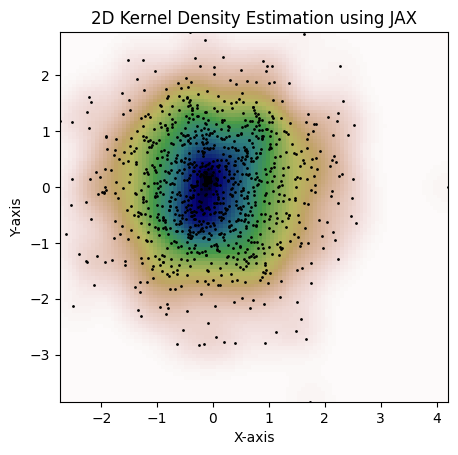
Here's an example that can be done with jax.scipy.stats.gaussian_kde:
kde = gaussian_kde(dataset, bw_method="scott")

fig = plot_kde(kde)
plt.show()
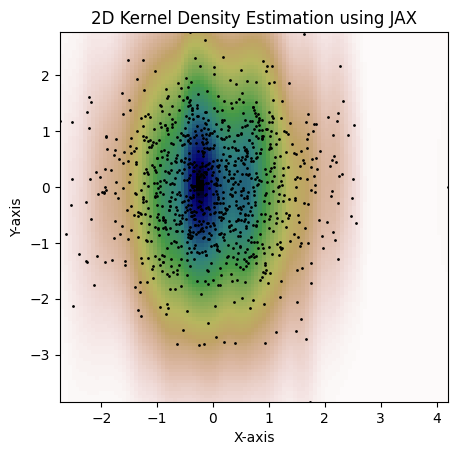
Here's an example with a per-dimension bandwidth. This is not possible with the
jax.scipy.stats.gaussian_kde:
kde = gaussian_kde(dataset, bw_method=jnp.array([0.15, 1.3]))

fig = plot_kde(kde)
plt.show()
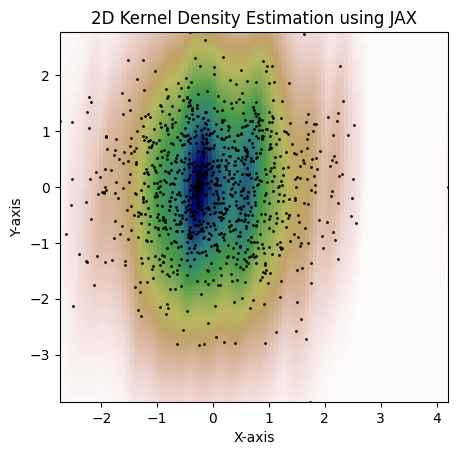
Lastly, here's an example with 2D bandwidth matrix:
bw = jnp.array([[0.15, 3], [3, 1.3]])
kde = gaussian_kde(dataset, bw_method=bw)

fig = plot_kde(kde)
plt.show()
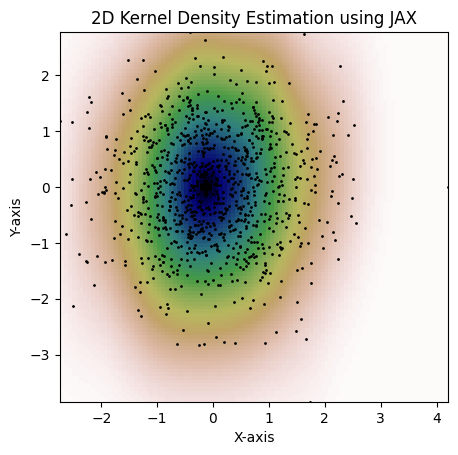
The previous examples are using the convenience function gaussian_kde. This
actually just calls the constructor method
MultiVariateGaussianKDE.from_bandwidth. This function allows for customixing
the bandwidth factor on the data-driven covariance matrix, but does not allow
for specifying the covariance matrix directly. To do that, you can call the
MultiVariateGaussianKDE constructor directly, or the from_covariance
constructor method. To illustrate the difference between modifying the bandwidth
and setting the full covariance matrix, consider the following example:
kde = MultiVariateGaussianKDE.from_covariance(
    dataset,
    jnp.array([[0.15, 0.1], [0.1, 1.3]]),
)

fig = plot_kde(kde)
plt.show()
Acknowledgments
This package modifies code from JAX, which is licensed under the Apache License 2.0.
1 maintainer

Metadata
1 maintainer
Release files for mvgkde 0.2.0
For a detailed explanation of source distributions (sdists) and built distributions (wheels), please see the package formats documentation.
Source distribution (sdist)
| File | Size | Uploaded | |
|---|---|---|---|
| mvgkde-0.2.0.tar.gz | 336.0 kB | Details |
Built distribution (wheel)
| File | Interpreter | ABI | Platform | Reset |
|---|---|---|---|---|
| mvgkde-0.2.0-py3-none-any.whl | Python 3 | none | any | Details |
Total release size: 353.4 kB
Release files / mvgkde-0.2.0.tar.gz
| Download URL | mvgkde-0.2.0.tar.gz |
|---|---|
| Size | 336.0 kB |
| Tags | Source |
|
SHA-256 checksum How to use checksums |
3cf6400661cd7be6d175d29c5760721aa89edbfd27769ea69c0f08bb64ab83b1
|
|
BLAKE2b-256 checksum How to use checksums |
33f54d3bc66ef6b5358a6693d052cc9a440a3ca064cfae8a044acf9af63a1632
|
| Upload date | |
|
Uploaded using Trusted Publishing? What is trusted publishing? |
Yes |
| Uploaded via |
twine/5.1.1 CPython/3.12.7
|
Provenance
Provenance describes where a file came from. On PyPI, provenance is shared via attestations, which provide a verifiable record of the build or publishing details. View details, limitations and caveats.


PyPI Publish Attestation
PyPI verified that this artifact, at this checksum, originated from the publisher listed below.
Signed by GitHub Actions, verified by PyPI on Nov 12, 2024.
Transparency logRelease files / mvgkde-0.2.0-py3-none-any.whl
| Download URL | mvgkde-0.2.0-py3-none-any.whl |
|---|---|
| Size | 17.4 kB |
| Tags | Python 3 |
|
SHA-256 checksum How to use checksums |
cc16d22785d61d0654d322d6132436a507cd90c79379178c78a683efad231dc1
|
|
BLAKE2b-256 checksum How to use checksums |
d97f305dc18b35ed5f0e1a13acfb30efe9b9e997d21371778ce8e946430b04e1
|
| Upload date | |
|
Uploaded using Trusted Publishing? What is trusted publishing? |
Yes |
| Uploaded via |
twine/5.1.1 CPython/3.12.7
|
Provenance
Provenance describes where a file came from. On PyPI, provenance is shared via attestations, which provide a verifiable record of the build or publishing details. View details, limitations and caveats.
PyPI Publish Attestation
PyPI verified that this artifact, at this checksum, originated from the publisher listed below.
Signed by GitHub Actions, verified by PyPI on Nov 12, 2024.
Transparency log













