
Agent-First symbiotic cognitive substrate — 18 fungal-named verbs (17 agent + 1 human `brief`), 11-dimension immune, substrate-local plugins, editable-by-default install, universal MCP stdio server.
Verified details
These details have been verified by PyPIProject links
GitHub Statistics
Maintainers

Project description
Myco
Devour everything. Evolve forever. You just talk.



What it is · How it lives · Quick start · Verbs · Self-validation
LangChain. LangGraph. CrewAI. DSPy. Claude Code skills. OpenHands. OpenClaw. Every few months the next framework drops and you migrate again.
Your notes rot too. The API you read three weeks back has changed. The doc you wrote last year is wrong now. Your AI does not even remember last week's decisions. Every new conversation starts from zero.
Now imagine one living substrate. It ingests the frameworks, the papers, the APIs, the codebases, the datasets, the decisions, the frictions. It keeps them connected in a graph the agent actually reads. It catches its own drift. It reshapes itself when your work outgrows its old form. For six months. For six years. No migration.
This is Myco.
What it is
Myco is a living cognitive substrate for your AI agent.
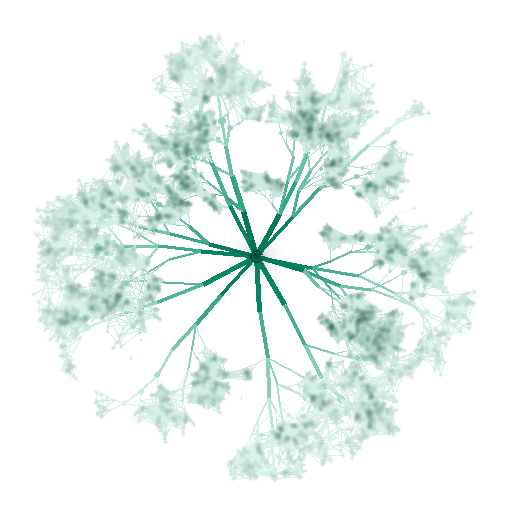
Everything the agent reads or writes — code, papers, decisions, frictions — lives on your filesystem as markdown + YAML, linked into a mycelial graph. The agent eats raw material, digests it into integrated knowledge, immune-checks against drift, propagates learning across projects, and — when your work outgrows the old shape — reshapes the substrate itself. The kernel that runs all this is itself a substrate: editable by default, maintained by the same agent that uses it.
Not a framework. Not a vector DB. Not a managed service. A living filesystem for an agent you talk to.
This works now, not because the idea is new, but because agents are finally smart enough to maintain the system themselves. Earlier attempts died because humans could not keep up. Myco bakes "the maintainer is an agent" into every surface, every verb, every rule.
How it lives
You speak. The agent listens. Between your turns, Myco runs a metabolism:
- Ingestion.
hungerasks what's missing.eatabsorbs whatever you point at — a path, a URL, a paragraph.senseandforagescan what's already here. - Digestion.
assimilatecooks raw notes into integrated knowledge.sporulateconcentrates integrated notes into a dispersible proposal. - Circulation.
traversewalks the mycelial graph for anastomotic health.propagatepublishes learnings to a downstream substrate. - Homeostasis.
immuneruns a 25-dimension lint against the seven hard rules.senescegracefully winds down each session. - Evolution. When the substrate's shape no longer fits — a canon field is missing, a lint dimension is needed, a verb must change —
fruitdrafts a three-round craft proposal,winnowgates its shape,moltships the contract bump.
Eighteen verbs, one manifest, two faces (a CLI for observation, an MCP server for the agent). You memorize nothing; the agent drives.
Five principles
- Only for the agent. Every surface is primary material for the agent, not documentation for a human reader.
- Devour everything. No filter on intake. Missing a signal costs more than eating one too many.
- Self-evolving shape. Canon, lint dimensions, verbs, the contract itself — all mutable through a governed craft loop.
- Nothing is final.
integratedis a state, not an endpoint. Today's conclusion is tomorrow's raw material. - Mycelium network. Every node links to every other by traversal. Orphans are dead tissue.
The kernel IS a substrate
Myco's own source tree is a substrate. _canon.yaml at the root. MYCO.md as the agent entry page. docs/primordia/ holds the three-round craft doc that justifies every contract bump. The Python code under src/myco/ is the innermost ring of its own ecosystem, not a read-only artifact someone else wrote.
So the normal install clones the source and pip install -es it. The agent that uses Myco is the same agent that maintains Myco; if it needs a new lint dimension, it scaffolds one with myco ramify, proposes with myco fruit, ships with myco molt. No fork. No waiting PR. 永恒进化.
PyPI exists for bootstrap + library-consumer use — not as the normal install.
Quick start
pipx run --spec 'myco[mcp]' myco-install fresh ~/myco
Clones the repo to ~/myco, pip install -es it, leaves you with a writable kernel. Then germinate a substrate for any project:
cd your-project
myco germinate . --substrate-id your-project
Hook Myco into your agent host in one command:
- Claude Code / Cowork —
/plugin marketplace add Battam1111/Myco, then/plugin install myco@myco. - Any other MCP host —
myco-install <cursor | windsurf | zed | vscode | openclaw | claude-desktop | gemini | codex | goose>. - Via the official MCP Registry —
io.github.Battam1111/mycofor clients that auto-resolve namespaces.
Per-host snippets for the nine hosts with divergent schemas, Python-framework adapters (LangChain / CrewAI / DSPy / Smolagents / Agno / PraisonAI / MS Agent Framework / Claude Agent SDK), and library-embedding examples live in INSTALL.md.
The eighteen verbs
Six subsystems. Every name is a fungal-biology term whose meaning tracks its action.
- Germination —
germinatestarts a fresh substrate. - Ingestion —
hunger(what's missing?),eat(absorb raw),sense(keyword search),forage(scan ingestible paths). - Digestion —
assimilate(raw → integrated),digest(promote a single note),sporulate(integrated → dispersible proposal). - Circulation —
traverse(walk the graph),propagate(publish downstream). - Homeostasis —
immune(25-dimension lint,--fixrepairs mechanically). - Cycle —
senesce(session dormancy),fruit(three-round craft),winnow(gate the craft),molt(ship the contract bump),ramify(scaffold new dim / verb / adapter),graft(manage substrate-local plugins),brief(human-facing state rollup).
Every verb lives in src/myco/surface/manifest.yaml. The CLI (myco VERB) and the MCP tool surface both derive from it mechanically — one source of truth for both faces. A downstream substrate can ramify its own dimensions or verbs into .myco/plugins/ without forking Myco.
Self-validation
Myco does not trust its agent to remember the contract. It enforces it.
- 25 lint dimensions across four categories — mechanical (canon invariants, write-surface, LLM-boundary), shipped (package ↔ canon version parity), metabolic (raw backlog, stale integrated notes), semantic (graph connectedness, orphan detection).
myco immune --fixrepairs mechanically where it can. - Seven hard rules (R1–R7) govern every session — boot ritual, session-end, sense-before-assert, eat-on-friction, cross-reference-on-creation, write-surface discipline, top-down layering. Full contract at
L1_CONTRACT/protocol.md. - Pulse sidecar. Every MCP tool response carries a
substrate_pulseechoing the current contract version and a rule hint that escalates (R1 → R3 → …) as the session progresses. A server-side push: the agent cannot accidentally forget. - Write-surface enforcement. Any write outside
_canon.yaml::system.write_surface.allowedis refused withWriteSurfaceViolation. Discipline as a mechanism, not as a request.
Zero host-side configuration. R1–R7 ride inside the MCP server itself, so every client — Claude Code, Cursor, Windsurf, Zed, Codex, Gemini, Continue, Claude Desktop, OpenClaw, OpenHands — gets the same contract on boot.
Integrations
- Claude Code and Cowork. Official plugin wires MCP + hooks + slash skills in one command. Or drop
.claude/in by hand. - Any MCP host. Ten automated via
myco-install; another nine with per-host snippets inINSTALL.md; any other client viamcp-server-mycoover stdio. - Python agent frameworks. LangChain, CrewAI, DSPy, Smolagents, Agno, PraisonAI, MS Agent Framework, Claude Agent SDK all consume Myco via
StdioServerParameters(command="mcp-server-myco"). - Downstream substrates.
myco propagatepublishes; adapters live inmyco.symbionts.
Learn more
L0_VISION.md · L1_CONTRACT/ · L2_DOCTRINE/ · INSTALL.md · CONTRIBUTING.md · Issues
Architectural changes land as dated craft docs under docs/primordia/. Every release is governed by a three-round debate, then a molt, then an auto-published fan-out to PyPI + MCP Registry + GitHub release.
Project details
Verified details
These details have been verified by PyPIProject links
GitHub Statistics
Maintainers
Release history Release notifications | RSS feed


Download files
Download the file for your platform. If you're not sure which to choose, learn more about installing packages.
Source Distribution
Built Distribution
Filter files by name, interpreter, ABI, and platform.
If you're not sure about the file name format, learn more about wheel file names.
Copy a direct link to the current filters
File details
Details for the file myco-0.5.15.tar.gz.
File metadata
- Download URL: myco-0.5.15.tar.gz
- Upload date:
- Size: 2.1 MB
- Tags: Source
- Uploaded using Trusted Publishing? Yes
- Uploaded via: twine/6.1.0 CPython/3.13.12
File hashes
| Algorithm | Hash digest | |
|---|---|---|
| SHA256 |
66c3a6ddafa5880a7494a1fa9ecf2abb1b7c4effe8c3d503698cbba689dc93de
|
|
| MD5 |
bf159f028bc50a217a4d1e63d6391d63
|
|
| BLAKE2b-256 |
260cde19ddc29a295754e8f0312f6c96b15d8bb5e86d0048c763cfe5a8c1de53
|
Provenance
The following attestation bundles were made for myco-0.5.15.tar.gz:
Publisher:
release.yml on Battam1111/Myco
-
Statement:
-
Statement type:
https://in-toto.io/Statement/v1 -
Predicate type:
https://docs.pypi.org/attestations/publish/v1 -
Subject name:
myco-0.5.15.tar.gz -
Subject digest:
66c3a6ddafa5880a7494a1fa9ecf2abb1b7c4effe8c3d503698cbba689dc93de - Sigstore transparency entry: 1357975618
- Sigstore integration time:
-
Permalink:
Battam1111/Myco@28fcfa264bfa24e252869fb619aed314fff87b13 -
Branch / Tag:
refs/tags/v0.5.15 - Owner: https://github.com/Battam1111
-
Access:
public
-
Token Issuer:
https://token.actions.githubusercontent.com -
Runner Environment:
github-hosted -
Publication workflow:
release.yml@28fcfa264bfa24e252869fb619aed314fff87b13 -
Trigger Event:
push
-
Statement type:
File details
Details for the file myco-0.5.15-py3-none-any.whl.
File metadata
- Download URL: myco-0.5.15-py3-none-any.whl
- Upload date:
- Size: 246.3 kB
- Tags: Python 3
- Uploaded using Trusted Publishing? Yes
- Uploaded via: twine/6.1.0 CPython/3.13.12
File hashes
| Algorithm | Hash digest | |
|---|---|---|
| SHA256 |
933644ca5dd4a156a1ab2624b836c18ccea7b1beed6f3892fa63f60eb45f8df3
|
|
| MD5 |
9afbb9cec08ce7be8a1e993332653109
|
|
| BLAKE2b-256 |
ff542adb608b8b98ef5eb508518374ec68cbee6b4c5752071c321f54ab90e163
|
Provenance
The following attestation bundles were made for myco-0.5.15-py3-none-any.whl:
Publisher:
release.yml on Battam1111/Myco
-
Statement:
-
Statement type:
https://in-toto.io/Statement/v1 -
Predicate type:
https://docs.pypi.org/attestations/publish/v1 -
Subject name:
myco-0.5.15-py3-none-any.whl -
Subject digest:
933644ca5dd4a156a1ab2624b836c18ccea7b1beed6f3892fa63f60eb45f8df3 - Sigstore transparency entry: 1357975705
- Sigstore integration time:
-
Permalink:
Battam1111/Myco@28fcfa264bfa24e252869fb619aed314fff87b13 -
Branch / Tag:
refs/tags/v0.5.15 - Owner: https://github.com/Battam1111
-
Access:
public
-
Token Issuer:
https://token.actions.githubusercontent.com -
Runner Environment:
github-hosted -
Publication workflow:
release.yml@28fcfa264bfa24e252869fb619aed314fff87b13 -
Trigger Event:
push
-
Statement type:






