

Real-time biosignal experiment GUI builder






Documentation · Playground · Paper · Virtual Hand · Changelog
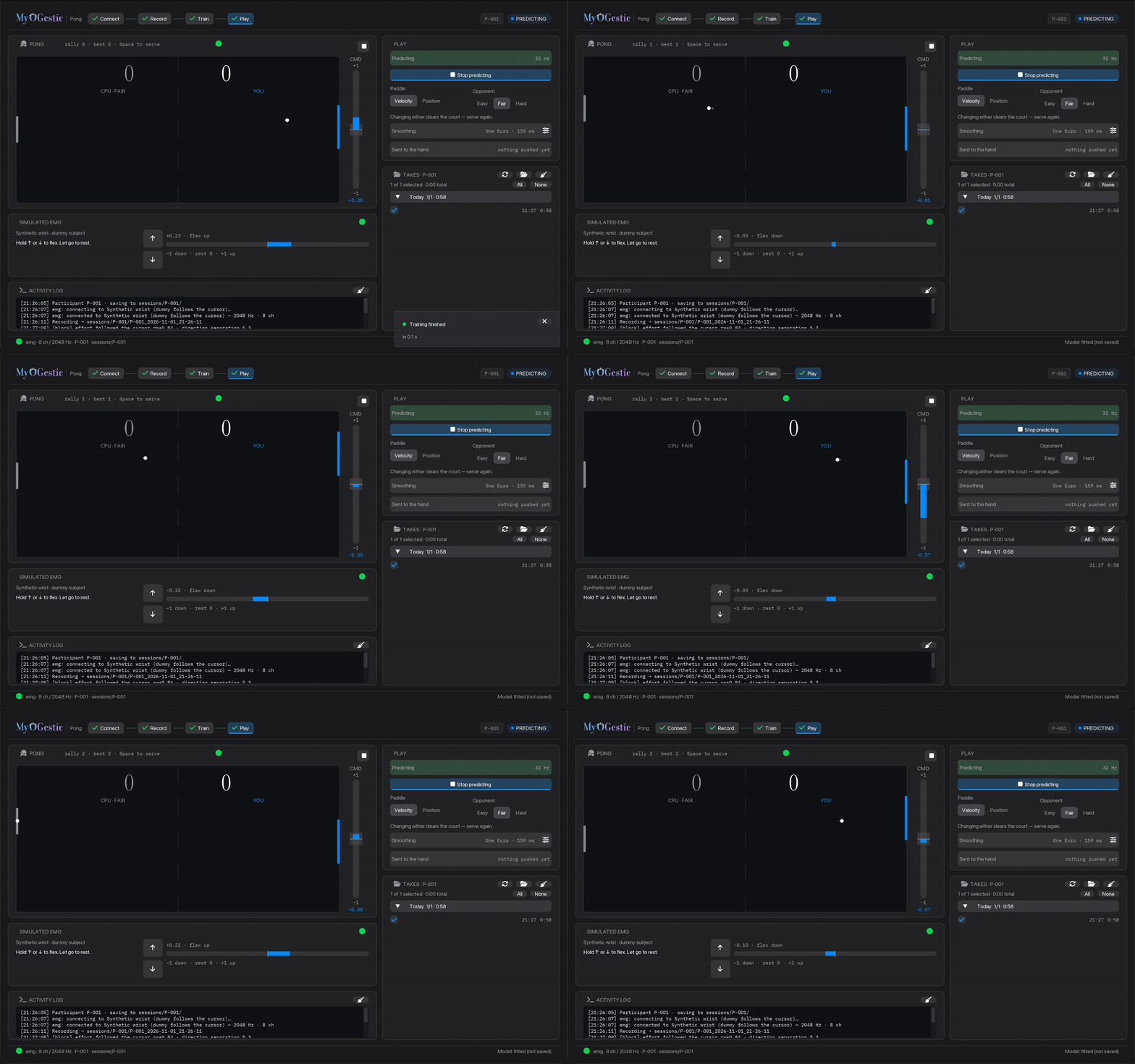
MyoGestic turns a short Python script into a live experiment with signal viewers, recording, training and prediction. No application subclass, registry or config file is required.
MyoGestic is built at the n-squared lab at Friedrich-Alexander-Universität Erlangen-Nürnberg (FAU) for myocontrol research. Version 2 is a ground-up rewrite of MyoGestic v1 with small, composable APIs and live extensibility.
Try it in your browser
A live MyoGestic app runs entirely in your browser via Pyodide at nsquaredlab.github.io/MyoGestic/playground. It streams synthetic electromyography (EMG), records in memory, trains a scikit-learn linear discriminant classifier and predicts live. No installation is required.
Install
pip install myogestic
Extras add optional parts. examples adds CatBoost, MyoVerse, PyTorch and
scikit-learn for the demos; grpc adds the Virtual Hand control plane. Other
extras are brainflow, bdi, serial, keyboard, zarrs, docs and dev.
Install one with pip install "myogestic[grpc]".
To run the examples, clone the repository and sync it with uv:
git clone https://github.com/NsquaredLab/MyoGestic.git
cd MyoGestic
uv sync --extra examples --extra grpc
Quick start
from myogestic import App, Stream
from myogestic.sources import LSLSource
from myogestic.widgets import RecordingControls, SignalViewer

app = App("Hello EMG")
app.streams(Stream("emg", source=LSLSource("EMG"), window_ms=1000))

viewer = SignalViewer("emg")
recording = RecordingControls(
    ["Rest", "Fist"], on_record=app.start_recording, on_stop=app.stop_recording
)


@app.ui
def ui(ctx):
    viewer.ui(ctx)
    recording.ui(ctx)


app.run()
Add a Pipeline and decorate extract / train / predict for a closed-loop
experiment.
Run a session
examples/start_here/
holds complete protocols you can take to a session unmodified. Each picks its
hardware from a dropdown, so the same file runs against any supported amplifier
or the synthetic amplifier when no hardware is available.
| Script | Protocol |
|---|---|
force_ramps.py |
Isometric force ramps. Track a trapezoid at a set percentage of maximum voluntary contraction, with the EMG, the force and the target recorded together. |
myocontrol.py |
Record cued Rest/Fist trials, train a classifier or a regressor, and drive the Virtual Hand from the prediction. |
pong.py |
Chase a cursor with the paddle, train one signed [−1, +1] command, and play Pong with your wrist. |
uv run --extra examples --extra grpc python examples/start_here/myocontrol.py
WINDOWS.md walks from an empty Windows machine to a recorded force-ramps session, with no programming assumed.
Widgets
Each widget is one public function or class with typed arguments, placed on a
Px/Fr grid. Every card can pop out into its own window.
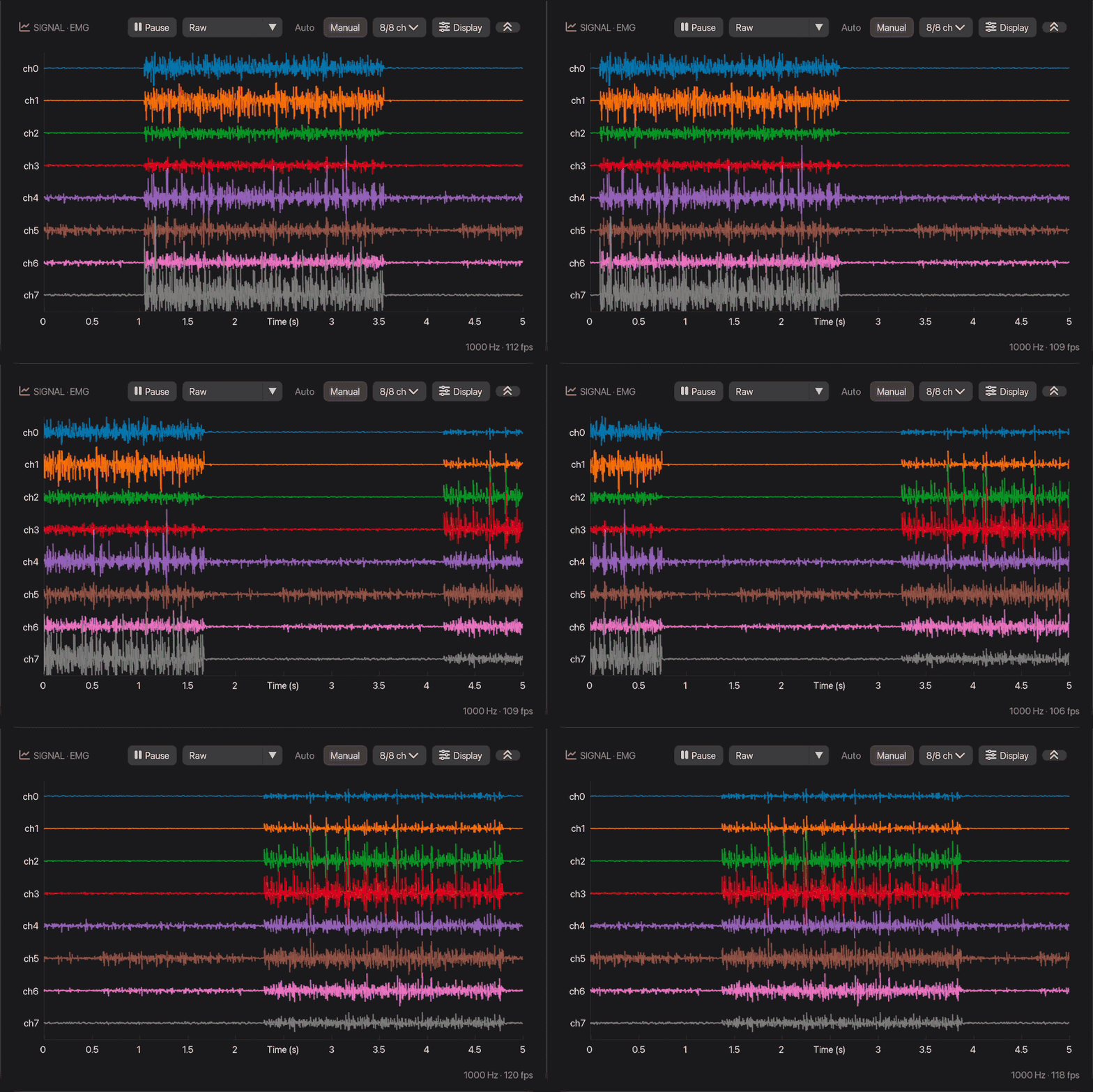 signal_viewerRecorded EMG, eight channels on one shared range. |
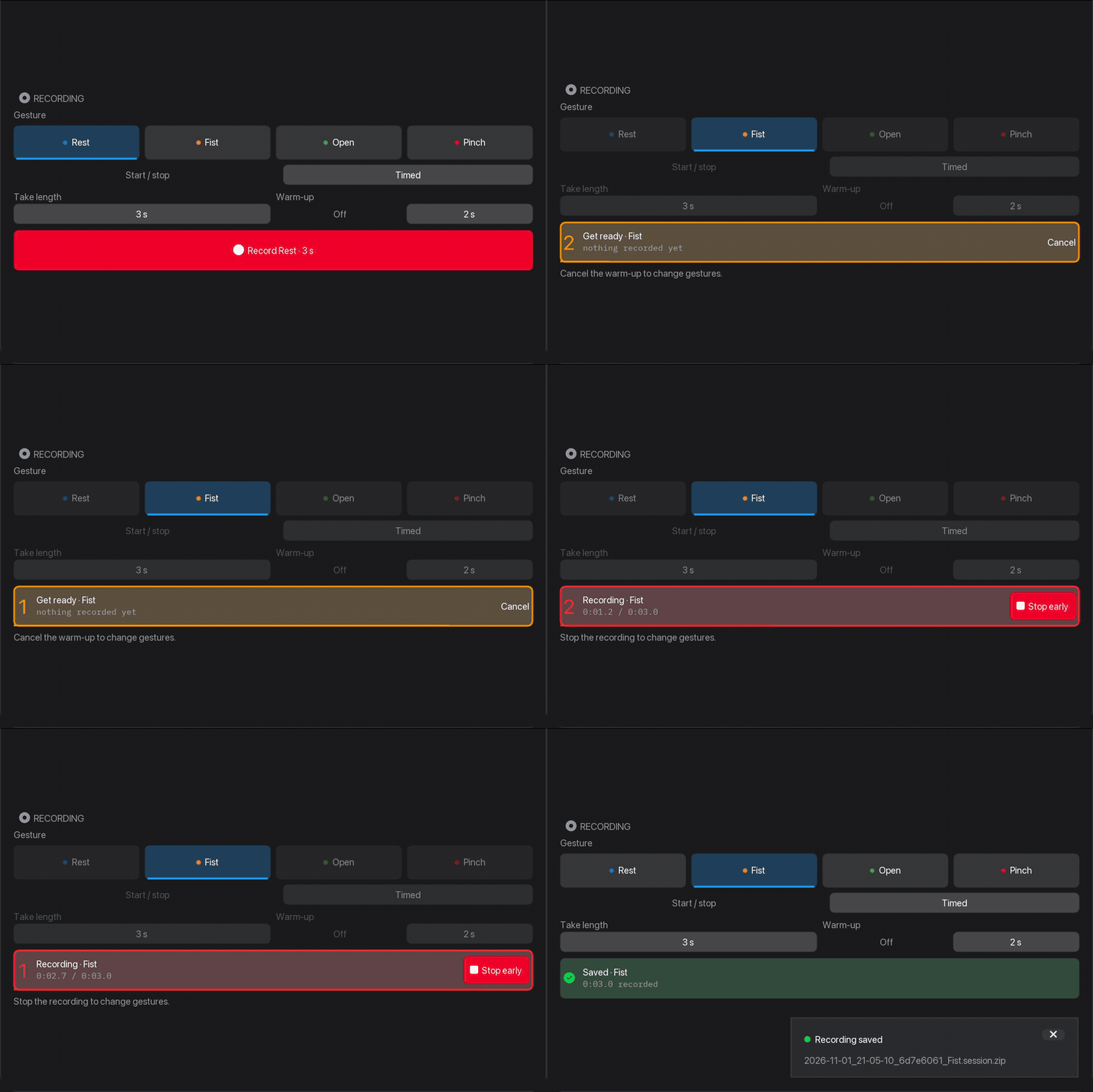 recording_controlsPick a gesture and record a timed take. |
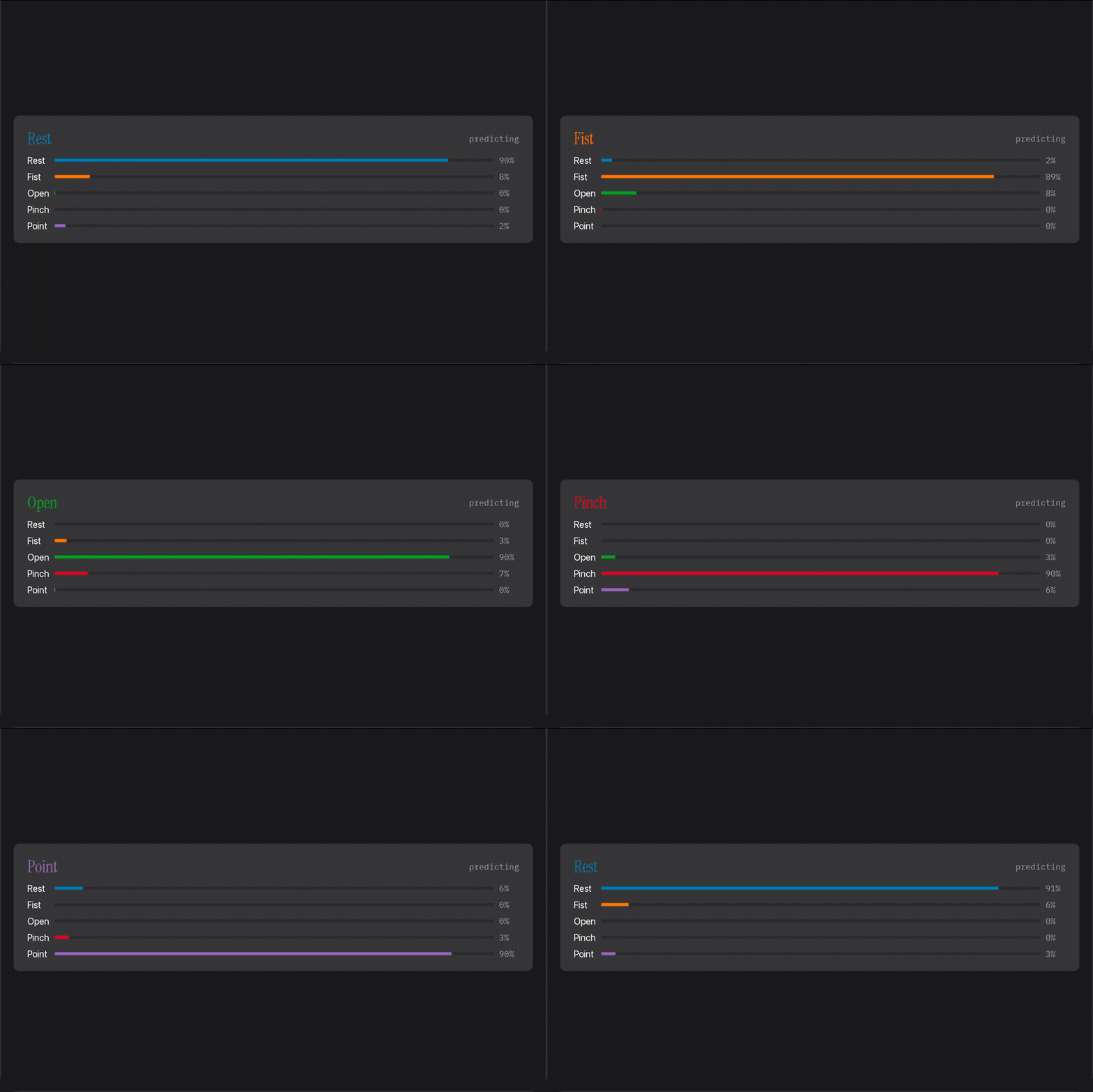 prediction_labelThe live prediction and each class's probability. |
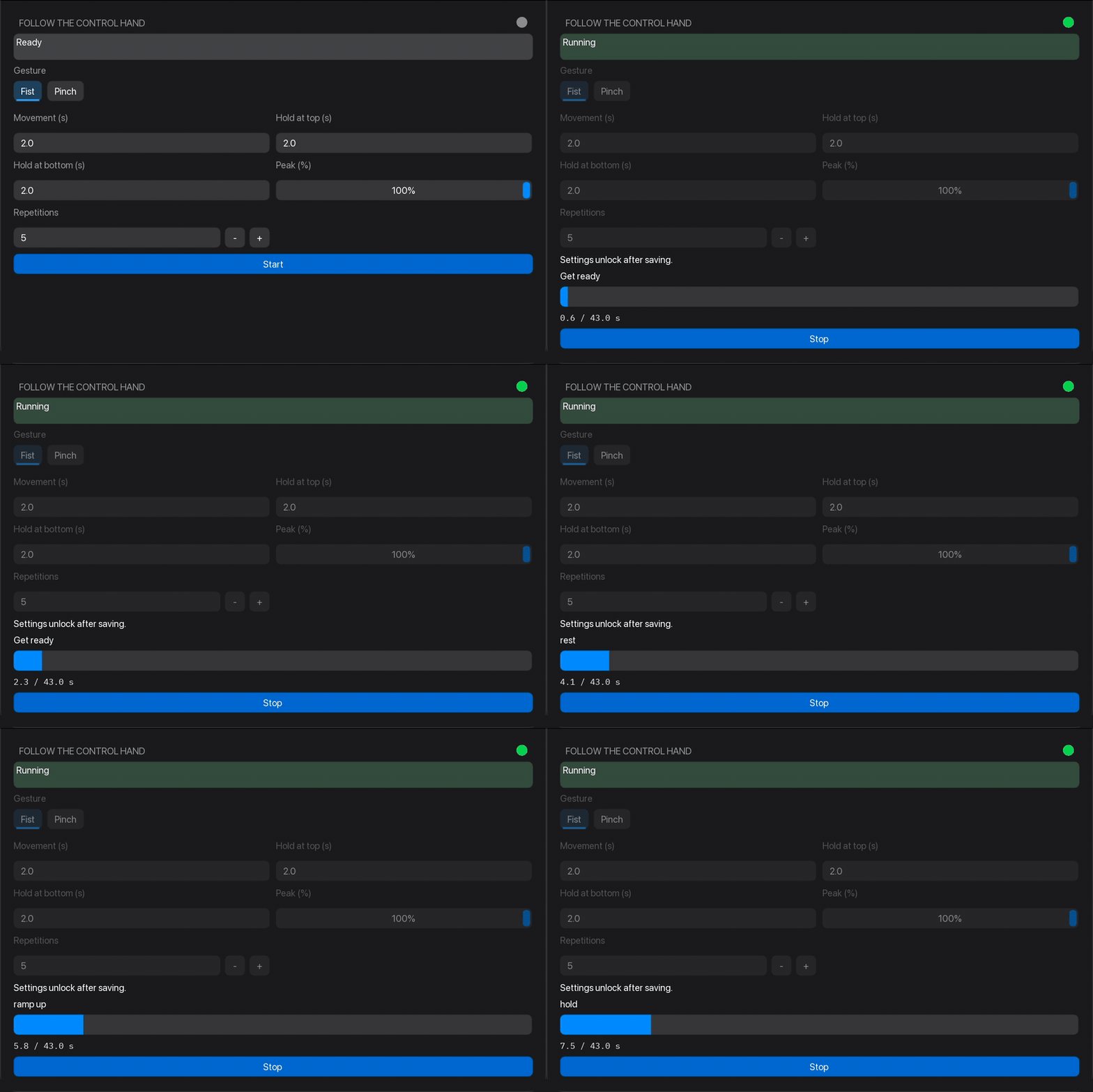 FollowRunRepetitions that follow the control hand. |
See every widget in the widget gallery.
What MyoGestic provides
MyoGestic provides live Lab Streaming Layer (LSL) ingest, on-disk recording
from Zarr to .mg.zip, a machine-learning pipeline with training
and prediction on their own threads, Dear ImGui widgets, output filters, and
gRPC plus LSL integration with the
Virtual Hand Interface.
Write signal processing, features and models with scipy, MyoVerse, CatBoost or PyTorch, or another library that fits the experiment.
More examples
examples/synthetic/
holds runnable demos and templates to copy.
| Script | Shows |
|---|---|
my_session_app.py |
A session app to copy. Change the classes, features, training and prediction. |
emg_classification.py |
Recommended first read. Binary CatBoost classification with an optional Virtual Hand. |
emg_regression.py |
Continuous regression of five degrees of freedom. |
emg_regression_raulnet.py |
The same flow with a PyTorch Lightning convolutional network. |
emg_32ch_multi_model.py |
A selectable classifier with Save and Load. |
electrode_grids.py |
A 256-channel stream split into four tiled viewers with a shared range. |
Documentation
| Page | Covers |
|---|---|
| Getting started | Install, run a protocol and write your own app. |
| Tutorials | EMG classification, and EMG regression with the Virtual Hand. |
| How-to guides | A custom source, widget or model, the Virtual Hand, and the recipe feature set. |
| Concepts | Architecture, streams, pipeline, threading, recording, the Px/Fr grid and the EdgeTrigger pattern. |
| API reference | Generated from the docstrings. |
| API cheatsheet | The most-used public symbols on one page. |
Development
uv sync --extra dev
uv run pytest -q
uv run ruff check .
Some integration tests need a live LSL outlet. To build and serve the docs locally:
uv sync --extra docs
cd website
npm ci
npm run dev
Use Node.js 22 (see website/.nvmrc), then open
http://localhost:4321/MyoGestic/. Run npm run build from website/
to build the site.
How to cite
If you use MyoGestic in your research, please cite our Science Advances paper:
Sîmpetru, R. C. et al. MyoGestic: EMG interfacing framework for decoding multiple spared motor dimensions in individuals with neural lesions. Science Advances 11, eads9150 (2025).
BibTeX
@article{Simpetru2025,
    author  = {Raul C. S{\^i}mpetru and Dominik I. Braun and Arndt U. Simon
               and Michael M{\"a}rz and Vlad Cnejevici
               and Daniela Souza de Oliveira and Nico Weber and Jonas Walter
               and J{\"o}rg Franke and Daniel H{\"o}glinger and Cosima Prahm
               and Matthias Ponfick and Alessandro Del Vecchio},
    title   = {MyoGestic: EMG interfacing framework for decoding multiple
               spared motor dimensions in individuals with neural lesions},
    journal = {Science Advances},
    volume  = {11},
    number  = {15},
    pages   = {eads9150},
    year    = {2025},
    doi     = {10.1126/sciadv.ads9150},
    url     = {https://www.science.org/doi/abs/10.1126/sciadv.ads9150},
}
Licence
MyoGestic is licensed under the GNU General Public License v3.0 (GPL-3.0), matching the v1 release. Derivative work must remain open under the same licence.
n-squared lab · Friedrich-Alexander-Universität Erlangen-Nürnberg

1 maintainer

Metadata
1 maintainer
Release files for myogestic 2.7.0
For a detailed explanation of source distributions (sdists) and built distributions (wheels), please see the package formats documentation.
Source distribution (sdist)
| File | Size | Uploaded | Provenance | Actions |
|---|---|---|---|---|
| myogestic-2.7.0.tar.gz | 1.3 MB | With provenance | Details for myogestic-2.7.0.tar.gz |
Built distribution (wheel)
| File | Interpreter | ABI | Platform | Actions Reset |
|---|---|---|---|---|
| myogestic-2.7.0-py3-none-any.whl | Python 3 | none | any | Details for myogestic-2.7.0-py3-none-any.whl |
Total release size: 2.1 MB
Release files / myogestic-2.7.0.tar.gz
| Download URL | myogestic-2.7.0.tar.gz |
|---|---|
| Size | 1.3 MB |
| Tags | Source |
|
SHA-256 checksum How to use checksums |
183115892e96adb44fa50c4c5b22e7157419fb8ab778dc74efbef76938708ee7
|
|
BLAKE2b-256 checksum How to use checksums |
13caaf705fd9cdc38d8441f9f3d255ccad189ff7ff15a8964fc50881b3172907
|
| Upload date | |
|
Uploaded using Trusted Publishing? What is trusted publishing? |
Yes |
| Uploaded via |
twine/7.0.0 CPython/3.13.16
|
Provenance
Provenance describes where a file came from. On PyPI, provenance is shared via attestations, which provide a verifiable record of the build or publishing details. View details, limitations and caveats.


PyPI Publish Attestation
PyPI verified that this artifact, at this checksum, originated from the publisher listed below.
Signed by GitHub Actions, verified by PyPI on Nov 7, 2026.
Transparency logRelease files / myogestic-2.7.0-py3-none-any.whl
| Download URL | myogestic-2.7.0-py3-none-any.whl |
|---|---|
| Size | 844.2 kB |
| Tags | Python 3 |
|
SHA-256 checksum How to use checksums |
bea50890755b9a55fe9c9ebc2d9deb0c65ba5f9566475fc254921f74185dc423
|
|
BLAKE2b-256 checksum How to use checksums |
deb47978243b241d4e2b2bed156fb52c2dfccb4be3c889ecdac69d78e91c66da
|
| Upload date | |
|
Uploaded using Trusted Publishing? What is trusted publishing? |
Yes |
| Uploaded via |
twine/7.0.0 CPython/3.13.16
|
Provenance
Provenance describes where a file came from. On PyPI, provenance is shared via attestations, which provide a verifiable record of the build or publishing details. View details, limitations and caveats.
PyPI Publish Attestation
PyPI verified that this artifact, at this checksum, originated from the publisher listed below.
Signed by GitHub Actions, verified by PyPI on Nov 7, 2026.
Transparency logSecurity for myogestic 2.7.0
Provenance
Provenance describes where a file came from. On PyPI, provenance is shared via attestations, which provide a verifiable record of the build or publishing details. View details, limitations and caveats.
Full provenance
Both files in this release have been uploaded with provenance metadata.
Attestation for myogestic-2.7.0.tar.gz
PyPI Publish Attestation
PyPI verified that this artifact, at this checksum, originated from the publisher listed below.
Signed by GitHub Actions, verified by PyPI on Nov 7, 2026.
Transparency logA note on package security
PyPI is a repository for distributing packages, not a service for auditing them. While third-party security researchers and our staff do their best to detect and remove malicious packages, PyPI cannot guarantee the quality, security or suitability of any given package.
To learn more about protecting yourself from malicious actors, visit our package security documentation.














