






Mythos is a Python package for simulating and fitting coarse-grained molecular models to macroscopic experimental data.
Currently, Mythos can run simulations using JAX-MD, oxDNA, GROMACS, and LAMMPS. (oxDNA, GROMACS, and LAMMPS must be installed separately.)
Further, Mythos supports fitting models using JAX-MD (Direct Differentiation, and DiffTRe) and oxDNA / GROMACS / LAMMPS (DiffTRe only). Built-in energy models include oxDNA1, oxDNA2, RNA, hybrid DNA/RNA, and MARTINI 2/3 coarse-grained lipid models.
Quick Start
We recommend using a fresh conda environment with Python 3.11. You can create a new environment with the following command:
conda create -y -n mythos python=3.11
conda activate mythos
Depending on your hardware, you may want to install the GPU accelerated version of JAX, see the JAX documentation for more details on how to do this. If you aren't interested in GPU support, you can skip straight to installing mythos which will install the CPU version of JAX.
First install mythos using pip:
pip install git+https://github.com/mythos-bio/mythos.git
Simulations
Information on how to run a simulation can be found in the documentation.
One advantage of mythos is that you can specify a custom energy function for both simulations and optimizations. Information on how energy functions are defined and how to define your own energy functions can be found in the documentation.
Optimizations
The optimization framework is built around four abstractions:
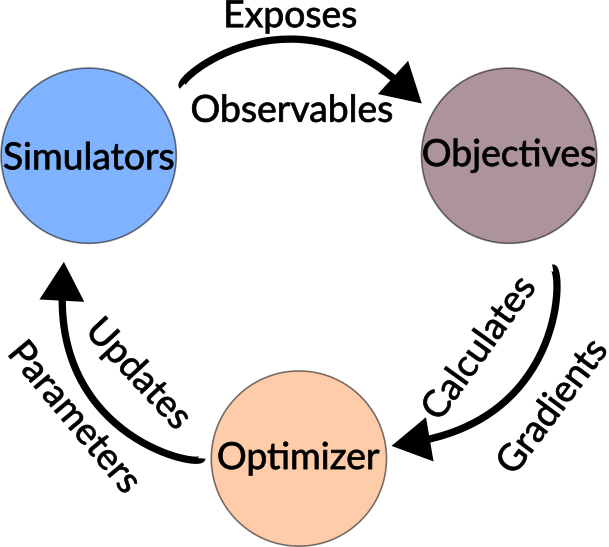
- Simulator — runs a simulation and produces observables.
- Observable — a quantity produced by a simulator (e.g. a trajectory, structural property, or thermodynamic measurement).
- Objective — computes gradients of a loss function with respect to the parameters being optimized.
- Optimizer — coordinates simulators, collects observables, passes them to objectives, aggregates gradients, and applies parameter updates.
Multiple simulators (potentially using different backends) and multiple objectives can be jointly optimized. For example, you can simultaneously fit structural and thermodynamic properties across simulations at different conditions. Parallel execution is supported via Ray, enabling distribution across local cores or a remote cluster.
For more details, see the optimization docs and the examples.
Development
We welcome contributions! If you are looking for something to work on, check out the issues.
If you have a feature request or an idea that you would like to contribute, please open an issue. The project is fast moving, opening an issue will help us to give you quick feedback and help you to get started.
See the CONTRIBUTING
1 maintainer

Metadata
1 maintainer
Release files for mythos-bio 1.0.0
For a detailed explanation of source distributions (sdists) and built distributions (wheels), please see the package formats documentation.
Source distribution (sdist)
| File | Size | Uploaded | |
|---|---|---|---|
| mythos_bio-1.0.0.tar.gz | 28.3 MB | Details |
Built distribution (wheel)
| File | Interpreter | ABI | Platform | Reset |
|---|---|---|---|---|
| mythos_bio-1.0.0-py3-none-any.whl | Python 3 | none | any | Details |
Total release size: 28.6 MB
Release files / mythos_bio-1.0.0.tar.gz
| Download URL | mythos_bio-1.0.0.tar.gz |
|---|---|
| Size | 28.3 MB |
| Tags | Source |
|
SHA-256 checksum How to use checksums |
2c8c3708a0ebc15b3a1a2437daf414b00401d53737aa0d4535b2b817f41ad58d
|
|
BLAKE2b-256 checksum How to use checksums |
7dbefa6072e205952705b3ce26a73e7ec7d0211b9eb8369aec3ca9c4d16e1274
|
| Upload date | |
|
Uploaded using Trusted Publishing? What is trusted publishing? |
Yes |
| Uploaded via |
twine/6.1.0 CPython/3.13.12
|
Provenance
Provenance describes where a file came from. On PyPI, provenance is shared via attestations, which provide a verifiable record of the build or publishing details. View details, limitations and caveats.


PyPI Publish Attestation
PyPI verified that this artifact, at this checksum, originated from the publisher listed below.
Signed by GitHub Actions, verified by PyPI on May 18, 2026.
Transparency logRelease files / mythos_bio-1.0.0-py3-none-any.whl
| Download URL | mythos_bio-1.0.0-py3-none-any.whl |
|---|---|
| Size | 303.5 kB |
| Tags | Python 3 |
|
SHA-256 checksum How to use checksums |
07839ceda96540ac6c9a75dab480a5210daeeecb93c63f783f23f8be0bc6d02c
|
|
BLAKE2b-256 checksum How to use checksums |
14c0c5ca48899ae96fb79bb9c09c4786baec3b15d86e7be305a02d45e7162514
|
| Upload date | |
|
Uploaded using Trusted Publishing? What is trusted publishing? |
Yes |
| Uploaded via |
twine/6.1.0 CPython/3.13.12
|
Provenance
Provenance describes where a file came from. On PyPI, provenance is shared via attestations, which provide a verifiable record of the build or publishing details. View details, limitations and caveats.
PyPI Publish Attestation
PyPI verified that this artifact, at this checksum, originated from the publisher listed below.
Signed by GitHub Actions, verified by PyPI on May 18, 2026.
Transparency log












