
Nodes and Edges: a declarative DSL over LangGraph — a declarative >-DSL over LangGraph with a build-time dataflow validator, compiled to native LangGraph

Project description
nae — Nodes and Edges: a declarative DSL over LangGraph
Build LLM agent graphs in a few lines. nae is a small declarative DSL over
LangGraph: wire self-contained,
tool-using agent nodes together with a > operator into a visible DAG —
fan-out, map-reduce, structured-output routing, human-in-the-loop — and skip the
add_node / add_edge / add_conditional_edges / Send boilerplate. It all
compiles down to a native LangGraph StateGraph.
nae builds on LangGraph, it doesn't replace it. LangGraph is well worth
learning directly — especially for experienced users who want full control.
nae's job is to make that capability more accessible: the value is
everything you don't write, folded into a small >-DSL. And because each node
declares the state keys it reads and writes, nae statically checks your graph
for read-before-written dataflow bugs before you invoke. You keep the whole
LangGraph ecosystem (streaming, async, checkpointers, LangSmith) and can drop
down to raw LangGraph anytime — no lock-in.
Full documentation: teeratp.github.io/nae.





nae vs. raw LangGraph
The same tool-using agent — an LLM that calls add / multiply in a loop until
it has the answer. Ask it "What is 21 + 21, then times 3?" and both print
126. The only thing that differs is how much graph plumbing you write:
3 lines vs. 10.
Shared setup for both versions — the model and the two tools:
from langchain_openai import ChatOpenAI

llm = ChatOpenAI(model="gpt-5.4-nano")
# swap for any LangChain chat model, e.g.:
#   from langchain_anthropic import ChatAnthropic;              llm = ChatAnthropic(model="claude-opus-4-8")
#   from langchain_google_genai import ChatGoogleGenerativeAI;  llm = ChatGoogleGenerativeAI(model="gemini-...")

def add(a: int, b: int) -> int:
    """Add two numbers."""
    return a + b

def multiply(a: int, b: int) -> int:
    """Multiply two numbers."""
    return a * b
# nae
from nae import AgentNode, AgenticGraph

agent = AgentNode(llm=llm, tools=[add, multiply])   # name inferred from the variable -> "agent"
graph = AgenticGraph(start_node=agent, end_nodes={agent})   # schema-free

graph.invoke(message="What is 21 + 21, then times 3?")      # -> 126
# raw LangGraph
from langgraph.graph import StateGraph, MessagesState, START, END
from langgraph.prebuilt import ToolNode, tools_condition

llm_with_tools = llm.bind_tools([add, multiply])

def call_model(state: MessagesState):
    return {"messages": [llm_with_tools.invoke(state["messages"])]}

builder = StateGraph(MessagesState)
builder.add_node("call_model", call_model)
builder.add_node("tools", ToolNode([add, multiply]))
builder.add_edge(START, "call_model")
builder.add_conditional_edges("call_model", tools_condition)  # tools? -> "tools" : END
builder.add_edge("tools", "call_model")                       # loop back to the model
graph = builder.compile()

graph.invoke({"messages": [{"role": "user", "content": "What is 21 + 21, then times 3?"}]})  # -> 126
Identical behavior — same tools, same loop, same answer. nae folds the model
node, the ToolNode, the tools_condition edge and the loop-back edge into
one AgentNode with a built-in tool-call loop, and infers the state schema
for you. Both versions run side by side in
examples/vs_langgraph.py.
Catch dataflow bugs at build time
Because every node declares what it reads and writes, AgenticGraph(...) runs a
forward dataflow analysis at construction and fails the build — before a
single model call — if a node reads a state key that nothing upstream produces:
from nae import AgentNode, AgenticGraph

early = AgentNode(llm=llm, reads=["summary"])    # name inferred -> "early"; reads 'summary'...
late  = AgentNode(llm=llm, writes=["summary"])   # ...-> "late"; but it's produced downstream
early > late

AgenticGraph(start_node=early, end_nodes={late})
# GraphValidationError: 'early' reads computed key 'summary' but no upstream node produces it
Raw LangGraph compiles the same graph and only trips at runtime, on the first
input that exercises the broken path. nae names the offending node and key at
build time; graph.validate() runs the same check on demand. Every bug class
it catches, with the verbatim errors:
The validator.
Examples
Two runnable galleries make the "nae vs. LangGraph" story concrete:
examples/basics/— one file per feature, each showing the nae version and the equivalent raw-LangGraph version side by side. The fastest way to see exactly what plumbing nae folds away — tool loops, fan-out/join, map-reduce, structured-output routing, typed state IO, human-in-the-loop — one concept at a time.examples/architectures/— famous agent patterns (router, evaluator-optimizer, orchestrator-workers, reflection, and more) built end-to-end in nae, so you can lift a whole topology instead of a single node.
Start with basics/ to learn the primitives, then reach for architectures/
when you're wiring a real system.
Interactive playground
python demo/app.py launches a local Gradio playground: paste a >-DSL snippet,
click Build + Validate, and see the compiled LangGraph diagram and the
build-time validator output side by side — no API key needed. See demo/.
Install
pip install nae

# nae works with ANY LangChain chat model — install the provider you want:
pip install langchain-openai python-dotenv   # OpenAI (used in the examples below)
pip install langchain-anthropic              # Anthropic
pip install langchain-google-genai           # Google
Nodes take the model via llm= — pass any LangChain BaseChatModel. (A
nae[openai] extra exists as a shortcut for langchain-openai +
python-dotenv, but it's convenience only, not a requirement.) Note:
reasoning_effort and structured-output routing are tuned to OpenAI gpt-5.x
semantics; core wiring, the tool-call loop, and routing are otherwise
provider-neutral.
Or from source (for development):
git clone https://github.com/TeeratP/nae && cd nae
python -m venv .venv && source .venv/bin/activate
pip install -e ".[openai,dev]"
Requires Python ≥ 3.10 (core deps: LangGraph ≥ 1.0, langchain-core ≥ 1.0,
Pydantic 2). Other extras: [rag] (langchain-chroma for ChromaRAG), [dev]
(pytest). For live model calls, set OPENAI_API_KEY (or your provider's key)
in your environment or a .env file.
30-second example: a multi-agent panel
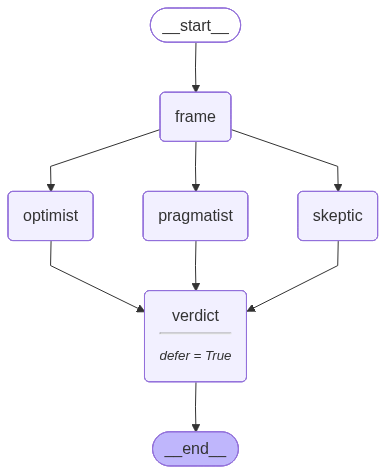
A question goes to frame (which sharpens it into one concrete decision), fans
out to three rival personas — optimist / skeptic / pragmatist — who argue
concurrently, then verdict weighs every argument into a one-paragraph
ruling. The whole thing is the one wiring line at the bottom.
from nae import AgentNode, AgenticGraph, fanout
from langchain_openai import ChatOpenAI

llm = ChatOpenAI(model="gpt-5.4-nano")   # swap for any LangChain chat model — see Install above

# names are inferred from the variables (frame, optimist, ...) — no name= needed
frame = AgentNode(llm=llm, node_prompt=(
    "Restate the user's question as ONE sharp, concrete decision. One sentence."))
optimist = AgentNode(llm=llm, node_prompt=(
    "Relentless optimist. Argue FOR the bold move — two strongest upsides."))
skeptic = AgentNode(llm=llm, node_prompt=(
    "Hard-nosed skeptic. Argue AGAINST — the two biggest risks."))
pragmatist = AgentNode(llm=llm, node_prompt=(
    "Pragmatist. Propose the smallest concrete next step that de-risks it."))
verdict = AgentNode(llm=llm, node_prompt=(
    "You are the chair. Weigh all three above into a balanced one-paragraph verdict."))

frame > fanout(optimist, skeptic, pragmatist) > verdict   # parallel, then join

panel = AgenticGraph(start_node=frame, end_nodes={verdict})   # schema-free

out = panel.invoke(message="Should an early-stage SaaS rewrite its monolith into microservices?")
print(out["messages"][-1].content)        # the verdict
panel.summary()                           # the topology table (below)
print(out["token"])                       # per-model token totals
Runs from a single paste with only OPENAI_API_KEY set. Full version:
examples/panel.py.
The graph also renders itself. In a notebook, end a cell with the graph — or
call display(panel) — and you get the compiled DAG:
from IPython.display import display
display(panel)    # or make `panel` the last expression of the cell
What you get
>wiring —a > b > cbuilds the graph; branches index by choice. Noadd_node/add_edgeboilerplate.- Parallel
fanout(...)+ deferred join —start > fanout(a, b) > combinerunsaandbconcurrently and joins once after both finish (the bracket formstart > [a, b] > combinewires identically). worker.map("field")map-reduce —dispatch > summarize.map("docs") > reducefans a worker out over a state list via LangGraphSend, once per item, in parallel, then joins once.- Schema-free typed state — nodes default to
messages;reads=[...]/writes=[...]give one node multi-key IO dispatched by value type (a message-list read is history, a scalar read is interpolated into the prompt).writes={"score": int}returns native-typed structured output (a realint, not a string). message=invoke shorthand —graph.invoke(message="...")wraps a string (or list of messages) ontomessages; the fullinvoke({...})state form still works.- Per-model token usage —
out["token"]is a{model: {total/input/output_tokens}}breakdown accumulated across every node. - Opt-in OpenAI prompt caching —
AgenticGraph(..., prompt_cache=True)threads one cache key through every OpenAIAgentNodecall. - Compile-time validation +
summary()— the constructor runs a forward dataflow analysis and fails the build if a node reads a key nothing produces upstream (with the offending key and real writer named), andsummary()prints amodel.summary()-style topology table:
AgenticGraph 'graph'   state=AgenticState
initial: log, messages, token
-----------------------------------------------------------------
node        type       reads     writes        available
frame       AgentNode  messages  log,messages  log,messages,token
optimist    AgentNode  messages  log,messages  log,messages,token
verdict     AgentNode  messages  log,messages  log,messages,token
skeptic     AgentNode  messages  log,messages  log,messages,token
pragmatist  AgentNode  messages  log,messages  log,messages,token
-----------------------------------------------------------------
5 nodes · 0 errors · 0 warning(s)
The offline, no-API-key tour of parallelism, map-reduce, typed IO, and
validation lives in examples/parallel_usage.py.
vs. LangChain's Functional API
The closest comparison isn't raw graphs — it's LangChain's own Functional API
(@entrypoint / @task), which also lets you skip explicit graph wiring. The
difference is visibility of control flow:
Functional API (@entrypoint/@task) |
nae | |
|---|---|---|
| Control flow | hidden in plain Python (loops, if, await) |
an explicit, declarative DAG |
| Fan-out / join | you orchestrate futures by hand | fanout(...) / .map("field"), one line |
| Inspect the topology | run it and trace | summary() prints the static DAG |
| Catch dataflow bugs | at runtime | at compile time, before any invoke |
Both are concise. nae's edge is that the topology is inspectable and validatable — you can see the fan-out/join/map-reduce structure, render it, and have the compiler reject read-before-written bugs — whereas the Functional API hides the graph inside ordinary Python, so you lose the auditable DAG.
How it works
a > b doesn't build an edge — it sets a.children = [b] and returns b,
so a > b > c builds a linked structure in memory. AgenticGraph(...) walks
that structure once at construction, emits the real LangGraph
add_node/add_edge/Send calls, runs the dataflow validator, and compile()s
to a native StateGraph — which AgenticGraph subclasses. So nae is a
build-time convenience that disappears at runtime: the execution underneath is
plain LangGraph (streaming, async, durability, checkpointers, LangSmith all
included), and you can drop down to it anytime. No lock-in.
Node types
Four node types cover the graphs above: AgentNode (an LLM step with an
optional built-in tool-call loop, capped by max_tool_iterations=25),
DecisionNode (LLM branching via structured output, constrained to valid
choices), ConditionNode (deterministic branching from a plain Python
predicate — no model call), and HumanNode (resumable human-in-the-loop
via interrupt()). The LLM-backed nodes share an LLMNode base; all take
cache_ttl/retry, and an AgenticGraph can itself be embedded as a node.
Each type with a runnable snippet:
Node types.
State
AgenticState is a TypedDict of reduced channels — messages
(add_messages), a log trace (operator.add), per-model token totals, and
a private decision_{name} key per router. Nodes return deltas, never mutate
state in place, and reducers merge them — the full channel model is in
State & observability.
Free observability: the token and log channels
Total token spend and a per-node trace come automatically — no callbacks, no
custom reducers. Every LLM call's usage is summed into token; every node
appends a trace line to log:
out = graph.invoke({"messages": ["..."], "log": []})   # seed log=[] to capture it
print(out["token"])   # {'gpt-5.4-nano': {'input_tokens': 42, 'output_tokens': 88, 'total_tokens': 130, ...}}
print(out["log"])     # ['frame:...', 'optimist:...', ...] — one line per node/tool call
token is the run total — it accumulates across every node, tool-loop
call, and parallel branch, deep-summed per model. In raw LangGraph you'd
hand-wire a usage callback plus a custom summing channel to get this.
Side-by-side vs. raw LangGraph:
examples/basics/13_token_and_log.py.
Limitations
Kept honest on purpose:
- Structured multi-write list fields are
str-only.writes=["a", "b"]produces onestrfield per key; use the dict formwrites={"a": int}for native-typed structured output. - Map workers don't echo their source item — return only what you computed; the item you mapped over doesn't need to appear in the worker's output.
[b, c] > [d, e]isn't supported. Two fan-outs chained directly is Python's element-wise list compare, not join wiring — insert a node between.- Async is graph-level only.
ainvoke/astreamrun the sync nodes in LangGraph's threadpool; true per-node async LLM calls aren't implemented. reasoning_effortisAgentNode-only — it conflicts withDecisionNode's structured output on current OpenAI models.
Running it
python -m pytest tests/                # full suite, no API calls (a scripted FakeLLM stands in)
python examples/parallel_usage.py      # offline tour: parallel + map-reduce + validation
python examples/panel.py               # live multi-agent panel (needs OPENAI_API_KEY)
python examples/vs_langgraph.py        # the 3-vs-10 comparison, both ways (needs OPENAI_API_KEY)
The 165-test suite covers state reducers, graph construction, routing, the
tool-call loop, interrupt/resume, RAG tool wiring, streaming/async, configurable
fields, parallel fan-out/join, map-reduce, multi-key IO, static validation, and
node caching/retry/reasoning_effort/durability.
License
MIT — see LICENSE.
Release history Release notifications | RSS feed

Download files
Download the file for your platform. If you're not sure which to choose, learn more about installing packages.
Source Distribution
Built Distribution
Filter files by name, interpreter, ABI, and platform.
If you're not sure about the file name format, learn more about wheel file names.
Copy a direct link to the current filters
File details
Details for the file nae-0.1.0.tar.gz.
File metadata
- Download URL: nae-0.1.0.tar.gz
- Upload date:
- Size: 76.8 kB
- Tags: Source
- Uploaded using Trusted Publishing? No
- Uploaded via: twine/6.2.0 CPython/3.12.9
File hashes
| Algorithm | Hash digest | |
|---|---|---|
| SHA256 |
a0682d4b4ae36cebeccf1d1809588c5a69b642c1f8babbab322425f2ded60146
|
|
| MD5 |
ea3eeacba35cbe0dbca54fedeecea6de
|
|
| BLAKE2b-256 |
4f46f07d4ee4acee6a18b50ac0cf24b569b2a4717a979d718ea9072f5ccb18b9
|
File details
Details for the file nae-0.1.0-py3-none-any.whl.
File metadata
- Download URL: nae-0.1.0-py3-none-any.whl
- Upload date:
- Size: 53.4 kB
- Tags: Python 3
- Uploaded using Trusted Publishing? No
- Uploaded via: twine/6.2.0 CPython/3.12.9
File hashes
| Algorithm | Hash digest | |
|---|---|---|
| SHA256 |
3f1b2ac2c94ecc96d20814814eea75d43aecb7a27e406d66ab0e481c8b8bef56
|
|
| MD5 |
bb700d7aa63764eaba7dd6254604bf22
|
|
| BLAKE2b-256 |
5b8031d9ebd3d4667266e76bb9924352465a16b6b4cd493f339ab5ec8ed0531d
|






