
NASimEmu: Network Attack Simulator & Emulator
Related
- Repository with deep RL agents
- NASimEmu: Network Attack Simulator & Emulator for Training Agents Generalizing to Novel Scenarios, SECAI workshop @ ESORICS 2023, preprint
- Applications of Deep Reinforcement Learning in Practical Sequential Information Acquisition Problems, Chapter 6 - Case Study: Automated Penetration Testing, Doctoral Dissertation, CTU, 2024, link
Introduction
NASimEmu is a framework for training deep RL agents in offensive penetration-testing scenarios. It includes both a simulator and an emulator so that a simulation-trained agent can be seamlessly deployed in emulation. Additionally, it includes a random generator that can create scenario instances varying in network configuration and size while fixing certain features, such as exploits and privilege escalations. Furthermore, agents can be trained and tested in multiple scenarios simultaneously.
The simulation is based on Network Attack Simulator and can be used to train and evaluate agents. It is a memory-based fast and parallelizable abstraction of real computer networks and can generate random scenario instances which can vary in network topology, configuration and number of hosts. The emulation is a controlled environment using industry-level tools, such as Vagrant, VirtualBox, and Metasploit. Agents trained in simulation can be transparently deployed in emulation.
NASimEmu introduces a few changes for training general agents that can transfer to novel, unseen scenarios. It includes dynamic scenarios that represent prototypical situations, e.g., typical university or corporate networks. In these scenarios, some attributes are fixed (network topology, OSs, services, exploits, etc.), while some are left to chance (network size and hosts' configuration). Lastly, multiple scenarios can be specified for training or testing.
The accompanying paper NASimEmu: Network Attack Simulator & Emulator for Training Agents Generalizing to Novel Scenarios can be found on arXiv.
Installation
Warning: NASimEmu-Enhanced 1.x depends on
gym==0.21.0, whose package metadata is rejected by current packaging tools. Untilgymis replaced, install with legacy tooling on Python 3.10:python3.10 -m venv .venv && source .venv/bin/activate pip install "pip<24.1" "setuptools<66" "wheel<0.40" pip install --no-build-isolation nasimemu-enhanced
The scenario files are not part of the package; get them from the scenarios/ folder of this repository.
For development, clone the repository and install it in editable mode (same legacy tooling as above):
git clone https://github.com/dreamfarer/NASimEmu-Enhanced.git
cd NASimEmu-Enhanced; pip install hatchling editables; pip install --no-build-isolation -e .
To use emulation, you have to install Vagrant yourself; see EMULATION.
Usage
import gym, random, logging
import nasimemu, nasimemu.env_utils as env_utils

# In this example, a scenario instance is randomly generated from either 'entry_dmz_one_subnet' or 'entry_dmz_two_subnets' on every new episode. Make sure the path to scenarios is correct.
# To use emulation, setup Vagrant and change emulate=True.
env = gym.make('NASimEmu-v0', emulate=False, scenario_name='scenarios/entry_dmz_one_subnet.v2.yaml:scenarios/entry_dmz_two_subnets.v2.yaml')
s = env.reset()

# To see the emulation logs, uncomment the following:
# logging.basicConfig(level=logging.DEBUG)
# logging.getLogger('urllib3').setLevel(logging.INFO)

# To see the whole network, use (only in simulation):
# env.render_state()

for _ in range(3):
    actions = env_utils.get_possible_actions(env, s)
    env.render(s)

    # you can convert the observation into a graph format (e.g., for Pytorch Geometric) as:
    # s_graph = env_utils.convert_to_graph(s)

    action = random.choice(actions)
    s, r, done, info = env.step(action)

    print(f"Possible actions: {actions}")

    (action_subnet, action_host), action_id = action
    print(f"Taken action: {action}; subnet_id={action_subnet}, host_id={action_host}, action={env.action_list[action_id]}")
    print(f"reward: {r}, done: {done}\n")
    input()
Gym integration
NASimEmu currently doesn't support many of the default agents made for gym, because it uses custom environment spaces (the size of the environment is unknown to the attacker at the beginning) and an action space that changes at each step when a new host is discovered.
Implemented Deep RL Agents
See the separate repository NASimEmu-agents for implemented agents.
Simulation
The simulation is based on Network Attack Simulator and you can read its docs here: https://networkattacksimulator.readthedocs.io
These are the changes in NaSimEmu:
- Support for new v2 scenarios, which define classes of problems from which random instances are generated. The v2 scenarios define a topology, sensitive subnets, services, processes and exploits. However, the generated instances vary in number of hosts in subnets and hosts' configuration. For example, you can define scenarios representing "bank", "university" or "enterprise" domains.
- Agent can be trained or deployed in multiple scerarios at once. This is useful to test generalization and transfer learning of the agent. E.g., how does it perform in the "enterprise" scenario when trained only in "bank" and "university"?
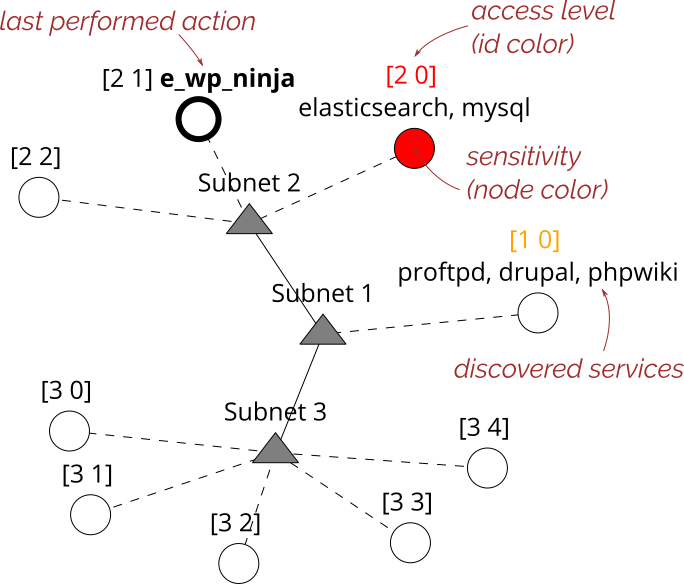
- The interface has been changed to true partial observability. That is, the agent cannot infer the number of hosts or subnets in the current scenario instance and all other unknown information is masked. To aleviate memorization of acquired information, the observation at each step records all the information gathered so far. Further, host and subnet ids are scrambled to avoid their memorization.
Emulation
The emulation is made with Vagrant and VirtualBox. You will need to install these on your system first. A scenario is converted into a Vagrantfile and deployed. The vagrant spawns a virtual machine for each host in the scenario (currently, Ubuntu and Windows machines are available) and configures them properly. Additionally, it deploys one RouterOS based router that segments the network into subnets and one attacker machine that runs Kali Linux and uses Metasploit with pre-configured exploits to run.
For more information about emulation, see EMULATION.
Limitations / Properties
Please, be aware of the following:
- exploits are assumed to always work (in emulation, this is not true)
- the services have a single version and are always exploitable, if the exploit is defined
- currently, the maximum number of subnets and hosts in subnets have to be defined, so that the host vector size is always the same
- if there are multiple paths from the attacker to a target (some of which are filtered by firewalls), the simulator assumes that the host is exploitable if any of the paths allow it; in emulation, this is not implemented (the first discovered path will be used); avoid doing this
- we assume that a firewall either block or allows all traffic between subnets
- in emulation, all hosts are on the same interface, which is only virtually segmented by the router; avoid using protocols that bypass the router (such as ARP)
- if defined in the scenario, sensitive services always run on all sensitive nodes; sensitive services also run on 10% of non-sensitive nodes
- emulation do not provide any rewards
Acknowledgements
@bastien-buil - windows emulation, bugfixes and part of documentation
1 maintainer

Metadata
1 maintainer
Release files for nasimemu-enhanced 1.0.1
For a detailed explanation of source distributions (sdists) and built distributions (wheels), please see the package formats documentation.
Source distribution (sdist)
| File | Size | Uploaded | |
|---|---|---|---|
| nasimemu_enhanced-1.0.1.tar.gz | 116.5 kB | Details |
Built distribution (wheel)
| File | Interpreter | ABI | Platform | Reset |
|---|---|---|---|---|
| nasimemu_enhanced-1.0.1-py3-none-any.whl | Python 3 | none | any | Details |
Total release size: 266.1 kB
Release files / nasimemu_enhanced-1.0.1.tar.gz
| Download URL | nasimemu_enhanced-1.0.1.tar.gz |
|---|---|
| Size | 116.5 kB |
| Tags | Source |
|
SHA-256 checksum How to use checksums |
00abb5d3340e19eb48711ecc67b796098d0453adf0c5b78cb1c9ac21a2996ed3
|
|
BLAKE2b-256 checksum How to use checksums |
058e86c15d44d2b5988317dbf5c5a0e64c57630293c90dcf691df586c11ad36d
|
| Upload date | |
|
Uploaded using Trusted Publishing? What is trusted publishing? |
Yes |
| Uploaded via |
uv/0.12.23 {"installer":{"name":"uv","version":"0.12.23","subcommand":["publish"]},"python":null,"implementation":{"name":null,"version":null},"distro":{"name":"Ubuntu","version":"24.04","id":"noble","libc":null},"system":{"name":null,"release":null},"cpu":null,"openssl_version":null,"setuptools_version":null,"rustc_version":null,"ci":true}
|
Provenance
Provenance describes where a file came from. On PyPI, provenance is shared via attestations, which provide a verifiable record of the build or publishing details. View details, limitations and caveats.


PyPI Publish Attestation
PyPI verified that this artifact, at this checksum, originated from the publisher listed below.
Signed by GitHub Actions, verified by PyPI on Oct 4, 2026.
Transparency logRelease files / nasimemu_enhanced-1.0.1-py3-none-any.whl
| Download URL | nasimemu_enhanced-1.0.1-py3-none-any.whl |
|---|---|
| Size | 149.5 kB |
| Tags | Python 3 |
|
SHA-256 checksum How to use checksums |
c20c4f1e6244c9353a0401695126898c4a87ddf482d8d0f58afbe065538454f9
|
|
BLAKE2b-256 checksum How to use checksums |
273253613ec5565813d5c5e763099d97e6adde9390487e8b4a0f160cbda32541
|
| Upload date | |
|
Uploaded using Trusted Publishing? What is trusted publishing? |
Yes |
| Uploaded via |
uv/0.12.23 {"installer":{"name":"uv","version":"0.12.23","subcommand":["publish"]},"python":null,"implementation":{"name":null,"version":null},"distro":{"name":"Ubuntu","version":"24.04","id":"noble","libc":null},"system":{"name":null,"release":null},"cpu":null,"openssl_version":null,"setuptools_version":null,"rustc_version":null,"ci":true}
|
Provenance
Provenance describes where a file came from. On PyPI, provenance is shared via attestations, which provide a verifiable record of the build or publishing details. View details, limitations and caveats.
PyPI Publish Attestation
PyPI verified that this artifact, at this checksum, originated from the publisher listed below.
Signed by GitHub Actions, verified by PyPI on Oct 4, 2026.
Transparency log













