
nave-xai
NAVE explanations of vision encoders: which concepts an encoder extracts, and where.
nave-xai is the official package of NAVE (Neuro-Activated Vision Explanations), from
Multi-depth Concept Extraction for Post-Hoc Vision Encoder Explanation (ECML PKDD 2026)
by Ahcène Boubekki, Samuel G. Fadel and Sebastian Mair.
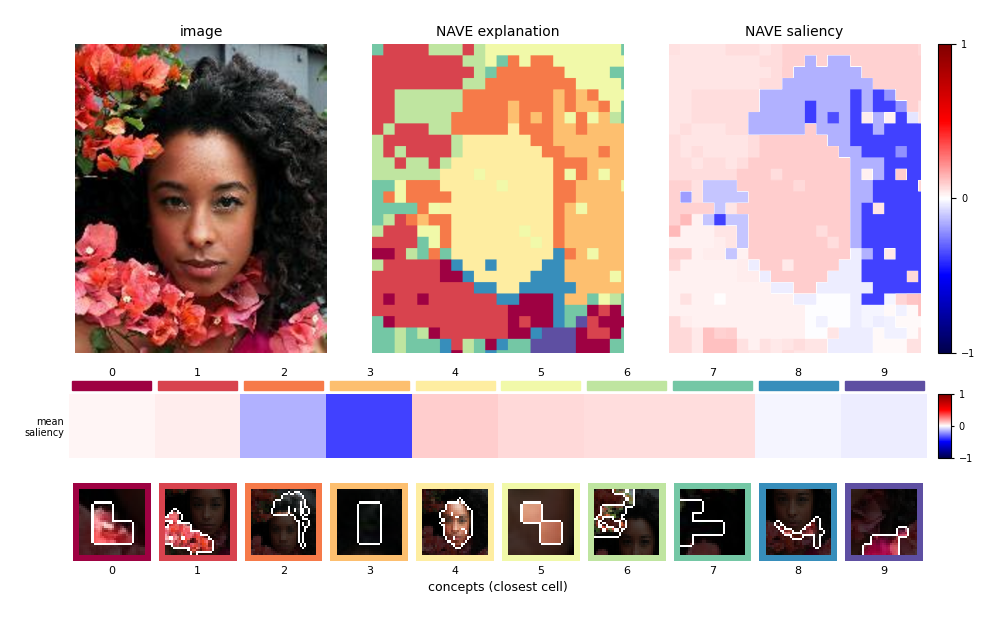
NAVE explains the encoder, not a prediction. It combines the feature activations of a frozen encoder at several depths, extracts concepts from them, and returns an explanation map: how the encoder decomposes the image, before any classifier gets involved. It is post-hoc, unsupervised and architecture-agnostic (CNNs and ViTs), and needs no fine-tuning.
If you use nave-xai in your work, please cite the paper (see Citation).
Install
pip install nave-xai               # works offline: ViT-Ti/16 (ImageNet) is shipped with the package
pip install "nave-xai[torch]"      # explain your own PyTorch models (GPU too)
Explain an image
from nave_xai import NAVEImage

explainer = NAVEImage()                        # ViT-Ti/16, ImageNet weights
exp = explainer.explain(image)            # (H, W, 3) array or PIL image

exp.explanation                           # (H, W) the concept of every pixel
exp.segmentation()                        # (H, W) connected regions, like skimage's slic
exp.border(width=1)                       # (H, W) 0/1 inner margin of every region
Draw it with any tool, e.g. matplotlib: plt.imshow(explainer.palette[exp.explanation]).
One concept can appear in several places: in a bird image, the scattered background shares one
concept; in a chest X-ray, both lungs do.
Concepts across a dataset
explainer = NAVEImage(model="resnet50", k=10).fit(images)          # one set of concepts for all images
explanations = explainer.predict(test_images)                  # the same concepts in every image

explainer.prototypes      # (K, D) concept prototypes
explainer.patches         # (K, 2, 32, 32, 3) closest and largest cell of every concept
explainer.classes         # predicted classes (or the groups given to fit)
explainer.correlation     # (K, C) correlation of concept proportions with the classes

explainer.fit(images, groups=labels)            # one projector per group (the paper's protocol)
explainer.reorder(by="classes", recolor=True)   # concepts grouped and coloured by class
explainer.summarize(image, saliency=True)       # a figure in the style of the paper's Figure 1
Time series and text
The same method explains sequence encoders, with one concept per time step or per token:
from nave_xai import NAVESeries, NAVEText

series_explainer = NAVESeries(my_1d_cnn, layers=["block3", "block4", "block5"], k=20).fit(recordings)
series_explainer.summarize(recordings[0])        # channels over the segmentation, snippets, profiles

text_explainer = NAVEText("spacy").fit(documents)  # pip install "nave-xai[text]"
text_explainer.summarize(documents[0])           # tokens on their concept's colour, concept table
See Time series and Text.
Choose what to explain
| Model | Trainings | Layers by default |
|---|---|---|
"vitt16" (ViT-Ti/16, shipped) |
random, imagenet | N:12 (last block) |
"resnet18", "resnet50" |
random, imagenet (+ dino for ResNet50) | N34 |
"vits16" (ViT-S/16) |
random, imagenet, dino | N:12 |
NAVEImage(model="resnet50", layers="N234")          # or layers=[2, 3, 4]
NAVEImage(model="vits16", training="dino", layers="N:9-12")
NAVEImage(projector="bayesian", k=100)              # learns how many concepts are needed
NAVEImage(projector="pca")                          # principal components as concepts
NAVEImage(model="vits16", training="dino", features="keys")   # ViTs: attention keys instead of block outputs
Shallow layers carry fine detail and edges, deep layers abstract semantics; NAVE's composite pixels combine both. Your own PyTorch models, ONNX files and plain functions work too, see Your own models.
GIMP plugin
gimp/ holds a GIMP 3 plugin, Filters › Generic › NAVE Superpixels…, that adds NAVE's segment
borders, average-coloured segments or concept colours to an image as new layers, with ResNet18, ResNet50 or
ViT-S/16 (random, ImageNet or DINO weights). It runs on its own: no torch, and it sets up a private Python
with numpy and onnxruntime on first use. See gimp/README.md for installation.
Documentation
- Getting started
- How NAVE works
- Fitting on a dataset
- Time series
- Text
- Inspecting models
- Your own models
- Memory and large images
- API reference
- Animated demos: encoders block by block, models during training, shortcuts, fine-tuning
- Demo notebook, time series, text
Citation
If you use nave-xai, please cite the paper:
Ahcène Boubekki, Samuel G. Fadel, Sebastian Mair. Multi-depth Concept Extraction for Post-Hoc Vision Encoder Explanation. Machine Learning and Knowledge Discovery in Databases (ECML PKDD), Research Track, Springer, 2026, pp. 449–467. https://doi.org/10.1007/978-3-032-37664-0_26
@inproceedings{boubekki2026nave,
  author    = {Boubekki, Ahc{\`e}ne and Fadel, Samuel G. and Mair, Sebastian},
  editor    = {Ceci, Michelangelo and Kocev, Dragi and Monreale, Anna and Vens, Celine and Flach, Peter
               and Manco, Giuseppe and Spiliopoulou, Myra and Masciari, Elio},
  title     = {Multi-depth Concept Extraction for Post-Hoc Vision Encoder Explanation},
  booktitle = {Machine Learning and Knowledge Discovery in Databases. Research Track},
  publisher = {Springer Nature Switzerland},
  address   = {Cham},
  pages     = {449--467},
  year      = {2026},
  doi       = {10.1007/978-3-032-37664-0_26},
  isbn      = {978-3-032-37664-0}
}
Some features go beyond the paper:
- overlapping windows for large images;
- Bayesian k-means;
- the uncertainty map;
- the saliency procedure.
Results with them are not those reported in the paper.
Acknowledgments
We thank Ulf Brefeld (Leuphana University Lüneburg) for lending us the computing resources without which this work would not have been possible.
Weights and licenses
nave-xai is released under the MIT license (see LICENSE). Pretrained weights keep their own
licenses:
- ViT-Ti/16 (shipped) and ViT-S/16 ImageNet: Touvron et al., Training data-efficient image transformers (DeiT, Apache-2.0), via timm
- ResNet18 / ResNet50 ImageNet: torchvision (BSD-3-Clause), via timm on Hugging Face
- DINO ResNet50 and ViT-S/16: Caron et al., Emerging Properties in Self-Supervised Vision Transformers (Apache-2.0)
Dependencies: numpy (BSD-3-Clause), onnxruntime (MIT), matplotlib (matplotlib license, BSD-style).
1 maintainer

Metadata
1 maintainer
Release files for nave-xai 0.1.4
For a detailed explanation of source distributions (sdists) and built distributions (wheels), please see the package formats documentation.
Source distribution (sdist)
| File | Size | Uploaded | Provenance | Actions |
|---|---|---|---|---|
| nave_xai-0.1.4.tar.gz | 23.7 MB | Without provenance | Details for nave_xai-0.1.4.tar.gz |
Built distribution (wheel)
| File | Interpreter | ABI | Platform | Actions Reset |
|---|---|---|---|---|
| nave_xai-0.1.4-py3-none-any.whl | Python 3 | none | any | Details for nave_xai-0.1.4-py3-none-any.whl |
Total release size: 34.5 MB
Security for nave-xai 0.1.4
Provenance
Provenance describes where a file came from. On PyPI, provenance is shared via attestations, which provide a verifiable record of the build or publishing details. View details, limitations and caveats.
No provenance found
None of the files in this release were uploaded with provenance metadata.
A note on package security
PyPI is a repository for distributing packages, not a service for auditing them. While third-party security researchers and our staff do their best to detect and remove malicious packages, PyPI cannot guarantee the quality, security or suitability of any given package.
To learn more about protecting yourself from malicious actors, visit our package security documentation.














