
🌐Documentation | 🤗HuggingFace Demo
Nyström Normalized Cut
Normalized Cut with Nyström approximation, handle large-scale graph with $O(n)$ time complexity, $O(1)$ space complexity. Solve million-scale graph in milliseconds.
https://github.com/user-attachments/assets/cdf53e33-bb34-4a84-b1f4-679b66da1d48
Installation
pip install -U ncut-pytorch
Quick Start: plain Ncut
import torch
from ncut_pytorch import Ncut, kway_ncut
from ncut_pytorch.color import umap_color, mspace_color

features = torch.rand(1960, 768)
eigvecs = Ncut(n_eig=20).fit_transform(features)  # (1960, 20)

# Color visualizations
rgb_umap = umap_color(eigvecs[:, :20])      # UMAP-based RGB
rgb_mspace = mspace_color(features, n_eig=20)  # M-space RGB

# Discrete segmentation
n_cluster = 10
kway_eigvecs = kway_ncut(eigvecs[:, :n_cluster])
cluster_assignment = kway_eigvecs.argmax(1)
cluster_centroids = kway_eigvecs.argmax(0)
Quick Start: Ncut DINOv3 Predictor
from ncut_pytorch.predictor import NcutDinov3Predictor
from PIL import Image

predictor = NcutDinov3Predictor(model_cfg="dinov3_vitl16")
predictor = predictor.to('cuda')

images = [Image.open(f"images/view_{i}.jpg") for i in range(4)]
predictor.set_images(images)

image = predictor.summary(n_segments=[10, 25, 50, 100], draw_border=True)
display(image)
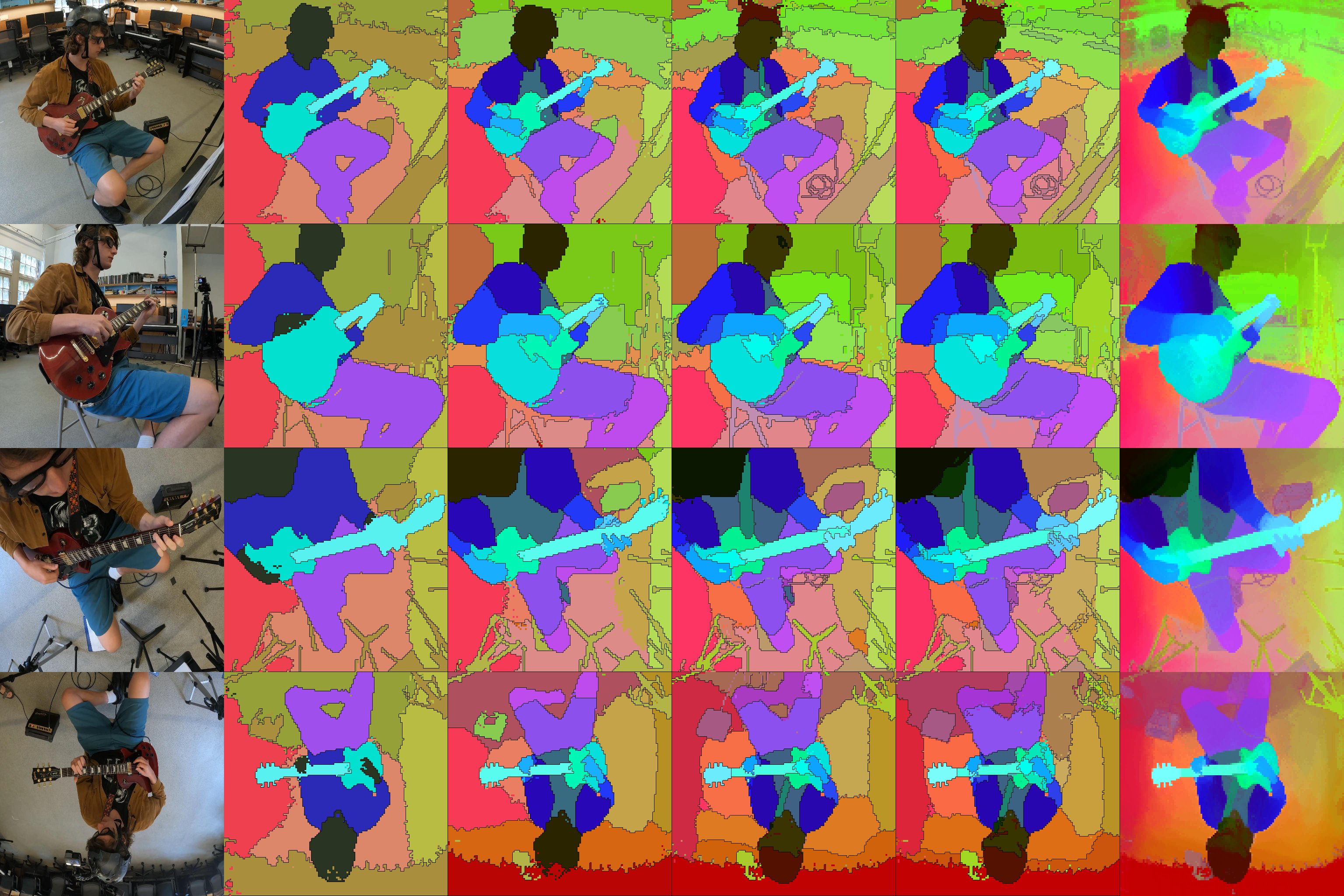
More examples and detailed usage can be found in the examples directory.
Performance
-
ncut_pytorch.Ncutis $O(n)$ time complexity -
sklearn.SpectralEmbeddingis $O(n^2)$ time complexity.
Setup:
CPU: Intel(R) Core(TM) i9-13900K CPU
RAM: 128 GiB
GPU: RTX 4090 24 GiB
SYSTEM: Ubuntu 22.04.3 LTS
Run benchmark:
pytest unit_tests/bench_speed.py --benchmark-columns=mean,stddev --benchmark-sort=mean
Results:
------------- benchmark 'ncut-pytorch (CPU) vs sklearn': 8 tests ------------
Name (time in ms)                        Mean                StdDev
-----------------------------------------------------------------------------
test_ncut_cpu_100_data_10_eig          2.5536 (1.0)          0.2782 (1.0)
test_sklearn_100_data_10_eig           4.0913 (1.60)         1.6749 (6.02)
test_ncut_cpu_300_data_10_eig          4.9034 (1.92)         1.6575 (5.96)
test_sklearn_300_data_10_eig          10.1861 (3.99)         3.8870 (13.97)
test_ncut_cpu_1000_data_10_eig        11.1968 (4.38)         1.7070 (6.13)
test_ncut_cpu_3000_data_10_eig        38.6101 (15.12)        1.6379 (5.89)
test_sklearn_1000_data_10_eig        193.5934 (75.81)        8.1933 (29.45)
test_sklearn_3000_data_10_eig      1,246.4295 (488.11)   1,047.0191 (>1000.0)
-----------------------------------------------------------------------------
------------- benchmark 'ncut-pytorch (GPU) n_data': 5 tests -------------
Name (time in ms)                         Mean            StdDev
--------------------------------------------------------------------------
test_ncut_gpu_100_data_10_eig           2.9564 (1.0)      0.1816 (1.0)
test_ncut_gpu_1000_data_10_eig          4.6938 (1.59)     0.3933 (2.17)
test_ncut_gpu_10000_data_10_eig        67.9607 (22.98)    4.0902 (22.52)
test_ncut_gpu_100000_data_10_eig      396.9994 (134.29)   3.6202 (19.93)
test_ncut_gpu_1000000_data_10_eig     798.4598 (270.08)   1.5704 (8.65)
--------------------------------------------------------------------------
------------- benchmark 'ncut-pytorch (GPU) n_eig': 3 tests --------------
Name (time in ms)                         Mean            StdDev
--------------------------------------------------------------------------
test_ncut_gpu_10000_data_10_eig        67.9607 (1.0)      4.0902 (10.76)
test_ncut_gpu_10000_data_100_eig       74.0033 (1.09)     0.7856 (2.07)
test_ncut_gpu_10000_data_1000_eig     179.8690 (2.65)     0.3801 (1.0)
--------------------------------------------------------------------------
Run benchmark:
python unit_tests/bench_memory.py
Results:
ncut-pytorch.Ncut is $O(1)$ space complexity
+---------------+------------------------+
| Data Points   |   Peak GPU Memory (MB) |
+===============+========================+
| 1,000         |                   8.14 |
+---------------+------------------------+
| 10,000        |                   0.1  |
+---------------+------------------------+
| 100,000       |                   0.39 |
+---------------+------------------------+
| 1,000,000     |                   0.39 |
+---------------+------------------------+
Citation
@misc{yang2024alignedcutvisualconceptsdiscovery,
      title={AlignedCut: Visual Concepts Discovery on Brain-Guided Universal Feature Space},
      author={Huzheng Yang and James Gee and Jianbo Shi},
      year={2024},
      eprint={2406.18344},
      archivePrefix={arXiv},
      primaryClass={cs.CV},
      url={https://arxiv.org/abs/2406.18344},
}
1 maintainer

Metadata
1 maintainer
Release files for ncut-pytorch 3.2.0
For a detailed explanation of source distributions (sdists) and built distributions (wheels), please see the package formats documentation.
Source distribution (sdist)
| File | Size | Uploaded | Provenance | Actions |
|---|---|---|---|---|
| ncut_pytorch-3.2.0.tar.gz | 54.9 kB | Without provenance | Details for ncut_pytorch-3.2.0.tar.gz |
Built distribution (wheel)
| File | Interpreter | ABI | Platform | Actions Reset |
|---|---|---|---|---|
| ncut_pytorch-3.2.0-py3-none-any.whl | Python 3 | none | any | Details for ncut_pytorch-3.2.0-py3-none-any.whl |
Total release size: 118.5 kB
Release files / ncut_pytorch-3.2.0.tar.gz
| Download URL | ncut_pytorch-3.2.0.tar.gz |
|---|---|
| Size | 54.9 kB |
| Tags | Source |
|
SHA-256 checksum How to use checksums |
3209e0cc65ad13fa908db77733a4e9332b031358b0f0f4978e79c4dd5af88aaf
|
|
BLAKE2b-256 checksum How to use checksums |
d2e87f45abd5fbf1283ba8f029ab8f9054687d844bbd95c245de50b45d8056bd
|
| Upload date | |
|
Uploaded using Trusted Publishing? What is trusted publishing? |
No |
| Uploaded via |
twine/6.2.0 CPython/3.12.10
|
Release files / ncut_pytorch-3.2.0-py3-none-any.whl
| Download URL | ncut_pytorch-3.2.0-py3-none-any.whl |
|---|---|
| Size | 63.5 kB |
| Tags | Python 3 |
|
SHA-256 checksum How to use checksums |
aa52f50cb5277446def5524d6bbe6e57ed1dee5081a43f64c13cdd2629909705
|
|
BLAKE2b-256 checksum How to use checksums |
1ce7e31abdb3e0e94a960e608d3363802b30728577075fe45336f9f51070cbf2
|
| Upload date | |
|
Uploaded using Trusted Publishing? What is trusted publishing? |
No |
| Uploaded via |
twine/6.2.0 CPython/3.12.10
|
Security for ncut-pytorch 3.2.0
Provenance
Provenance describes where a file came from. On PyPI, provenance is shared via attestations, which provide a verifiable record of the build or publishing details. View details, limitations and caveats.
No provenance found
None of the files in this release were uploaded with provenance metadata.
A note on package security
PyPI is a repository for distributing packages, not a service for auditing them. While third-party security researchers and our staff do their best to detect and remove malicious packages, PyPI cannot guarantee the quality, security or suitability of any given package.
To learn more about protecting yourself from malicious actors, visit our package security documentation.














