
Python Name Disambiguation Metrics (ND_Metrics)
Metrics implementation in Python for Author Name Disambiguation (AND) evaluation methods.
More information about metrics and details of the algorithms can be found in the following publications:
Kim, J. "A fast and integrative algorithm for clustering performance evaluation in author name disambiguation." Scientometrics (2019): 661-681, 120(2).
Amigó, Enrique, et al.: A comparison of Extrinsic Clustering Evaluation Metrics based on Formal Constraints. In: Information Retrieval 12.4 (2009): 461-486.
Installation
You can simply use pip (or any similar package manager) for installation:
pip install nd-metrics
or, if you prefer a local user installation:
pip install --user nd-metrics
Usage
To evaluate any algorithm output you will need ground-truth data (also called gold-standard data). We call this the y_true. The ground-truth is represented in a:
- (1) dictionary, where the keys are author labels in the gold-standard and the values are sets of annotated categories for those auhor lables. Or;
- (2) list/numpy 1-d array, where author labels in the gold-standard as list or numpy 1-d array. In this case, the index vector represents the citations of each author.
For example:
# For (1) representation
y_true: {
    1: {0, 1, 2},
    2: {3, 4},
    3: {5, 6, 7}
}

# For (2) representation
y_true = np.array([1,1,1,2,2,3,3,3])
In the above example, key 1 on (1) y_true is an author label 1, with contains three citações in the ground-truth. The same applies to the other keys (2 and 3).
The algorithm output to be evaluated is called the y_pred and is also represented as same cases of y_true (ground-truth)
# For (1) representation
y_pred: {
     1: {0, 1, 2},
     2: {3, 4, 5, 6, 7}
}

# For (2) representation
y_pred = np.array([1,1,1,2,2,2,2,2])
Other examples
Example 2
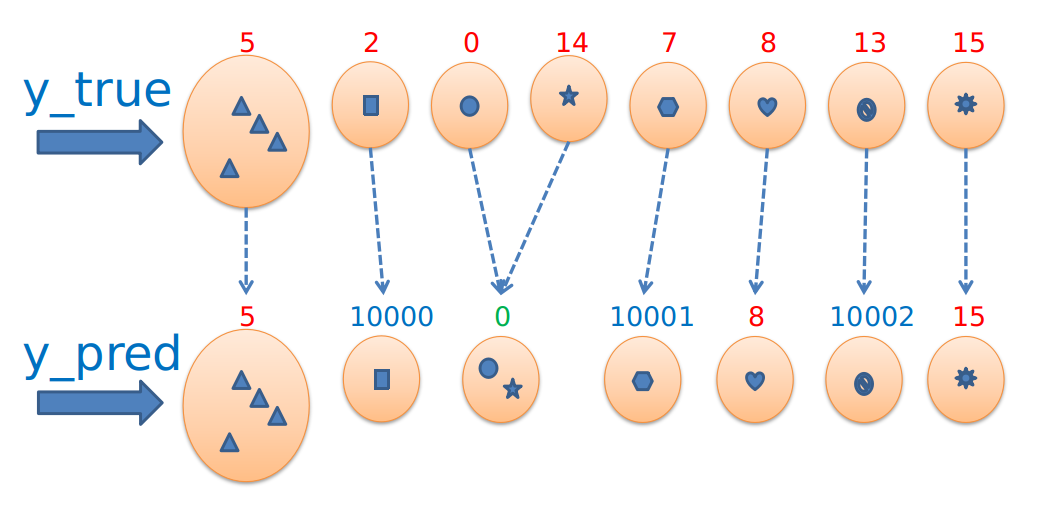
# For representation (1)
y_true = {
     '5': {0, 8, 2, 4},
     '2': {1},
     '0': {3},
    '14': {5},
     '7': {6},
     '8': {7},
    '13': {9},
    '15': {10}
}

y_pred = {
        '5': {0, 8, 2, 4},
    '10000': {1},
        '0': {3, 5},
    '10001': {6},
        '8': {7},
    '10002': {9},
       '15': {10}
}

# ------------------------------------------------------------------------------ #

# For representation (2)

y_true = [5,    2,5,0,5,14,    7,8,5,   13,15]

y_pred = [5,10000,5,0,5, 0,10001,8,5,10002,15]
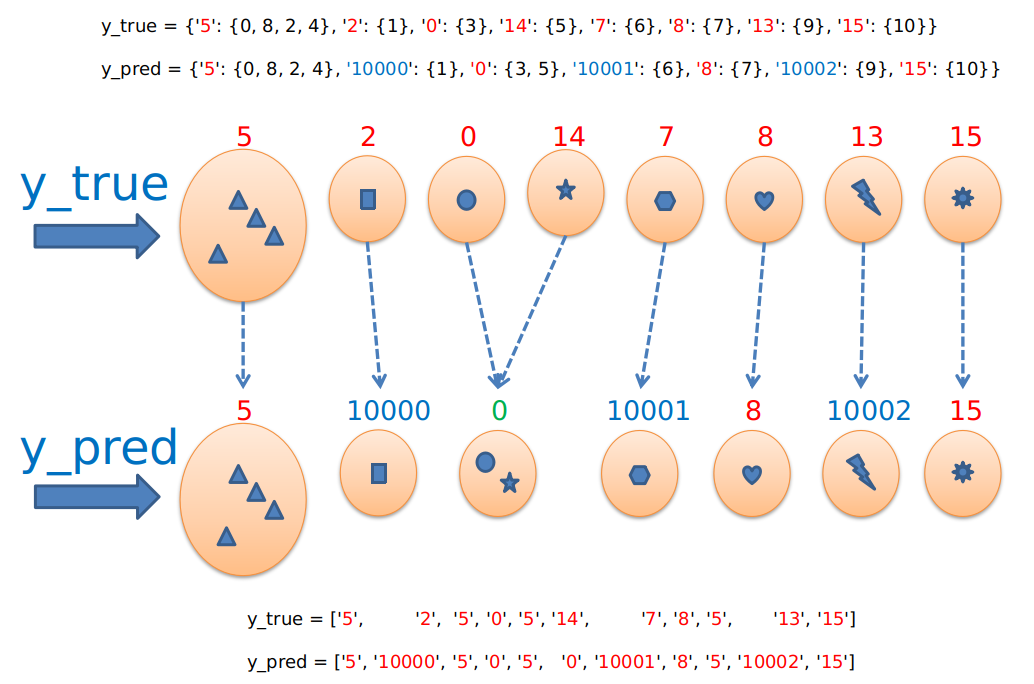
Example 3
Example 4
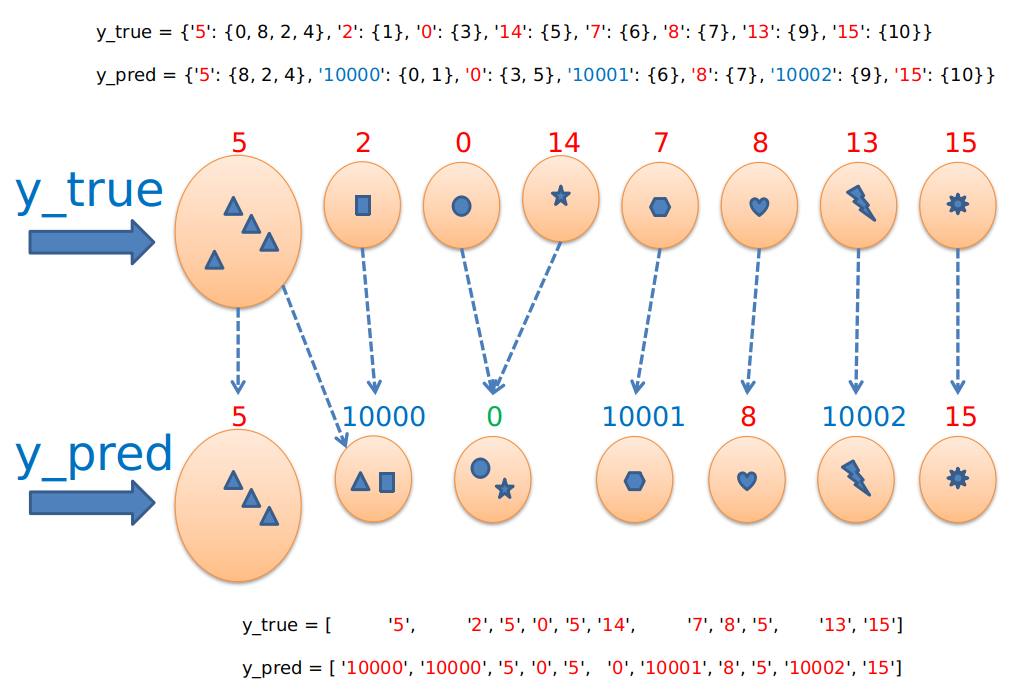
Please note that the author names (or keys in dict) do not need to be the same as in the ground-truth data because the algorithm only considers the groupings, it does not try to match the names of clusters to the ground-truth labels.
Once you have defined the y_true (ground-truth data) and the y_pred (algorithm output to evaluate), you can simply do the following to obtain metric values:
from nd_metrics.utils import make_clusters
from nd_metrics.metrics import all_metrics

# true and pred labels as list or numpy 1-d array
y_true = np.array([1,1,1,2,2,3,3,3])
y_pred = np.array([1,1,1,2,2,2,2,2])

# true and pred clusters as dict of sets
y_true_c, y_pred_c = make_clusters(y_true, y_pred)
# y_true_c: {1: set({0, 1, 2}), 2: set({3, 4}), 3: set({5, 6, 7})}
# y_pred_c: {1: set({0, 1, 2}), 2: set({3, 4, 5, 6, 7})}

# all_metrics calculate
all_metrics(y_true_c, y_pred_c)

# output is:

# Metric               P     R     M
# ClusterFMetric       0.500 0.333 0.400
# KMetric              0.700 1.000 0.837
# BCubedMetric         0.700 1.000 0.824
# SELEMetric           0.000 0.385 0.000
# PairwiseFMetric      0.538 1.000 0.700
A simple example can be found in the included example.py file, where the examples of the source publication are used.
License
This software is under the Apache License 2.0.
Licensed under the Apache License, Version 2.0 (the "License");
you may not use this file except in compliance with the License.
You may obtain a copy of the License at

    http://www.apache.org/licenses/LICENSE-2.0

Unless required by applicable law or agreed to in writing, software
distributed under the License is distributed on an "AS IS" BASIS,
WITHOUT WARRANTIES OR CONDITIONS OF ANY KIND, either express or implied.
See the License for the specific language governing permissions and
limitations under the License.
How to cite this work
@misc{Espiridiao2021,
  author = {Espiridiao, L.V.B.},
  title = {Python ND_Metrics},
  year = {2021},
  publisher = {GitHub},
  journal = {GitHub repository},
  howpublished = {\url{https://github.com/lucianovilasboas/nd_metrics}}
}
1 maintainer

Release files for nd-metrics 0.0.8
For a detailed explanation of source distributions (sdists) and built distributions (wheels), please see the package formats documentation.
Source distribution (sdist)
| File | Size | Uploaded | |
|---|---|---|---|
| nd_metrics-0.0.8.tar.gz | 102.0 kB | Details |
Release files / nd_metrics-0.0.8.tar.gz
| Download URL | nd_metrics-0.0.8.tar.gz |
|---|---|
| Size | 102.0 kB |
| Tags | Source |
|
SHA-256 checksum How to use checksums |
192733ea28d22be747acf27314863fce3b601e13f5c5aa355ce4bb46c5cdb1b0
|
|
BLAKE2b-256 checksum How to use checksums |
f665cf4863c94b1d216cdb57fb2757f8f013b674deb87645b9ce0af8c34c1a1b
|
| Upload date | |
|
Uploaded using Trusted Publishing? What is trusted publishing? |
No |
| Uploaded via |
twine/3.4.1 importlib_metadata/4.0.1 pkginfo/1.7.0 requests/2.24.0 requests-toolbelt/0.9.1 tqdm/4.60.0 CPython/3.6.13
|














