
ndoptimize







ndoptimize minimizes objective functions for many independent problems at
once, similar to
scipy.optimize,
but compiled and parallelized using
Numba.
Its main function,
ndoptimize.least_squares(),
fits a model to every spectrum of a spectral cube, or any other batch of small
datasets, using the Levenberg-Marquardt method.
Compared to calling scipy.optimize.least_squares() in a loop, it offers:
- Speed. The fits run in parallel on every CPU core, roughly half a million fits of a five-parameter model to 39 points per second on a 48-thread machine.
- Correlated noise. The noise of neighboring data points may be correlated, as it is in resampled data, which makes the fit generalized least squares, with parameter uncertainties to match.
- Priors and bounds. Each parameter of each fit may have a Gaussian prior and bounds, to keep faint fits stable.
- Missing data. Data points which are NaN are left out of their fit.
- Broadcasting. The independent variable, data, noise variance, initial guess, bounds and priors are broadcast against each other, so each fit can have its own. The correlation of the noise is shared by every fit.
- Custom models. A model is a short Numba function which computes its values and their derivatives. Every model shares the same fitting kernel, which is compiled once and cached on disk.
Differences from scipy.optimize.least_squares
For the same objective, the two find the same minimum, to a thousandth of a standard deviation in the tests, but they differ in the following ways.
- Derivatives. A model computes its own Jacobian. There is no finite-difference approximation.
- Noise and priors. The variance of the data, the correlation of its
noise, and the Gaussian priors are arguments, and the result includes the
covariance of the parameters.
scipy.optimize.least_squares()minimizes the sum of squares of whatever residual it is given, and returns the Jacobian at the solution, from which the covariance can be computed. - Bounds. Steps are clipped to the bounds, and a parameter which the
gradient pushes against its bound is held fixed for that step. SciPy's
"lm"method does not support bounds, and its"trf"and"dogbox"methods handle them with trust regions. - Convergence. A single tolerance on the decrease in chi-squared that a
Gauss-Newton step predicts replaces
ftol,xtolandgtol. - Model arguments. A model takes only the points
xand the parameters, so any other data it needs, such as the edges of each bin, goes in more columns ofx. SciPy passes extra data throughargsandkwargs. - Results.
chi2is the sum of the squares of the whitened residuals, without the priors, while SciPy'scostis half the sum of the squares of whatever residual it is given.max_iterationsanditerationscount accepted steps, while SciPy'smax_nfevandnfevcount evaluations of the residual. - Not supported: robust loss functions and sparse Jacobians.
The full documentation is hosted on Read the Docs.
Installation
ndoptimize is published on PyPI and can be installed using pip.
pip install ndoptimize
Quickstart
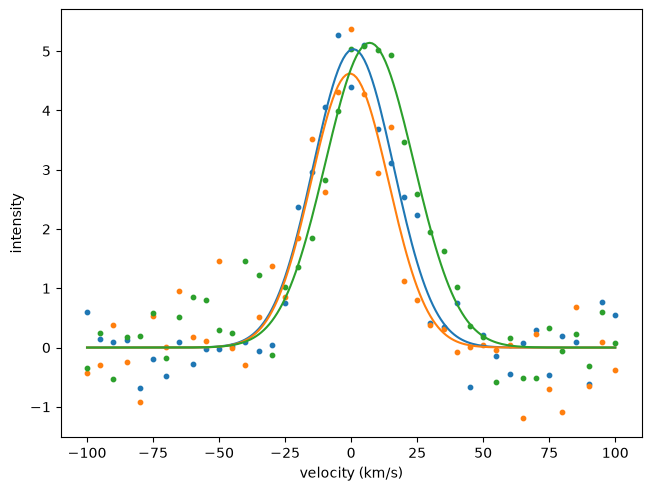
Fit a Gaussian to each of a thousand noisy spectral lines at once, and evaluate the best-fit models on a finer grid.
import numpy as np
import ndoptimize

rng = np.random.default_rng(0)

# a thousand noisy Gaussian lines with random centers
velocity = np.linspace(-100, 100, 41)
center = rng.normal(0, 10, size=(1000, 1))
noise = 0.5
data = 5 * np.exp(-np.square((velocity - center) / 15) / 2)
data = data + rng.normal(0, noise, size=data.shape)

# start each fit at the peak of its line
guess = np.stack([
    data.max(axis=-1),                # amplitude
    velocity[data.argmax(axis=-1)],   # center
    np.full(len(data), 10),           # width
], axis=-1)

# fit every line at once
result = ndoptimize.least_squares(
    model=ndoptimize.models.gaussian,
    x=velocity[:, np.newaxis],  # shape (num_points, num_inputs)
    data=data,
    variance=noise**2,
    guess=guess,
)

result.parameters  # shape (1000, 3)
result.covariance  # shape (1000, 3, 3)

# the best-fit model of every line on a finer grid, shape (1000, 201)
velocity_fine = np.linspace(-100, 100, 201)
fit = ndoptimize.evaluate(
    model=ndoptimize.models.gaussian,
    x=velocity_fine[:, np.newaxis],
    parameters=result.parameters,
)
The documentation plots three of the lines with their fits:
Writing a model
A model is a function, model(x, parameters, f, jacobian), which writes its
value at the points x, an array of shape (num_points, num_inputs), into
f, and its derivatives with respect to the parameters into jacobian.
The
ndoptimize.model
decorator compiles it and names its parameters.
The compiled model is cached on disk, so define it in a file or a notebook.
A model defined in the interactive interpreter needs
@ndoptimize.model(..., cache=False).
import math
import numpy as np
import ndoptimize

@ndoptimize.model(parameters=("amplitude", "scale"))
def exponential(
    x: np.ndarray,
    parameters: np.ndarray,
    f: np.ndarray,
    jacobian: np.ndarray,
) -> None:
    """An exponential decay, amplitude * exp(-x / scale)."""
    amplitude, scale = parameters[0], parameters[1]
    for i in range(x.shape[0]):
        e = math.exp(-x[i, 0] / scale)
        f[i] = amplitude * e
        jacobian[i, 0] = e
        jacobian[i, 1] = amplitude * e * x[i, 0] / scale**2
ndoptimize.models
has some common models: a Gaussian, a Gaussian averaged over each bin, a
Gaussian plus a straight line, and two Gaussians plus a straight line.
Citation
If you use ndoptimize in your research, please cite it.
The citation metadata is kept in CITATION.cff,
which the "Cite this repository" button on GitHub can export as BibTeX or APA.
Please include the version of ndoptimize that you used,
which is given by importlib.metadata.version("ndoptimize").
@software{ndoptimize,
  author = {Smart, Roy T.},
  title = {ndoptimize},
  version = {X.Y.Z},
  url = {https://github.com/sun-data/ndoptimize},
}
1 maintainer

Metadata
1 maintainer
Release files for ndoptimize 0.1.0
For a detailed explanation of source distributions (sdists) and built distributions (wheels), please see the package formats documentation.
Source distribution (sdist)
| File | Size | Uploaded | Provenance | Actions |
|---|---|---|---|---|
| ndoptimize-0.1.0.tar.gz | 33.9 kB | With provenance | Details for ndoptimize-0.1.0.tar.gz |
Built distribution (wheel)
| File | Interpreter | ABI | Platform | Actions Reset |
|---|---|---|---|---|
| ndoptimize-0.1.0-py3-none-any.whl | Python 3 | none | any | Details for ndoptimize-0.1.0-py3-none-any.whl |
Total release size: 62.6 kB
Release files / ndoptimize-0.1.0.tar.gz
| Download URL | ndoptimize-0.1.0.tar.gz |
|---|---|
| Size | 33.9 kB |
| Tags | Source |
|
SHA-256 checksum How to use checksums |
bfe000fc5bc96dd8faff61462223d313832bca22efdb4bbf1fe2c329d13cb51c
|
|
BLAKE2b-256 checksum How to use checksums |
69d08fc20ea045997091602f8afc6ffa736ae7b907f18cf97cfd4d8f8f58981b
|
| Upload date | |
|
Uploaded using Trusted Publishing? What is trusted publishing? |
Yes |
| Uploaded via |
twine/7.0.0 CPython/3.13.14
|
Provenance
Provenance describes where a file came from. On PyPI, provenance is shared via attestations, which provide a verifiable record of the build or publishing details. View details, limitations and caveats.


PyPI Publish Attestation
PyPI verified that this artifact, at this checksum, originated from the publisher listed below.
Signed by GitHub Actions, verified by PyPI on Oct 19, 2026.
Transparency logRelease files / ndoptimize-0.1.0-py3-none-any.whl
| Download URL | ndoptimize-0.1.0-py3-none-any.whl |
|---|---|
| Size | 28.8 kB |
| Tags | Python 3 |
|
SHA-256 checksum How to use checksums |
a6c061c2ebec6658e08109990e9dfa33ab04b5304cdf8c6575ac3bc91a5b5fc5
|
|
BLAKE2b-256 checksum How to use checksums |
192e0015da16932c954faac1f1d04d19090a9948eaab6ec8f8b288e1ac121fde
|
| Upload date | |
|
Uploaded using Trusted Publishing? What is trusted publishing? |
Yes |
| Uploaded via |
twine/7.0.0 CPython/3.13.14
|
Provenance
Provenance describes where a file came from. On PyPI, provenance is shared via attestations, which provide a verifiable record of the build or publishing details. View details, limitations and caveats.
PyPI Publish Attestation
PyPI verified that this artifact, at this checksum, originated from the publisher listed below.
Signed by GitHub Actions, verified by PyPI on Oct 19, 2026.
Transparency logSecurity for ndoptimize 0.1.0
Provenance
Provenance describes where a file came from. On PyPI, provenance is shared via attestations, which provide a verifiable record of the build or publishing details. View details, limitations and caveats.
Full provenance
Both files in this release have been uploaded with provenance metadata.
Attestation for ndoptimize-0.1.0.tar.gz
PyPI Publish Attestation
PyPI verified that this artifact, at this checksum, originated from the publisher listed below.
Signed by GitHub Actions, verified by PyPI on Oct 19, 2026.
Transparency logA note on package security
PyPI is a repository for distributing packages, not a service for auditing them. While third-party security researchers and our staff do their best to detect and remove malicious packages, PyPI cannot guarantee the quality, security or suitability of any given package.
To learn more about protecting yourself from malicious actors, visit our package security documentation.














