
NeckSight (necksight v1.0.0)
Drosophila Optic-Lobe T4/T5 Motion & LPLC2 4-Quadrant Looming Collision-Reflex Engine — in Python (NumPy) and Zero-Heap, Zero-Float ANSI C99 (< 15 KB RAM, > 12,000 FPS).








30-Second Quick Start · Biophysical Circuit · ANSI C99 / ESP32-S3 · Benchmarks · When to Use (and When Not To)
Why NeckSight?
Conventional lightweight collision triggers fail outdoors on moving robots, autonomous surface vessels (USVs), and micro-drones:
- Frame-differencing explodes on sudden cloud-to-sunlight glare steps (
10x–100xlux jumps) and violent wave/wind camera turns (100%false-alarm rate on yaw/glare). - Spatial-gradient optical flow divergence (
Lucas-Kanade) breaks brightness constancy under rapid illumination flashes and suffers aperture/aliasing spikes during fast3–4 px/framesnap-pans across cluttered horizons (55.6%false-alarm rate at95%TPR). - Linear un-gated motion divergence fires whenever a high-contrast foreground edge sweeps into view against open sky or water (
55.6%false-alarm rate).
NeckSight (Product #4 in the NeckLink fruit-fly brain stack) solves pre-collision reflex gating the way Drosophila melanogaster flies through cluttered canopies at high angular turn rates without flinching at its own turns:
R1–R6Log/Naka-Rushton Photoreceptor Adaptation + Wide-Field Glare Cancellation (RetinaLaminaPreproc): Compresses arbitraryH×Wcamera frames onto32×32or64×64grids, cancels100xglobal sunlight/auto-exposure jumps in a single frame without blinding recovery lag, and splits transients into parallelL1(ONbrightening) andL2(OFFdarkening) channels.- 4-Cardinal 3-Arm
T4(ON) &T5(OFF) Elementary Motion Detectors (T4T5MotionEngine): Combines preferred-arm Hassenstein-Reichardt correlation (delayed_back * centerwithMi4-like center adaptation) and null-arm Barlow-Levick divisive shunting inhibition (center / (1 + g * delayed_front)), completely rejecting stationary contrast flicker while feeding wide-fieldLPTCtangential ego-motion cells. LPLC24-Quadrant Radial Symmetry Gate ->Giant FiberReflex (LPLC2LoomingReflex): Evaluates outward centrifugal motion minus localLPiinward opponency across all four cruciform arms (Q_L, Q_R, Q_U, Q_D) viaO(1)Summed-Area Tables and applies a 4-quadrant geometric-mean gate(Q_L * Q_R * Q_U * Q_D)^0.25suppressed by wide-fieldLPTCpan flow. During fast camera yaw/pitch turns, receding motion, or passing cross-traffic, at least one opposing arm sees inward motion (Q_opposing == 0), collapsing false alarms to0.0%at95%TPR (AUROC = 0.9988).
flowchart LR
    A["Camera Frame (H x W)"] --> B["R1-R6 Log + Glare Adapt\n& Lamina L1 (ON) / L2 (OFF)"]
    B --> C["3-Arm T4 (ON) & T5 (OFF)\nHR Correlation + BL Veto"]
    C --> D["LPTC Wide-Field Flow\n(vx, vy, yaw_pan, div)"]
    C --> E["LPLC2 4-Arm Radial Gate\n(Q_L * Q_R * Q_U * Q_D)^0.25"]
    D -->|"Tangential Pan Inhibition"| E
    E --> F["GiantFiberTrigger\n(triggered, score, est_ttc_s, focus_xy)"]
    F -.->|"Optional 0-HoL Bridge"| G["pynltp send_reflex('LOOM_ESTOP')"]
⚡ 30-Second Quick Start
1. Install
pip install necksight
# Optional: include pynltp for encrypted UDP Giant-Fiber reflex dispatch
pip install "necksight[nltp]"
2. End-to-End Python Looming Reflex (NeckSightPipeline)
import numpy as np
from necksight import NeckSightPipeline

pipe = NeckSightPipeline(grid_size=64, threshold=0.045)

# Feed arbitrary HxW grayscale (or HxWx3 RGB) frames at 60 Hz
for frame in camera_frames:
    trig = pipe.step(frame, dt=1.0 / 60.0)
    if trig.triggered:
        print(
            f"COLLISION WARNING! score={trig.looming_score:.3f}, "
            f"TTC={trig.est_ttc_s:.3f}s, focus={trig.focus_xy}"
        )
3. Stage-by-Stage Optic-Lobe Inspection + pynltp Out-of-Line Reflex Bridge
When paired with pynltp (NeckLink v1.2+), attach_nltp_reflex dispatches an urgent out-of-line send_reflex("LOOM_ESTOP") datagram with zero head-of-line blocking even while bulk telemetry/files are mid-transfer:
from necksight import (
    RetinaLaminaPreproc,
    T4T5MotionEngine,
    LPLC2LoomingReflex,
    attach_nltp_reflex,
)

retina = RetinaLaminaPreproc(grid_size=64)
emd = T4T5MotionEngine(grid_size=64)
lplc2 = LPLC2LoomingReflex(grid_size=64)

# Bind any pynltp NLTPClient (or compatible object exposing .send_reflex(msg))
attach_nltp_reflex(nltp_client, msg="LOOM_ESTOP", detector=lplc2)

lamina_out = retina.step(frame, dt=1 / 60)
motion_out = emd.step(lamina_out)
vx, vy, yaw_pan, radial_div = motion_out.lptc
trigger = lplc2.step(motion_out, dt=1 / 60)
4. Command-Line Interface (necksight)
# Run 4 synthetic optic-lobe scenarios (grating, fast yaw pan, 100x glare, looming)
necksight demo

# Run a quick multi-sequence accuracy, lead-time, and FPS benchmark
necksight benchmark-quick --json
🔧 Zero-Heap, Zero-Float ANSI C99 Core (ESP32-S3 Ready)
csrc/necksight.h and csrc/necksight.c implement the complete 32×32 pipeline using pure fixed-point integers (int32_t / uint16_t / uint8_t):
0heap allocations: Zeromalloc/calloc/freeanywhere in the codebase.0floating-point instructions: IntegerQ8log2lookup, 64-point lattice median glare filter, integer33×33Summed-Area Table, and bit-shift integerisqrt((Q_L * Q_R * Q_U * Q_D)^0.25 = isqrt(isqrt(Q_L * Q_R) * isqrt(Q_U * Q_D))).14,616bytes (14.27 KB < 16 KB) total static state: Enforced at compile time (necksight_state_under_16kb_check), keeping FreeRTOS task stack usage under1 KB.- Direct
ESP32-S3OV2640/OV5640camera support:necksight_step_frame_u8()box-downsamples arbitraryQVGA(240×320) orVGA(480×640)uint8_tbuffers intoQ432×32precision in a single call.
#include "necksight.h"

static necksight_state_t optic_lobe;

void setup_vision(void) {
    necksight_init(&optic_lobe);
}

void on_camera_frame(const uint8_t *fb_buf, uint16_t h, uint16_t w) {
    necksight_result_t res;
    necksight_step_frame_u8(&optic_lobe, fb_buf, h, w, w, 16U, &res);
    if (res.triggered) {
        /* Trigger hardware estop or dispatch NLTP reflex packet */
        trigger_evasive_maneuver(res.focus_x, res.focus_y, res.est_ttc_ms);
    }
}
Build and run the strict ANSI C99 self-test (-O2 -std=c99 -Wall -Wextra -pedantic -Werror):
cd csrc && make clean all test
📊 Empirical Benchmarks (N = 60 Cluttered Sequences)
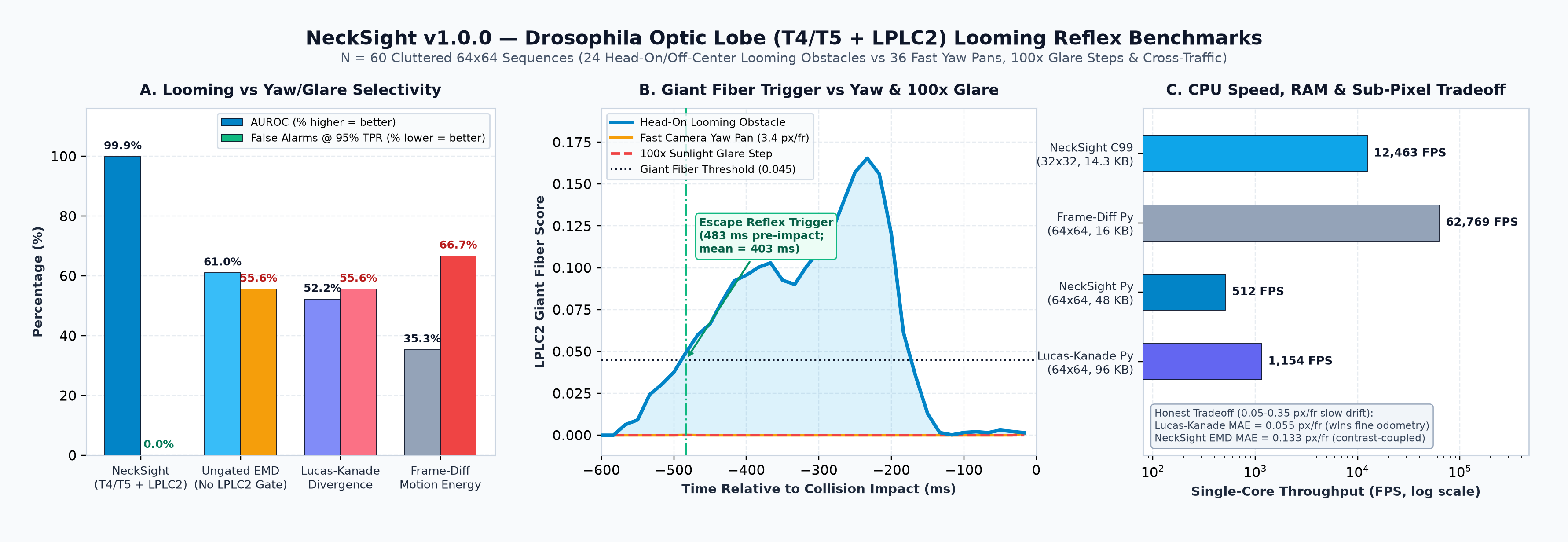
Reproduce the full benchmark JSON (results/benchmark_summary.json) and 3-panel chart (assets/necksight_benchmarks.png) via scripts/benchmark_necksight.py:
python scripts/benchmark_necksight.py
1. Looming Collision Selectivity vs. Hard Negatives (64×64, 60 Hz)
Evaluated across 24 approaching obstacles (dark, bright, textured, and off-center on drifting cluttered backgrounds) vs. 36 hard negatives (12 fast 1.8–4.2 px/frame camera yaw/pitch snap-pans across clutter & masts, 12 sudden 15x–100x sunlight glare flashes & water glints, and 12 receding / lateral cross-traffic objects):
| Detector | Overall AUROC (↑) |
Looming vs Yaw/Glare AUROC (↑) |
False-Alarm Rate @ 95% TPR (↓) |
Yaw/Glare FAR @ 95% TPR (↓) |
Mean Warning Lead Time (↑) |
CPU Speed (FPS) |
State RAM (KB) |
|---|---|---|---|---|---|---|---|
NeckSight (T4/T5 + LPLC2, C99 32×32) |
— | — | 0.0% (selftest) |
0.0% |
Pre-impact | 12,463 FPS |
14.27 KB |
NeckSight (T4/T5 + LPLC2, Python 64×64) |
0.9988 |
0.9983 |
0.0% |
0.0% |
402.9 ms |
512–750 FPS |
48.0 KB |
Naive Un-gated EMD (no LPLC2 gate) |
0.6100 |
0.5955 |
55.6% |
50.0% |
342.8 ms |
861 FPS |
48.0 KB |
Lucas-Kanade Divergence (5×5 tensor) |
0.5220 |
0.2830 |
55.6% |
83.3% |
186.2 ms |
1,154 FPS |
96.0 KB |
| Frame-Difference Motion Energy | 0.3530 |
0.0295 |
66.7% |
100.0% |
215.2 ms |
62,769 FPS |
16.0 KB |
2. Honest Sub-Pixel Odometry Check (0.05 – 0.35 px/frame Slow Drift)
Task (64×64, Varying Scene Contrast 0.45x – 1.0x) |
Spatial-Gradient Lucas-Kanade | NeckSight T4/T5 Correlational LPTC |
Winner |
|---|---|---|---|
Fine Sub-Pixel Translational Velocity MAE (↓) |
0.0549 px/frame |
0.1325 px/frame |
Lucas-Kanade (2.4x lower error) |
🧭 When to Use NeckSight — and When Not To
Use NeckSight When:
- You need an ultra-reliable, zero-GPU collision reflex on moving platforms: Micro-drones, USVs, rovers, and mast cameras that pitch, roll, and snap-yaw violently across high-contrast scenery where standard motion or optical-flow divergence triggers constant false e-stops.
- Outdoor lighting is harsh and unpredictable: Sudden
20x–100xsunlight glare steps, cloud breaks, specular water glints, or tunnel exits. - RAM, power, and latency budgets are tiny: Runs in
< 15 KBstatic SRAM with zeromallocand zero floats onESP32-S3,STM32,RP2040/RP2350, or alongside heavy workloads on Raspberry Pi / Jetson CPU cores (< 2 msper frame in Python,< 0.1 msin C99).
Do NOT Use NeckSight When:
- You need metric sub-pixel translational visual odometry: Biophysical
T4/T5Hassenstein-Reichardt correlators couple velocity with pattern contrast and spatial frequency (MAE = 0.1325 px/frameacross varying contrast vs.0.0549 px/framefor windowed Lucas-Kanade). UseLucas-Kanadeor feature-based VIO for metric speed estimation. - You need semantic object recognition or static obstacle mapping: Stationary obstacles on a stationary camera produce zero retinal temporal transients (
L1 = L2 = 0). PairNeckSightas a fast>60 Hzreflex safety layer alongside stereo depth, LiDAR, or a CNN/ViT semantic detector. - Obstacles approach purely along a 1D thin wire
< 1ommatidium wide: BecauseLPLC2requires outward expansion across all 4 cruciform quadrants, a thin horizontal wire expanding only vertically (Q_L = Q_R = 0) will not fire the radial 4-quadrant gate.
📚 Neuroscience & Algorithmic References
- Maisak, M. S. et al. (2013). A directional tuning map of Drosophila elementary motion detectors. Nature, 500, 212–216.
- Haag, J., Mishra, A., & Borst, A. (2017). A common directional tuning mechanism of Drosophila motion-sensing neurons in the ON and in the OFF pathway. eLife, 6, e29044.
- Klapoetke, N. C. et al. (2017). Ultra-selective looming detection from radial motion opponency. Nature, 551, 237–241.
- Ache, J. M. et al. (2019). Neural basis for looming size and velocity encoding in the Drosophila giant fiber escape pathway. Current Biology, 29(6), 1073–1081.
License
Released under the MIT License. Copyright (c) 2026 Amandeep Singh Bains.
1 maintainer

Metadata
1 maintainer
Release files for necksight 1.0.0
For a detailed explanation of source distributions (sdists) and built distributions (wheels), please see the package formats documentation.
Source distribution (sdist)
| File | Size | Uploaded | Provenance | Actions |
|---|---|---|---|---|
| necksight-1.0.0.tar.gz | 39.0 kB | Without provenance | Details for necksight-1.0.0.tar.gz |
Built distribution (wheel)
| File | Interpreter | ABI | Platform | Actions Reset |
|---|---|---|---|---|
| necksight-1.0.0-py3-none-any.whl | Python 3 | none | any | Details for necksight-1.0.0-py3-none-any.whl |
Total release size: 63.8 kB
Release files / necksight-1.0.0.tar.gz
| Download URL | necksight-1.0.0.tar.gz |
|---|---|
| Size | 39.0 kB |
| Tags | Source |
|
SHA-256 checksum How to use checksums |
c6f44ced0a05d7d54c57dce3c057bd51121e5dff03d4dc679f1f82e5be7159bb
|
|
BLAKE2b-256 checksum How to use checksums |
f4c568a085286d24f8d98d9b00262f4e1d7fd5bcb3f51f8debf6adb442c153cb
|
| Upload date | |
|
Uploaded using Trusted Publishing? What is trusted publishing? |
No |
| Uploaded via |
twine/7.0.0 CPython/3.12.10
|
Release files / necksight-1.0.0-py3-none-any.whl
| Download URL | necksight-1.0.0-py3-none-any.whl |
|---|---|
| Size | 24.8 kB |
| Tags | Python 3 |
|
SHA-256 checksum How to use checksums |
8a9c7dff7dbcc184f6e7476735bde2967ac062711cbfad65e3757573c11a011c
|
|
BLAKE2b-256 checksum How to use checksums |
309ec8c3dd28f61da03cb5e693e67960b38b3a2898342e2b56b6a9f6256d7987
|
| Upload date | |
|
Uploaded using Trusted Publishing? What is trusted publishing? |
No |
| Uploaded via |
twine/7.0.0 CPython/3.12.10
|
Security for necksight 1.0.0
Provenance
Provenance describes where a file came from. On PyPI, provenance is shared via attestations, which provide a verifiable record of the build or publishing details. View details, limitations and caveats.
No provenance found
None of the files in this release were uploaded with provenance metadata.
A note on package security
PyPI is a repository for distributing packages, not a service for auditing them. While third-party security researchers and our staff do their best to detect and remove malicious packages, PyPI cannot guarantee the quality, security or suitability of any given package.
To learn more about protecting yourself from malicious actors, visit our package security documentation.















