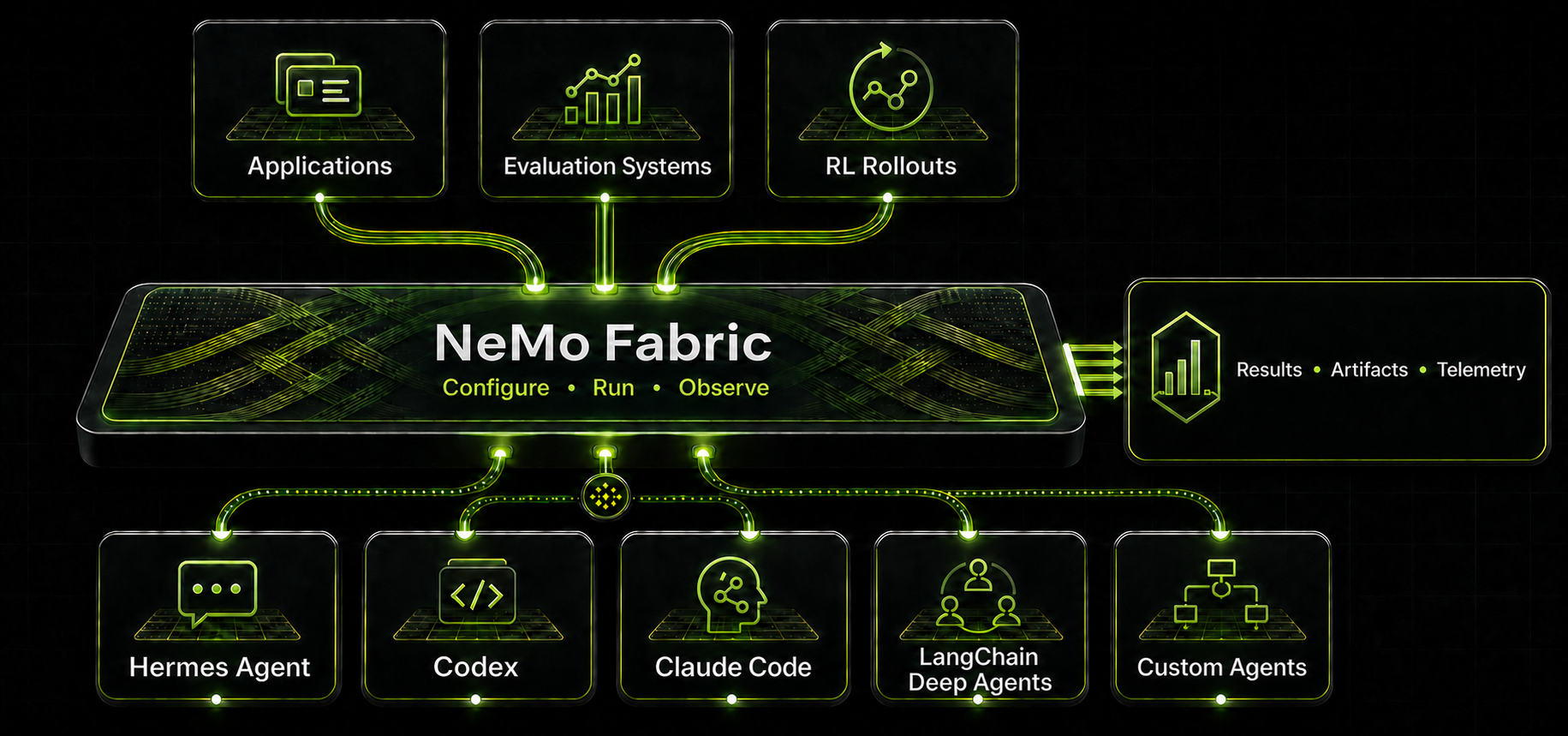
Codex SDK adapter for NeMo Fabric
Project description
NVIDIA NeMo Fabric Codex Adapter

The nvidia.fabric.codex adapter uses the official Codex Python SDK behind
Fabric's normalized invocation contract. It does not resolve or execute a
separately installed codex command. The SDK package owns its pinned
app-server runtime and typed JSON-RPC protocol.
Install
To install just the Codex adapter by itself:
pip install "nemo-fabric[codex]"
To install just the Codex adapter along with the NeMo Fabric Runtime:
pip install "nemo-fabric[codex, runtime]"
Authentication
Fabric reuses the authentication state that Codex stores under CODEX_HOME
(default: ~/.codex). Fabric does not perform an interactive login, copy
credentials, or mutate the user's Codex configuration.
Codex supports two OpenAI authentication modes:
- ChatGPT login: Sign in through Codex with a ChatGPT plan. Fabric can then
run without
OPENAI_API_KEYwhile that cached login remains valid. - API key login: Provision the same Codex credential store with an OpenAI API key. This mode uses OpenAI Platform billing rather than ChatGPT plan credits.
For a nondefault credential store, set CODEX_HOME before both login and the
Fabric invocation. Treat CODEX_HOME/auth.json as a secret when Codex uses
file-based credential storage. Refer to the
Codex authentication documentation
for login, headless setup, and credential-storage options.
The adapter forwards OPENAI_API_KEY and a selected model's api_key_env to
the SDK runtime. The current real-agent acceptance path validates an existing
Codex login; it does not yet claim a raw environment variable as a complete
login flow.
The dependency graph includes openai-codex-cli-bin. The Codex SDK owns this
pinned app-server distribution; Fabric does not treat it as a user-installed
command or an adapter descriptor requirement.
This adapter pins openai-codex==0.1.0b3, which pins
openai-codex-cli-bin==0.137.0a4. A newer codex command on PATH is not used
implicitly. When testing a newer compatible runtime, set
harness.settings.codex_bin to an app-server path that is absolute or relative
to the Fabric config root. Fabric passes the resolved path through
CodexConfig.codex_bin; the SDK remains the execution driver.
Execution Model
Each Fabric invocation starts a fresh SDK client and closes its app-server transport before returning. The first invocation creates a Codex thread and persists its ID under the Fabric artifact root. Later invocations for the same Fabric runtime resume that exact thread. Codex owns the transcript; Fabric owns runtime-to-thread correlation, timeout, cancellation, and cleanup.
The result includes the SDK's typed terminal response, turn status, token usage, timing, and completed thread items. It does not expose CLI commands, return codes, stdout, or stderr.
Configuration
Use normalized FabricConfig fields for portable configuration:
modelsselects the Codex model. The adapter requires and explicitly selects the built-inopenaiprovider.environment.workspacesets the working directory.telemetryenables native OpenTelemetry or NeMo Relay observability.
Codex-specific controls belong in harness.settings:
sandbox:read-only,workspace-write, ordanger-full-accessapproval_mode:auto_reviewordeny_allbase_instructionsanddeveloper_instructionspersonality,reasoning_effort,service_name, andservice_tieroutput_schemafor SDK-native structured outputcodex_binfor an explicit Codex app-server runtime overrideconfig_overridesas dotted request-scoped Codex configuration keystimeout_seconds, defaulting to 1800envfor variables explicitly forwarded to the Codex runtimenemo_relay_commandfor the optional external Relay gateway executable
The removed CLI settings codex_command, codex_args, codex_profile,
codex_state_dir, and skip_git_repo_check are errors. model_name and cwd
must use the normalized model and environment fields.
The adapter filters the inherited environment. It retains portable OS and
Codex state variables, the selected model's api_key_env, and explicit
settings.env values while clearing unrelated parent-process secrets.
Relay Observability
Enable Relay through Fabric's normalized telemetry configuration. For each Relay-enabled invocation, Fabric:
- Resolves one external
nemo-relayexecutable. - Generates invocation-scoped gateway and plugin configuration.
- Starts and health-checks
nemo-relay --config ... --bind .... - Redirects the built-in OpenAI provider with request-scoped
openai_base_urland passes Relay hooks through the Codex SDK'sconfigargument. - Interrupts timed-out turns, closes the SDK runtime, and stops the gateway.
The SDK remains the Codex execution driver. Relay is a supervised sidecar and
hook forwarder; the adapter never invokes a nemo-relay codex wrapper. The
result reports the gateway config, URL, log, and collected Relay artifacts.
Fabric deliberately keeps Codex on its reserved built-in openai provider.
Defining Relay as a custom model-provider alias breaks the Python SDK's
ChatGPT-authenticated request path. Redirecting only openai_base_url preserves
the SDK's supported authentication and host metadata while allowing Relay to
capture Responses traffic. Fabric does not spoof the Codex CLI identity or fall
back to CLI execution. Relay routes and observes requests; it does not provide
OpenAI credentials or change the selected Codex authentication mode.
Relay-enabled runs require the external nemo-relay CLI in addition to the
Python package dependencies. Fabric accepts CLI versions >=0.6.0,<0.7.0.
Until the request-decoding fix is released, install the tested PR revision:
git clone https://github.com/NVIDIA/NeMo-Relay.git nemo-relay
git -C nemo-relay fetch origin pull/452/head
git -C nemo-relay checkout --detach 0b02e01ac10d7d678da28830feba0ebf6743a7c0
cargo install --locked --path nemo-relay/crates/cli
Removal of this temporary source installation is tracked in TODO.md.
The nemo-relay Python package does not install this executable. Refer to the
NeMo Relay installation guide
for other supported installation methods.
Relay owns HTTP content decoding at the gateway boundary; Fabric does not
configure Codex request compression. The Relay 0.6.0-alpha.20260716 tag cannot
recover semantic fields from zstd-compressed SDK requests. Until a later 0.6.x
release contains the fix, use the pinned
NeMo Relay PR #452 revision
above.
For Phoenix, native Codex OpenTelemetry targets the OTLP collector at
http://localhost:4318/v1/traces and provides low-level app-server spans.
Relay OpenInference provides the semantic chain, LLM, and tool hierarchy with
decoded prompt, response, and token attributes. Prefer Relay OpenInference for
agent-turn inspection.
Project details
Release history Release notifications | RSS feed
Download files
Download the file for your platform. If you're not sure which to choose, learn more about installing packages.
Source Distribution
File details
Details for the file nemo_fabric_adapters_codex-0.1.0a20260717.tar.gz.
File metadata
- Download URL: nemo_fabric_adapters_codex-0.1.0a20260717.tar.gz
- Upload date:
- Size: 7.9 kB
- Tags: Source
- Uploaded using Trusted Publishing? No
- Uploaded via: twine/6.2.0 CPython/3.14.6
File hashes
| Algorithm | Hash digest | |
|---|---|---|
| SHA256 |
0bcc2dc659e6a3a9a81f072c398927efba4dbbfc0a795fd6f140d910da20c60f
|
|
| MD5 |
66c70d6c326b0d73dbc5601b914b2803
|
|
| BLAKE2b-256 |
06aa010803ffefb2f835b387e429d3f37f4cd7017d77289a222541779620ae61
|